Flash Offer Design for Restaurant SMS Campaigns
Timing and specificity beat discount size in driving flash offer redemptions.
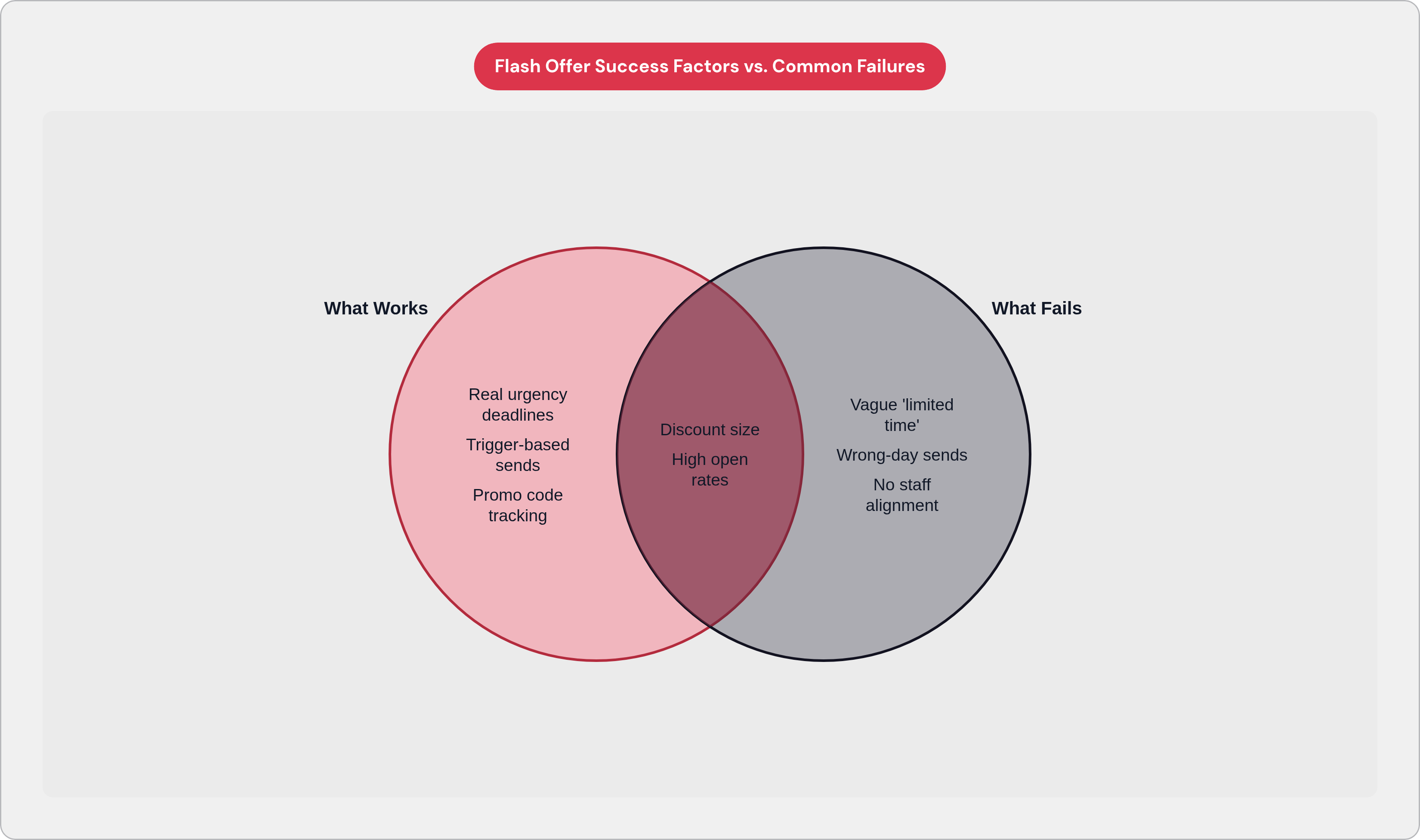
The core idea here is simple and most restaurants get it backwards: the discount in a flash offer barely matters. Timing, urgency mechanics, redemption friction, and whether you can actually prove any of it worked afterward decide whether a text fills a dining room or gets read and ignored, and most operators are quietly failing at least two of those four without knowing it.
What a flash offer is actually doing when it works
A flash offer wears a discount like a costume. Underneath the 20% off or the free appetizer sits a behavioral trigger with an expiration date bolted onto it, and the whole job of that trigger is to take a decision that would normally sit in someone's head for a week (maybe we'll go to that place Friday) and force it into the next few hours instead.
Three things have to happen at once for that compression to work. The urgency has to be real, distinct from the countdown-timer theater you see on a deal site that resets itself every time you refresh the page. The gap between reading the text and walking through the door has to basically disappear. And the whole thing needs to leave a trail, so somebody can tell afterward whether it worked or just felt like it worked. That last part trips up more restaurants than you'd guess, and we'll get into why in the measurement section, because "it felt busy that night" tells you nothing.
What separates a flash offer from a regular promotion is how narrow it is, in both time and scope. Hours, maybe a single day, rather than a week. One item, one deal, one number, rather than "20% off everything," which scatters attention instead of focusing it. And it has to be actionable right from the text itself. Make someone go somewhere else first and you've already lost a chunk of them before they finish reading.
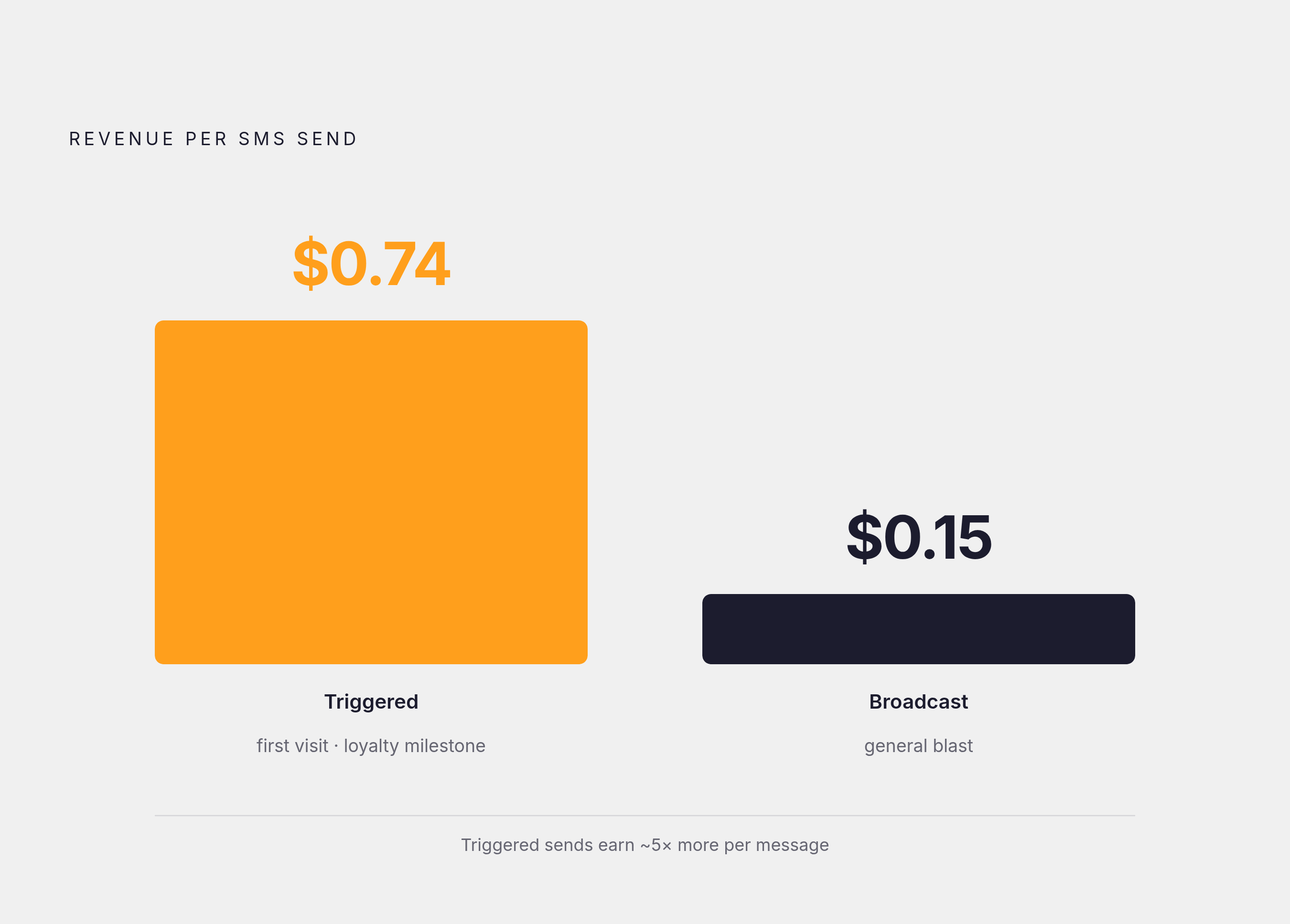
Automated messages tied to a specific behavioral trigger, a first visit, a loyalty milestone, something the subscriber actually did, earn around $0.74 per send. A general broadcast blast earns roughly $0.15. Call it five times the revenue, and copywriting has almost nothing to do with the gap. A restaurant is selling a visit: a car ride, a parking spot, the decision to get off the couch, something a shopper ordering at 2am in pajamas never has to weigh. Generic messages don't move people. Specific ones sometimes do.
Timing decisions that determine whether the message lands in intent or dead air
Pick one lever in this whole system to obsess over and make it timing. It isn't close. Write the sharpest offer of your career and it'll still die quietly if it lands on someone's phone at the wrong hour on the wrong day.
For independent restaurants, Thursday afternoon and Sunday morning consistently show the highest ordering intent. Thursday makes sense once you sit with it: that's when households start deciding where they're eating Friday and Saturday, the weekend's still an open question mentally, and a well-timed text slots right into that planning moment. Sunday morning works for a different reason entirely. People are slower, more receptive, already halfway into next-week-planning mode before their coffee's even cold.
Now the don'ts. Don't send a weekend offer on a Monday or Tuesday; the gap between message and offer window is long enough that whatever urgency you built has evaporated by the time it matters. Skip sending into the middle of a busy weekday, too, because you're competing against someone's inbox, their boss, and their lunch order, and that's a fight you lose almost every time. Also avoid scheduling around whenever it's convenient for the restaurant to hit send. The subscriber's routine matters more here than the manager's slow Tuesday afternoon.
Here's a gut check worth running every time: does the offer duration actually match when you're sending it? "Tonight only" sent Thursday at 3pm is clean, credible, easy to size up against the rest of the day. "This weekend only" sent Sunday morning still works, though the urgency softens a bit with the extra runway. A "24-hour" offer sent Wednesday morning is where things get strange, because you're claiming urgency while handing someone an entire day to forget you exist. The stated deadline and the actual send time are fighting each other.
Then there's frequency, which nobody wants to hear about because everyone wants to text their list more than they should. Four to six outbound messages a month is roughly the ceiling for an independent restaurant. Push past that and opt-outs climb, and an unsubscribe isn't a soft loss. It's permanent. SMS punishes overuse harder than almost any other channel out there. A list is an asset, and like most assets, it depreciates the second you start mishandling it.
The urgency mechanics that actually move people off the couch
Urgency is a mechanism. Mechanisms either function or they don't, and the test worth applying before every send is simple: would this urgency survive a skeptical subscriber actually checking your math?
Two flavors matter. Time scarcity kills the offer at a specific hour, "valid today until 9pm." Quantity scarcity caps the redemptions, "first 30 tables only." Quantity scarcity tends to read as more credible, mostly because it's harder to fake, and subscribers have spent years learning to spot a fake deadline.
What kills urgency outright? Vague language is the worst offender: "limited time" with no endpoint attached, "while supplies last" with no supply count mentioned anywhere near it. That reads as a suggestion, not a deadline. Recurring "flash" sales that mysteriously extend themselves every single time do real damage too, training your list to just wait you out. And an offer indistinguishable from whatever you sent last Tuesday gives nobody a reason this one's different.
Take "50% off tacos this week" against "Half-price birria tacos, tonight only, 5 to 8pm, first 40 orders." Every added word in the second version narrows the window, and every narrowing raises the cost of waiting around. That's the behavioral logic, stated plainly: the more specific and scarce something looks, the faster a subscriber's internal math shifts from "I'll think about it" to "I need to decide right now." It's also why trigger-based automated messages consistently beat mass broadcasts. The urgency feels personal instead of blasted out to four thousand strangers at once.
Redemption friction as the silent conversion killer
A subscriber who's genuinely interested but even mildly confused about how to redeem your offer will not figure it out. Calling the restaurant won't happen, and neither will digging through your website looking for fine print. They'll close the text and go make a sandwich, and you'll never know they existed.
Friction shows up in a handful of predictable places. Instructions demanding a screenshot, a printout, or a memorized code. A redemption process the front-of-house team has genuinely never heard of, which is its own particular flavor of chaos on a Friday night. An offer requiring a second action, booking through some app, before it even applies. And the most common failure of all: no instruction whatsoever. "Show this text" tells someone exactly what to do. "Visit our website for details" reads like a homework assignment, and nobody's doing homework for 20% off pasta.
The ideal path is almost embarrassingly short: read message, show phone at the host stand, get seated. That's the whole thing. Anywhere you've added more steps than that, ask what each one is actually earning you.
Staff alignment isn't optional, and this is where I've watched well-designed offers collapse in real time more than once. Every front-of-house person on shift needs to know the offer exists before the first message goes out, not after a confused customer shows up waving their phone at a host who's never seen this promotion before. That kind of moment doesn't just wreck the guest's night. It wrecks your attribution too, because now there's no clean record of what actually happened.
Promo codes solve two problems at once, which is probably why they've stuck around this long. They're lower friction than a screenshot, and every redemption doubles as a tracked conversion, which is about the simplest offline attribution a restaurant can get without buying any new infrastructure. Hand different segments different codes and you've added a measurement layer without asking the subscriber to lift a finger. QR codes work as a secondary bridge, linking to a reservation page or a loyalty claim and capturing a digital identity tied straight back to the campaign that produced it.
Worth sitting with for a second: the friction problem and the measurement problem are the same problem wearing two different hats. A redemption path with no friction is, almost by definition, the cleanest path to attribute.
Building the list that makes flash offers possible
None of the mechanics above matter if the list underneath them is thin, and the encouraging part is that consumer willingness isn't the bottleneck anymore. As of 2025, 84% of consumers have opted in to SMS from at least one business. The limiting factor is restaurant discipline in actually building the list, not some deep public resistance to getting texted about tacos.
Where does opt-in actually happen? QR codes on menus, table tents, and receipts catch people at the exact moment they're already sitting in your restaurant, which is about as high-intent a moment as exists anywhere in this business. A sign-up incentive, a discount, a free appetizer, some loyalty points, gives people a reason to act on that intent instead of nodding and scrolling past. Website, social, and email cross-promotion pulls in the colder crowd who hasn't walked through the door yet.
One more signal worth noting: 79% of SMS subscribers say they're more likely to buy once they've subscribed. The opt-in itself is a flag. These are people who raised a hand, not cold names sitting on a spreadsheet.
Segmentation is where a list stops being a list and starts being a tool. Frequent diners deserve early access or a better tier, because loyalty that goes unrewarded eventually finds somewhere else to be loyal. Lapsed visitors need an entirely different pitch, usually a higher perceived value to justify coming back at all. Takeout-preferring subscribers don't need a "first 30 tables" constraint, since there's no table involved in the transaction. And menu-interest segments matter more than most operators give them credit for: send a vegetarian subscriber a brisket flash deal and you've wasted the send and told them, quietly, that you weren't paying attention to who they are.
A segmented list makes the urgency itself land harder, and that's what actually turns "I'll think about it" into "I'm already grabbing my keys." A smaller list of engaged regulars will beat a bloated one built off a giveaway that pulled in a thousand names with zero real connection to the restaurant, every time.
Measuring whether a flash offer actually filled tables
Open rate answers a question nobody actually asked. What needs measuring is incremental covers: the visits that happened because of the offer, separate from the total traffic that showed up on a random Thursday that also happened to have a flash offer running in the background.
Here's the structural problem, and it's less the restaurant's fault than a gap baked into how these systems were built in the first place. The SMS platform reports sends and opens. The POS system reports covers and revenue. By default, nothing connects those two data sets, so you end up with two spreadsheets technically describing the same night with no shared record of what actually happened.
Three ways to close that gap, running from simplest to most complete. Promo code redemption is the easiest: every code redeemed is a confirmed, traceable conversion tied straight to that send, and it works with basically any POS on the market. Host stand source tracking is lower-tech and surprisingly reliable if staff actually does it: someone asks "how'd you hear about tonight's offer?" and logs the answer instead of shrugging. POS match-back is the most complete method, comparing guest emails or phone numbers captured at checkout against the subscriber list, catching people who came in because of the offer but never touched a code.
Timing the attribution window matters more than most people assume going in. Credit a visit too fast and you'll miss people who needed a day or two to actually plan the trip out. Credit it over too long a window and you start crediting visits that would've happened regardless, offer or not, and your numbers start lying to you in the opposite direction.
When you calculate ROI, use incremental net profit during the offer period, above whatever the normal baseline would've been, minus cost of goods sold on the discounted items, staff time, and the cost of the send itself. Gross revenue lift looks great in a screenshot and tells you almost nothing useful about whether the offer actually paid for itself.
Closing this gap means connecting a specific SMS or social-driven flash offer to the POS visit it actually produced, so an operator isn't left guessing whether Thursday's text filled the dining room or just generated a stack of opens that went nowhere quietly. Once you can see per-offer ROI, decision-making gets a lot less superstitious. Double down on what worked, the timing, the segment, the structure, and cut the rest without much hand-wringing about it.
When flash offers compound: layering SMS with paid social to amplify the same event
An SMS flash offer sent only to your existing list reaches people who already know you exist. Useful, sure, but it's also a ceiling. Paid social reaches the neighborhood around you that hasn't found you yet, and running the identical offer across both channels, same code, same landing page, closes a loop that neither channel closes on its own.
Here's how it actually plays out on a given night. An SMS subscriber sees the text, redeems the code at the host stand, tracked. Someone scrolling Meta or TikTok sees the same offer as an ad, redeems the same code, tracked through the identical mechanism. Now the restaurant can actually see which channel produced which covers, instead of just noticing the dining room felt fuller than the average Thursday.
Facebook's offer ad format was practically built for this. The restaurant sets up the promotion, users save it straight to their phone, and the platform automatically fires off expiry reminders on its own, which is free urgency amplification nobody had to write a single word of.
Local creators add a third layer worth considering here. A creator whose audience actually lives near the restaurant, posting about tonight's flash deal, is reaching people who already clear the most basic requirement for showing up: proximity. Local creator audiences tend to outperform broader influencer reach for exactly that reason, since a viewer three states away can't redeem a dinner offer no matter how good the video is.
In 2024, restaurants reported a notable average revenue increase tied directly to social media strategy. That's the engine pulling in the room beyond whoever's already on your list, working alongside the flash offer rather than off in its own lane. Running this multi-channel version, too, isn't meaningfully harder than a standalone SMS send. Same offer, same urgency mechanics, same redemption path, just spread wider, with the same measurement logic applied consistently everywhere it touches.
The structural checklist before any flash offer goes out
Everything above collapses into a handful of questions worth running through before you hit send, and most of them take less time to check than they just took to read.
On the offer itself: is it specific enough that someone stops scrolling, meaning the item, the discount, and the time window are all named outright instead of implied? Is the expiry real and enforced, or is this a "flash" sale your list has already watched you extend twice before? Is there an actual constraint on quantity or time, rather than a cosmetic one dressed up to look urgent while doing nothing?
On timing: does the send land in a genuine intent window, Thursday afternoon or Sunday morning, rather than whenever the schedule happened to free up that week? And is the window short enough to create real pressure while still leaving someone enough runway to actually plan the visit around it?
Run through those and you've covered most of what separates a flash offer that fills a dining room from one that just produces an impressive open rate and nothing else. The discount was never the hard part. The system around it always has been.