Finding Local Food Creators for Restaurant Partnerships
Local food creators need geography-focused audiences, not just nearby followers.
The instinct is to define a local food creator by where they live. That instinct is incomplete in ways that cost money.
Local relevance is three things operating simultaneously: where the creator is based, where their audience actually lives, and whether food is their consistent editorial focus. A creator can be geographically local but have an audience skewed internationally from a single viral moment. A food creator with national reach occasionally posts from the restaurant's city without any meaningful audience concentration there. Neither version puts people in seats.
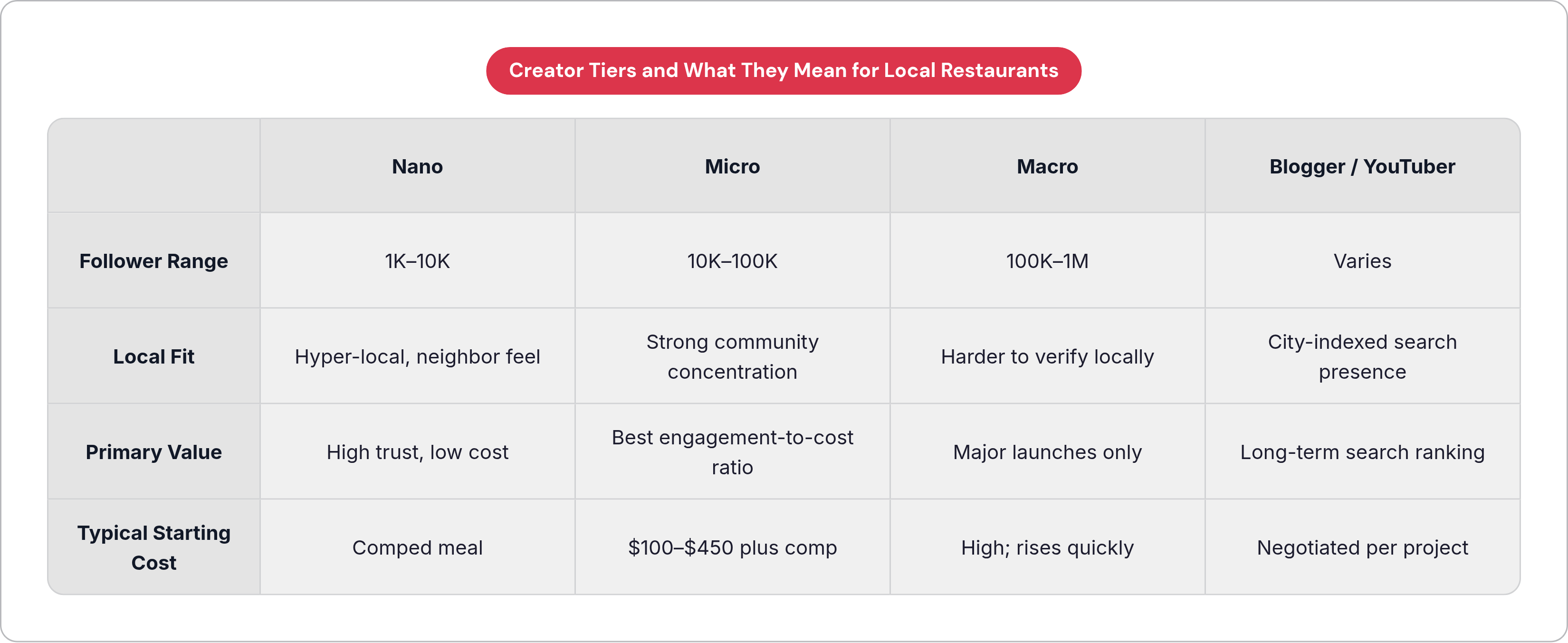
The tier framework maps directly to local restaurant economics, which is why it matters. Nano influencers, those with roughly 1,000 to 10,000 followers, are hyper-local, often already regulars, and carry unusually high trust precisely because they feel like a neighbor rather than a media property. Compensation at this tier frequently begins at a comped meal. Micro influencers, in the 10,000 to 100,000 range, are the primary working tier for most single-location restaurants: stronger community feel than macro creators, more affordable, and consistently higher engagement rates. Macro influencers, from 100,000 to one million followers, are occasionally worth it for major launches, but local audience concentration gets harder to verify and cost rises fast. Food bloggers and long-form YouTubers sit outside this tier structure entirely and carry a distinct asset: a detailed review ranks in search and keeps driving traffic long after posting, which is a different instrument altogether.
The working definition to carry forward: a local food creator is someone whose content focuses consistently on food and whose audience is geographically concentrated in the restaurant's city or region. Not just someone who lives nearby and occasionally posts a dinner photo.
Where to find local food creators before spending anything on tools
The warmest lead available is already sitting in the location tag. Search the restaurant's own tag on Instagram and TikTok. Accounts that have posted there organically are self-selected fans. They already like the place. That is a meaningful informational advantage before a single conversation has happened.
Hashtag search is the next layer. City- and neighborhood-specific food hashtags surface active local creators who have already signaled their niche. The filter that matters is consistency: look for frequent posters, not one-time users. Anyone can hashtag a single dinner. Someone posting local food content three times a week has made it a practice.
Once a promising account surfaces, Instagram's "similar accounts" feature becomes a rapid discovery engine. The platform has already done geographic and topical clustering. Use it.
Google search is underrated here. Searching "restaurant influencers [city name]" or "food bloggers [city name]" frequently surfaces curated lists, local media roundups, or creator directories that have already done preliminary vetting. That is free pre-screening.
The most underused channel, by a considerable margin, is peer referral. Ask non-competing neighboring restaurateurs which creators they have actually worked with and seen results from. That produces leads with a quality signal already embedded: someone in the same market, with the same business problem, vouches for the outcome.
One other bridge worth noting: Yelp Elite users. Active local reviewers with established audiences frequently cross-post to social media, straddling review culture and creator culture in a way that is particularly useful for restaurants where online review presence matters alongside social reach.
When paid tools and platforms add real value to the search
The free methods above are sufficient for some operators. For a single-location restaurant running two or three partnerships a year, free discovery plus one verification tool is often sufficient.
But what platforms actually solve is real: manual hashtag searching produces unfiltered results and consumes time with compounding opportunity cost. Platforms allow simultaneous filtering by geography, niche, audience size, and engagement rate, and they surface the audience-geography data that is otherwise hard to access without asking each creator directly.
A few platforms worth understanding specifically. Mustard.love is purpose-built for local restaurant influencer campaigns and matches restaurants with creators whose followers are geographically close enough to actually visit. The geographic filtering is the product. Sup is built specifically for restaurants and enables hyperlocal discovery by postcode or tight radius, useful when the restaurant's genuine draw is neighborhood-level. Upfluence operates as a larger influencer database with granular foodservice filters and is strongest for operators who want to track influencer-driven sales directly through CRM integration. Aspire carries an extensive culinary influencer database with audience insights and workflow automation, better suited for restaurants running multi-influencer campaigns simultaneously. HypeAuditor's primary value is fraud detection and audience quality analysis; even if another platform handles discovery, running a creator through HypeAuditor before any paid commitment is worth the friction. Social Cat focuses on micro-influencers and product seeding, with lower overhead for restaurants testing small-scale user-generated content campaigns.
Platform use becomes most defensible when the restaurant is running simultaneous campaigns, needs audience-geography data it cannot pull manually, or has had fraud problems with past partnerships. The honest trade-off is cost and a learning curve. Neither is trivial for an owner-operator running thin margins.
How to evaluate a creator once you've found them
Follower count is the least reliable signal of local relevance or real influence. Leading with it is the category mistake in miniature.
Start instead with audience geography, which is non-negotiable for local restaurant partnerships. A commonly used benchmark is requiring 70% or more of a creator's audience to be located in the restaurant's city or region. A creator based in New York but drawing 60% of their audience from Indonesia has real reach that cannot put bodies in seats. Most platforms surface audience-geography data directly. When doing this manually, ask the creator for a screenshot of their audience insights. Any creator worth working with will provide it without hesitation.
Engagement rate is the primary quality signal after geography clears. A 10,000-follower account with genuine local engagement will outperform a 100,000-follower account whose comments are fire emojis from accounts with no profile pictures. Read the actual comments. Are they specific? Do followers reference previous posts, ask follow-up questions, share personal stories? Real community engagement shows in the texture of responses, not the volume.
Content authenticity requires a longer look. A feed that is entirely paid partnerships signals something: the audience has likely learned to tune out endorsements. A healthy mix of sponsored and organic content is a better indicator that the creator's recommendations still carry weight. Visual quality matters here in a way that is easy to overlook. The creator's photos and videos are how their audience will see the restaurant. Assess honestly whether their aesthetic matches the restaurant's positioning.
Fake follower risk is not theoretical. HypeAuditor and similar tools detect purchased followers, inflated engagement, and bot activity. Run any creator through one of these before committing to a paid partnership. This is due diligence, not an accusation.
Finally, check posting history across several months, not just the most recent content. Has food been a consistent editorial focus, or does it appear occasionally between lifestyle content and sponsored fitness supplements? Consistency is the signal.
How to approach a creator and structure the initial conversation
Pre-outreach groundwork matters. Follow the target creator for two to three weeks before reaching out. Engage sincerely with their content. The goal is that the restaurant's name is not entirely unfamiliar when the pitch arrives. That changes the opening dynamic in a small but real way.
Reach out by DM or email. Avoid commenting on a post with a partnership inquiry. That is publicly awkward and signals inexperience. Do not copy-paste the same message to multiple creators. Reference something specific about their content in each pitch. This takes three additional minutes and meaningfully increases response rates.
The opening message needs to accomplish a few things efficiently. Introduce the restaurant briefly and specifically, one or two sentences about what makes it worth the creator's audience's attention. Acknowledge the creator's work with specificity: which post caught the restaurant's attention and why. State clearly what is being proposed, whether a tasting visit, a partnership, or a specific event, without making it feel transactional.
Frame the creator as a collaborator, not a vendor. They know their audience. The restaurant knows its food. The best content tends to emerge from that combination, not from a shot list delivered alongside a contract.
FTC compliance should enter this conversation early. Any post involving compensation, whether monetary or a comped meal, requires clear disclosure per FTC Endorsement Guides. The FTC finalized a rule in August 2024 banning fake reviews and fake follower purchases, with civil penalties reaching up to $51,744 per incident. Restaurants share legal responsibility: if an influencer fails to disclose a known partnership, the restaurant can face penalties too. Disclosure must be obvious to a normal viewer at first glance; platform "Paid Partnership" tags alone are not sufficient per FTC guidance. Raise this plainly in the initial conversation so there is no ambiguity later.
One thing restaurants cannot do: contractually require a positive review. The FTC is explicit on this. Creative freedom is both a legal requirement and, practically speaking, a quality signal. A creator required to say something favorable will produce content that reads like it. An audience trusts a creator because they believe the opinion is genuinely theirs.
What compensation looks like across different partnership types
Compensation varies by creator tier, platform, content format, and the scope of what is being asked. That sounds obvious, but every restaurateur I've spoken with who approached five different creators with the same flat offer left value on the table.
For local micro-influencers in the 5,000 to 15,000 follower range, paid sponsored content typically runs $100 to $450 on top of a complimentary dining experience, according to Influencer Marketing Hub. Nano influencers and existing regulars are often reachable through a comped meal or modest food credit, particularly when the creator is already a genuine fan.
Non-cash partnership formats deserve more consideration than they typically receive. A hosted tasting event inviting several creators at once lowers per-creator cost while generating multiple posts from a single evening. A behind-the-scenes kitchen experience is high-value to the creator because it produces exclusive content, and it costs the restaurant almost nothing monetarily. Giveaway collaborations, where the creator offers their audience something like a dinner for two, drive direct engagement and reservation intent from an audience that has self-selected as interested. Menu launch coverage provides a natural news hook that gives the creator a reason to post without the arrangement feeling purely transactional.
Long-term ambassador arrangements, where a creator posts consistently over several months, generate more cumulative value than one-off partnerships. The restaurant becomes a recurring reference point in the creator's content rather than a single mention. An audience that sees a creator recommend the same restaurant across multiple visits starts to internalize it as a genuine endorsement. That internalization is the actual asset, and it is not something a single post can manufacture.
What content formats actually drive reservations and visits
Short-form video is the dominant discovery format for food on TikTok and Instagram Reels. Behind-the-scenes content, kitchen tours, chef prep, plating process, creates a sense of insider access that audiences respond to in ways a polished ad cannot replicate. Dish-reveal and reaction videos are visceral, shareable, and short. ASMR-style food content is a niche but high-engagement format with strong retention rates that signal genuine viewer interest rather than passive scrolling.
Long-form YouTube reviews and food blog write-ups operate on a different timeline. They rank in search, surface when someone Googles the restaurant's name months later, and keep driving traffic long after the original posting date. That is a different asset class from a Reel, and worth treating as such when planning a content mix.
Format priority depends on the goal. Discovery favors short-form. Credibility and sustained search presence favor long-form. The mistake is treating them as interchangeable.
The trend running through 2024 and into 2025 is a clear movement toward long-term influencer partnerships over one-off campaigns. Repeated coverage builds familiarity; familiarity builds intent. The mechanics are not complicated, but they require patience that one-off thinking forecloses.
When briefing a creator, give access and context rather than a shot list. What is the story behind the dish? What makes the kitchen interesting? Better access tends to produce better content.
How to measure whether a partnership actually worked
Around 70% of brands now track influencer campaign ROI by analyzing conversions, revenue attribution, reach, and audience sentiment, according to 2024 and 2025 industry reports. The question is not whether to measure but which instruments are actually worth using.
The cleanest attribution method for restaurants is the unique promo code, one per creator, which ties reservations or orders directly to a specific partnership. UTM links add a top-of-funnel layer: appending creator-specific parameters to reservation links in the creator's bio, then tracking traffic in Google Analytics, shows how many people moved from the post to the restaurant's booking flow. Platforms like Toast or Resy can often surface promo-code redemption data without requiring a separate analytics infrastructure.
Beyond direct sales attribution, several other signals are worth monitoring. Reach and impressions indicate how many people in the local area saw the content. Engagement rate on the specific post, particularly comments, saves, and shares, signals whether the audience found it credible rather than merely visible. Walk-in volume in the week following the post matters; the 2024 and 2025 Restaurant Trend Report found local influencer campaigns generated a 30% average bump in reservations within a week of posting.
These benchmarks set expectations too neatly. The same trend report found local food creator campaigns generated roughly 8× ROI on average; QSR Magazine reported in 2024 that restaurants working with influencers typically earn around $6.50 for every dollar spent. These figures are useful orientation, not guarantees. Your market, your creator tier, and your content format will produce their own numbers, which is exactly the point of tracking them in the first place.
The most useful thing a restaurant can do with this data is use it to refine the next campaign. Which creator tier drove the most reservations? Which content format generated the highest engagement? Which promo code actually got used? Those questions are worth asking because they are answerable, and answerable questions are the ones that compound over time. Feastalytics, a restaurant analytics platform that ties marketing campaigns and promotions directly to in-store POS revenue, is built to make exactly this kind of per-campaign accounting routine for operators.