Connecting POS Revenue Data to Marketing Campaigns
Most restaurants can't connect ad spending to actual POS revenue.

Most established restaurants allocate somewhere between 3 and 6 percent of revenue to marketing. Growth-stage operators push that toward 10. These figures are commonly cited across industry sources, though aggregated national totals vary by methodology and reporting period. Among chain-level operators, total net marketing spend for concepts above a certain revenue threshold grew substantially in 2025, year over year, according to industry tracking data.
Here is the uncomfortable part. Strong digital marketing benchmarks for restaurants put the return at 300 to 500 percent per dollar spent. A significant gap often exists between that benchmark and actual operator performance. That gap is not explained by bad menus or indifferent service. It is explained, in meaningful part, by the absence of any infrastructure connecting spending to outcome.
Operators know their overall restaurant revenue. What they cannot do is separate marketing-driven revenue from baseline traffic. When sales are up, they credit the campaign. When sales are flat, they cut it. Both conclusions rest on the same foundation: nothing verifiable. The spend exists. The measurement infrastructure to justify or optimize it largely does not.
Why the attribution gap is structural (not a failure of effort)
The tools were never designed to talk to each other. That is the whole story, really, but it is worth unpacking.
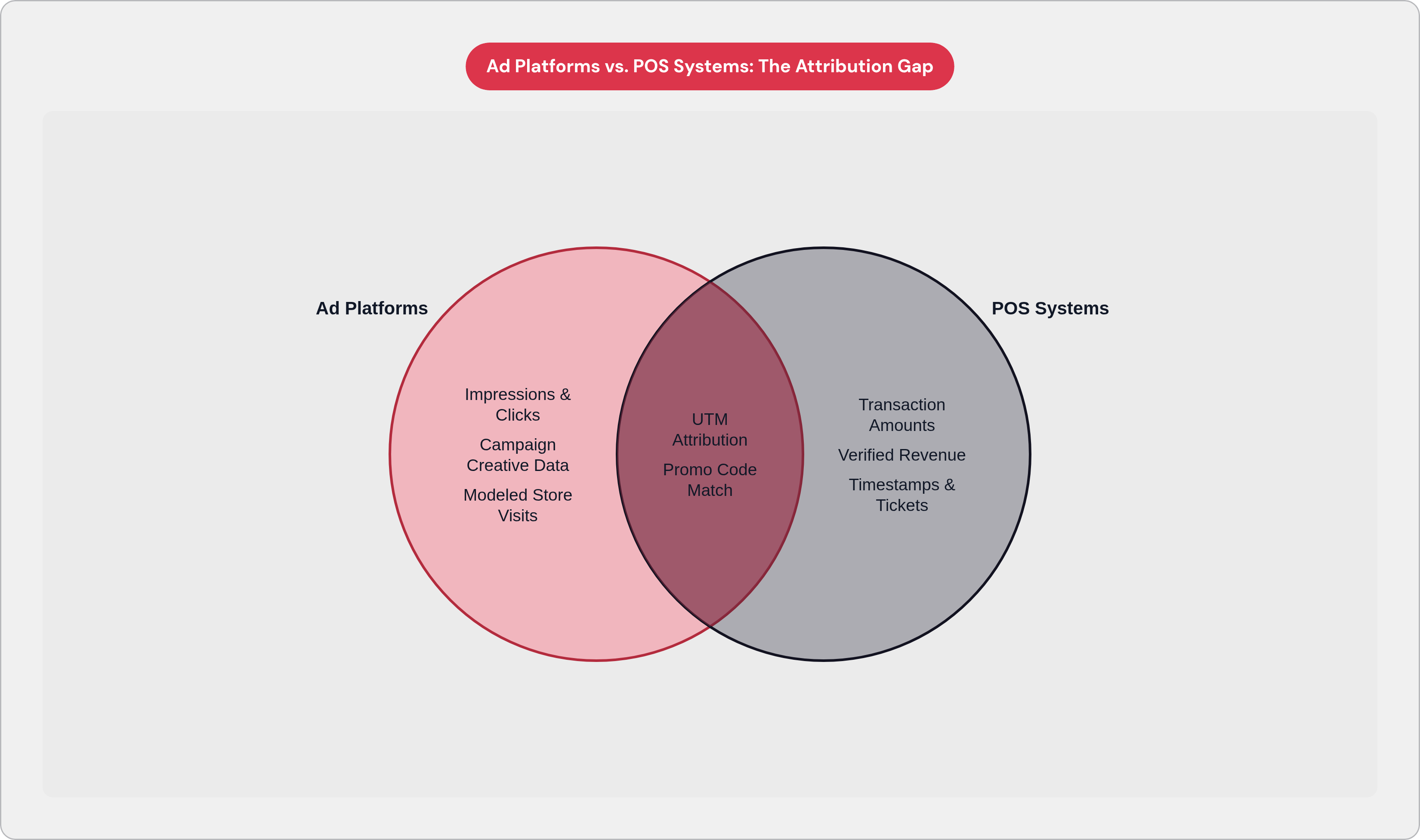
Paid media data lives in ad platforms. Reservation data lives in a separate system. POS data lives somewhere else entirely. No common identifier connects them by default, and nothing in the standard restaurant tech stack was built to pass conversion data back to ad platforms the way an e-commerce checkout page does automatically. A restaurant is not a checkout page. The conversion happens in person, in a room, between a person and a plate of food.
Consider also what the measurement tools being used actually measure. Browser-based pixels, including Meta's, TikTok's, and Google's, miss a meaningful share of conversions due to ad blockers, iOS privacy restrictions, consent gating, and cookie expiry — industry estimates vary, but the gap is widely acknowledged. On the programmatic side, industry analysis has suggested that a substantial portion of every programmatic dollar does not reach the consumer, evaporating in the supply chain before attribution can even begin. Specific figures differ by study and methodology; operators should consult current research from sources such as the Association of National Advertisers for up-to-date estimates.
So a campaign looks successful on Meta because impressions were high, while the POS shows a flat week. The ad platform knows someone clicked. The POS knows someone paid. Nothing in the default stack proves they are the same person. This is not a failure of effort on anyone's part. It is a structural mismatch between tools built for digital retail and a business where the conversion happens at a table.
What untracked spend actually costs (in guests, in revenue, in margin)
One reasonable position holds that the inability to measure marketing precisely is simply a cost of doing business in hospitality. Restaurants have operated profitably without attribution for decades. Why change now?
That raises an important question: what is the untracked spend actually costing, in concrete terms?
Start with guest economics. Cost per guest acquired varies widely, and almost no operator has a verified benchmark because almost nobody measures it. Take a full-service restaurant averaging $55 per visit, with a guest visiting four times per year. That is $220 in annual value, or $660 over three years, from a single guest whose acquisition cannot be attributed to any specific campaign. Scale that across even a modest paid effort and the untracked opportunity stops being a rounding error, it becomes the whole equation, which is the core problem Feastalytics, a restaurant analytics platform that ties marketing campaigns directly to POS-recorded sales revenue, was built to quantify.
Bloom Intelligence's 2025 data makes this concrete from a different angle. According to that data, restaurants using integrated customer data see substantially higher ROI on retention marketing, while those operating on fragmented systems face significant guest churn and associated revenue loss. Operators should review Bloom Intelligence's published reports directly to evaluate the specific figures and methodology.
The subtler cost is the learning cost, and this one compounds quietly. When business improves, operators assume marketing worked. When sales are flat, they cut the campaign, even if that campaign was suppressing a worse decline. Wrong channels get renewed. Winning campaigns get cut. The operator learns nothing useful from either outcome. The cost of not measuring is not neutral; it is active and accumulating.
How POS-to-campaign attribution actually works (the architecture behind closing the loop)
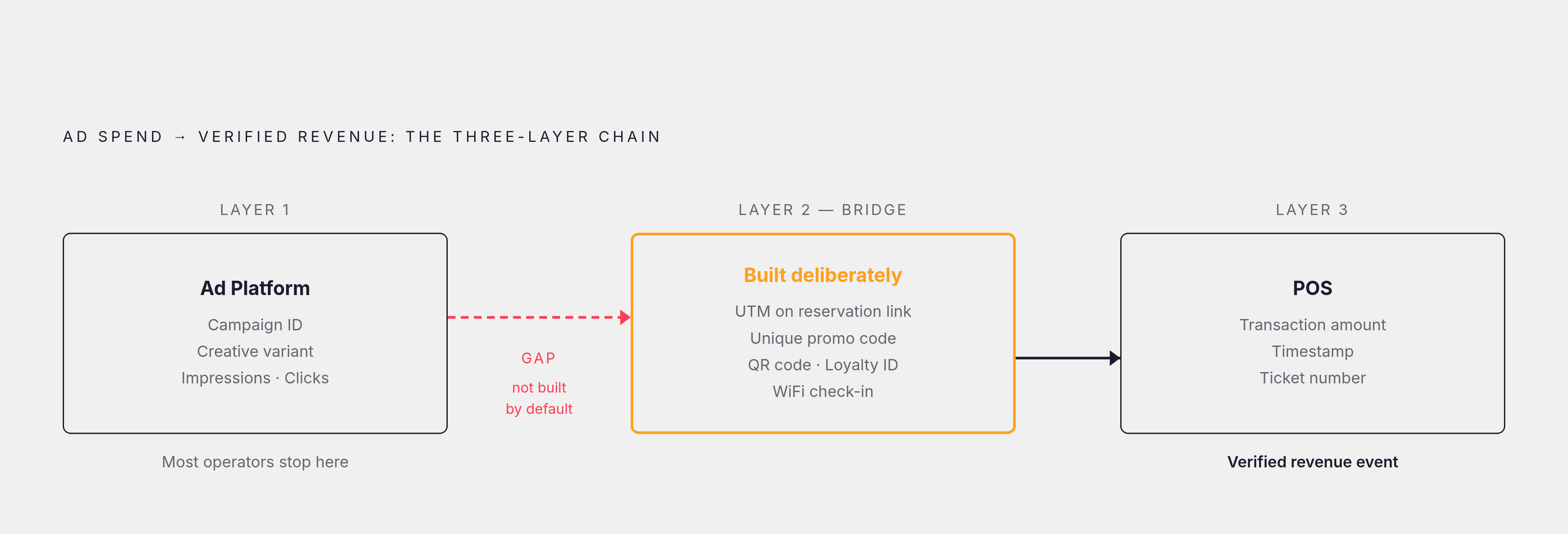
Attribution, in its cleanest form, is a chain of custody. It begins with an ad exposure and ends with a verified transaction. Every link in between is an opportunity for the chain to break.
There are three layers that must be bridged deliberately.
The first is the ad platform layer: campaign ID, creative variant, impression and click data. This is what platforms report natively, and it is where most operators stop, because stopping there is easy.
The second is the bridge layer, which does not exist by default and must be built. It is the identifier that crosses the digital-to-physical gap: a UTM parameter on a reservation link, a unique promo code, a QR code redeemed at the POS, a loyalty ID, a WiFi check-in. Something that connects the digital touchpoint to the physical visit.
The third is the POS layer: transaction amount, timestamp, table or ticket number. The verified revenue event.
A concrete example. A restaurant runs a paid social campaign driving traffic to an OpenTable reservation link. That link carries UTM parameters identifying the campaign and the specific creative. The guest books. If the reservation system integrates with the POS, the operator can confirm not just that the booking happened, but what that guest actually spent. Covers booked is an input. Revenue generated is the output. Only the POS produces the latter.
Lookback windows matter here, and the industry has not thought carefully enough about them. A 48-hour attribution window reflects actual restaurant decision-making behavior more accurately than the 30-day windows commonly used by platforms like Google. Longer windows risk crediting a campaign for organic visits that would have happened regardless.
Multi-touch reality adds another wrinkle. A diner sees a social ad on Monday, receives an email on Wednesday, walks in on Friday. Last-click attribution gives the email full credit and the social ad none. An architecture that does not distribute credit across touchpoints will systematically miseducate the operator about which channel is doing actual work.
One clarification worth making explicit: platform-reported store visit metrics — Meta's modeled store traffic data, Google's aggregated location signals — are probabilistic estimates. Useful for directional signal. Not revenue accountability. The POS has no opinion. It only records what was purchased.
The attribution mistakes that quietly corrupt the numbers
Discount attribution error is the first and most pervasive. A redeemed offer does not prove the offer created the visit. It is just as likely to have reduced margin on a visit that was already going to happen. Credited revenue and incremental revenue are different things. Conflating them inflates apparent ROI in ways that can survive multiple budget cycles before anyone notices, usually when the CFO starts asking questions.
Cross-location blind spots matter more as restaurant groups scale. One location's campaign drives a guest who converts at a different branch. Branch-level reporting then shows the originating location with poor ROI and the receiving location with unexplained lift. Both conclusions are wrong. The campaign worked; the measurement did not.
Incomplete cost accounting quietly distorts everything. Marketing ROI calculations that exclude labor for content creation, agency fees, or the cost of discounts inflate apparent returns. True ROI subtracts every cost tied to running the campaign, including the ones that feel like overhead because they are absorbed elsewhere in the P&L.
Loyalty distortion is perhaps the most consequential, and the least discussed. Loyalty members tend to visit more often and spend more per visit than non-members — a pattern documented across multiple industry studies, though specific figures vary by concept and market. If campaigns are disproportionately targeted at existing loyalty members, reported ROI reflects the pre-existing behavior of a high-value cohort, not the campaign's persuasive power. The numbers look excellent. The operator concludes the campaign was excellent. Neither conclusion is warranted.
The corrective is the incrementality test. Compare visit rate among users exposed to the campaign against a matched control group that was not. The difference is the true incremental lift. Without a control, operators are measuring correlation, not causation, and any attribution number worth acting on must be able to answer one question: would these guests have come anyway?
What the data looks like when attribution is working (and what operators do with it)
The output of a working attribution system is not a dashboard. It is a number attached to a campaign that tells the operator whether to renew, scale, or cut. The dashboard is a byproduct. The decision is the point.
In practice, from restaurant customer data platforms, it looks like this: a win-back campaign recovered a defined set of guests with verified revenue in a given month. A birthday campaign generated revenue from a tracked number of redemptions. A VIP offer drove incremental revenue. Each figure is verified through POS transaction data. The platform did not decide those guests came in. The POS recorded that they did.
Operators using structured, data-informed marketing generally see higher marketing ROI versus ad-hoc efforts, and restaurant guest intelligence platforms can return meaningful multiples on annual investment, though actual results vary by operator, concept, and execution quality. Published case studies from platform vendors should be read alongside independent assessments where available.
But what if the more interesting change is behavioral rather than financial? Operators who close the attribution loop describe something that is harder to put in a ROI formula: they stop guessing, and they stop defending spend based on feel. Winning creative gets identified and moved into paid amplification based on verified revenue, not likes. Underperforming channels lose budget in the next cycle rather than surviving by inertia. Guest segments that respond to specific offers receive those offers; segments that do not stop receiving spend. Each campaign informs the next. The system gets less wrong over time — not glamorous, but that steady correction is the actual value, the way a good kitchen knife is not exciting until you try to cook without one.
How to build the connection in practice (what operators need to put in place)
This does not require enterprise infrastructure, long vendor contracts, or a dedicated analytics team. The logic is straightforward. The failure mode to avoid is building the attribution system after the campaign runs. Identifiers must be embedded before launch, or the thread is permanently broken and no amount of post-hoc analysis recovers it.
Start with an audit of what the POS already exports. Most modern systems produce transaction-level data with timestamps. Confirm whether that data can be queried by time window and ticket size. Many operators are surprised to find they already have access to it and have simply never asked.
Before any campaign goes live, assign a unique identifier: UTM parameters on reservation and order links, unique promo codes, dedicated landing page URLs. A campaign that launches without a unique identifier cannot be attributed retroactively, full stop.
The bridge mechanism should match the channel. For email and paid social driving online reservations, UTM parameters passed through to the booking confirmation, matched to POS check-in data. For paid social driving walk-in traffic, a promo code or QR code redeemed at the POS. For creator and influencer content, a unique offer code per creator; redemptions tracked at the POS give per-creator revenue attribution without any platform intermediary.
On lookback windows: 48 hours is appropriate for most restaurant campaigns given the short consideration cycle. Extending to 30 days risks attributing organic visits to a campaign that had nothing to do with them.
True campaign ROI uses only incremental revenue: revenue from attributable transactions, minus campaign cost including ad spend, creative, labor, and any discount offered, divided by total campaign cost. If the discount is not in the denominator, the number is not real.
When budget allows, run a simple incrementality check. Hold out a small matched segment from the campaign. Compare their visit rate to those who received it. The difference is the number worth defending in a budget conversation. It is the one that does not collapse when someone asks a follow-up question.
The complexity lives in the discipline of executing this consistently, not in the architecture itself. The POS is already recording ground truth. The only question is whether the operator has built the thread that connects it back to the campaign that was supposed to generate it. Most have not, which is either a problem or an opportunity, depending on which side of the gap you are standing on.