Connecting Catering and Events Revenue to Marketing Sources
Extend your attribution window to capture the full catering sales cycle, not just the final click.

Standard restaurant attribution is built around a tight loop. Someone sees an ad, clicks, reserves, visits. The whole sequence can compress into a single afternoon, which is exactly what Meta and Google's default attribution windows were calibrated for: short consideration, fast decision, clean click-to-conversion path.
Catering breaks every link in that chain, and the industry has been slow to notice.
A prospect planning a holiday party or a corporate team lunch is not acting on a craving. They are conducting research across days or weeks, sometimes looping in a second decision-maker, comparing venues, moving through something that looks far more like a B2B sales cycle than a dinner reservation. The inquiry, when it finally arrives, frequently comes by phone or email rather than a digital form. The confirmed booking lands a week or more after that first contact.
So what does last-click attribution actually capture in this scenario?
Usually, a branded Google search. The prospect, after weeks of deliberation, finally types the restaurant's name into a search bar and lands on the catering page. Last-click logic assigns 100% of the credit to that final action. The paid social post they saw three weeks earlier, the creator video that made them save the restaurant's profile, the retargeting ad that kept the venue top of mind while they deliberated: all of it registers as zero. This would be a minor nuisance if catering were a small revenue category. It is not.
Research into multi-channel attribution in hospitality has surfaced this exact distortion. Email, for instance, frequently drives a substantial share of reservations as an assist channel, a contribution that last-click logic renders completely invisible. Given catering's longer consideration window, the distortion is almost certainly worse, and operators are making budget decisions on top of it.
The platform-native windows compound the problem further. Meta's default seven-day click, one-day view model was designed around impulse-driven consumer purchases. A catering buyer who encounters a venue on Instagram today will not submit an inquiry for three weeks. That impression, the one that actually initiated the relationship, is never credited.
What operators are left with is a systematically distorted picture. Channels that seed awareness and generate intent appear unproductive. Brand search, which functions as a collection point for demand generated elsewhere, appears to be doing all the work. Budget follows that distortion, and the channels actually driving catering consideration get quietly defunded. Then operators wonder why the pipeline feels inconsistent despite continued spend.
That is not a technology failure. It is a conceptual one: applying a framework built for impulse-driven dining to a sales process that looks nothing like one.
The specific tracking methods that can close the catering attribution gap
No single method is sufficient. Catering attribution requires layering several approaches, each closing a different part of the gap that an extended sales cycle creates. This is less a technical challenge than a discipline one, but the distinction rarely makes it easier.
The most accessible starting point is unique campaign links. Every ad, creator post, and email promoting catering should carry UTM parameters pointing to a dedicated catering landing page, with different sources getting different links. This means operators can see, at the inquiry stage, whether a lead arrived from a Meta campaign, a TikTok creator post, a Google ad, or an email, before a booking is confirmed and before revenue is realized. That timing matters more than it sounds.
Phone tracking addresses what UTM parameters cannot. A meaningful share of catering inquiries, especially from corporate buyers who want to talk before committing, arrives by phone. Dynamic number insertion assigns a unique phone number to each traffic source, so a call from someone who clicked a Meta ad is logged separately from one who arrived via Google. Without this, every call-based booking defaults to unknown source and quietly inflates the apparent performance of direct or organic channels. The word "direct" in a catering attribution report is often less a source and more a confession that tracking broke down somewhere upstream.
Promo codes and offer-specific landing pages serve as low-friction checkpoints for cases that evade digital tracking entirely. A campaign-specific code tied to a complimentary tasting or a planning consultation creates a traceable thread even when pixels and UTMs have failed. Not sophisticated, but it catches what no technical solution fully captures.
The connective tissue for all of this is CRM or inquiry-log discipline: recording source at the point of contact and carrying that data through to the confirmed booking. Without this step, lead-source data lives in the ad platform and booking revenue lives in the POS, and the two never meet. Every tracking method upstream becomes decorative.
Finally, where platforms allow it, extending click attribution windows to 28 or 30 days better reflects catering's actual consideration cycle. Meta's Incremental Attribution option, available from April 2025, offers a more accurate read on which ads actually shifted behavior rather than simply appearing somewhere along the path. Worth testing, though it requires operators to already have the foundational tracking in place before the more sophisticated analysis means anything.
Why multi-touch attribution is non-negotiable for catering and events marketing
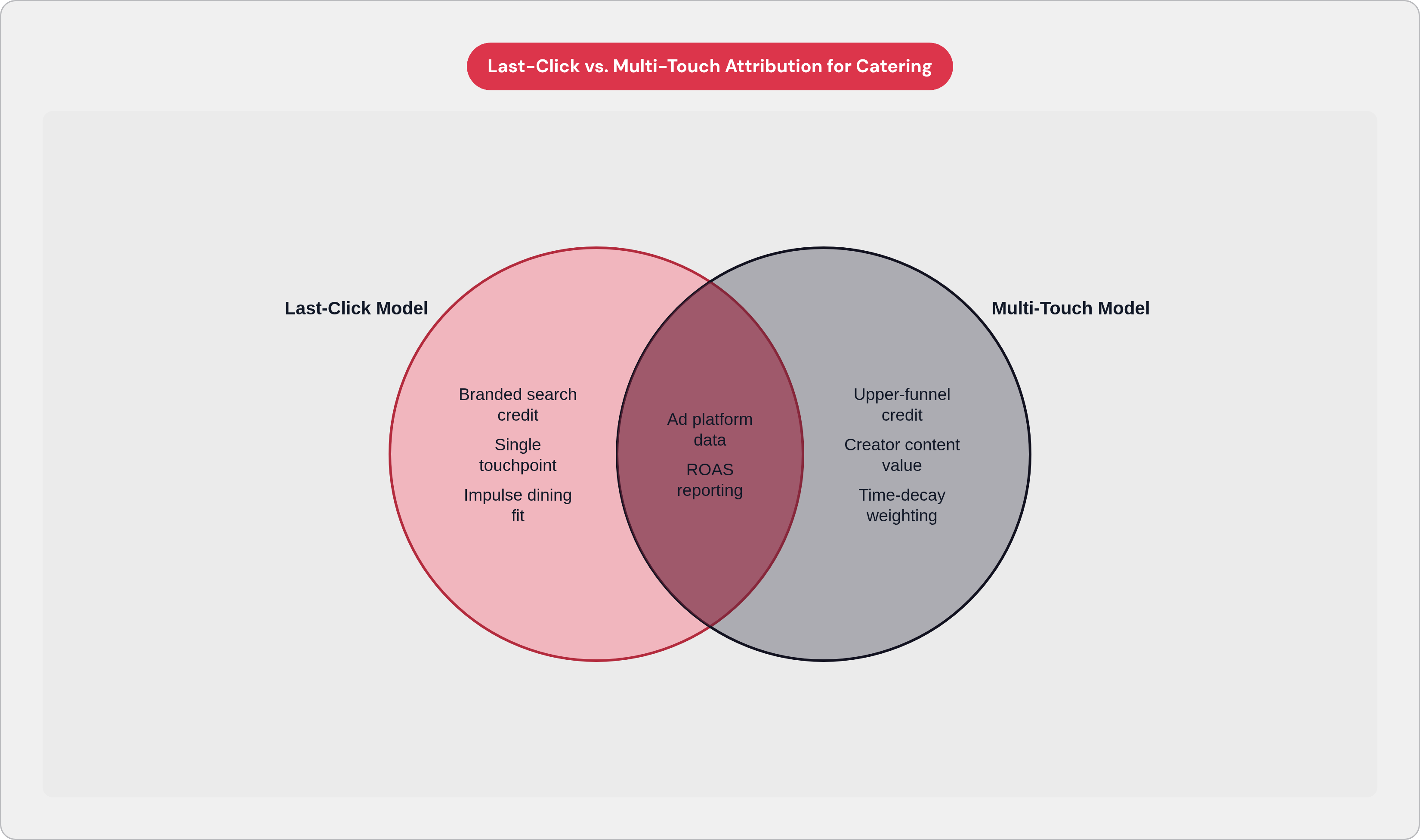
I understand the counterargument: operators are already stretched thin, margins are tight, and layering analytical complexity onto a burdened team sounds like a punishment. But settling for last-click does not simplify catering marketing. It misdirects it quietly, without any warning signal. That is the part that should be unsettling.
Catering buyers rarely convert on first contact. The typical journey runs through multiple touchpoints across multiple channels before an inquiry is ever submitted. A prospect encounters a creator's walkthrough of a private dining room on Instagram, later searches for private dining options in their city and clicks a Google ad, sees a retargeting unit, then visits the website directly to fill out an inquiry form. Last-click assigns 100% of the credit to that final form visit. Everything earlier, including the creator content that first made the venue feel right for the occasion, shows zero contribution.
Multi-touch attribution distributes credit across the full journey. Linear models split it evenly; time-decay models weight touchpoints closer to conversion more heavily; data-driven models, which Google adopted as its default in the early 2020s, use machine learning to assign credit based on what actually correlates with conversion in a given business's historical data. None of these is perfect. All of them are more honest than last-click.
For catering specifically, multi-touch attribution surfaces something counterintuitive: upper-funnel content, creator posts, video ads, email sequences, is doing more conversion work than last-click reporting suggests. Operators running on last-click will systematically underfund these early-touch channels because their contribution never appears in the report. They will then over-attribute to brand search, which is merely collecting intent that upper-funnel channels already generated. The causality runs backwards, and nobody flags it.
Budget misdirection follows. Spend flows toward the channel that collected the inquiry rather than the channels that generated the intent to inquire. Catering pipeline becomes inconsistent, and operators blame the market. That is a comfortable mistake, because the market cannot defend itself.
Multi-touch attribution is not a platform feature that gets switched on in an afternoon. It requires stitching together data from ad platforms, CRM, and POS into a coherent view of the booking journey, and each of those pieces is typically held by a different person on the team, if different people exist at all. That integration is precisely where most operators fall short, and it is the gap that actually determines whether catering marketing scales or just treads water.
How creator content fits into the catering and events funnel
Creator content is well suited to catering awareness, and the reason is rooted in how catering buyers actually make decisions, which is fundamentally different from how they decide where to have dinner on a Tuesday.
A corporate event planner or a couple planning a rehearsal dinner is not browsing menus looking for a dish that sounds appealing. They are looking for a venue that feels appropriate for an occasion, one that communicates the right atmosphere and gives them confidence the experience will match the expectation they are selling to their own guests or stakeholders. A creator's walkthrough of a private dining room, a styled event setup, a behind-the-scenes look at how the kitchen prepares for a buyout: these formats deliver something a static ad cannot. They deliver the felt sense of what an evening in that space would actually be like. That affective signal is exactly what a catering buyer needs before they ever pick up a phone, and it is almost impossible to manufacture through a paid creative brief.
Local creators are especially relevant here. A national food account with a large following is largely irrelevant to a restaurant's catering pipeline. The prospect needs to be in the same city and realistically able to book. Local creators, whose audiences are geographically concentrated, reach exactly that pool. This seems obvious when stated plainly, yet most operators who work with creators prioritize reach metrics that say nothing about whether the audience can actually show up.
But creator content for catering is only useful if it is tracked. A unique UTM link in the creator's bio or story, pointed at a catering-specific landing page, creates a traceable path from the post to the inquiry form. A creator-specific promo code handles the cases where the viewer converts days later via a direct search rather than clicking the original link. Without these mechanisms, creator-driven catering bookings dissolve into "direct" or "organic" traffic, making the creator investment appear unproductive while an untracked booking quietly arrives weeks later. The creator gets no credit. The operator draws the wrong conclusion. The relationship ends.
Boosting creator content as paid ads through whitelisting or dark posts extends reach and brings the performance into the ad platform's own reporting, giving operators a ROAS figure they can act on rather than a view count they cannot.
Why does any of this matter beyond basic accountability? Because creator content tracked to confirmed bookings provides the most defensible evidence available that a creator relationship is producing revenue rather than just impressions. Booking-level attribution connected to a specific creator's post becomes the basis for deciding which creators to rebook and at what investment level. Without it, those decisions default to follower counts and engagement rates, neither of which has a demonstrated relationship with catering revenue. And that is a strange way to allocate what are often a restaurant's largest single marketing commitments.
What a complete catering attribution system looks like in practice
The system has three layers, and all three must connect for the attribution loop to close. Missing any one of them is roughly equivalent to having two legs of a three-legged stool and wondering why things keep tipping over.
The first is distribution. Every ad, creator post, and email promoting catering carries a unique tracking identifier, whether UTM parameters, a campaign-specific phone number, or a promo code. This is largely a discipline problem rather than a technology problem. It requires whoever is building and launching catering campaigns to treat tracking as a prerequisite, not an afterthought. In practice, this is where things break first, because the lunch rush does not care about your UTM taxonomy.
The second is inquiry capture. Every inquiry, regardless of channel, is logged with its source at the point of contact and carried through to the confirmed booking. Digital inquiries often carry source data automatically via UTM parameters in the form submission. Phone inquiries require the person answering to record the source. Walk-in inquiries require the same. The CRM or shared inquiry log, even a well-maintained spreadsheet if that is what exists, is the only mechanism that moves source data from the moment of contact to the moment of booking confirmation. Without that habit, the tracking infrastructure upstream produces data that simply never arrives anywhere useful.
The third is revenue reconciliation. Confirmed bookings and their revenue are matched back against marketing sources so that per-channel and per-campaign ROAS can be calculated for catering specifically, separate from regular dining revenue. This step requires connecting POS or invoicing data to the CRM data captured upstream. Without that connection, the attribution loop remains open: operators have lead data and revenue data, but cannot match them to each other, which is the whole point.
The system does not need to be perfect. Capturing source data on a strong majority of inquiries and reconciling it to confirmed bookings gives operators enough signal to identify which channels are generating profitable catering revenue and which are producing inquiries that do not convert. The question is not "did we capture every touchpoint" but "do we now understand more about what drives catering bookings than we did before, and is that changing how we allocate budget."
For operators starting from nothing, the build sequence is: create a dedicated catering landing page with a single trackable inquiry form; add UTM parameters to every link pointing to that page and set up phone tracking for the catering inquiry line; establish the habit of recording inquiry source in whatever system logs catering leads; reconcile confirmed booking revenue to source monthly; then connect ad platform data and POS data through an integration layer so the reconciliation eventually runs automatically. Each step is individually achievable. The discipline is in doing them in sequence, which is harder than it sounds once service starts.
What operators can actually do with catering attribution data once they have it
Attribution data for catering bookings answers three questions that operators are currently guessing at: which channel produces the highest-value bookings, not just the most inquiries; which creator posts drove inquiries that actually converted to confirmed bookings; and what the actual cost per confirmed catering booking is by channel.
That last question deserves a moment. A channel generating high inquiry volume at low conversion rates is not a productive catering channel. It is a targeting problem presenting as a performance number. Without booking-level attribution, that distinction is invisible, and operators keep funding it. They fund it because the inquiry volume looks like evidence of something working, and in a category where the feedback loop is already slow, that is enough to prevent scrutiny.
With per-channel catering ROAS in hand, the decisions get cleaner. Double down on the channel or creator producing the strongest confirmed-booking ROAS during the planning windows, typically late summer and early fall for holiday events, when catering buyers are actively searching and competition for attention is highest. Reallocate away from channels generating inquiries that do not convert, which often signals poor audience targeting or a mismatch between the ad's promise and the actual catering offering. Rebook the local creators who drove attributed revenue rather than rotating to new creators based on follower count.
The compounding effect here is real and consistently underappreciated. Each catering season an operator runs this system produces a cleaner dataset and a more accurate picture of what drives bookings. Within a few cycles, an operator knows their cost per booked event by source, their average booking value by channel, and which creator content format generates inquiries that actually close. That is specific operational knowledge, not a benchmark from a trade report.
Competitors can run the same ads. They cannot run those ads with the same informed confidence, because that confidence accumulates from booking-level data that takes seasons to develop and cannot be purchased or replicated quickly.
Catering and events revenue is high enough per booking that even modest improvement in attribution accuracy changes the economics materially. In a revenue category where a single booking can exceed a week of table revenue, knowing which half of the marketing budget is working is not a marginal gain. It is the difference between a catering program that scales deliberately and one that just somehow filled a calendar and cost a lot of money doing it.