Toast Loyalty Program Setup and Performance Benchmarks
Configure rewards and automation on day one or watch your program quietly die.

The navigation path is simple enough: Toast Web, then Marketing, then Loyalty, then Settings. Minimum viable activation requires at least one reward configured, a signup method selected, and the program live across your chosen ordering channels. Servers look up guests by name, email, or phone through the customer search on the POS. That's your enrollment moment, and it happens entirely at the counter, which tells you something important about where the real friction lives.
The first structural decision is your earning model. Points per dollar rewards higher checks; points per visit rewards frequency regardless of spend. These produce different guest behaviors over time, and the right choice depends on whether your business model benefits more from ticket growth or from shortening the interval between visits. Neither is wrong. But picking one without thinking through the implication is.
The threshold decision is the one most operators underestimate. Set it too high in the name of margin protection and guests disengage before they ever experience a payoff. The novelty of joining evaporates faster than points accumulate. There's a real cost to that abandonment, and most operators don't calculate it until well after launch, if ever.
Birthday rewards should be configured at setup. Their redemption rate runs measurably higher than standard rewards, which makes every month you run without them a month of performance left on the table.
Toast Marketing Suite handles automated email and SMS triggers. A loyalty program without automated re-engagement is a sign-up sheet with ambitions. The operational difference between a program that compounds and one that quietly stalls is nearly always whether someone set up the automation on day one or told themselves they'd get to it later.
One pricing note worth keeping in your denominator: according to publicly available Toast pricing information, Toast Loyalty runs in the range of a few hundred dollars per month on top of the base POS subscription. That figure should inform every threshold, reward, and automation decision before you go live.
The Enrollment Rate Problem Most Operators Don't Notice Until Months In
Here's a pattern that plays out constantly: an operator launches the program, watches the member count climb, and assumes things are working. They check back six months later and find that the active list is a fraction of total enrollment, new signups have plateaued, and no one can pinpoint when the momentum stalled.
The structural reason is specific to how Toast Loyalty is architected. There's no wallet card, no app icon, no notification badge. The program has no persistent presence on the customer's phone between visits. It is entirely invisible until the next transaction. Which means the only moment a guest learns the program exists is at the point of sale, while they're also managing their payment, their bag, and whatever else is competing for their attention.
That puts the entire weight of enrollment on staff prompting. Enrollment rate — the share of transactions that result in a new signup — is largely a training and culture variable. Not a technology one.
Operators who treat enrollment as optional server behavior see lower rates than the program can produce. Clutch's 2026 KPI framework identifies enrollment conversion rate as a metric that belongs on an executive loyalty dashboard reviewed monthly, not as a vanity count but as a leading indicator of future revenue. A large database of infrequently visiting, loosely engaged members is a worse asset than a smaller, actively transacting one.
The levers are practical. A welcome bonus configured at setup gives servers something concrete to say: "Sign up now and you'll earn X points immediately." That's a scripted sentence, not a pitch. Staff who understand the value proposition, not just the mechanics, will actually use it. Receipt prompts provide a secondary path for guests who slipped through at the register.
The gap between a large list and a healthy one starts here, at enrollment. Volume without follow-through engagement produces dormancy, and dormancy is considerably harder to reverse than it is to prevent.
What Active Membership Actually Looks Like, and How Fast Programs Go Dormant
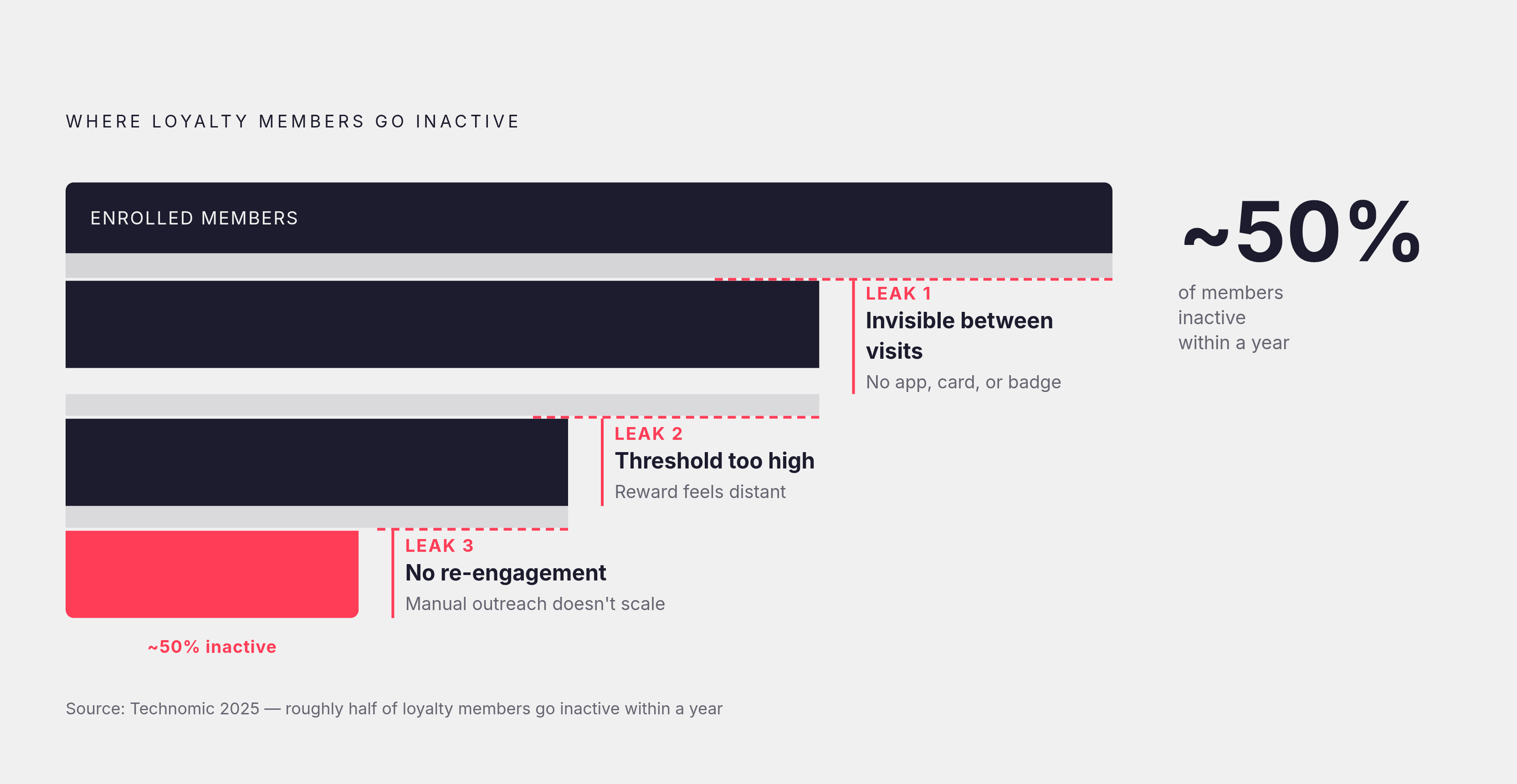
Roughly half of loyalty members become inactive within a year. That figure, from Technomic's 2025 Consumer Loyalty Insights Report, is the most important benchmark in this piece, and it's one operators are less likely to have internalized when they're celebrating their enrollment numbers.
Active-member rate — the share of enrolled members who transacted within a defined window (typically 90 days) — separates a growing program from a decaying list. It's a lagging indicator of everything: enrollment quality, reward relevance, communication timing, threshold calibration. When it drops, something upstream broke months ago.
Why does dormancy happen so predictably? Three causes account for most of it. First, no visible reminder between visits; the wallet-card gap isn't just an enrollment problem, it's a retention problem, because guests who don't think about the program don't come back for it. Second, a threshold set too high; members accumulate slowly, the first redemption feels distant, and the novelty dissipates before the payoff arrives. Third, no automated re-engagement; programs that rely on manual outreach miss most of their re-engagement opportunities because manual outreach simply doesn't scale.
But what does a functioning program actually produce? Toast's platform data shows loyalty participants spend, on average, 39% more than non-loyalty guests, and restaurants running automated loyalty programs generate 20 to 30% of their revenue from repeat customers, per Toast's 2025 Restaurant Technology Report. Those figures also assume an active program, not a dormant list.
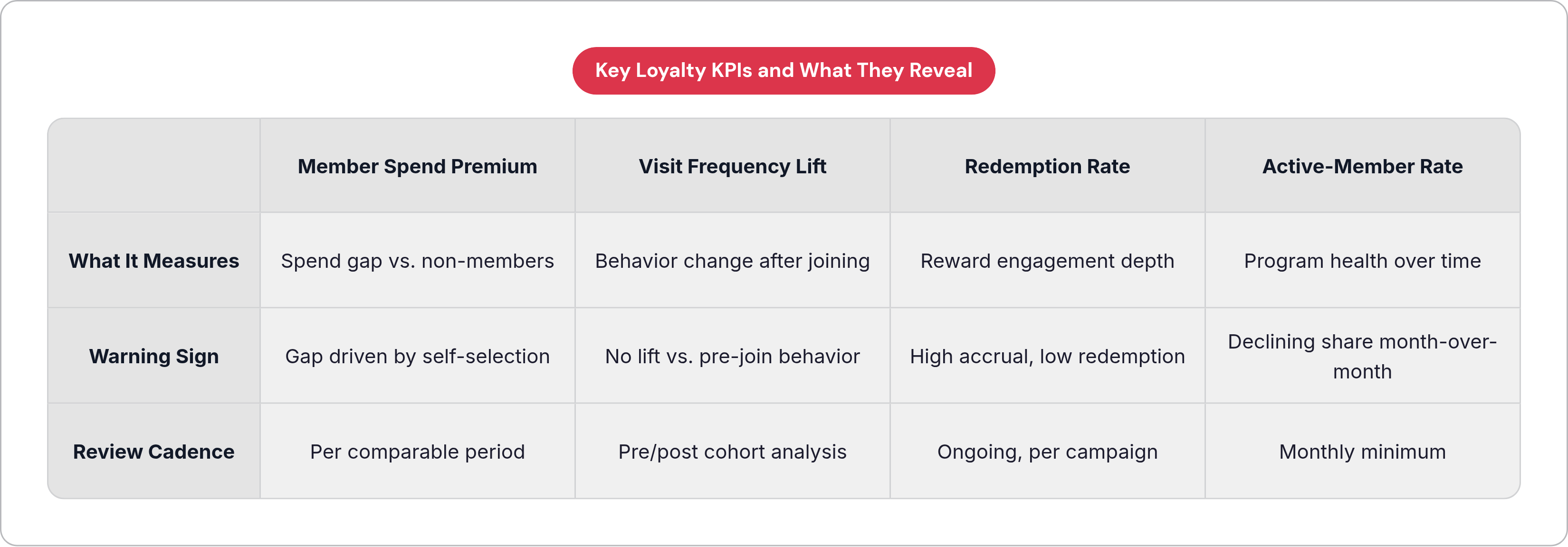
One qualifier is necessary. Higher spend among loyalty members is a useful signal; it is not proof the program caused the lift. Frequent guests self-select into loyalty programs, and some portion of that 39% premium reflects who joined, not what the program did to their behavior. Operators should hold that figure at arm's length and look for evidence of changed behavior in individual member cohorts rather than treating the average as conclusive.
The Specific Rewards That Drive Visits Versus the Ones That Just Get Redeemed
Not all redemptions are equal, and conflating them is a mistake that makes a mediocre program look better than it is.
Birthday rewards are the clearest example of an incremental visit driver. Redemption rates run 40 to 60% higher than standard rewards, per the Toast Industry Report 2025. The structural reason: birthday rewards are time-anchored, which creates urgency; they're personally relevant, which makes them feel earned rather than promotional; and they're connected to a visit that, in most cases, wouldn't have happened on that specific day without the prompt. That incremental visit is the actual ROI event. The redemption itself matters less than the occasion it generates.
Win-back campaigns targeting members who haven't transacted within a defined window follow the same logic. When messaging is targeted and timed correctly, re-engagement rates justify the effort, making this a high-leverage automation in the toolkit for preventing dormancy from becoming permanent attrition. The window calibration matters more than most operators realize: too short and you're messaging guests who were never really lapsed, too long and you're messaging guests who have genuinely moved on.
Double-point days are a different animal. They're effective for shifting visit timing, filling a slow Tuesday, redistributing demand from a peak Friday. But they aren't inherently incremental. Operators should track whether double-point days pull visits forward from periods that would have produced them anyway, or generate visits that wouldn't otherwise occur. That answer determines whether the promotion is a scheduling tool or a growth lever. Many operators run them without ever asking the question.
Threshold calibration is the least glamorous variable and often the most consequential. The faster a new member earns a first redemption, the lower the early dropout rate. Setting the threshold conservatively in pursuit of margin protection frequently costs more in abandonment than it saves in discount expense. That tradeoff is worth running the math on before launch rather than after.
One more finding from Toast's 2026 Regulars Report worth incorporating: regulars are 80% more likely to try a new menu item. A functioning loyalty program is also a product launch channel — it's your most receptive audience already seated at the table. Operators who treat loyalty as purely a retention tool are leaving a second use case on the table.
How Operators Should Measure Whether the Program Is Generating Real Revenue Lift
Loyalty members spend more on average. Some of that gap is the program working. Some of it is selection bias, frequent guests self-selecting into programs they'll get value from regardless. Both are true simultaneously, and conflating them produces ROI calculations that look flattering in a dashboard and fall apart under scrutiny.
The honest ROI formula is incremental gross profit attributable to the program, minus the full cost of running it: subscription fee, reward costs, points liability, and staff time. Not gross revenue times margin. Not total loyalty member spend. Incremental profit, which is a harder number to produce and the only one that holds up.
Four KPIs matter most at the operator level. Member spend premium: how much more do members spend per visit compared to non-members in comparable periods? Visit frequency lift: are members visiting more often after joining than they did before? Redemption rate: are members actually using rewards, or accumulating points they never cash in? High accumulation with low redemption signals a disengaged list, not an engaged one. And active-member rate, reviewed monthly, which functions as the leading indicator for whether the program is growing or quietly hollowing out.
What Toast's dashboard surfaces is member versus non-member spend comparisons. What it omits is isolated incremental behavior per cohort. That's not a criticism of the product; it's a description of its scope. Operators who want to get closer to true lift need to run their own pre/post analysis on joiners, comparing transaction behavior before membership to behavior after. The data Toast provides makes that analysis possible; it just requires someone to actually build it rather than accepting the default view.
Revenue concentration matters here. A large share of restaurant revenue comes from a small share of guests, and accurate measurement of loyalty ROI matters most precisely because these are the guests whose behavior drives the largest swings. Modest errors in measuring their incremental contribution compound into large errors in budget allocation. Operators who can show per-program ROI rather than aggregate loyalty member spend are in a stronger position when those conversations happen.
Where Toast Loyalty's Measurement Ends and the Attribution Gap Begins
Toast Loyalty closes one loop well: it connects a known member to a transaction at a POS terminal the restaurant controls, across multiple locations if the operation has them. That's useful infrastructure, and it's more than most operators had before.
What it cannot do is connect a social media view, a paid ad impression, or a creator video to the visit that follows. The channel that drove a new customer to the restaurant in the first place, and whether that customer then enrolled in loyalty, is invisible to Toast's reporting. That's not a knock on Toast. It's a description of where the system ends.
That raises an important question: does the gap actually matter? The answer is yes, and for a specific reason. Loyalty program growth depends on acquisition as well as retention. Operators who cannot measure which marketing drove enrollments cannot optimize their acquisition spend. A stagnant enrollment rate eventually means a shrinking active base, regardless of how well the retention mechanics are performing. The two are connected. Most measurement frameworks treat them as separate problems.
The third-party delivery data gap compounds this further. Delivery platform orders generate no customer identity for the restaurant. A segment of potentially loyal guests — guests who are already ordering from you regularly — never enters the loyalty database. They're transacting; they're just invisible.
The broader attribution problem is not Toast-specific. Deloitte Digital's 2025 State of Social data shows restaurants reported a 9.9% average increase in B2C revenue tied to social media strategies in 2024, and 90% of operators describe social media as very or extremely important to their overall digital approach. Yet most have no mechanism to trace which social touchpoints drove a first visit that led to a loyalty enrollment. Platforms report views and clicks. POS systems report transactions. Nothing natively connects the two. The gap exists between every major platform and every major POS, and it sits precisely where acquisition spend and retention performance intersect.
Closing the Loop Between Social Marketing and Loyalty Enrollment
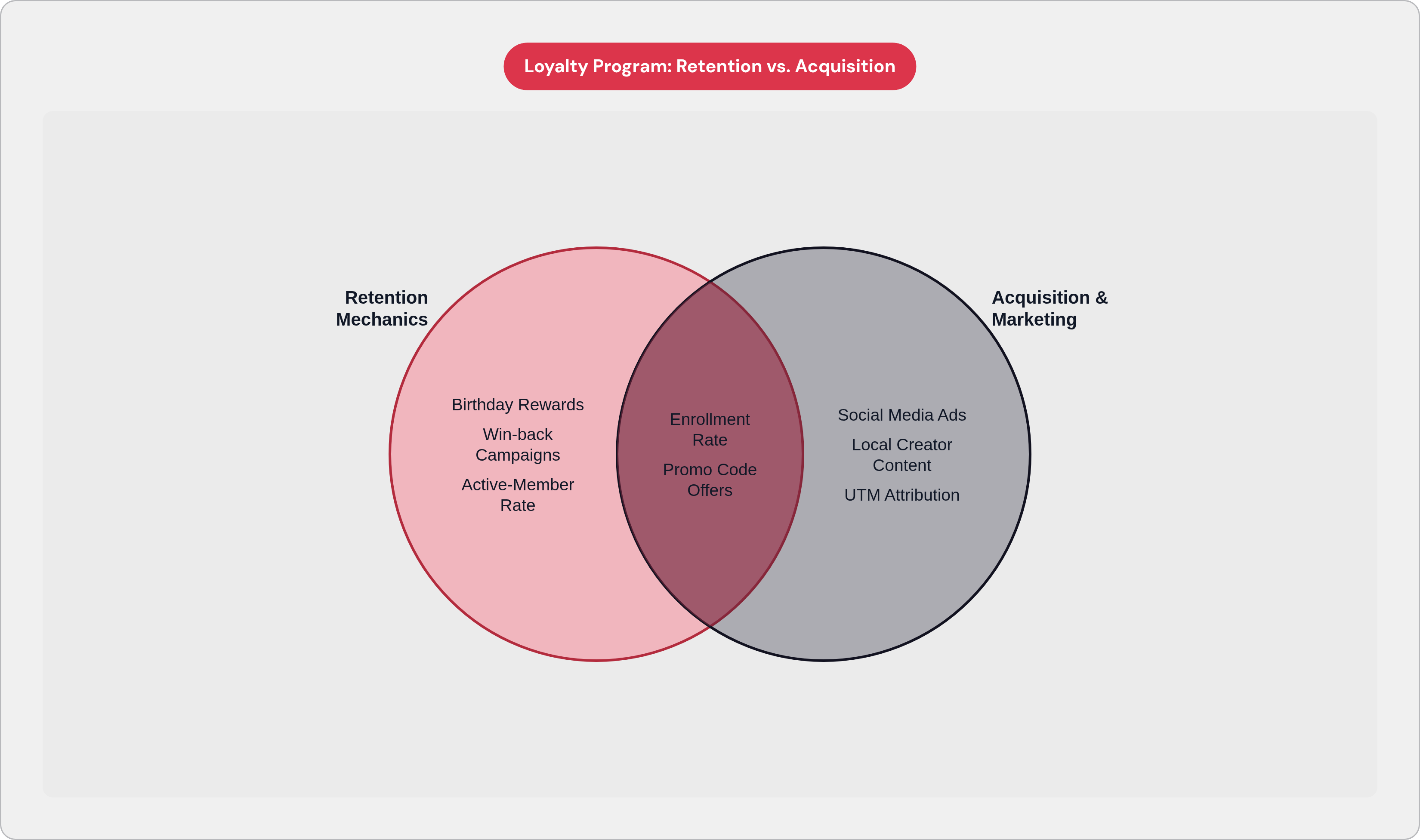
The enrollment funnel has two stages that need to be measured separately: what drove a new guest to the restaurant, and whether that guest then converted into a loyalty member. Most operators are measuring neither with any precision, which makes it very difficult to know which marketing is actually building the program and which is generating traffic that never sticks.
Practical attribution approaches exist for operators running paid social alongside a loyalty program. UTM-tagged links on any digital loyalty signup page identify which campaign or channel drove enrollment. Offer-based campaigns — Facebook or TikTok offer ads with a unique promo code — create a traceable conversion at the POS tied to a specific ad. A 21-day attribution window is a reasonable standard for restaurant campaigns: long enough to capture guests who need time to plan a visit, short enough to avoid crediting campaigns for visits that would have happened regardless.
What connected measurement makes possible is not just knowing that loyalty members spend more, but knowing which ads drove the members who spend the most. That's a materially different piece of information. It enables budget reallocation toward the creative and channels producing the highest-value enrollees, not just the highest enrollment volume. Volume and quality are not the same thing, and optimizing for the wrong one is easy to do when the data doesn't distinguish between them.
Feastalytics is one example of a tool built to close this gap, using attribution that connects a specific social ad — including local creator content — to a recorded POS transaction. Local creators matter here for a structural reason. Their audiences are geographically concentrated, which shortens the discovery-to-visit conversion window and raises the likelihood of loyalty enrollment. A broad-reach influencer campaign generates view counts from audiences who may never become repeat guests. A local creator whose followers live within three miles of the restaurant is working in a fundamentally different conversion environment.
The practical test for whether a loyalty program is a system or just a database is this: can you show active-member growth, a measurable spend premium, and a traceable line from marketing spend to enrollment? If yes, you have something that compounds. If you can only report member count and aggregate spend, you have a database with open questions about what's actually driving it. Toast Loyalty gives you the infrastructure to build the former. Getting there requires a measurement layer above it, one that connects the marketing decisions to the loyalty outcomes they're supposed to be generating.