Restaurant Loyalty Card Programs Compared to Digital Alternatives
Digital programs unlock customer data that paper never can—and retention hinges on it.
There is something almost charming about a paper punch card. It asks nothing of you. No app download, no account creation, no algorithmic nudge. You buy ten coffees, you get one free, and somewhere in the transaction there is a quiet, analog dignity to it. I do not say this sarcastically. I have worked with enough independent restaurants to know that simplicity is not nothing. Sometimes it is everything.
But here is the tension worth sitting with: roughly 69% of first-time restaurant guests never come back at all. When you aggregate lapsed visitors across a full year of foot traffic, the opportunity cost at a single location can be substantial. That is not a loyalty program problem. That is a retention problem, and the format of your loyalty program is either a tool for solving it or a polite fiction that lets you feel like you tried.
Loyalty program adoption is now effectively mainstream, with the large majority of both full-service and quick-service restaurants running some version of a program. Which means the question is no longer whether to run one. The question is what you actually need it to do.
What Paper Punch Cards Actually Deliver, and Where They Structurally Fail
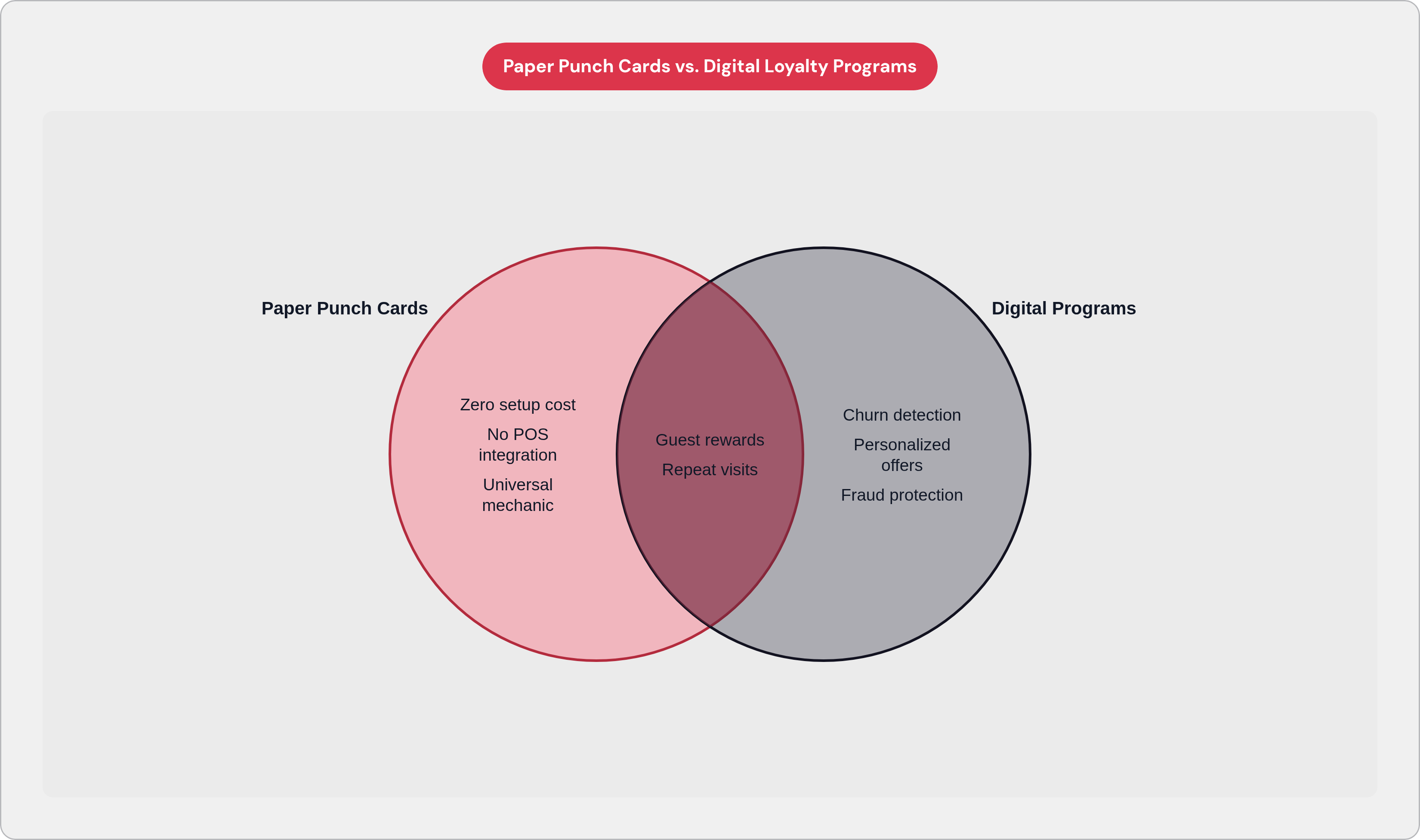
The honest case for paper punch cards starts and ends with friction, or rather the absence of it. Zero cost to launch. No POS integration. No staff training beyond "stamp the card." Every demographic understands the mechanic instinctively. If your goal is to signal goodwill, to offer a small tangible reward that makes a guest feel noticed, paper accomplishes that without asking anything of your operation.
The structural failure is equally honest. A meaningful share of paper punch cards are never redeemed — lost, forgotten, or destroyed in a laundry cycle. And that is not a design problem you can iterate your way out of. It is intrinsic to the format. A physical object that lives outside the customer's phone lives outside their attention.
But the more consequential failure is informational. When a guest stamps a paper card, the restaurant learns nothing. No visit frequency. No average spend. No gap-in-visits signal. No way to know when your most reliable Tuesday regular quietly stopped showing up three weeks ago. The card offers no churn warning, no lapse trigger, no audit trail of any kind. It also treats every customer identically, which means the guest who visits twice a week and the one who wanders in on their birthday get the same tenth-visit reward. That is not personalization. That is a vending machine with a stamp.
There is also a fraud exposure that operators consistently underestimate. Stamps can be duplicated. There is no verification layer. For high-volume operations, this is not trivial. A program with no fraud protection is not a retention system. It is a goodwill gesture with a ceiling, and operators should price it accordingly before comparing it to anything else.
What Digital Loyalty Programs Can Track That Paper Cannot
The value proposition of digital programs is not the technology. It is the signal. Every interaction becomes a data point: visit frequency, average check, time between visits, which rewards get redeemed and which get ignored, and, most critically, when a customer goes quiet.
That last signal is the one paper will never produce. A digital program can identify the moment a regular's visit gap exceeds their established pattern and trigger a win-back offer before the relationship fully lapses. Paper programs cannot do this because paper programs do not know the relationship exists. The restaurant that runs paper cards has no idea who its regulars are in any systematic sense. The restaurant running a connected digital program has a map.
Why exactly does this matter at scale? Because loyalty members who actively engage — not merely those who enrolled — visit more often and spend more per visit than non-members. But that lift is conditional. It depends on the program being visible, easy to access at the point of decision, and connected to something the customer actually values. A digital program that buries its reward behind multiple taps and a login prompt will not produce that lift. It will produce frustration.
It is also worth considering the behavioral context. A growing share of diners, particularly among younger cohorts, are actively using loyalty programs to manage household spending rather than simply as a perk. That is a motivated user base. A well-structured digital program captures that motivation. A punch card does not even know it exists.
One important caveat: a significant share of loyalty members fail to check for available rewards before ordering. Digital programs solve many problems that paper cannot. They do not automatically solve the visibility problem at the moment of purchase. That still requires design intentionality.
The Redemption and Engagement Gap Between Formats in Practice
The operational difference between formats shows up most clearly in redemption behavior. Digital loyalty formats demonstrate redemption rates meaningfully higher than paper. Programs that keep rewards visible and easy to use show visit frequency improvements over non-participants.
The mechanism here is simple enough that it almost sounds trivial, but it is worth stating precisely. Digital programs live on a device the customer checks dozens of times a day. Paper programs require the customer to remember a separate physical object, carry it to the right location, and think to produce it at the register. Every additional step is an attrition point. The gap in redemption rates is not a mystery. It is a predictable consequence of where each format lives in the customer's daily attention. In that sense, the format difference is less a technology question than a real estate one: the program that lives in the customer's pocket wins, and the one that lives in their junk drawer loses.
That said, a digital program with a clunky redemption flow can underperform paper in actual behavior, even while appearing superior on paper. Ease of reward access at the moment of ordering is the conversion point. The format advantage is real but not automatic. A poorly designed digital experience is worse than a punch card, because it creates an expectation it then fails to fulfill, which is more damaging than setting no expectation at all.
The long-run stakes are significant. Research on retention economics consistently finds that even modest improvements in customer retention rates produce meaningful profit gains. The redemption gap between formats is not a feature comparison. It is a proxy for whether the program is actually retaining anyone.
Which Digital Loyalty Formats Fit Which Restaurant Types
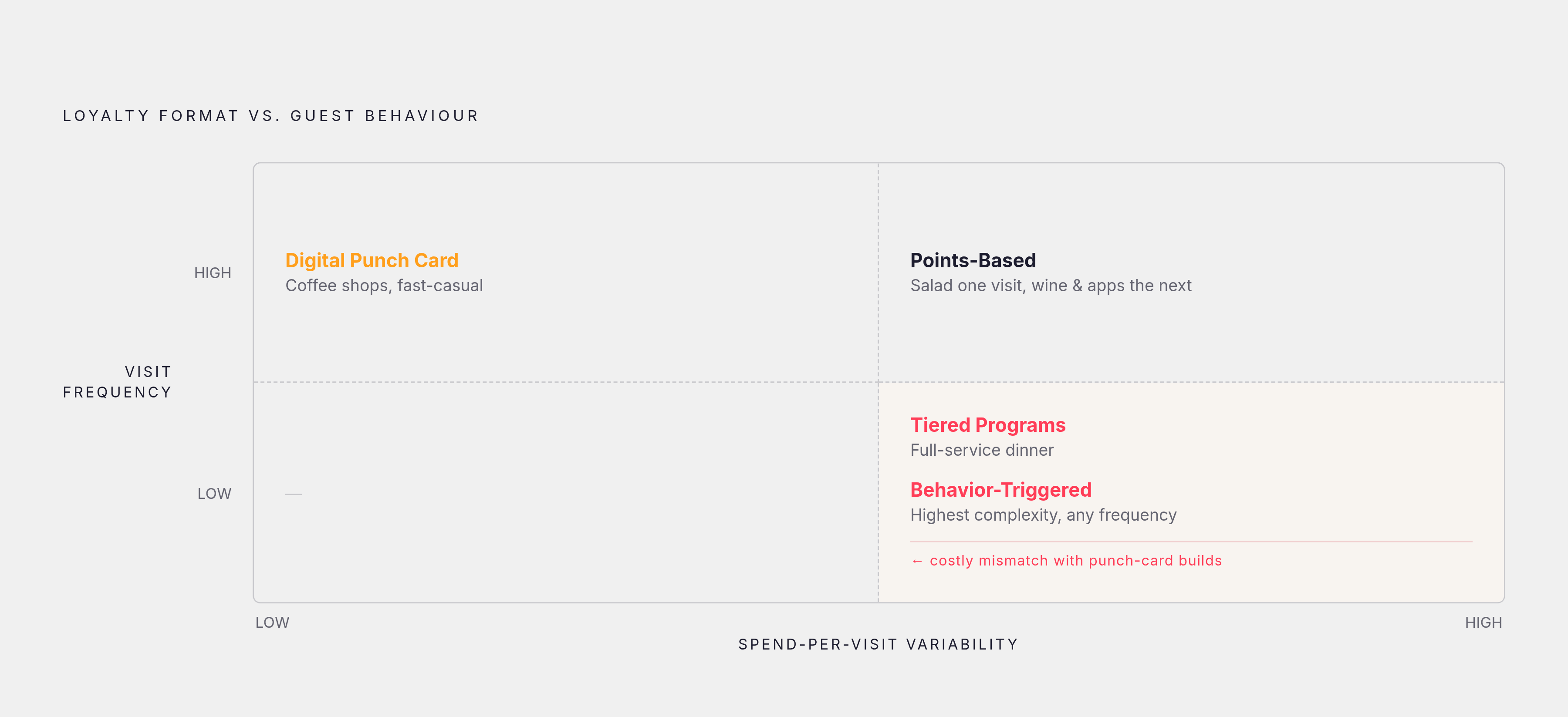
Not all digital programs are the same tool, and deploying the wrong structure for a given operation is a common and costly mistake.
Digital Punch Cards and Stamp Systems
The direct analog to paper, minus the physical object. These work well for high-frequency, lower-ticket purchases: coffee shops, fast-casual lunch counters, quick-service concepts where the visit pattern is daily or near-daily. The mechanic is familiar, the data layer is preserved, and the adoption curve is gentle. For operators who want to graduate from paper without overhauling their entire customer engagement approach, this is the logical first step.
Points-Based Systems
Better suited to operations where spend per visit varies meaningfully. Points accumulate proportionally to check size, which means the guest who regularly orders appetizers and a bottle of wine earns more than the guest who orders a salad and water. That proportionality is not just fair; it is operationally intelligent. It rewards the behavior you most want to reinforce.
Tiered Programs
Most defensible for full-service restaurants where visits are less frequent but checks are substantially higher. Tiers introduce status, and status introduces aspiration. A guest working toward a "gold" or "preferred" designation has a behavioral incentive that transcends any individual redemption. The psychology here is well-established: people work harder to avoid losing a status they have achieved than to gain one they have yet to reach. Tiered programs are built around that asymmetry.
Personalized and Behavior-Triggered Programs
The highest-capability option and the highest-complexity one. These programs use order history and visit patterns to surface offers specific to a given customer — not a customer segment, not a daypart, but the individual. Done well, this is the difference between receiving a coupon for a dish you never order and receiving a reminder about the seasonal item you ordered three times last spring. The former is noise. The latter is a relationship.
The format-to-restaurant match matters more than most operators realize before they have already purchased something. A full-service dinner concept running a digital punch card optimized for coffee-shop visit frequency is using the wrong architecture entirely.
The Cost and Complexity Tradeoffs Operators Rarely See Clearly Before Choosing
Paper punch cards have one overwhelming advantage in a cost analysis: they cost almost nothing. The entire argument for them rests here, and it is a legitimate argument for operators with no margin for infrastructure investment and no immediate ambition to build a data asset.
Digital programs carry real costs: platform or software fees, potential POS integration work, staff training, and the ongoing management of the data the program generates. That last cost is invisible in most vendor conversations and almost always underestimated. Data that no one reads is not an asset. It is storage.
But here is the comparison that rarely gets made explicitly. Acquiring a new customer costs more than retaining an existing one. When you frame platform cost against that alternative, it stops looking like an expense line and starts looking like an investment with a known benchmark on the other side. The question is not whether digital programs cost money. They do. The question is what you are comparing that cost against.
One signal worth taking seriously: reported dissatisfaction with fast-food and fast-casual loyalty programs reached 28%, up from 15% the prior year, per the 2026 Phygital Index Report. That is not an argument against digital programs. It is an argument against poorly designed ones. A complex program that confuses guests or buries rewards behind friction actively erodes the relationship it was meant to strengthen.
The hidden variable in all of this is the enrollment moment. A digital program that staff do not consistently offer at checkout will produce thin data, low engagement, and results that cannot be distinguished from paper. The best program is the one that actually gets used, which means the operator question to answer before choosing a format is not "what does this platform do?" It is "what will my staff do consistently at the point of sale?"
A meaningful share of diners still belong to no restaurant loyalty program at all. The program has to earn enrollment. It cannot assume it.
Where Loyalty Data Connects, and Disconnects, from the Rest of Restaurant Marketing
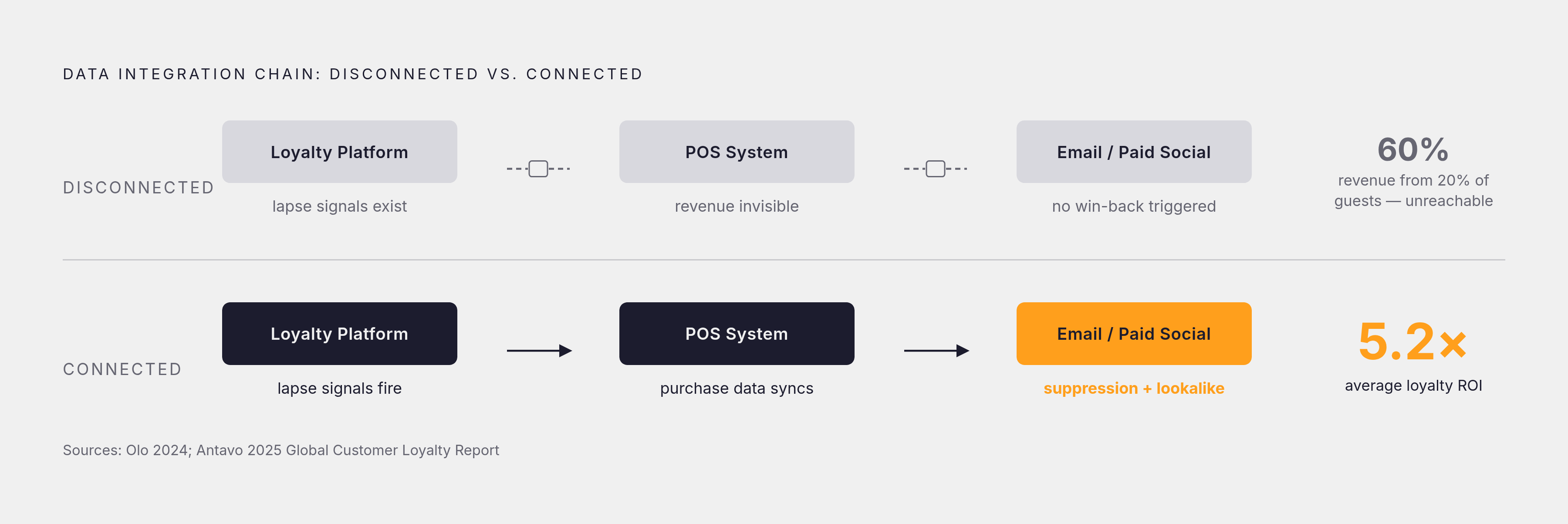
A digital loyalty program generates first-party data that most independent restaurants have never had access to before: visit history, spend patterns, lapse signals, preference indicators. That is genuinely valuable. It is also completely inert unless something acts on it.
The common failure mode is not bad data. It is disconnected data. The loyalty platform sits in one system. The POS sits in another. Email marketing and paid social live in a third. None of them talk to each other, which means the guest who has not visited in 45 days never triggers a win-back campaign. The lapse signal exists. No one receives it. Closing that gap is the core function of tools like Feastalytics, a restaurant analytics platform that unifies POS, delivery, and marketing data so operators can tie campaigns and promotions directly to in-store revenue rather than watching each system report in isolation.
That raises an important question: if the data never leaves the loyalty platform, what did you actually buy? Per Olo's 2024 data, roughly 60% of restaurant revenue comes from approximately 20% of guests. A properly connected loyalty database is essentially a map of those guests. Disconnected from the rest of the marketing stack, it is a list that goes nowhere.
The integration potential is significant when it exists. Loyalty data connected to paid advertising enables suppression — meaning you stop paying to acquire customers you already have — and lookalike targeting, meaning you find new guests who resemble your best regulars. Those are measurable efficiencies with concrete return on ad spend implications. Antavo's 2025 Global Customer Loyalty Report found that businesses actively measuring loyalty ROI earn an average of 5.2 times their program investment. The operative phrase is "actively measuring." That requires the program to be connected to revenue data, not just to redemption counts.
Platforms that enable that connectivity deserve serious evaluation. Olo, for instance, has built its infrastructure around data integration between ordering, loyalty, and guest-level analytics. That does not make it the right fit for every operator, but for restaurants looking to connect loyalty data to the broader revenue picture, the architecture matters as much as the features.
The measurement gap here mirrors a broader attribution problem that plagues restaurant marketing generally. Loyalty platforms report redemptions. POS systems report revenue. Nothing automatically connects which redeemed reward translated into which visit and which check size. Operators who do not actively build that connection end up with redemption counts that feel like success and revenue data that tells a different story.
What the Loyalty Format Decision Actually Comes Down to for an Independent Restaurant
If the goal is a simple goodwill gesture with no data ambition and no infrastructure investment: paper still works. Enter that choice with clear eyes on the non-redemption ceiling and the complete absence of any churn signal, and it is a legitimate, honest choice. Not every independent restaurant needs a retention system. Some need a stamp.
If the goal is retention as a measurable, improvable system — one where you can track who is drifting, re-engage lapsed regulars, and personalize offers based on actual behavior — digital is the only format that can do it. There is no version of paper that produces that capability. The format ceiling is not a weakness to be worked around. It is the format.
A 2025 YouGov survey found that 77% of diners say a loyalty program would motivate them to visit more often. That demand signal is real. Whether a given program captures it depends entirely on whether the program is designed and connected well enough to act on it.
But here is the harder question, the one that the format comparison tends to obscure. Loyalty is one piece of a customer-revenue loop that also includes how new guests are acquired and whether those acquisition channels can be held accountable to actual in-store revenue. The same measurement gap that makes ad spend feel like guesswork applies to loyalty ROI when platforms do not communicate with each other. Operators who connect loyalty data to their broader marketing — attribution, paid distribution, and local audience development — turn a retention tool into a revenue intelligence system. Those who treat it as a standalone perk get redemption counts but not decisions.
The format question is answerable. Paper or digital is a real choice with real consequences, and the analysis above should make the tradeoffs legible. The harder question is whether the restaurant has a system capable of acting on what the chosen format reveals. A loyalty program that generates signals no one reads is not meaningfully better than one that generates none at all. It just costs more and feels more sophisticated while delivering the same outcome.
That, ultimately, is the decision: not which format, but what you intend to do with what it tells you.