Marketing Attribution Models for Restaurants
CFOs are demanding proof that restaurant marketing spending drives actual visits, not just clicks.

Finance is now in the room in a way it wasn't five years ago, and everyone is a little uncomfortable about it. The 2025 CMO Survey found that 63% of marketing leaders report increased CFO scrutiny on marketing accountability, up from 52% the prior year. Digital marketing budgets have grown alongside that scrutiny, which creates a specific kind of exposure: the larger the spend, the more conspicuous it becomes when the measurement is soft.
Restaurant revenue concentration sharpens the stakes. Olo's 2024 data suggests roughly 60% of restaurant revenue comes from 20% of guests. When attribution is weak, decisions about allocating between acquisition and retention spending aren't just imprecise; they're imprecise about the decisions that matter most. Acquiring a guest who would have returned anyway, or throwing retention offers at someone already lapsing, both look like wins in a poorly attributable channel mix. Nobody notices until the finance team starts asking what the click-through rate actually converted to in the dining room.
Customer acquisition costs have also risen as digital advertising grows more saturated. Spending more to reach the same diners means the cost of a mismeasured channel mix is higher in absolute terms than it used to be. Restaurant marketers who can't connect spend to visits end up defending budgets with engagement metrics: clicks, impressions, reach, open rates. Those metrics can sustain a budget conversation for a while. They get harder to hold as CFOs grow more fluent in digital marketing, and CFOs are growing more fluent at an inconvenient rate.
There's a deeper structural problem underneath the budget pressure, though. Restaurant marketing attribution isn't a technology problem dressed up as a measurement problem. It's the reverse. E-commerce closes the loop in the same environment where it opens it: a guest sees an ad, clicks, buys, and the platform records everything. Restaurant marketing does none of that. The ad platform registers a click or an impression. The guest walks through the door three days later, pays in cash. Two events, same guest, zero connection between them — like trying to connect two dots drawn in different notebooks.
A mid-size restaurant group running Google and Meta for paid media, a reservation platform, a location-specific POS, a loyalty program, and an email platform is operating five or six data environments that were never designed to speak to each other. Marketers can count clicks with precision and count covers with precision and cannot connect the two. Attribution isn't a reporting preference. It determines whether budget decisions reflect reality or reflect whatever the ad platform found convenient to claim credit for.
Single-Touch Models: Blunt Instruments With Legitimate Uses
Two variants have existed since the beginning of digital marketing, and one of them still dominates despite its limitations. First-touch assigns 100% of credit to the channel that first introduced the guest to the brand. Last-touch assigns 100% of credit to the final touchpoint before conversion. Per Forrester's 2024 Wave report, 35% of organizations still use last-touch as their primary model. That is a remarkable persistence for a methodology that Google's own GA4 deprecated as a default in January 2024.
Why does last-touch endure? It's easy to implement, requires minimal system integration, and is defensible to a non-technical stakeholder in a budget meeting. Those aren't nothing. The model also has a legitimate use case: when the guest journey is notably short. An impulse lunch decision. A walk-in after seeing a sidewalk sign. A Friday dinner chosen because a friend texted a recommendation twenty minutes ago. In those situations, the final touchpoint is the only meaningful touchpoint, and building infrastructure to track something that doesn't exist is a waste of time and money.
Where it breaks down is in the guest journeys that drive significant revenue. A three-message retention sequence, where the first message reactivates latent interest, the second delivers the offer, and the third contains the call to action, will have only the third message receive credit under last-touch. The sequence that moved the guest earns nothing; the delivery mechanism collects everything. One analysis of fine-dining attribution found that Instagram ads drove roughly 10% of reservations directly but influenced 40% of all bookings across multi-touch paths. Last-touch misses that 30-point gap and will cheerfully report that Instagram is underperforming.
First-touch is underused relative to last-touch, which is strange, because it answers a distinctly different and valuable question: how do guests discover you? That is not the same question as what finally moved them to book. Neither model should serve as the sole framework, but both answer real questions when applied to the right part of the journey. The problem is that most operators run one or the other as a default and treat it as comprehensive.
Multi-Touch Models and What Each One Implies About the Guest Journey
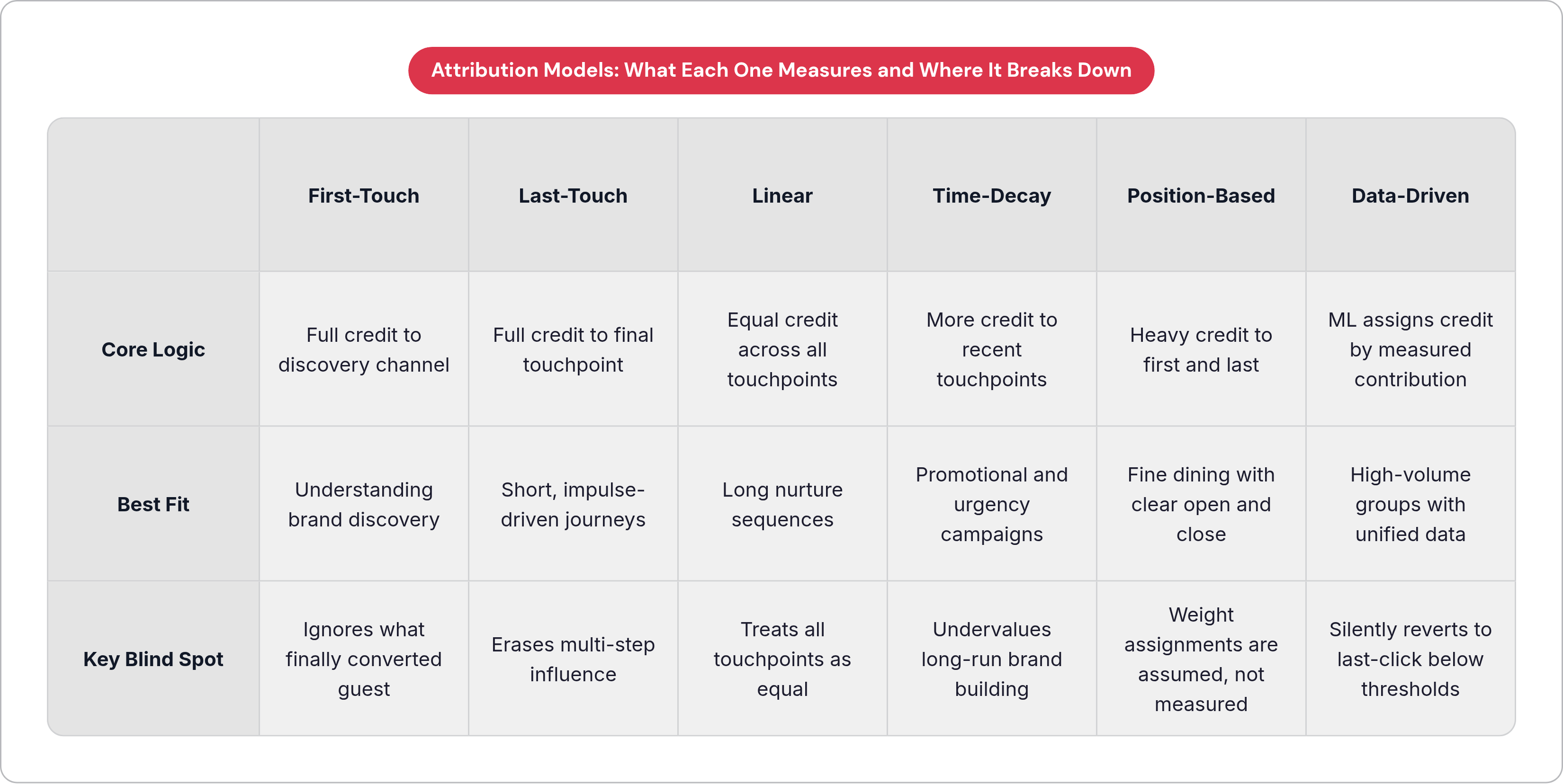
If single-touch models are clearly inadequate for complex guest journeys, why did multi-touch adoption take so long? Because multi-touch models are harder to explain, harder to build, and require more integrated data. Adoption has accelerated, though; by 2026, roughly 75% of companies had adopted some form of multi-touch attribution, up from 58% in 2024, per Improvado's analysis. The infrastructure eventually caught up.
Three rule-based variants dominate in practice, and each one encodes a different implicit belief about how guests actually behave.
Linear Attribution
Linear models distribute credit equally across all touchpoints a guest encounters before converting. The underlying assumption is that sustained nurture matters and no single touchpoint is inherently more consequential than another. A French fine-dining chain that switched from last-click to linear attribution discovered that email was driving nearly 30% of reservations as an assist channel, a contribution that had been invisible in the prior model. That finding drove a meaningful reallocation toward email.
The limitation is that linear attribution treats a brand awareness impression and a coupon redemption as equivalent. They are not. The impression is scrolled past in three seconds; the coupon required intentional action. Treating them identically is its own kind of distortion, just a different one than last-touch produces.
Time-Decay Attribution
Time-decay models assign progressively more credit to touchpoints closer to the conversion event. The logic is that the touchpoint which moved the guest to act now is more causally proximate than the impression they encountered three weeks ago. This model fits promotional campaigns well: a limited-time offer, a weekend event, a seasonal menu with a hard end date. Urgency signals matter, and time-decay reflects that.
The risk is systematic undervaluation of brand-building activity. If Instagram spent six months constructing aspiration around a new concept and a promotional SMS finally closed the booking, time-decay under-credits six months of work and hands all the glory to a text message.
Position-Based Attribution
Position-based models, sometimes called U-shaped, concentrate credit at the first and last touchpoints and distribute the remainder across the middle. The premise is that discovery and the closing action are both meaningfully important; the middle of the journey matters, but less. This fits fine dining reasonably well, where the initial brand impression and the final reservation trigger are both consequential, and neither should be collapsed into the other.
Organizations that shift from last-click to any multi-touch model tend to see meaningful reallocation in channel budgets, with customer acquisition cost reductions following from better channel mix decisions, per McKinsey's 2024 Digital Marketing Analysis. The specific percentages are less important than the pattern: rule-based multi-touch models consistently surface assist channels that single-touch models erase.
But the weight assignments in all three models are assumptions, not conclusions derived from actual conversion data. Someone decided that first and last touch each deserve 40% in a U-shaped model. Whether that reflects your guests' actual behavior is a different question entirely, and most operators never ask it.
Data-Driven Attribution and the Entry Barrier Most Restaurants Don't Know Exists
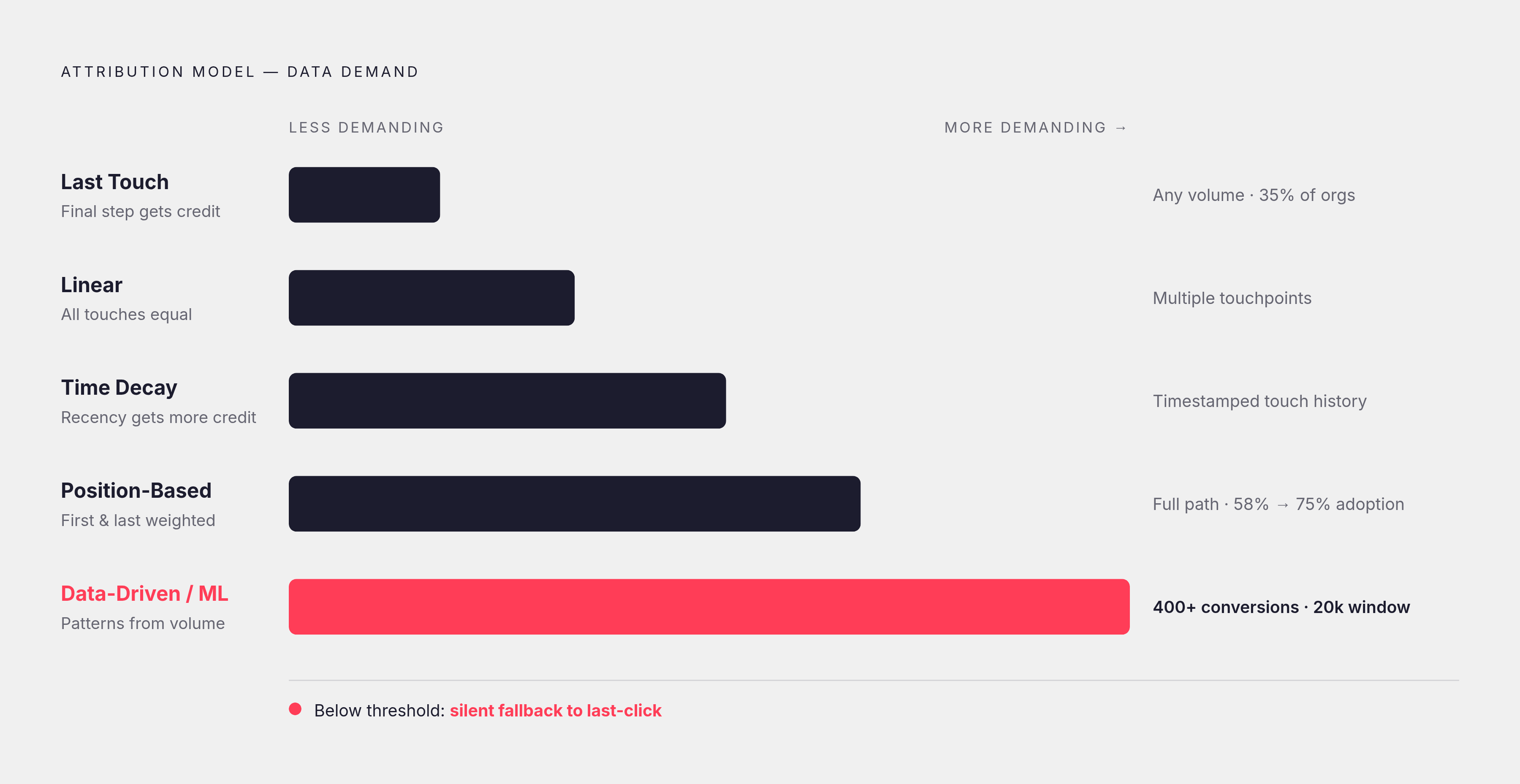
Data-driven attribution resolves the assumption problem by using machine learning to evaluate both converting and non-converting paths, assigning credit based on each touchpoint's measured contribution rather than a preset rule. It is now the default in GA4 and Google Ads, which means many restaurant marketers believe they are running it.
Here is where assumption and reality diverge uncomfortably. GA4's data-driven attribution requires at least 400 conversions for the specific tracked action and 20,000 total conversions within the lookback window. Below those thresholds, GA4 silently falls back to last-click attribution. No alert, no notification. A smaller restaurant group that has configured GA4 and believes it is benefiting from machine-learning attribution is, in practice, running last-click with a more sophisticated-looking dashboard. You ordered the chef's special; you're eating the house salad.
Who actually meets the threshold? Multi-location groups with high reservation volume or significant online order activity, combined with centralized analytics infrastructure and robust digital conversion tracking. Single-location restaurants, concepts with low online conversion events, and operators without a unified digital identity layer are not good candidates yet. Running the model does not mean the model is running correctly.
And even when thresholds are met, data-driven attribution still operates exclusively on digital signals. It does not resolve the offline visit problem, which is the structural issue that defines restaurant attribution in the first place.
The Offline Visit Gap That All Digital Models Share
Every attribution model discussed so far assigns credit among digital touchpoints. The conversion event for most restaurant guests is walking through a door, not clicking a confirmation button. The guest who saw a Facebook ad, never clicked, and visited three days later is invisible to every digital model. The walk-in influenced by a Google Maps proximity search generates a partial signal at best. The guest who came on a hotel concierge recommendation, a category representing 20% of bookings in one attribution study, is invisible entirely.
Why does this gap persist? Bridging online signals to offline visits requires deliberate infrastructure investment, not just better analytics tooling. And most of the channels that can close this gap are ones restaurants already operate but rarely instrument deliberately.
Loyalty program enrollment at the point of sale ties a transaction to a known identity. WiFi login captures device-level presence and can, with the right tooling, be matched to prior digital activity. Reservation systems create a pre-visit digital record that can be matched to actual covers in the POS. Online ordering provides the cleanest signal of all: a full digital trail from intent to transaction, closed loop. Post-visit surveys are low-tech but surface channels like word-of-mouth and concierge recommendations that no passive tracking will ever capture. In one case, a seafood bistro found that digital models undervalued word-of-mouth by 25% when survey data was run alongside platform data. That's not a rounding error; it's a structural blind spot hiding in plain sight.
The counterintuitive implication: model sophistication is secondary to data infrastructure. A restaurant running linear attribution with solid first-party identity linkage will outperform one running data-driven attribution on fragmented, cookieless data. The math only works if the inputs are real.
Privacy Changes and Cookie Deprecation: Worse for Some Restaurants Than Others
Roughly half of the web is already operating in a cookieless environment, per Evok Advertising's 2026 analysis. This is not a horizon event; the degradation is ongoing. Third-party cookie-based attribution once achieved accuracy in the high 80s to low 90s in vendor studies. Cookieless methods range considerably lower: identity graphs reach the 70-85% range, and probabilistic matching drops to 50-65%, per Improvado's 2026 analysis. Apple's ATT, Safari ITP, GDPR consent requirements, and Chrome's deprecation trajectory have collectively reduced usable identity coverage dramatically from the near-universal coverage of the cookie era.
One observation is that this affects all digital marketers equally, not just restaurants. True, but restaurants have a structural advantage that pure e-commerce players often lack: natural physical touchpoints that generate owned, first-party identity data. Every loyalty enrollment, every reservation, every WiFi login, every online order creates a linkable record that persists regardless of cookie policy. The restaurant owns that relationship in a way that a display retargeting audience never did. If your customer base was built on third-party behavioral data, you were always renting it — and now the landlord has changed the locks.
For restaurants relying on Meta or Google retargeting audiences built on third-party behavioral data, those audiences are degrading, and the attribution signals tied to them are degrading in parallel. The platforms reporting attribution are doing so with less signal and more modeled inference than their dashboards typically indicate. They are not advertising this fact aggressively, for obvious reasons.
Marketing Mix Modeling: Useful Precisely Because It Ignores Individual Guests
Marketing mix modeling works differently from everything discussed so far. Rather than tracking individual guest journeys, it correlates aggregate marketing spend by channel against aggregate revenue outcomes over time, using statistical regression to isolate each channel's contribution. Less elegant on a slide deck, but it measures things that multi-touch attribution cannot.
Offline channels: radio, out-of-home, direct mail. Brand effects that accumulate over months rather than resolve in a single session. Seasonality, weather, and local events that shift baseline demand independent of marketing activity. A restaurant running a significant out-of-home campaign alongside digital cannot attribute billboard effects through GA4; MMM can estimate them. The tradeoffs are real: MMM tells you the channel worked without telling you which guest it moved, it requires at least two years of historical data to build reliably, and it does not update in real time. It is not a tool for in-campaign optimization.
The most useful application for restaurants is often as a sanity check on multi-touch attribution outputs. When MMM and MTA diverge significantly on a channel's contribution, that divergence deserves interrogation before the budget decision is made. McKinsey has noted that integrating MMM with other measurement approaches can produce meaningful lift in marketing ROI. If both models agree, you have some confidence. If they disagree sharply, one of them is wrong, and it's worth knowing which before committing the spend.
Choosing a Model Based on Where the Restaurant Actually Is
That is the governing question, and it sounds obvious until you watch a single-location restaurant attempt to implement data-driven attribution on twelve conversions a month. The model is not the answer. The answer is building the infrastructure that makes any model useful.
For a single-location restaurant with limited digital infrastructure, the priority is not model sophistication; it is establishing a data foundation. First-touch attribution to understand discovery channels. Post-visit surveys to surface what digital models miss. The highest-value investment at this stage is a loyalty or reservation system that ties a transaction to a known identity, because that record becomes the input for everything more sophisticated that follows.
For a multi-location group with loyalty and POS integration but no unified data layer, linear or time-decay attribution is achievable and will surface assist channels that have been systematically undercounted. Before claiming the benefits of GA4's data-driven attribution, verify whether conversion volume thresholds are actually being met. Many groups running GA4 are running last-click and don't know it.
But what if the question isn't which model to choose, but whether the data exists to make any model meaningful? That is the more straightforward version of the attribution conversation for most restaurant operators. The model choice is secondary to having a common guest identifier across POS, loyalty, and digital platforms; first-party data collection at every owned touchpoint; and the institutional willingness to accept that some channels, occasionally the best ones, will never be directly attributable.
Attribution models reduce uncertainty; they do not eliminate it. The restaurants that extract the most value from them are the ones that understand which uncertainties their data can actually address, and which ones require a different kind of evidence altogether. Feastalytics, a restaurant analytics platform that unifies POS, delivery, and marketing data to tie campaigns directly to in-store revenue, is one tool built specifically for operators trying to close that loop.