Attribution Challenges Unique to Multi-Location Restaurant Groups
Marketing and operations data rarely connect, creating a data labyrinth when restaurants expand.

The attribution problems facing multi-location restaurant groups are not a scaling challenge. They are a different problem entirely, one that emerges from the structure of restaurant operations rather than from the volume of them. Understanding why requires starting somewhere uncomfortable: the average restaurant group is running its marketing with instruments designed for a different vehicle.
The metaphor that keeps coming back to me is the "two brains" gap. The marketing stack knows who clicked. The operations stack knows who paid. Nothing connects them. For a single location, this gap is painful but workable; operators can observe patterns, run informal tests, triangulate roughly. Add a second location, then a third, and you do not simply widen the gap. You multiply the number of disconnected data environments, each running its own POS history, its own local audience, its own ad account configured by whoever set it up. The gap becomes a labyrinth.
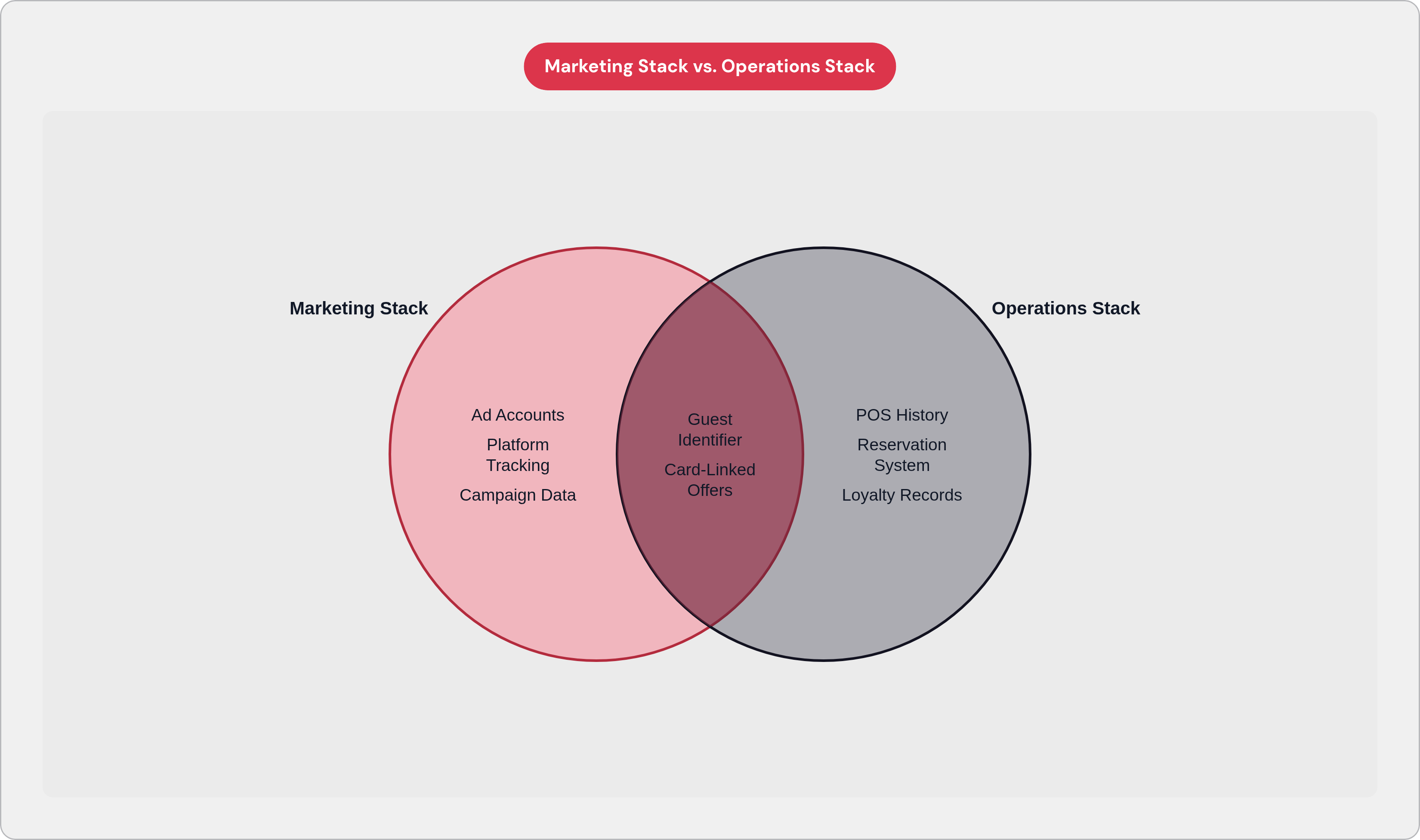
Every New Location Is Its Own Data Island
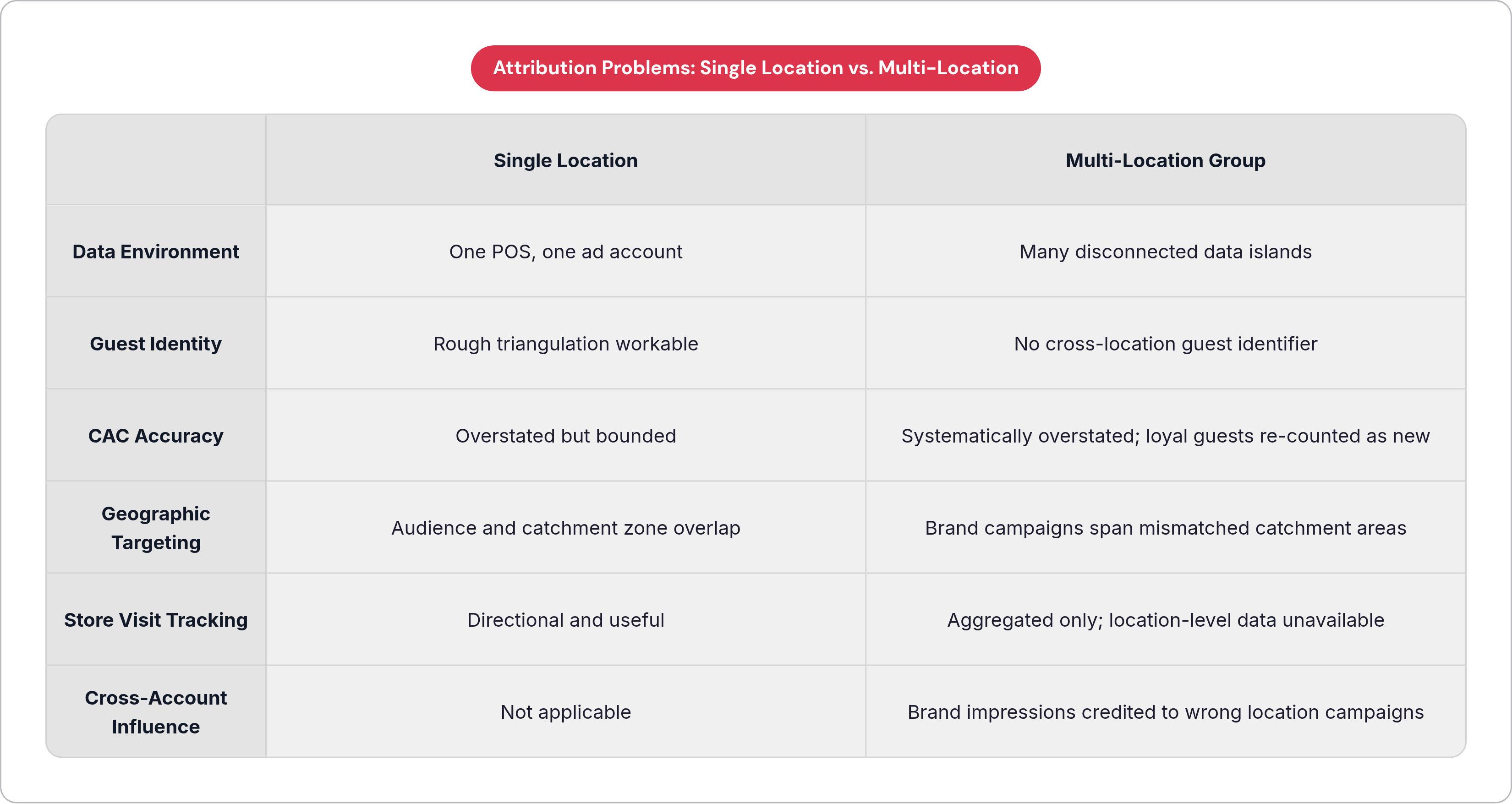
Each location in a restaurant group typically runs its own POS instance, its own reservation system, and its own loyalty records. These systems rarely share a unified guest identity layer. That architectural reality has a specific, concrete consequence: a guest who visits Location A after seeing an ad served by Location B's campaign is invisible to both measurement systems. Neither system registers a connection because neither was built to look for one.
The proliferation compounds. Social accounts, Google Business profiles, and ad accounts accumulate without a shared taxonomy, different naming conventions, inconsistent attribution windows, campaign structures set by whoever managed the last onboarding. What looks like a portfolio of locations is, from a data perspective, a collection of largely autonomous entities that happen to share a logo.
The most underappreciated consequence of this structure is what it does to customer acquisition cost. Without a consistent guest identifier traveling across locations, the same person appears as a new customer at every new location they visit. This means CAC is systematically overstated for groups operating in overlapping markets: re-acquisition of guests who are already loyal to the brand gets counted as fresh acquisition. The math on this is quietly brutal. Research on restaurant guest behavior puts annual churn at roughly 78.8 percent per location, representing somewhere around $375,380 in lost opportunity per location. But that figure is partly a measurement artifact. A meaningful portion of those "churned" guests are likely still active at other locations in the same group; the system simply has no way to see them.
That raises an important question: is the group actually losing those guests, or losing track of them? The distinction matters enormously for how you respond.
The Geographic Audience-Splitting Problem No Single-Location Operator Faces
A single-location restaurant runs ads to a radius around one address. The conversion zone and the audience zone overlap cleanly enough that even rough measurement produces useful signal. A multi-location group running brand-level campaigns broadcasts to an audience that spans multiple catchment areas simultaneously, some viewers near Location A, some near Location C, most near nothing actionable at all.
This is not just an efficiency problem. It is an attribution problem. Platform algorithms optimizing for engagement surface ads to the users most likely to interact, not the users most geographically proximate to a location. Those are not the same population, and treating them as equivalent is where the model starts to fail.
Why exactly does this happen? Because Meta and TikTok were built for brand advertisers measuring reach, not operators measuring which location filled tables on a Tuesday. The platform's incentive is engagement and impression volume. The operator's incentive is butts in seats at a specific address on a specific night. These objectives are frequently in tension, and the platform's reporting architecture reflects the platform's objective, not the operator's.
The geographic splitting problem becomes especially visible around local creator campaigns. A location-specific creator with an audience concentrated in a single neighborhood consistently outperforms a nationally distributed influencer for that location's conversion goals, a pattern the industry has observed clearly enough that it barely warrants argument anymore. But at the group level, a brand must decide whether to run creator campaigns per location, which is expensive and operationally complex, or accept diluted geographic relevance in exchange for scale. Neither option is clean.
The cross-location cannibalization dynamic is also worth examining. When two locations share a market boundary, ad spend targeting potential guests of one location is inevitably reaching potential guests of the other. Standard attribution assigns a win to whichever location the guest eventually visits, crediting the campaign that "worked" while the cannibalization effect disappears from the ledger entirely. The incrementality test, running a promotion at one location while holding it back from a comparable nearby location, is the most methodologically sound way to measure this. It is also the most operationally fraught, because defining a "comparable location" in partially overlapping markets is difficult. You can run the test and still argue about whether the control was valid.
Platform-Native Store Visit Tracking Was Not Built for This
Meta and Google store visit tracking works by matching device location history to verified business addresses within an attribution window. For a single verified address, this is directional and useful. It provides a baseline for offline attribution even when no promo code was redeemed, no reservation was made, no digital fingerprint was left at the point of transaction.
For a group, the structural problems are immediate. A visit attributed to a brand campaign may have occurred at any of a dozen locations; the platform reports aggregate store visits, not which specific location was visited. Budget allocation decisions require location-level data. Aggregate visit counts do not support them.
The setup problem is also worth noting. Store visit tracking must be manually applied to each verified business location. Setup errors and inconsistent verification across a portfolio introduce systematic gaps. The data is aggregated and anonymized, which means it only reports at scale; small or new locations routinely fall below the reporting thresholds entirely, which is precisely when location-level attribution data would be most useful.
The hybrid account structure that many groups eventually adopt, a corporate master account for brand campaigns, individual accounts per location for local campaigns, addresses budget control but creates a new blind spot. Brand campaign impressions served from the master account influence visits that ultimately get credited to location-level campaigns in separate accounts. Cross-account attribution is not native to either platform. The influence happened; the credit goes somewhere else. This is a problem that is difficult to solve within platform-native reporting. It requires infrastructure the platform was not designed to provide.
Server-side tracking through Meta's Conversions API or Google's Offline Conversion tools is a critical bridge between POS data and ad platforms. But the integration complexity scales directly with location count, and both APIs were designed with e-commerce checkouts in mind. A restaurant POS transaction is not a checkout event. The translation is possible; it is not trivial, and it compounds with each location added.
Standard Multi-Touch Models Were Built for a Journey That Ends Online
Multi-touch attribution, distributing credit across touchpoints that preceded a conversion, is more intellectually honest than last-click for any restaurant context. A guest did not decide to visit because of a single ad. They saw a creator video, then a promoted post, then a Google result, and the visit was the cumulative result. Crediting only the last touchpoint is a polite fiction.
But standard multi-touch models were built for e-commerce journeys that terminate in an online transaction, with a clear session log, a clear conversion event, and a digital record connecting exposure to outcome. Restaurant group guest journeys have properties these models were not designed to handle.
The "conversion" is a physical visit with no guaranteed digital fingerprint at the point of transaction. A guest interacted with Location A's ads before visiting Location B. No model credits the right campaign because no model knows which location was actually visited from ad exposure alone. Repeat visits get counted as separate acquisition events unless a persistent guest identifier connects them across sessions and locations.
The temporal mismatch deserves its own attention. Brand-building campaigns can require six to twelve months before ROI becomes measurable in any meaningful way. Evaluating them at two weeks produces misleading negative results. Operators who cut those campaigns early based on short-window attribution data are making real budget decisions on phantom signal, and they will likely repeat the mistake because the system rarely shows them the counterfactual.
The measurement window problem is further complicated in mixed-concept portfolios. A fast-casual lunch brand and a premium dinner brand have different consideration cycles, different decision latencies, different behavioral patterns between awareness and visit. Applying a uniform attribution window across both produces numbers that are internally inconsistent and functionally incomparable. You end up unsure whether you have a data problem or a concept problem.
What Actually Works, and Why It Starts in Operations

A persistent, cross-location guest identifier is the foundational requirement. Phone number, email, or payment token, something that travels with the guest regardless of which location they visit or which campaign originally touched them. Without this, every other attribution improvement is largely cosmetic.
POS integration with the ad platform is the bridge. When a guest submits a phone number at reservation, redeems an offer, or triggers a loyalty event, that identifier can be matched back to ad exposure. This is how social-to-store attribution closes the loop without depending on platform-native store visit estimates. Card-linked offers go further: they provide closed-loop attribution at the transaction level without requiring the guest to take any action at all. The card becomes the persistent identifier, connecting marketing spend to transaction lift across locations passively and accurately.
Holdout experiments by location remain the most causally defensible measurement method available. Run a promotion at one location, withhold it from a comparable location, compare revenue over the same period. The difference is the true incremental impact, not modeled credit distributed by an algorithm. The operational difficulty is real, but the methodological clarity is worth the friction.
For groups running the hybrid account structure, attribution setup must deliberately account for cross-account influence. UTM parameters, offline conversion imports, and consistent naming conventions across all accounts are prerequisites, not optimizations. They are the minimum viable infrastructure for the attribution model to produce numbers worth arguing about.
The compounding value of getting this right is not trivial. Research from 2025 indicates that restaurants using integrated customer data platforms and marketing automation are capturing 52 to 69 times ROI on retention marketing. The gap between that and fragmented-system performance is primarily a structural gap, not a creative gap or a media-buying gap. It reflects the difference between having a unified guest record and lacking one. Feastalytics, a restaurant analytics platform that ties POS and delivery data to marketing campaigns and attributes promotions directly to in-store sales revenue, is one tool operators have used to begin closing that structural gap.
But what if that framing is itself the problem? The tendency in marketing conversations is to position attribution infrastructure as a marketing tool, something layered on top of operations to improve campaign measurement. The more accurate framing is that attribution infrastructure for a restaurant group is fundamentally an operations problem that marketing happens to depend on. The POS, the reservation system, and the loyalty program need to share data intentionally, with the restaurant group owning the connection rather than delegating it to Meta or Toast or any single platform that serves its own interests first.
The restaurant industry is still waiting for its e-commerce equivalent: one checkout, one data loop, clean attribution by default. It may not be coming. The physical nature of the transaction, the geographic distribution of the locations, the operational independence of franchisees and regional managers, these are not technical problems awaiting a software solution. They are structural realities that require structural responses. The groups that close the gap will not do it by finding a better attribution platform. They will do it by deciding that the guest record belongs to the brand, and building accordingly.