Growing a Restaurant SMS Subscriber List
SMS texts beat email open rates by 15-to-1 for restaurants.

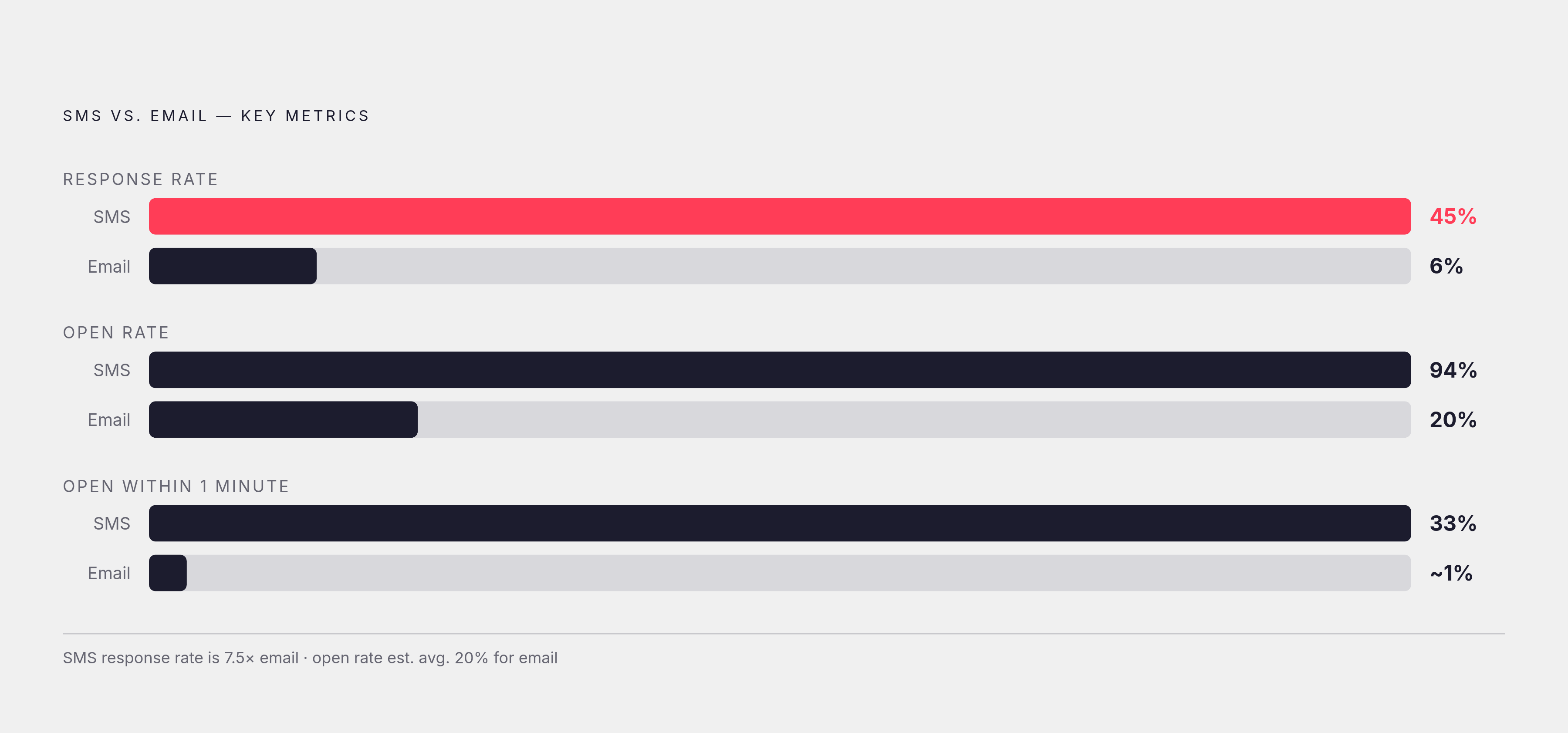
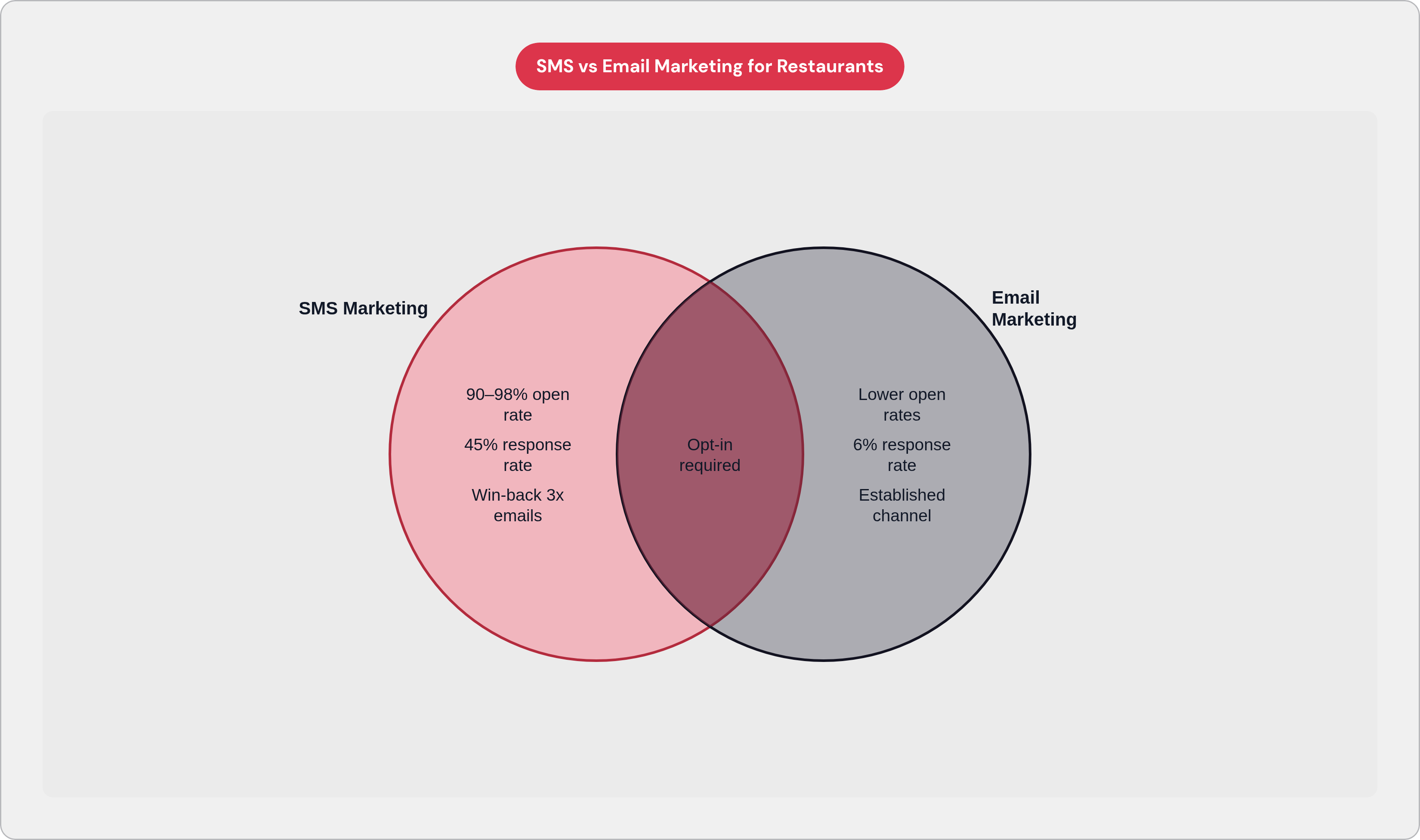
Restaurant SMS lists beat email marketing badly enough that the comparison stops being interesting after a while. Text open rates run 90 to 98%, response rates hit 45% against email's 6%, and a third of recipients open the message within a minute of it landing. That last part is the whole game: you're catching someone while dinner is still an active thought in their head, likely before they've even opened the day's other messages. This piece walks through where that gap comes from, how to build the list without wrecking it, and why most operators measure the wrong thing once the list actually starts working.
Texting is the top mobile activity for 83% of consumers, ahead of social media and ahead of email. Restaurants are competing for the app people already have their thumb resting on. Hospitality's caught up to this: 69% of hospitality businesses reported opt-in growth over the last year, and win-back texts recover lapsed guests at three times the rate of win-back emails. None of this is a ceiling, and it's closer to a floor, which is the part worth sitting with before getting into tactics.
What a subscriber is actually worth before the first campaign goes out
Here's the number that should reset how an operator thinks about this: an SMS subscriber is worth roughly 2.3 times an email subscriber in dollar terms. Scale that out and every thousand subscribers throws off somewhere between $600 and $1,850 a month. Wide range, sure, but wide enough that you can plug in your own average check and traffic and get something closer to a real projection than a vendor's pitch deck.
The lift shows up at the top line too, not just per-subscriber. Restaurants growing their SMS lists see a 14% bump in annual revenue tied to that growth, and it's a baseline shift, not a spike that fades after the campaign ends. Some of this is psychological before it's transactional, since subscribers are 21% more likely to buy than non-subscribers, and by 2024 nearly 8 in 10 consumers had already opted in to text from at least one business. The opt-in does some of the selling before you've written a single message; the guest already told you they're open to hearing from you, which is a different starting line than a cold list.
An Italian place in Austin ran a simple test: free appetizer, redeemable on your next dine-in visit, in exchange for a phone number. Zero subscribers to 1,200 in three months, and those subscribers averaged more than two extra visits over the following six months. The calamari, however good it was, paid for itself many times over. A subscriber is a standing invitation you get to send, for free, until they tell you to stop.
The in-store moments where opt-ins are easiest to capture
Right after the check gets paid is the best moment to ask, full stop. Trust peaks right there, the transaction's fresh, and a server saying "want me to text you a discount for next time?" followed by a tablet is enough. One sentence, one tablet, nothing fancier required.
Plenty of moments don't need a human at all, though. QR codes on table tents or menus work fine as passive capture; no staff involvement, just a phone camera and a guest who's already sitting there waiting on the check anyway. WiFi portal opt-ins might work even better, since the guest has to give up the number before they get online. Friction's near zero because they're already holding the phone and already trying to connect, so the ask lands before they've even glanced at the menu.
Keyword shortcodes are worth a mention mostly because they're dead simple. "Text PASTA to 55555" on a receipt does the job with zero staff effort and zero interaction. Not glamorous, but it works.
What actually separates fast list-builders from slow ones isn't which of these tactics they use. It's whether they tag subscribers by source starting on day one. A table-tent opt-in during happy hour and a QR code scan during the lunch rush are not the same audience, and treating them the same means you're stuck retrofitting segmentation later, which is a much bigger headache than tagging from the start. One thing that isn't optional, either: every collection point needs clear brand ID and opt-out language to stay inside TCPA rules, and using double opt-in stretches subscriber retention out by roughly a quarter. Boring compliance work, sure, but it's the reason the list stays clean as it grows instead of turning into a liability.
Digital touchpoints that collect subscribers before a guest walks in
Nobody has to be standing at a register to opt in anymore. The online ordering page might actually beat the in-person checkout for this, since a timed popup or checkbox offering a first-order discount hits while the guest is already mid-purchase. Attribution's clean here too, since sign-up and transaction happen in the same session, so there's no guessing what caused what.
Reservation and waitlist forms work on the same logic: low friction, high intent, a checkbox at the point of booking. Social adds another lane entirely, tap-to-join links in a bio, a Story, keyword shortcodes cross-posted so the Instagram follower and the TikTok follower both have a path in. On the website itself, the SMS opt-in deserves its own popup, separate from email capture. Bundle the two together and you weaken both asks; each channel earns its own pitch.
Tagging matters here just like it did in-store. A catering inquiry, an online order, and a social click are three different guests with three different reasons for raising their hand, and tagging by source is what lets the first text feel relevant instead of generic. Incentive-based opt-ins convert 54% better than offers with nothing attached, and something as small as a line of social proof, "Join 800+ guests who get our weekly specials," bumps signups by 19%. People like knowing they're not the first ones in the room.
How the incentive offer is structured determines whether it attracts real guests or deal-seekers
The type of incentive matters as much as the dollar value behind it, maybe more. A free appetizer tied to a return dine-in visit filters naturally for guests who actually plan to come back. A flat percent-off code with no visit requirement pulls a different crowd entirely: people chasing the discount once and disappearing. Same signup form, wildly different guest on the other end.
Tie the reward to a return visit instead of the signup moment itself, and you're building an actual behavior, not just harvesting a phone number. The subscriber has to walk back through the door to collect, so the incentive does double duty as acquisition and retention at once. For operators worried about food cost eating into the offer, there's another lever: early access to a new menu item, or reservation priority, costs nothing in goods and runs entirely on exclusivity.
Timing matters more than most operators account for. SMS databases grow 40 to 41% on average in Q4, driven mostly by early access offers and holiday exclusives. That's the highest-leverage window on the calendar, and treating Q4 like any other quarter for list growth is leaving the easiest gains sitting on the table. Worth circling back to that Austin appetizer one more time, actually, because it makes the same point from a different angle: the cost got recovered over six months of repeat visits, not on the first redemption. Anyone modeling incentive ROI against that first visit alone is measuring the wrong window.
Frequency, segmentation, and the list management decisions that protect what you've built
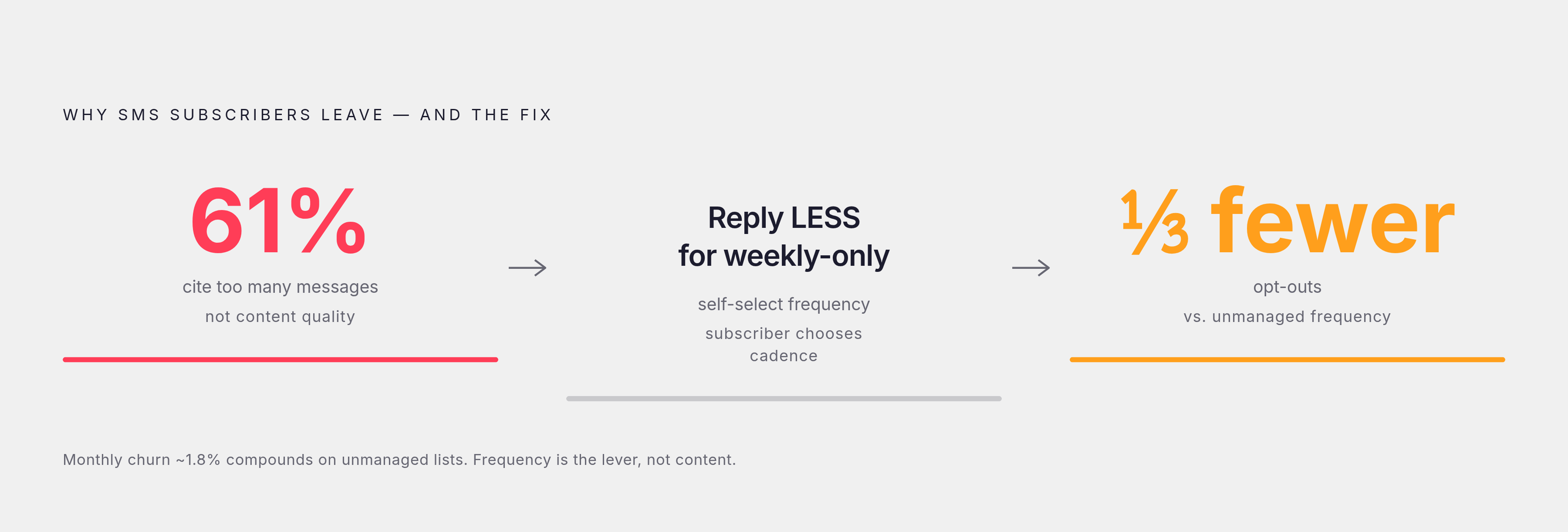
Building the list is half the job, and the other half is not losing it. Monthly churn on SMS lists runs around 1.8%, which sounds harmless until it compounds against a list nobody's actively managing; the list can shrink in real terms even while new signups keep trickling in the front door. And the top reason people give for leaving is frequency, not content: 61% cite too many messages as the reason they unsubscribed.
The preference data splits fairly cleanly. Around half of subscribers want messages roughly every other week, while another third or more are fine with weekly contact. Landing somewhere around two to four messages a month per segment sits comfortably inside both camps. One small design choice moves the needle here more than you'd expect: letting subscribers self-select frequency, something as simple as "Reply LESS for weekly-only offers," cuts opt-outs by a third. Tiny UI tweak, outsized payoff.
Segmentation does even heavier lifting than frequency control. One fast-casual chain sent a salad-focused promo only to guests tagged as salad buyers and saw conversion rates that were nearly triple what the same message achieved when sent to the full list. Not a rounding error. A segmented message reads as relevant; a blast reads as noise, and guests can tell the difference instantly even if they couldn't explain why if you asked them.
A handful of technical minimums hold the whole thing together: messages at or under 160 characters, opt-out language in every text, double opt-in enforced at signup. These aren't just compliance boxes to check; they're the actual foundation under 99% deliverability, and skipping them tends to catch up with a list eventually, usually right when you need it most.
Closing the loop between a subscriber and the visit they generate
A list that grows without attribution will hand you open rates and click rates and absolutely nothing about the question that actually matters: did any of it fill a table? Vanity metrics look great in a monthly deck and mean almost nothing at the P&L level.
Closing that gap takes three pieces working together. A trackable opt-in first, meaning the subscriber gets tagged with a campaign source through a UTM parameter or a specific keyword right at signup. Proof-of-visit verification second, where a POS-CRM integration ties that subscriber to an actual recorded transaction instead of an assumed one. And an attribution window third; most restaurants find that 21 days captures planned visits without overcounting activity that would've happened regardless. All that source-tagging work from earlier sections is what makes this framework possible at all, which is exactly why it has to happen at the point of capture and not months later when someone finally asks for a report.
Run the ROI math once that infrastructure exists and things get concrete fast: net profit divided by marketing cost. A campaign generating four times its cost in net profit is a 400% return, but that number only holds up if the source is tied directly to the transaction rather than inferred after the fact from a dashboard. Social platforms report their own engagement, SMS platforms report their own opens and clicks, and neither talks to the POS system unless somebody builds that bridge on purpose. The same closed-loop logic that makes a social opt-in traceable to a physical visit at the register is what makes SMS revenue something you can point to on a spreadsheet, instead of something you estimate and hope lands close.
A bigger list without attribution is just a bigger number that feels nice in a board meeting. The actual goal is a list where every campaign's contribution is visible enough to double down on what's working and cut what isn't. The list is infrastructure for that decision, and infrastructure only earns its keep when someone's watching what it produces.