Automating Restaurant SMS Campaigns Around Visit Triggers
Timing automated texts to what guests actually do beats sending them when marketing needs a push.
Restaurant sales hit record highs in 2025 while the number of actual visits kept shrinking, month after month. Casual dining held up better than most, but the pattern underneath it, more dollars chased by fewer people walking through the door, showed up almost everywhere. That squeeze matters here because it's the reason automated SMS, and specifically the moment it fires, has become one of the few marketing levers operators can pull without touching labor or the menu. This piece focuses on that lever: when the text gets sent and why, more than what the text actually says.
Labor costs are up. Food costs are up. Nobody's cutting the kitchen staff to fix a marketing problem, and nobody's slashing portion sizes to protect margin, so budget flexibility has migrated to the one line item that doesn't require a union conversation. Marketing spend is climbing on operators' priority lists even though most independents still put a fairly modest slice of gross revenue behind it. Which raises the obvious question: if you're going to spend more on marketing while traffic is soft, can you afford to spend it on the wrong message at the wrong moment to the wrong guest? You cannot. That's the tension this whole piece sits inside.
What makes SMS structurally different from other marketing channels for restaurants
Start with where the message lands. Email goes into a folder a person checks on their own schedule, sandwiched between a receipt from Amazon and a newsletter they'll never read. SMS lands in the same inbox as a text from their kid's teacher. That distinction shapes the whole way the channel behaves. Open rates in food service run dramatically higher for SMS than email, and when people respond, they respond within minutes, not across the span of a workday.
The two channels serve different jobs. Email builds a relationship over weeks and months: it tells a story, it sets up anticipation, it's where a restaurant explains why the new chef matters. SMS changes what someone does today, a narrower and more immediate function. And consumer willingness to buy after opting into SMS has kept growing year over year, meaning the channel's pull isn't leveling off the way a lot of digital tactics eventually do.
Here's the part that trips people up: running SMS and email together beats running either alone, but only if they're sequenced, not duplicated. Blast the same offer on both channels at the same hour and you've just built a more expensive way to annoy someone twice. Sequencing means email opens the door and SMS walks through it later, or the reverse, depending on the trigger.
And the automation piece is where the real gap shows up. Brands running automated SMS sequences see meaningfully higher click and conversion rates than brands sending manual one-off blasts. That gap comes down to discipline: the automated version fires because something happened, the manual version fires because someone remembered it was Tuesday and the restaurant hadn't sent anything in a while. One respects the guest's actual behavior. The other respects the marketing calendar. Guess which one converts better.
The four visit-based triggers that produce the highest returns
SevenRooms looked at loyalty program data across a lot of guest activity and landed on four triggers that consistently outperform everything else: first visit, visit milestone, days-since-last-visit, and birthday or anniversary. What ties them together is that each one fires because of something real that happened to a specific guest, not because a campaign needed to go out this week.
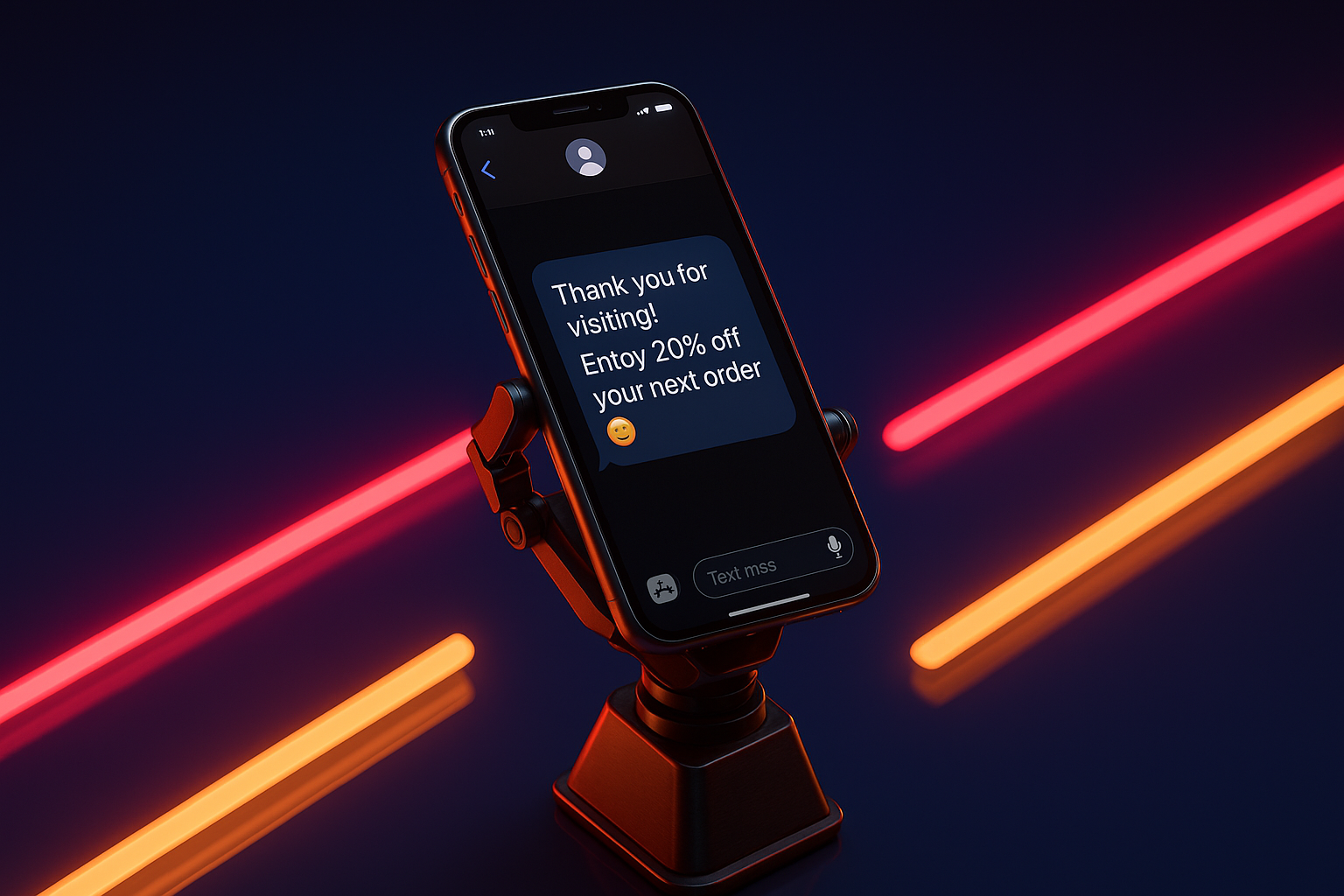
First-visit welcome. This fires the moment a new guest identity shows up at the POS for the first time. The entire goal is converting that trial visit into a second one, because the second visit is the single most predictive signal of whether someone becomes a repeat customer at all. Timing here is almost comically strict: a welcome text sent three weeks later reads as noise, an afterthought, digital junk mail with a first name plugged in. Sent within 24 hours, it reads as a restaurant that noticed you showed up.
Visit milestone. Fifth visit, tenth visit, some cumulative spend threshold, whatever the number, this trigger functions less as a reward mechanism and more as a signal that says "we've been paying attention," and it lands best when it feels personal rather than mechanical, like a form letter with a milestone number swapped in.
Days-since-last-visit, the win-back. This is the trigger everyone talks about and the one most operators get wrong, badly enough that it deserves its own section, which is coming up next.
Birthday and anniversary. The most obvious of the four, and somehow still underused. It works because it fires at a moment the guest is already thinking about where to celebrate; you're not interrupting their intent, you're meeting it halfway. The catch: you have to collect the date at opt-in. Skip that step during enrollment and this trigger simply doesn't exist for you, no matter how good your platform is.
Notice what's absent from that list. No "Taco Tuesday reminder." No "we're running a promotion this weekend." Those are calendar-driven messages, and calendar-driven messages are exactly the category this article is arguing against.
Why win-back timing is the most consequential design decision in the system
Most automated SMS systems that underperform aren't failing because of bad copy. They're failing because someone picked a single lapse window and applied it to every guest, as if a person who eats there twice a week and a person who visits once a month are running on the same clock. They are not.
A twice-weekly regular who hasn't shown up in fourteen days has gone quiet in a way that actually means something. A once-a-month guest at day fourteen hasn't done anything unusual at all; they're right on schedule. Apply one universal threshold across both and you get two distinct ways to fail. Fire too early for the infrequent guest and the restaurant looks needy, maybe a little confused about its own guest, texting "we miss you" to someone who was never gone. Fire too late for the frequent guest and by the time the message lands, that person has already found a new Tuesday-night spot. The offer isn't preventing churn at that point; it's chasing behavior that already happened, like calling a cab after the flight left.
The fix looks like a ladder, not a single trigger. Email goes first, low friction, low cost, appropriate for a gentle nudge. If that produces no response, SMS escalates, because the higher cost and higher urgency of a text should be reserved for guests actually worth the push. If SMS still gets nothing back, a final offer goes out, the last real investment before the operator accepts that this guest has churned. That escalation order matters for a reason worth sitting with for a second: SMS shouldn't be the opening move for someone who might have simply missed an email in a crowded inbox. Save the more intrusive channel for when the quieter one has already failed.
Skip the segmentation step, and the whole win-back sequence becomes effectively random. And random timing, whatever else you want to call it, produces random results. SevenRooms' guest data attributes a significant chunk of lost annual revenue, guests who visit once and simply never come back, largely to the absence of any follow-up at all, correctly timed or otherwise. The lesson isn't subtle: the win-back trigger is where the design work either pays off or quietly costs you money every single month.
What the POS connection actually enables — and what it requires
Every trigger above depends on the system knowing something a transaction actually recorded. That means POS data has to flow into the marketing platform in real time, or close enough to it that "real time" isn't doing a lot of rhetorical lifting. Without that pipe, there's no first-visit trigger, no milestone count, no win-back clock. There's just guessing dressed up as automation.
Platforms including Toast, Square, Klaviyo, and SMSBump now connect directly to POS data, which lets birthday flows, win-back sequences, and post-visit follow-ups fire off actual transactions rather than a marketing calendar someone built in a spreadsheet. What that means practically: an independent operator with zero in-house marketing staff can run sequences that, a decade ago, would have required an enterprise martech budget and a team to manage it.
The minimum data setup to make any of this work isn't complicated, but it is non-negotiable. You need a guest identity record, at minimum a phone number or email tied to a real person. You need transaction history, visit dates, what they spent, ideally what they ordered. And you need engagement data, whether that guest opened the last message you sent or ignored it completely. Live POS signals can push further than that, tagging a guest's favorite dish or their usual daypart, which is how a trigger stops feeling templated and starts feeling like the restaurant actually knows who you are.
The failure mode here has a very specific, very embarrassing symptom. Popmenu's 2025 benchmark data found the average independent restaurant has access to several thousand guest records through its existing systems but actively markets to only a small slice of them, because those records are locked in silos that don't talk to each other. POS over here, reservations over there, online ordering somewhere else, WiFi login data floating in its own little island. When those systems don't communicate, you get the classic disaster: a "We miss you!" text landing in someone's phone moments after they've paid the check and walked out the door. Nothing says "we've been thinking about you" quite like being wrong about whether you left.
The trigger is only as good as the data defining it. POS integration isn't a nice feature to add later; it's the floor everything else stands on.
How AI-powered tools are changing what trigger-based campaigns can do
Layer on top of a well-built trigger, and there's another gear available: machine learning that studies when a specific subscriber tends to open messages, then sends within that person's most receptive window, not just whenever the trigger condition happens to be met. The trigger says "this guest is now eligible." The model decides the best minute inside that eligibility to actually pull the trigger.
Paytronix's Journey Builder, which launched in late 2025, is a good example of what this looks like in practice. It moves past batch campaigns, the kind where every eligible guest gets the identical message at the identical hour, toward one-to-one personalization at scale. Per Paytronix's own platform data, that shift increases campaign effectiveness by a wide margin over batch sends, and loyalty programs tied into online ordering see a meaningful bump in order frequency, tightening the loop between a digital nudge and an actual walk-in.
What changes with AI in the mix is subtle but real: a static trigger fires the instant a condition is met, full stop. An AI-augmented trigger takes that same condition and then adjusts the send time and even the message variant based on predicted receptivity. The trigger remains the strategic core of the whole system, while AI optimizes the execution wrapped around it.
Worth saying plainly: none of this fixes bad data. A model built on top of a fragmented POS feed just produces a more confident-sounding version of the same wrong answer. Garbage in, garbage out, dressed up in a nicer interface. For an independent operator without an enterprise budget, the useful question isn't whether to chase AI as a feature. It's whether the platform on the table has actually started building it in, because the performance gap between AI-optimized sequences and manually managed ones is widening, not holding steady.
Connecting the triggered message back to an in-store visit — the attribution problem
Here's an uncomfortable question: how would an operator actually know that a text drove a visit, rather than the guest just happening to come in anyway that week? For most restaurants, the honest answer is they can't. The SMS platform reports opens and clicks. The POS reports revenue. Nothing in between connects the two, which means the ROI on the whole campaign is essentially invisible, and reinvesting or cutting the program becomes a guess dressed up as a decision.
Counting every returning guest as a campaign win overstates things, sometimes by a lot, because plenty of those guests would have shown up regardless of whether a text ever landed on their phone. Real measurement needs a control group: guests eligible for a trigger who didn't get it, used as a baseline so the campaign's actual incremental effect can be isolated from the guests who were coming back anyway. That's not an easy build for a solo operator to run on a spreadsheet, but it's the only honest way to separate correlation from cause.
What good infrastructure looks like here: POS integrations that tie a marketing touchpoint to a specific guest check, and customer data platforms that unify online and offline activity, so when someone redeems a triggered offer, that redemption traces back to the exact message that produced it. That's a very different posture from a broadcast blast with no memory of itself.
A large share of restaurant marketing budgets get allocated on guesswork rather than data, and operators running triggered SMS without any attribution layer are still flying partially blind, even if their system is far more sophisticated than a mass text to the whole list. Restaurants with real attribution in place are pulling retention returns that outpace fragmented setups by a wide margin. The measurement gap isn't a footnote here; it's a competitive one.
Guardrails that keep the system from degrading into noise
The exact properties that make SMS so effective, the personal inbox, the high open rate, the fast response, are the same properties that make it the first thing a guest opts out of the moment it starts to feel intrusive. Power and fragility, same coin.
Frequency capping is where this gets enforced. The general industry guideline: no guest should get more than two SMS messages a week, no matter how many separate trigger conditions they happen to satisfy at once. And they will collide. A guest's birthday can fall in the same week as their win-back window, and when that happens the system needs a priority hierarchy sorting out which message wins, not a queue that just fires both and hopes for the best.
List quality matters more than list size, and this one's worth sitting with because it cuts against instinct. A smaller list of people who genuinely want the texts will outperform a bloated list full of people who vaguely remember checking a box eight months ago. Where consent gets captured matters too: opt-ins collected at the point of an actual transaction, at the POS, over WiFi, through online ordering, produce far better subscribers than a passive form buried on a website somewhere.
Testing needs to be an ongoing habit, not a launch-day checkbox you tick once and forget. Trigger thresholds deserve a look every quarter, because a win-back window that was correctly calibrated six months ago drifts as the guest database grows and visit patterns shift. Message variants should be tested against a genuine holdout group, not just pitted against each other in isolation.
The bigger point underneath all of this: the goal is a system that runs quietly in the background, doing its job because the triggers, the data pipeline, and the frequency caps were all built correctly the first time, rather than one that demands constant creative attention and fresh copy every week. Restaurants running email and SMS automation together, with this level of discipline behind it, see meaningful lifts in monthly covers, and that lift compounds. The guest database grows, the triggers sharpen, and the whole system gets a little smarter every month without anyone having to sit down and write a new campaign from scratch.