Segmenting Restaurant SMS Lists for Personalized Offers
Divide your text list by customer behavior to send offers that actually drive repeat visits.
Text messaging works for restaurants when the segment does the heavy lifting. I've watched this play out enough times, and watched enough operators ignore it and pay for that decision, that it's worth writing down properly. Some of what follows I learned the expensive way, staring at a POS report that told me exactly how badly I'd misjudged a group of guests.
Quick disclosure: I've built these lists by hand, sent the wrong offer to the wrong segment more than once, and pieced together most of this from cleanup work afterward. A collection of mistakes with numbers attached to them.
Start with the stat everyone quotes: SMS open rates sit near 98%. Sounds incredible until you sit with what it actually means, which is that there's no spam folder left to blame. Email gives you a mulligan; send a bad one and half your list never sees it, so you get to pretend the offer was fine and deliverability was the problem. Text doesn't offer that exit. Everybody sees it, and if it's junk, they see that too, right before they text back STOP.
Segmented sends convert better, and the reason the gap keeps widening comes down to how people now behave on this channel. More purchases complete directly off a text prompt than did two years ago, which means the audience shows up ready to act. Whether what you sent them was worth acting on is a separate question entirely, and usually the one nobody bothers to ask before hitting send.
One blast to the whole list is junk mail with a great delivery rate. Frequency matters almost as much as targeting; even a trusted channel burns goodwill fast when it overstays its welcome, so keeping send volume in check is essential to holding opt-out rates down. This whole conversation is moot if you're not collecting real opt-ins and following TCPA and GDPR rules, since that's the floor you need to clear before worrying about anything else in this piece.
The behavioral framework restaurants should use to build their segments
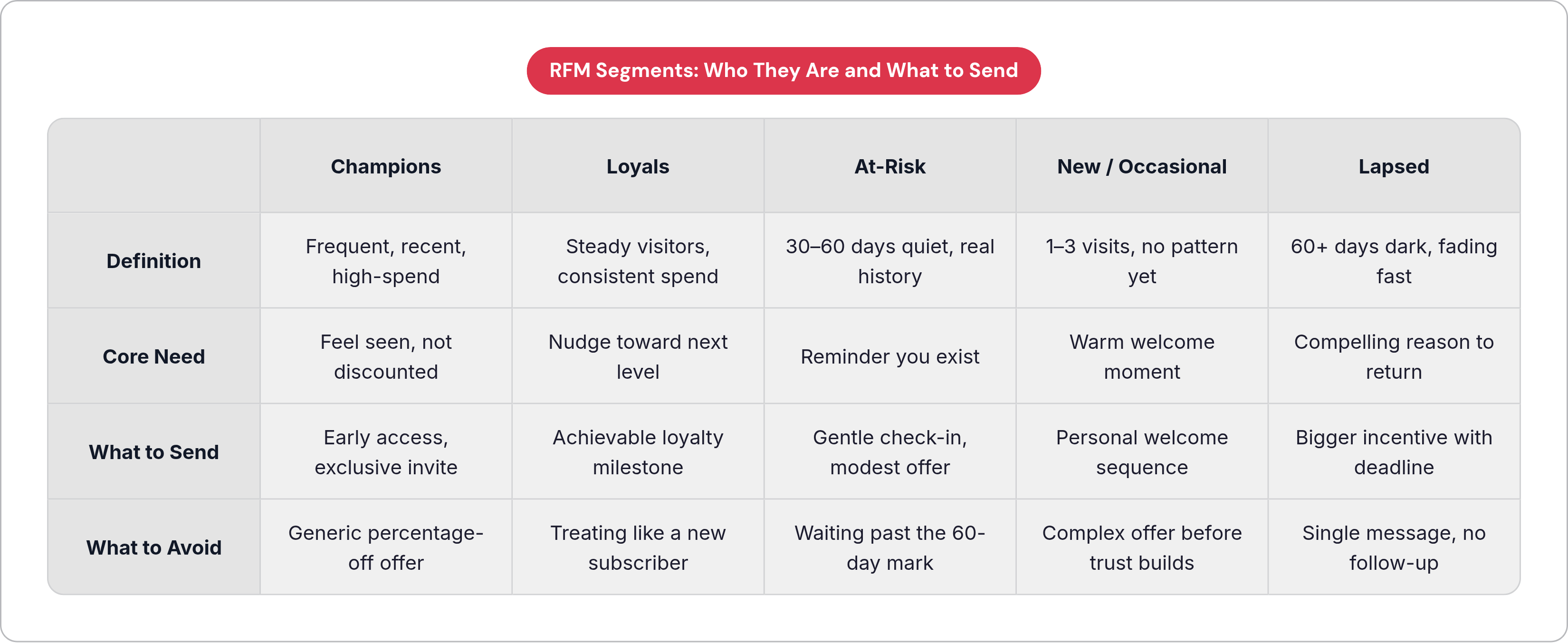
RFM stands for recency, frequency, monetary value, which boils down to three questions: when did they last walk in, how often do they walk in, and what do they spend when they show up? Most POS systems already sit on this data, waiting for someone to finally ask it a question.
Restaurants have it easier than most retail categories here. A table visit is a timestamped, dollar-denominated event; nobody's guessing whether a guest "engaged" with the brand the way a retailer has to infer intent from an opened email. The guest sat down, ordered, paid, left, and the system logged all of it.
Run RFM against a guest list and five groups tend to fall out. Champions show up often and recently; they don't need a discount, they need to feel seen. Loyals visit at a steady clip and respond to a nudge that makes leveling up feel achievable. At-risk guests have real history but have gone quiet for 30 to 60 days, and I'd argue this is the highest-return group on the whole list, because they already like you and just need a reminder you exist. New and occasional guests, one to three visits deep, want a "glad you're here" moment more than an offer. Lapsed guests, 60-plus days dark, are the hardest pull but worth a real sequence instead of a shrug and a coupon.
Here's a number worth sitting with: something close to 20% of customers generate around 80% of revenue in the restaurant category. Send your Champions the same offer as a brand-new subscriber and you've wasted the best relationship on your list on a message built for strangers.
No loyalty program or CRM yet? Don't wait for one to materialize, since POS exports and phone numbers collected at reservation or checkout get you moving. Messy, but enough to start.
I think about a seafood counter I worked with a few years back. They built same-day segments off recency, purchase count, and proximity, then texted offers tied to whatever came in fresh that morning. Nothing fancy: "halibut came in, you're five minutes away, fifteen percent off before 3pm." Fewer customers went three-plus months between visits after that. Catching someone before they drift is cheaper than manufacturing demand out of thin air, and that's really the whole game.
Layer in daypart habits and known preferences, vegan, gluten-free, the family of six that books every third Sunday like clockwork, and the targeting sharpens without changing the underlying logic. Same RFM skeleton, sharper trigger. One warning, and it's a real one: push personalization too far and "relevant" tips into "how does this brand know that," which is a genuinely uncomfortable feeling for a guest to have.
What to send VIP and high-frequency guests — and what not to
Champions don't need a coupon, since they're already coming. Send one anyway and you've taught your best customer to wait for a discount before their next visit, which is a strange thing to train into the exact people who never needed the training.
So what do you send instead? Early access works: a reservation window before the fall menu opens to everyone else, an invite to a chef's table, a seat before the general public even knows there's a seat worth fighting over. Plain acknowledgment works too, more than you'd expect from something this simple. "You're one of our most loyal guests" does something a 15%-off headline never manages, because it's relational instead of transactional. Milestone messages, tied to visit count or an anniversary, round it out.
Tone matters as much as the offer, maybe more, and it pays to keep things warm, short, personal. "We're previewing the fall menu Thursday, want a seat before we open it up?" beats any percentage-off subject line because it treats the guest like someone on the inside, not a name on a list. A complimentary dessert firing automatically off a birthday in the reservation system runs on the same logic: you're rewarding a relationship, not marking down a transaction.
Measuring this part is refreshingly uncomplicated. VIPs are usually already in a loyalty program or have reservation history on file, so the POS confirms whether the text preceded a visit without any special tracking setup, with no promo code and no guesswork required.
Why build a whole section around this? Keeping a high-frequency guest costs a fraction of what pulling in a new one does, and mishandling a VIP relationship doesn't just cost you one guest. It costs you revenue way out of proportion to how small that group looks on paper. Get careless here and the damage compounds fast; losing your best customer is a different, pricier problem than losing an average one, and it deserves to be treated that way.
Re-engaging lapsed guests before they're gone for good
Doing nothing here costs more than most operators want to admit. A restaurant losing guests at a steep annual churn rate can be looking at several hundred thousand dollars a year in lost opportunity once you benchmark against lifetime guest value. A number worth putting in front of whoever signs off on the marketing budget.
Timing matters more than almost anything else in this segment. The 30-to-60-day quiet window is the sweet spot for a win-back message. Wait past that and recovery gets a lot harder, requiring a bigger, pricier offer just to get someone's attention again. So the segment needs two tiers, not one blended list.
At-risk guests, 30 to 60 days quiet, get a lighter touch: a genuine check-in and a modest incentive. "Haven't seen you in a while, here's something for your next visit" does the job without sounding like begging. Lapsed guests, past 60 days, need something sharper: a bigger incentive with a real deadline, one that creates urgency without tipping into desperation.
One text rarely closes the deal either way. Plan a short sequence, two or three messages spread over two to three weeks, before retiring the contact from active campaigns. Then measure what actually matters: did a redemption happen, a code get scanned, a reservation get booked within 72 hours of the send? Whether someone opened the message tells you almost nothing, while whether they walked in tells you everything.
This is where the return gets hard to argue with. Retention programs running a couple hundred dollars a month per location can return many multiples of that spend, but only when win-back sends are actually tracked instead of assumed to be quietly working somewhere in the background. Restaurants running connected data and automation see dramatically higher returns on retention spend than those without one. The restaurants skipping structured systems are still losing that same steep churn rate every year, and they just don't know how many of those guests were sitting right there, recoverable, waiting on a text that never got sent.
Converting new subscribers into repeat guests in the first 30 days
New subscribers are a strange group because there's no RFM signal yet, and no history means nothing to score. Sounds like a disadvantage until you flip it: you get to shape the entire first impression on your own terms, before the guest has formed any opinion about what these texts are going to be like.
The fix is a short onboarding sequence built to earn a second visit before the first one fades from memory. Message one, same day or within 24 hours of opt-in: a welcome, confirmation of what they signed up for, a soft offer that feels personal rather than automated. Message two, around day 7 to 10: point at one specific reason to come back, a dish, an event, a daypart they haven't tried. Message three, day 20 to 25: a real incentive with a real expiration date, built to drive that second visit before the 30-day window shuts.
Why fixate on the second visit specifically? A guest who comes back twice is far more likely to turn into a regular than someone who visited once and vanished. Onboarding exists to get someone through the door again, a different job entirely from thanking them for showing up the first time, and it calls for a different kind of message.
There's room for personal touches even without visit history to lean on. How someone opted in tells you something: a guest who signed up at the table is a different starting point than someone who clicked a link off a local food creator's Instagram story, and the welcome text can reflect that. Track one number above everything else in this segment: the share of new subscribers logging a second POS visit within 30 days. That rate tells you whether the sequence is doing its job or just filling phones with messages nobody reads twice.
Daypart and occasion segments — using behavioral timing as the targeting layer
A guest who eats lunch at your place every Tuesday isn't the same customer as someone who only shows up for Friday dinner, even if their RFM numbers look identical on paper. Their behavior differs, and treating them the same wastes timing data that's already sitting in your reservation system doing nothing.
Lunch regulars, office workers and nearby residents on a predictable weekday pattern, respond to speed, value, and a "see you tomorrow" tone. Weekend brunch guests tend to be occasion-driven and traveling in groups, so reservation prompts and seasonal specials land better than a flat percentage off. The late-night and bar crowd wants event-based texts: drink specials, live music, something that gives an ordinary Tuesday a reason to matter.
Occasion overlays run on their own clock entirely. Birthdays, anniversaries, holiday booking windows fire off time, not behavior, but pull from the same POS and reservation data already powering everything else, with nothing new to bolt on.
Think about what a mismatch costs. Send a "midday special" text to someone who's only ever come for dinner and it reads as noise from a brand that clearly doesn't know them. Send that exact same text to a known lunch regular and it becomes a reason to walk in today. Same words, wildly different result, entirely because of who was on the other end of it.
Most SMS platforms that plug into a POS or reservation system surface daypart patterns automatically, so manual tagging usually isn't necessary once the pipeline exists. What to measure: does a daypart-targeted text produce an actual transaction in that window, same day or the day after? That's the signal telling you the segment is pulling real behavior instead of sitting untouched in someone's phone.
Closing the loop between the message sent and the table filled
Here's the gap that turns most SMS programs into expensive guesswork: the texting platform reports opens and clicks, the POS reports revenue, and almost nothing connects the two. Plenty of restaurants can tell you a campaign got opened, but fewer can tell you whether it filled a single table.
Closing that gap doesn't take anything exotic. Unique promo codes per segment do a lot of the work: a code that only shows up in the lapsed-guest text tells you, cleanly, which visits that campaign drove the moment it gets scanned at checkout. Reservation-trigger tracking works even without a code, if the text links to a booking page; the timestamp and party size become the conversion event on their own. For segments without a code or link, watching POS activity in the 24 to 72 hours after a send gets you directional insight even when it isn't perfectly clean. UTM tags on any link show which segment drove web traffic or an online order, and that matters more every year as ordering keeps moving off-premise.
The real discipline is measuring each segment on its own instead of averaging results across the whole list. Averaging hides exactly which segments carry the program and which ones quietly waste sends month after month, and you'll never know which is which if everything blends into one number.
Segmented lists outperform one-size-fits-all blasts by a wide margin, and automated behavioral sequences outperform generic sends by several multiples on top of that. Neither figure means much sitting alone on a slide. They start to matter once you know where your own restaurant's per-segment numbers land, which is really the whole point of building the tracking in the first place.
The formula underneath all of it stays simple: attributed revenue minus program cost, divided by program cost, run separately for each segment instead of blended into one campaign-wide average. Restaurants running structured systems instead of ad-hoc blasts tend to see a real lift in marketing ROI, somewhere in the neighborhood of a third better, and that lift traces directly back to the kind of segment-level tracking this piece has been walking through.
A restaurant that knows exactly what its lapsed-guest win-back generates per send, and knows what its VIP sequence generates separately, is running an actual system. Everybody else is just hoping that 98% open rate does the work segmentation was supposed to do all along.