SMS vs Email Marketing Performance for Restaurants
SMS reaches faster but email builds loyalty; running both together fills more seats.
This piece is about restaurant marketing, but the real fight isn't SMS versus email. It's about whether either channel can actually prove it put a body in a seat, because the numbers everyone quotes to settle the debate were never built to answer that question in the first place.
What the raw channel numbers actually show
Let's give SMS its due, because on paper the numbers are hard to argue with. MailerLite's 2025 data puts SMS open rates around 98%, against an email average of 43.46% across all categories. Commercial and promotional email does worse: retail sits at 37.47%, e-commerce at 32.67%. SMS gets read fast too, typically within 90 seconds, while email can sit unopened for four hours or more. Click-through on a text with a link runs 19 to 36%. Response rate for email averages 6%; for SMS it's 45%.
If you stopped reading right there, you'd think the debate was over. The reason it isn't comes down to list size.
Restaurants collect five to ten times more email addresses than phone numbers from the same number of guests walking through the door. A busy 200-cover dinner shift might net five or ten new emails; phone numbers trickle in slower still. So while restaurant-specific email benchmarks look modest on the surface (25% open rates, 3% click rates), the revenue per dollar spent comes in around $42, which is close to or above what SMS delivers in reported ROI ranges of $21 to $71 per dollar. That spread measures how well different restaurants happen to run their programs, more than it measures the channel itself.
These figures, on either side, tell you whether someone looked at a screen. They don't tell you whether the message filled a table. Those are separate events, and the gap between them is where most SMS-versus-email arguments quietly fall apart.
How restaurants actually use SMS (and where it earns its place)
SMS works best as a clock. Its best restaurant uses are all time-bound: a flash promotion to move excess inventory on a dead Tuesday, a same-day reservation reminder that cuts down no-shows, an event announcement with a hard deadline that's a week out at most. The 90-second read window is the entire value proposition. A message that doesn't need to be read in the next hour is a poor fit for SMS.
The channel has grown up fast. Restaurant use of SMS marketing software rose from 55% in 2022 to 80% in 2024, and roughly 84% of consumers have opted in to receive texts from at least one business. That kind of reach changes what guests expect: novelty wears off, patience for spam does not improve.
Frequency discipline matters more here than almost anywhere else in restaurant marketing. Most SMS programs top out at one message a week before guests start opting out, and under the FCC's April 2025 rule, that opt-out is permanent and enforced at the platform level. There's no unsubscribe-and-win-back play like there is in email. Consumers can revoke consent in any reasonable way they choose, and businesses have ten business days to honor it. Send too often, and the cost isn't a lost subscriber but a lost number, permanently.
And the list itself stays small by nature. Fewer guests hand over a phone number than an email address, so even a high engagement rate is working off a smaller base. A 45% response rate on a list of 300 numbers isn't automatically worth more than a 6% response rate on a much larger email list. Do the math before you get excited about the percentage.
Where email holds its ground despite lower open rates
Email's whole advantage is that it can afford to be slow. It's the format for menu photography, for the story behind a new dish, for the kind of content that builds a reason to come back next month rather than tonight. An occasion-planning decision rarely comes from a text message; email tends to carry that weight instead, and does it well.
The real return shows up in behavioral automation, not blasts. A message triggered by something specific (time since the guest's last visit, an anniversary, their usual order) outperforms a generic newsletter by more than 7x. This is where loyalty actually lives: the "we miss you" note, the birthday offer, the follow-up after a first visit. It's not glamorous, but it's the difference between shouting into a list and having a conversation with a person who ordered the branzino twice last spring.
Here's where it gets interesting, and where a lot of operators talk themselves into cutting the channel for the wrong reason. One French fine-dining group switched its attribution model from last-click to linear, crediting every touchpoint in a guest's path instead of just the final one, and found email was quietly driving close to 30% of reservations as an assist. Under last-touch measurement, that contribution was invisible. The email that warmed the guest up got zero credit; whatever channel closed the reservation got all of it. Judging email purely on open rate risks crediting the closer while overlooking the setup man who made the close possible.
There's a deliverability wrinkle worth naming plainly: about 58% of emails land in Gmail's primary inbox, and 38% get filtered straight to promotions. That 43.46% open-rate average is already discounting reach that never happened. Still, the list itself compounds. Somewhere between 15 and 25% of guests will give you an email if you simply ask, and that pool, unglamorous as it looks in month one, tends to become the restaurant's most valuable owned asset by the twelve-to-eighteen-month mark. Opt-outs are rare compared to texting; the list just sits there, aging like a good stock reduction, getting more useful the longer you tend it.
What happens when restaurants run both channels together
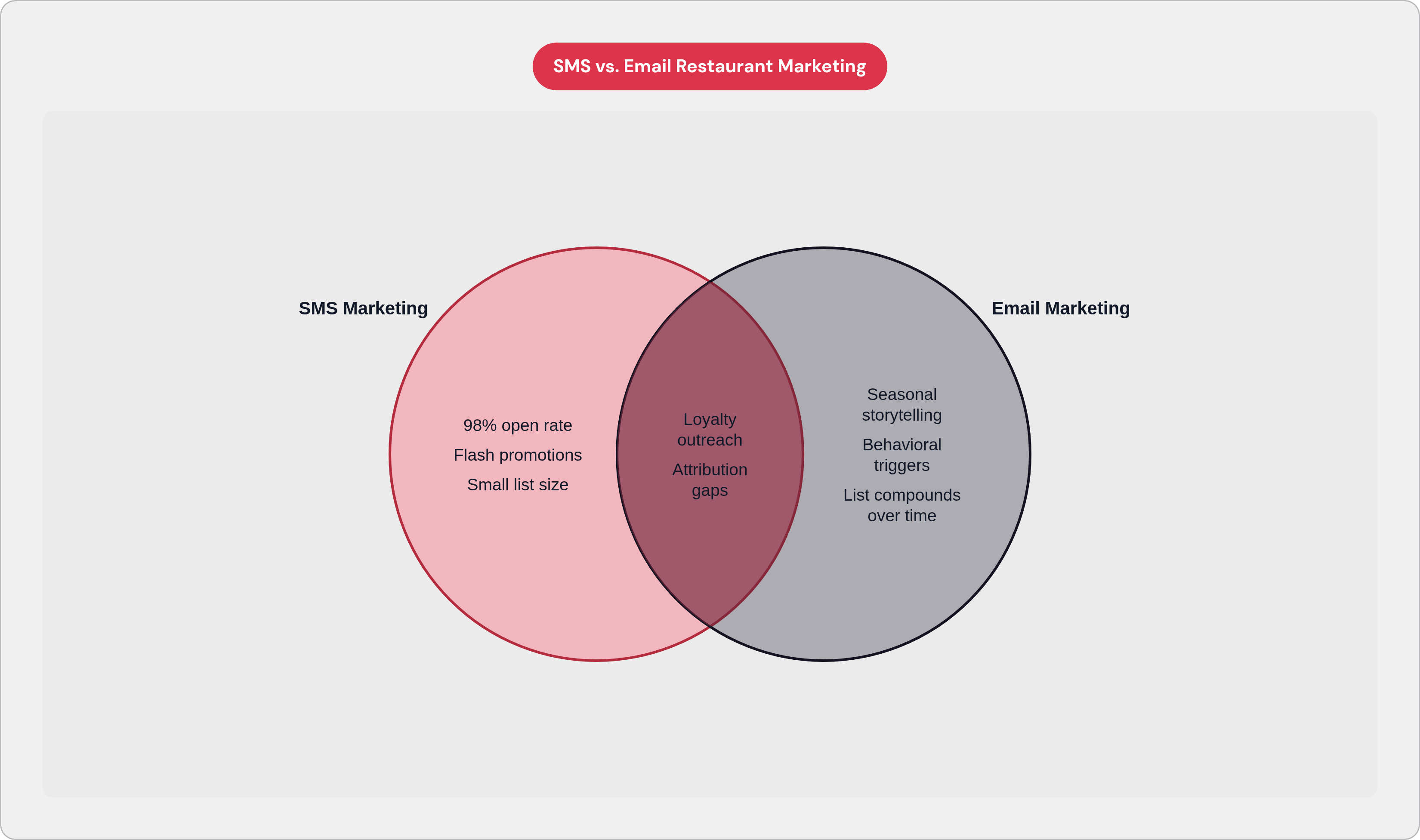
Running both channels closes gaps that either one leaves open by itself, because email and SMS occupy different moments in a guest's relationship with a restaurant.
Hospitality Technology's 2025 multi-channel study found restaurants running email and SMS automation together generate 2.3 times more revenue per campaign than restaurants using just one. The National Restaurant Association's 2025 State of the Industry Report backs that up from another angle: restaurants with automated email and SMS campaigns fill 15% more covers per week than those still doing outreach by hand.
Here's the part that should actually change how an operator thinks about this: fewer than 30% of independent and multi-unit restaurants with two to ten locations have any marketing automation running at all, according to Toast's Restaurant Technology Report. Most of the field hasn't shown up to this fight yet. The advantage of running even a basic, unglamorous program is sitting there unclaimed for most independents, which is a strange thing to say about a tactic this well documented.
The clean division looks like this: email for relationship-building, behavioral triggers, seasonal storytelling, loyalty win-backs. SMS for anything with a countdown clock attached, reservation logistics, flash offers, same-day nudges. The mistake to avoid is running each channel like the other one: sending SMS for content that had no urgency to begin with, or leaning on email for an offer that expires before most people even open their inbox.
Why neither channel can answer the question that actually matters without attribution
Open rates and clicks describe what happened to a message. They say nothing about whether a guest walked through the door afterward, and that's the entire crux of this piece. This blind spot isn't unique to SMS or email either; it's the same gap that haunts paid social, influencer posts, and pretty much every other digital channel restaurants throw money at.
Forrester's 2024 Wave report found that 35% of organizations still lean on last-touch attribution as their primary model, a method that hands full credit to whatever touchpoint happened last and erases everything that led up to it. For a restaurant, that often means the reservation platform or the loyalty app gets the glory while the text that actually nudged the guest to book in the first place disappears from the record entirely.
Olo's 2024 data adds weight to why this matters so much: roughly 60% of restaurant revenue comes from just 20% of guests. When attribution is this blurry, the decision about how much to spend chasing new guests versus keeping the ones you already have is being made without seeing the one number that should be driving it.
What operators actually need is a closed loop: a message goes out, a visit gets recorded at the POS, and the two get connected to each other, rather than to a click on a landing page. That's the standard that makes an SMS-versus-email comparison mean anything at all, weighing which channel drove a cover, and what it cost to get there, above which channel got opened more.
How to actually measure which channel is driving visits for your restaurant
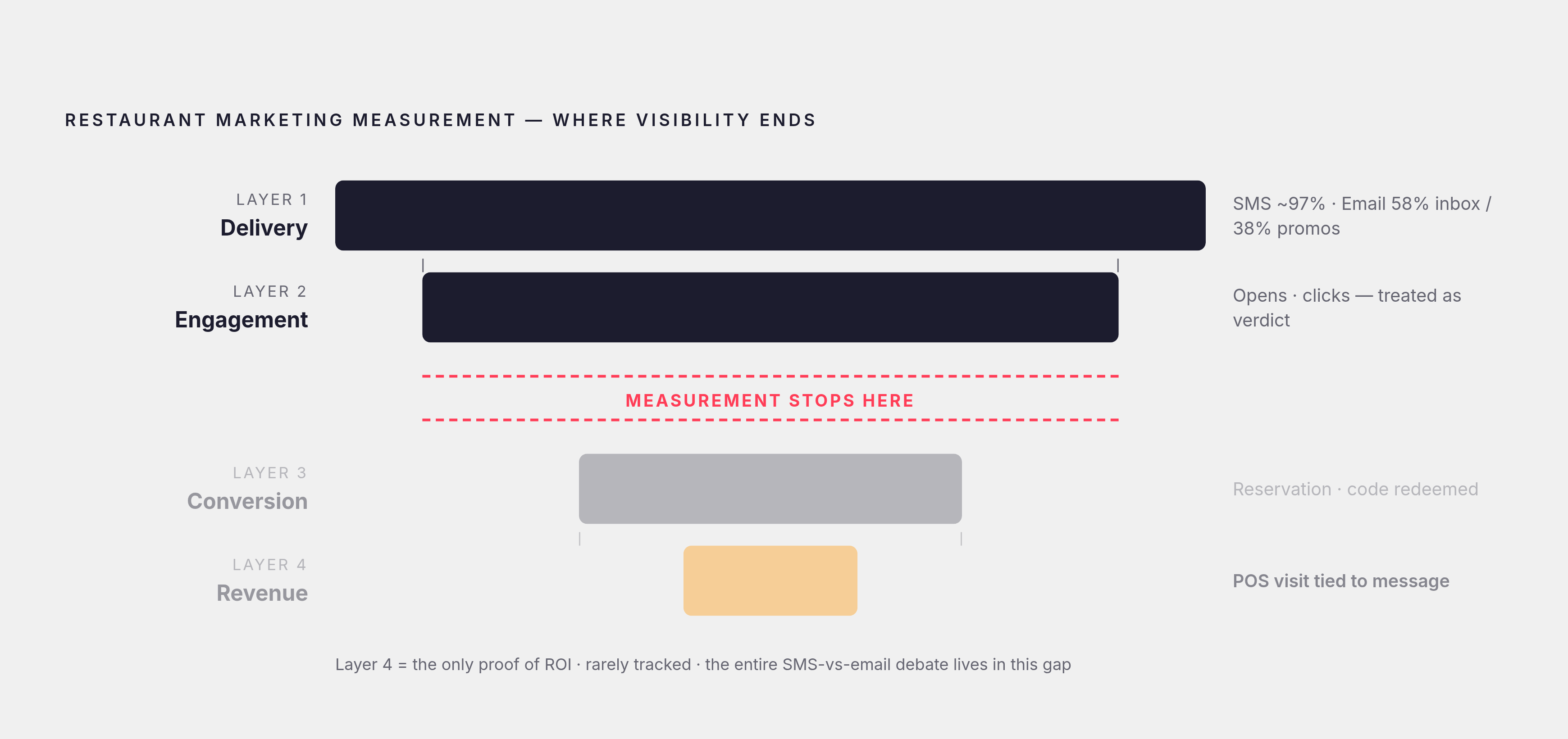
Think of it as a four-layer funnel, and most restaurants are only measuring the top two layers. Delivery: did the message arrive? SMS deliverability sits around 97%; for email, check the split between inbox and promotions tab, because that split is doing more damage to your open rate than you think. Engagement: did anyone open it or act on it? Useful as a diagnostic, though far short of a verdict. Conversion: did the guest make a reservation, redeem something, take an action you can actually track? Revenue: did a visit happen, and can you tie it back to the exact message that caused it?
That last layer is where almost every restaurant's measurement stops working, and it's also where independent operators can do more than they'd expect without enterprise software. Unique redemption codes (a different code for the SMS send than the email send), tracked at the POS, will tell you plenty on their own. Offer-specific landing pages with UTM parameters feeding into a simple CRM do the same job digitally. Even something as basic as comparing covers on the night after a send against a comparable night with no send, controlling for day of week and season, gives you a real signal instead of a guess.
Then feed what you learn back into the next decision. Which type of message (the flash offer, the loyalty trigger, the event announcement) drives a visit this week versus a booking three weeks out? Do certain guest segments respond to SMS urgency while others need the slower pitch of an email story? The answer probably splits by occasion type and by how long someone's been a regular, and you won't know until you look.
The honest caveat: most restaurant POS systems don't talk to marketing platforms out of the box. Closing that loop takes either a third-party integration or a platform built specifically to bridge it, and pretending otherwise just sets operators up to keep guessing with better-looking dashboards. It's also worth noting that the 7x outperformance of behavioral email over generic blasts carries a measurement lesson alongside the marketing one: a trigger tied to a specific guest action creates a testable cause and effect that a calendar blast never will.
Channel choice as a decision, not a debate
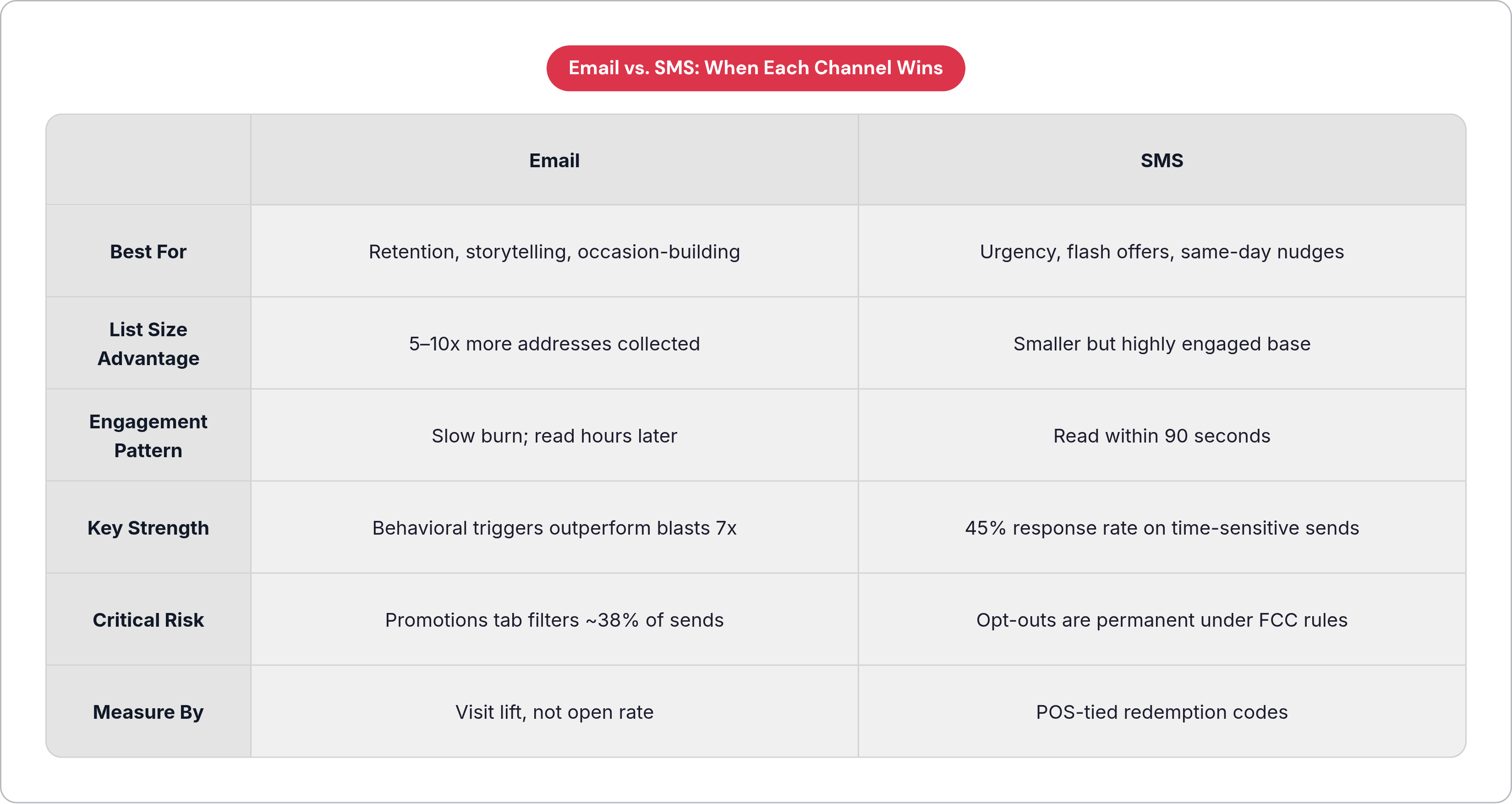
"SMS or email" was never a fair question, because it assumes a universal winner exists. The real question is which channel fits the moment you're trying to create, and whether you can actually measure what it did once it left your hands.
A rough framework, and it really is rough, holds up reasonably well in practice. If the goal is urgency and the list is small but loyal, SMS wins, with strict frequency limits and a redemption mechanism tied to the POS so you're not just hoping it worked. If the goal is retention or building toward an occasion, behavioral email automation wins, measured by visit lift and not by open rate. And if there's neither a real list nor any measurement in place yet, start with email, since it's structurally easier to build, get one behavioral trigger running well, and add SMS after that foundation exists.
The 2.3x revenue lift from running both channels together is real, but it comes with a condition attached: it only holds if an operator can tell what each channel actually contributed. Otherwise, two channels are running as two unmeasured guesses side by side, dressed up as a strategy.
The number that should sit above every other metric on a restaurant marketing dashboard is cost per attributed in-store visit, full stop, ranked well above cost per click or cost per open. Get that number right, and the SMS-versus-email debate mostly resolves itself: whichever channel fills more seats for less money wins, and that answer looks completely different for a forty-seat neighborhood spot sending one text a week than it does for a multi-location group with a loyalty list built out over years.
Knowing which channel drove which visit belongs at the center of the budget meeting, not on the sidelines as a nice add-on. Without it, every dollar spent on either channel is a well-dressed guess, and the restaurant industry has never had a shortage of those.