Promotional Offer Design for Restaurant SMS Campaigns
Four design decisions shape SMS offer success before any copywriting happens.
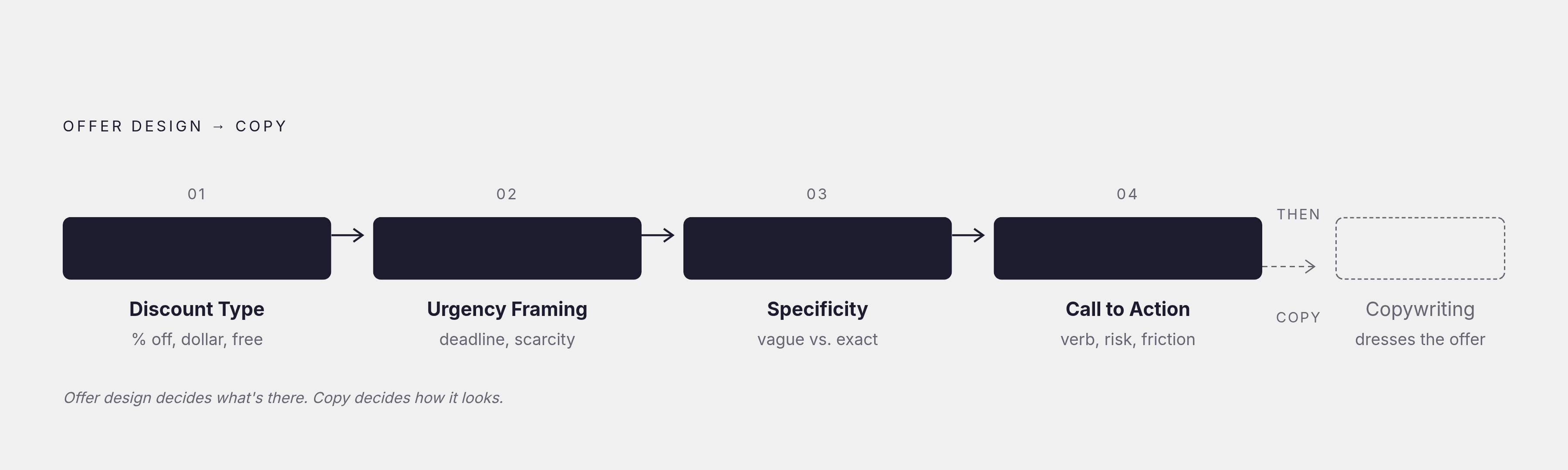
Offer design is the set of decisions that set the economic and behavioral terms of a promotion before anyone writes a single word of copy. Four decisions carry the weight: discount type, urgency framing, specificity, and the call to action. Copywriting shows up after that, and it can only do so much. It dresses the offer in nice sentences, but offer design decides whether there's anything under the outfit worth dressing.
I've watched restaurant owners burn an entire afternoon on whether "Don't miss out!" beats "Last chance!" Neither wins. A plainly worded message built on a strong offer beats a beautifully worded message built on a weak one, and it isn't close. Birthday SMS promotions with specific, personalized details generate 72% higher redemption than generic blasts, according to the data most SMS platforms track internally, and that lift traces back to targeting, full stop.
Most restaurants get this backwards. They'll A/B test message length, argue about Tuesday at 4pm versus Wednesday at 11am, obsess over emoji placement, all while holding the actual offer constant the entire time. Offer design is the contract you're drafting with the guest before a single word gets typed: what you're giving them, under what conditions, and what you want back in return. Mess up the contract and no amount of pleasant language rescues it. Copy can polish a good deal; resurrecting a bad one is beyond its reach.
How discount type shapes guest behavior before they even read the fine print
Four formats dominate restaurant SMS, and each nudges behavior in a different direction before the guest consciously registers why. There isn't a "best default" among them, no matter how many times an operator asks me to just name one. The right call keeps shifting depending on margin and occasion, and that instability is honestly more useful to understand than any single winner would be.
Percentage-off deals feel abstract at low numbers. Ten percent off a $14 entrée saves a dollar forty, which is a real discount that reads, psychologically, as basically nothing at all. Percentages start to feel real around 25% and up, especially tied to something concrete like half off a specific dish. The format scales with check size, which helps for big-spend occasions, but it can quietly discourage the smaller, casual visit that might be the exact behavior you're trying to drive.
Dollar-off offers skip the math problem entirely. "$5 off any order over $25" requires zero mental arithmetic; the guest sees a number and knows precisely what they're getting. The minimum-spend threshold does something sneaky too: guests routinely order a little more just to clear the bar, which quietly lifts average check size. It's a discount and an upsell mechanism sharing the same body.
Free items might be the most underrated lever in the whole drawer. A complimentary appetizer carries a menu price well above what it actually costs the kitchen to plate, so the guest perceives far more value than the restaurant gives up. It also drives trial. A guest who's walked past the truffle fries for two years finally orders them because they're free, and now there's a real shot that becomes a standing order. No math, no friction, and a genuinely good memory attached to the visit.
BOGO and bundle offers solve a different problem: whether to bring someone along. They answer the "should I ask a friend to come" question by making the answer financially obvious. Lean on them too often, though, and the brand starts to smell like a discount outlet instead of a restaurant, so save them for slow-period recovery or loyalty moments rather than the default Tuesday blast.
Match the format to the invitation you're actually extending, and most of this sorts itself out. A free dessert says stay a while. Five dollars off lunch says come back on a random Tuesday, no occasion required.
Why urgency framing is the mechanism that converts intent into a visit
Somewhere between "I should use that" and never opening the text again sits the point where most SMS campaigns die quietly. Urgency framing prevents that outcome by attaching a real deadline to a real reason, instead of letting the offer drift indefinitely in the guest's mental someday-pile.
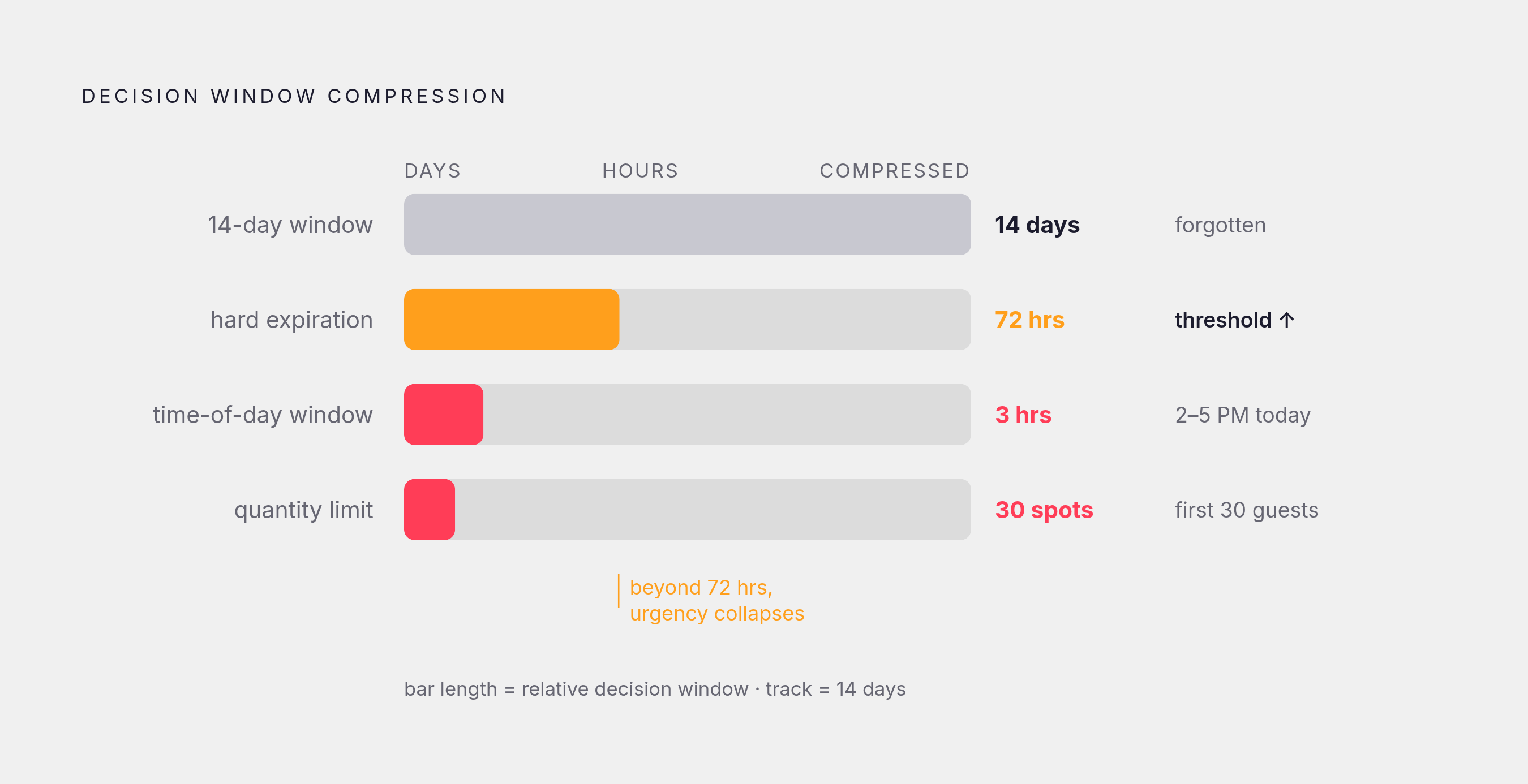
Three mechanisms handle this, and they don't behave the same way. A hard expiration date, "valid through Sunday only," is the most familiar. It works when the window feels genuinely short, somewhere around 72 hours or less. Give someone two weeks and you've basically handed them a permission slip to forget. This pairs well with slow-period recovery: send a text Thursday morning that expires Saturday night, and the deadline lines up with the exact hole in your reservation book you needed filled.
Time-of-day windows go a step further. "Today only, 2 to 5 PM" tells the guest exactly when to show up, which is about as specific as urgency gets. It's a natural fit for happy hour or a dead afternoon stretch. But if you promise a 2 to 5 window, the kitchen and floor staff actually need to be ready for it at 2:01. A promise the restaurant can't keep undermines the urgency and damages trust.
Quantity limits, "first 30 guests," run on social scarcity instead of time pressure, and they shine for new-menu launches or one-off tasting events. The catch is honesty. If the limit never gets enforced, or 30 never comes close to selling out, subscribers notice, and the next "limited" offer reads as the fiction it's become.
The pattern across high-performing SMS campaigns is time-sensitive construction rather than longer copy or bigger discounts. Urgency needs a reason to feel earned instead of manufactured, so tying the deadline to something real, a weekend, a seasonal ingredient running low, a staffing gap, keeps it credible. Slap "expires tonight!" on every send, though, and the list trains itself to ignore the phrase entirely. Save the loud urgency for the sends where filling specific capacity is the actual goal.
How specificity in offer language increases the chance a guest acts
Vague offers make the guest do work they never signed up for. "Save on your next meal" forces the reader to imagine an entire hypothetical visit before they can even decide if the deal is worth acting on. That's friction, and friction kills conversion, plain and simple. "Free queso with any entrée tonight" does the imagining for them, delivering one sentence, one full picture, zero homework.
Specificity works on two levels, and they're worth separating. Item-level specificity means naming the actual dish, not "your meal," not "food." It doubles as menu marketing: an item-specific offer gives a subscriber who's never touched the smoked wings a financial reason to finally try them, and the restaurant gets to pick exactly which dish earns that push. High-margin items are the obvious candidates, since the discount costs less and the kitchen can produce volume without breaking a sweat.
Guest-level specificity, otherwise known as personalization, is the stronger lever, and the birthday number proves it cleanly. That 72% redemption lift traces to the guest sensing, correctly, that the restaurant actually knows who they are, rather than to the word "birthday" showing up in a text. Past-order history, visit frequency, loyalty tier, and time since last visit are the raw inputs that let a restaurant scale that feeling without hand-writing a message to every single subscriber. Even something as blunt as "hasn't visited in 30 days" produces a sharper offer than a broadcast to the whole list.
Specificity without segmentation isn't really possible, and this is worth sitting with instead of skating past. A genuinely specific offer requires knowing who you're talking to, which means list segmentation and offer specificity are two names for the same discipline. A reasonable starting point for anyone who hasn't segmented yet: split the list into new subscribers, lapsed guests, and loyalty regulars, then write three separate offers instead of one blast to everyone. It's more setup work going in, and it also stops the restaurant from sending a "we miss you" message to someone who ate there four days ago, which is its own small, avoidable embarrassment.
Designing a call to action that removes every step between reading and showing up
A call to action in a restaurant SMS message is an instruction delivered in a sentence or less, and the plainer that instruction reads, the more people actually follow it.
Two formats cover nearly every use case. Show-this-text requires nothing digital: the guest pulls up the message at the counter, staff applies the discount, done. Zero friction, nothing to tap, nothing to remember. It fits quick-service or counter-service spots where the phone's already out at checkout anyway. The tradeoff is attribution: unless the message itself carries a distinguishing marker, the restaurant knows the offer got redeemed but can't always say which send, which segment, or which campaign drove it.
Unique redemption codes fix that directly. The guest enters or states a code, the POS logs it, and now there's a straight line from a specific text message to a specific dollar amount rung in. Codes should carry information, not just function. "LUNCH25" tells you almost nothing useful; "LUNCHJAN-B" tells you the campaign, the month, and the segment in one glance. This is the design choice that turns SMS into something measurable, and it matters even more once we get to the tracking problem below.
Link-based CTAs (tap to reserve, tap to order) have their place when the action genuinely needs a digital step. But every tap added is a small drop-off point where someone gets distracted, hits a slow-loading page, or just loses interest halfway through. One action per message. Imperative verbs. Skip hedging language like "feel free to mention this" when "show this text tonight" says the same thing with more spine.
None of it matters, though, if the person behind the counter has no idea the promotion exists. A guest who proudly shows a cashier a text offer, only to get a blank stare and a "let me go ask someone," has just had a bad experience wrapped in what was supposed to be a nice surprise. Staff readiness is CTA design too, even though it never shows up anywhere in the message itself.
Why a redeemed offer that isn't tracked is half a campaign
Here's what makes SMS structurally different from nearly every other channel a restaurant touches: because it's one-to-one and opt-in, you can know, with precision, exactly which subscriber got which offer and whether they used it. The infrastructure for real attribution already sits inside the channel. Most restaurants just never flip the switch.
Instead, the typical pattern goes like this: same offer to the entire list, one generic code or no code at all, and success measured by whether the dining room "felt busier" that night. That's an impression rather than a measurement, and the gap between an impression and actually knowing your SMS send generated a countable lift in covers is exactly what keeps operators guessing instead of improving.
Closing that gap takes a few pieces working together: unique codes or trackable links tied to individual sends and segments, a POS system that logs the code at redemption, and a reporting view simple enough to show messages sent, codes redeemed, revenue from those redemptions, cost per redemption, and the resulting return. None of this is exotic. It's basic accounting applied to a marketing channel that too often skips the accounting part.
Without that stack, a restaurant running a campaign with a perfectly respectable redemption rate has no real way to decide whether to repeat it, tweak it, or scrap it entirely. All the offer design work from the earlier sections, the discount type, the urgency window, the specificity tier, the CTA format, only compounds in value once someone can actually see which combination worked. Otherwise you're guessing again next month, with slightly nicer language than last time. Social platforms hand you views and clicks; the POS hands you revenue; neither one talks to the other unless somebody builds that bridge at the offer level, on purpose.
Putting the structure together: what a high-converting restaurant SMS offer looks like in practice
A high-converting SMS offer gets more precise: a specific discount, on a specific item, inside a specific window, redeemable through one clear action, tracked by a code that actually means something to whoever reads it later.
Run a check on the four levers before every send. Does the discount format match the occasion and the behavior you're trying to provoke? Is the urgency window short enough to feel real, tied to a reason a guest would actually believe? Is the offer reaching the right segment, and does it name the item or occasion outright instead of gesturing at "your next visit"? And is there exactly one action for the guest to take, with staff already briefed that the thing is live?
Put it together and it might look like this: target guests who haven't visited in 45 days, offer a free order of truffle fries with any entrée, give it a 72-hour window, attach a code like "WINBACK-45" that ties straight back to the segment and the send date. That sentence reads as structural, plain, almost boring to read out loud, and that plainness is sort of the point. The sentence matters less than the architecture holding it up, and everything in this piece has been an argument for building the architecture first.