Flash Sale and Limited Time Offer SMS Campaigns
SMS texts beat email for flash sales because 90% open within three minutes.
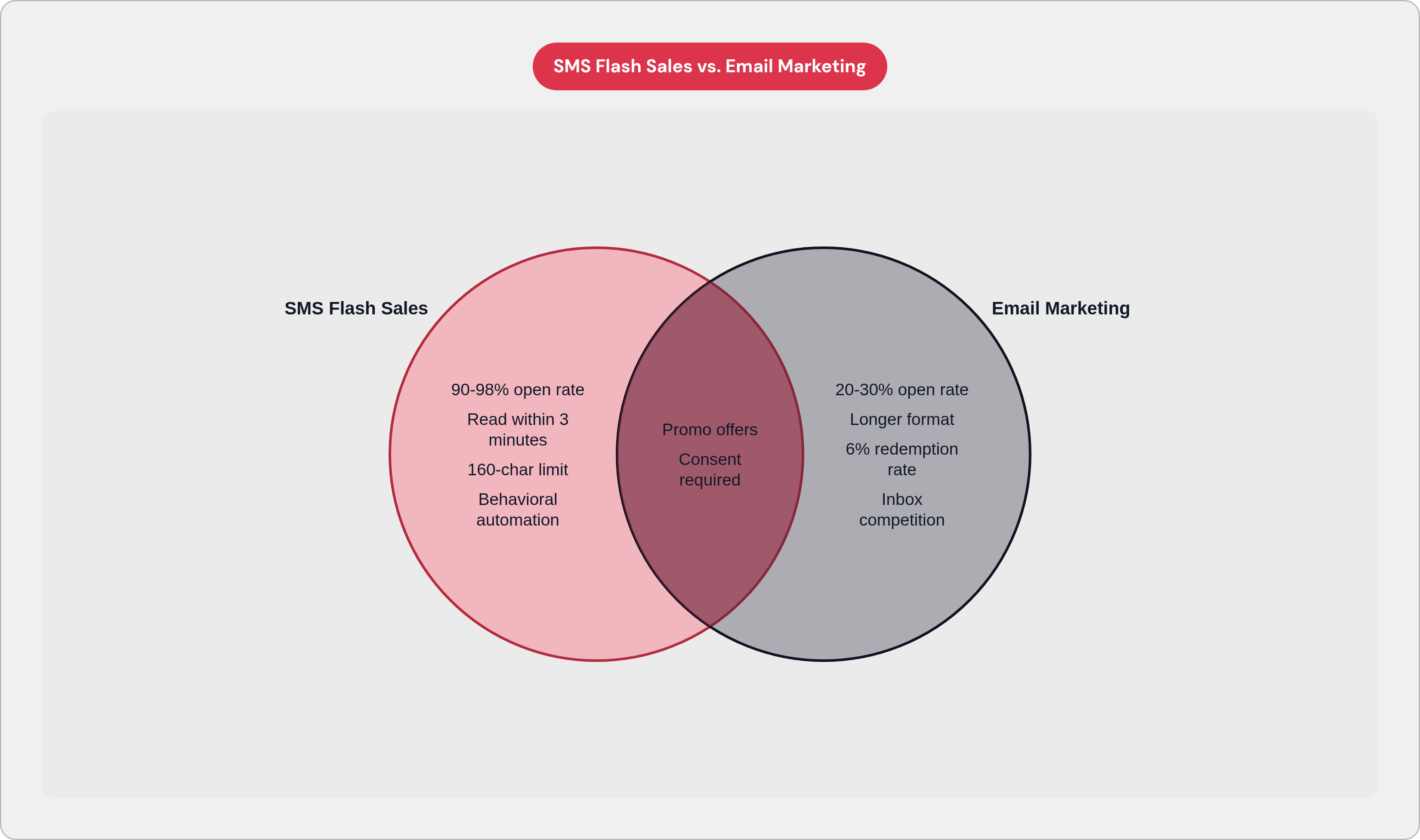
SMS flash sales work because texting sits closer to instinct than intention. Open rates run 90 to 98%, compared to 20 to 30% for marketing email, and that gap reflects a structural difference in how each channel gets read, not something a better subject line can close. Roughly 90% of texts get read within three minutes of landing, which is the entire reason a flash sale text can function like a lever you pull at 11:30 a.m. and watch move bodies into chairs by noon.
Think about what that lunch-decision window actually means. Someone standing in an office kitchen at 11:30, phone in hand, hasn't decided where to eat yet; they're mid-decision, and a text that lands right then is competing for a choice that's still open. Compare that to email, where the same offer sits in an inbox behind four newsletters and a receipt from a shoe purchase, waiting for someone to "check it later." Later doesn't exist for a lunch decision, and no other owned channel gets this combination of speed and open rate. Food and beverage SMS click-through rates average 12 to 14%, with redemption sitting at 23% versus 6% for email promotions, according to the Mobile Marketing Association's 2024 Mobile Marketing Report.
Here's the catch nobody puts on the brochure: the channel's power is structural, not automatic. A text message doesn't fill a table by existing. It fills a table when the restaurant treats the send like a system, with the right offer shape, the right cadence, the right list, and a way to check afterward whether anyone actually showed up. That's the rest of this piece.
What makes a flash sale offer actually work inside a text message
Three things have to be in the message, every time, or the text just becomes noise with better delivery rates: a specific deadline, a clear value statement, and a call-to-action that asks for almost nothing. Miss any one of the three and the timing advantage goes to waste.
The 160-character limit gets treated like a constraint, but it's closer to a forcing function. Email lets you hedge; you can write three paragraphs about "an exciting limited-time opportunity" and still not say anything, since there's room to pad around the point. SMS gives you maybe two sentences before you run out of room, so specificity becomes the only option. "Tonight only, 6 to 8 p.m." beats "limited time" because it removes ambiguity about whether the deal still applies when someone reads it at 8:15. A named dish or a dollar figure beats "great deal" for the same reason: specificity is what makes an offer feel real instead of promotional.
Urgency language isn't decoration, either. According to the Digital Marketing Institute's 2024 Consumer Behavior Study, SMS offers using countdown language generate 45% higher click-through rates than static promotional messages, and that's not a small edge. Personalization stacks on top of that: personalized texts see conversion rates up to 29% higher than generic blasts, especially when the message references a guest's last visit or a dish they've ordered before. A text that says "the usual, 20% off, tonight only" is doing something a blanket "20% off dinner" message structurally cannot.
One clear call-to-action works better than two. "Reply YES or call us or click this link" spreads the ask across too many paths, and every extra option is a decision point where flash urgency dies quietly. Tone matters more than most restaurants assume, too: a text that reads like a press release kills the exact intimacy that makes SMS work in the first place.
None of this is optional under the law, by the way. TCPA requires express written consent before you send a single commercial text, and opt-out language has to be there. This isn't a growth hack footnote; it's the floor.
Timing and frequency: when to send and how often before subscribers leave
A slow Tuesday at 4 p.m. is not the same problem as a Friday that needs upselling, and the same send time won't solve both. Lunch promotions land best 90 to 120 minutes before service, while dinner offers do better sent in the late afternoon, right when evening plans are still soft and moldable. Send too early and the offer gets forgotten; send too late and you're competing with a decision that's already been made.
Frequency is where restaurants tend to overcorrect in one direction or the other. The documented sweet spot is two to four sends a month; push past that and unsubscribe rates start climbing. Well-run SMS programs keep unsubscribe rates in the 0 to 1.5% range per send, and food and beverage lists tend to sit at the lower end of the broader 0.5 to 0.9% industry band. That's a pretty forgiving ceiling, as long as you don't test it every week.
Here's the part that surprises people: frequency matters less than relevance. A fifth send that's sharply targeted to a guest's actual behavior will beat a third send that's generic, every time, and volume plays a smaller role than most operators assume.
Tying sends to something real, a local event, a holiday, a legitimately slow Tuesday, gives the message a reason to exist beyond "we wanted to sell more food." SMS campaigns anchored to seasonal or event hooks lift engagement by 25% in food and beverage specifically. One underused frequency-friendly send worth mentioning: reservation reminders. Effective reminder texts cut no-shows by up to 40%, and a missed reservation costs a restaurant roughly $40 on average. Framed that way, the reminder functions less like promotional noise and more like a direct piece of revenue protection.
Building the subscriber list that makes flash campaigns worth sending
A flash sale blasted to 50 people and the same offer sent to 2,000 are different campaigns entirely, and list size is only half of why. Quality matters just as much as scale.
Where does the list come from? POS checkout prompts, reservation confirmation flows, table cards with QR codes, loyalty enrollment. Every one of these is a moment where a guest is already engaged and willing to say yes to something. A list built from guests who've visited in the last 90 days will consistently outperform a bigger, staler list, because you're reaching people who already have a reason to come back. Size without recency is just a longer list of people who've forgotten you exist.
Segmentation has to start at the opt-in, not six months later when someone finally gets around to building it. Visit frequency, occasion type, location preference for multi-unit groups; capture that at signup and you've built the raw material for behavioral sends down the line. According to Epsilon's 2024 Personalization Report, 73% of consumers prefer brands that use purchase history to customize communication, and that preference is only usable if you collected the data in the first place.
One more thing worth saying plainly: the consent record and the compliance record are the same document. Method, date, source, for every single subscriber. Boring, yes, but skip it and you're one complaint away from a real problem.
Growth here isn't a launch event you run once and declare finished. Operators who build list collection into daily operations, rather than treating it as a one-time sign-up push at opening, grow their lists faster and keep growing them. The restaurants treating list-building as ongoing infrastructure are outperforming the ones that treated it as a marketing sprint.
How behavioral automation turns one-off blasts into a repeatable revenue system
A blast goes to everyone on the same calendar day, whether they're ready to hear from you or not. A behavioral send goes to the right guest when their own behavior says they're ready. That distinction is the whole ballgame, and it's why automated workflows built on guest behavior, time since last visit, past order history, outperform generic blasts by more than 7x.
Take the winback flow as a working example. A guest hasn't visited in 45 days. Instead of a generic "come back" message, they get a flash offer tied to the specific dish they ordered last time. That's a different psychological pitch entirely, one that's specific and personal rather than generic, and it works because it's tailored to that guest.
Post-visit flows work on the opposite end. A thank-you text with a short-window offer for the next visit, sent within 24 hours, catches a guest while satisfaction is still fresh, before the memory of the meal fades. Stack a flash offer on top of a lapsed-visit trigger instead of a calendar date, and urgency shifts from something broadcast to something personal. That's the mechanical trick behind all of this: same urgency language, aimed at one person's actual timeline instead of everyone's inbox on the same Tuesday.
Worth remembering here: loyalty members visit 20% more often and spend 20% more per visit than non-members, so the guests these automated flows are chasing down aren't marginal; they're disproportionately valuable, which makes the reactivation math better than it looks on paper. Once the workflow exists, each additional send costs next to nothing to run. The system pays for itself just by catching guests who'd otherwise drift away without anyone noticing.
Pairing SMS with creator content to give the offer something to land on
A text that says "half-price ramen tonight at 7" lands differently depending on whether the recipient has already seen that bowl of ramen on their feed, posted by someone local they actually follow. That's the entire argument for pairing SMS with creator content: the text handles urgency, but it needs something to land on first.
Local creator content is a pre-sell mechanism. It builds appetite and familiarity before the promotional text ever arrives, which lowers the mental barrier between "saw a text" and "walked in the door." The sequence tends to run in order: a local creator posts to their neighborhood audience, paid amplification pushes that content in front of more nearby diners, and then the SMS flash offer closes the loop with a deadline attached. Each piece does a job the other pieces can't.
This is where micro and local creators earn their keep over bigger national names. A national influencer's audience is scattered across time zones and cities; they can't act on a same-day flash offer even if they wanted to, because most of them aren't within driving distance of the restaurant. A local creator's audience physically lives nearby, which means the content and the offer are actually reaching the same pool of people.
There's also a practical division of labor worth naming. SMS cannot carry a video, and it cannot show the cheese pull or the steam coming off a bowl. Creator content supplies that sensory hit, the thing that makes someone hungry in the first place, while the text supplies the clock. Restaurant SMS campaigns already run 78% higher engagement than email; pairing that with warm audience priming from creator content stretches the advantage further, because the recipient isn't cold when the offer arrives. Local content, paid distribution, SMS follow-through: that combination is what turns a flash sale from a single spike into something you can run again next month with confidence.
Measuring whether the campaign actually filled tables, not just inboxes
Open rate and click-through rate feel like finish lines, but they're really just checkpoints, and a flattering checkpoint can sit on top of a losing campaign without anyone noticing. A 30% click rate looks great in a report, but it means nothing if nobody who clicked actually walked in and sat down.
Incremental revenue is the only number that tells the truth. If a restaurant normally does a certain volume on a Tuesday night, the campaign's real return is whatever came in above that baseline, minus cost of goods, labor, and whatever the campaign itself cost to run. According to a 2025 Litmus benchmark, restaurants earning $3 to $5 back for every $1 spent on marketing are in strong shape, and most operators, if they're honest, couldn't tell you which side of that line they're on.
Why not? The measurement gap sits right in the middle of the workflow. SMS platforms report opens and clicks, while POS systems report revenue, and nothing automatically connects the two. Without a bridge, the ROI number is a guess dressed up as a metric. Unique promo codes redeemed at the register, dedicated landing pages with reservation tracking, QR codes embedded in the follow-up text; these are the practical ways to build that bridge instead of assuming it exists.
The whole exercise is undermined if you're only looking at last-touch attribution, since a guest who saw creator content and a paid ad before the text arrived will still get logged as an "SMS conversion" if the text was the last thing they touched. That overstates the channel's credit, and a multi-touch view is more honest, even if it's messier to build.
The data from one send should shape the next one directly: which offer worked, which daypart performed, which segment responded, and just as important, which combination flopped and should get cut rather than repeated out of habit. Operators who actually close that loop stop running flash sales as a hopeful guess and start running them as a system they can improve month over month. That discipline is what separates a promotional slot machine from a revenue line you can actually plan around.