Timing and Frequency Strategy for Restaurant SMS Campaigns
SMS converts when timed to decision windows, not marketing calendars.
Restaurant SMS works because people actually read it. That's the whole engine of this piece: the channel's advantage comes almost entirely from timing and frequency discipline, and operators who treat SMS like a shrunken email blast are leaving real money sitting on the table.
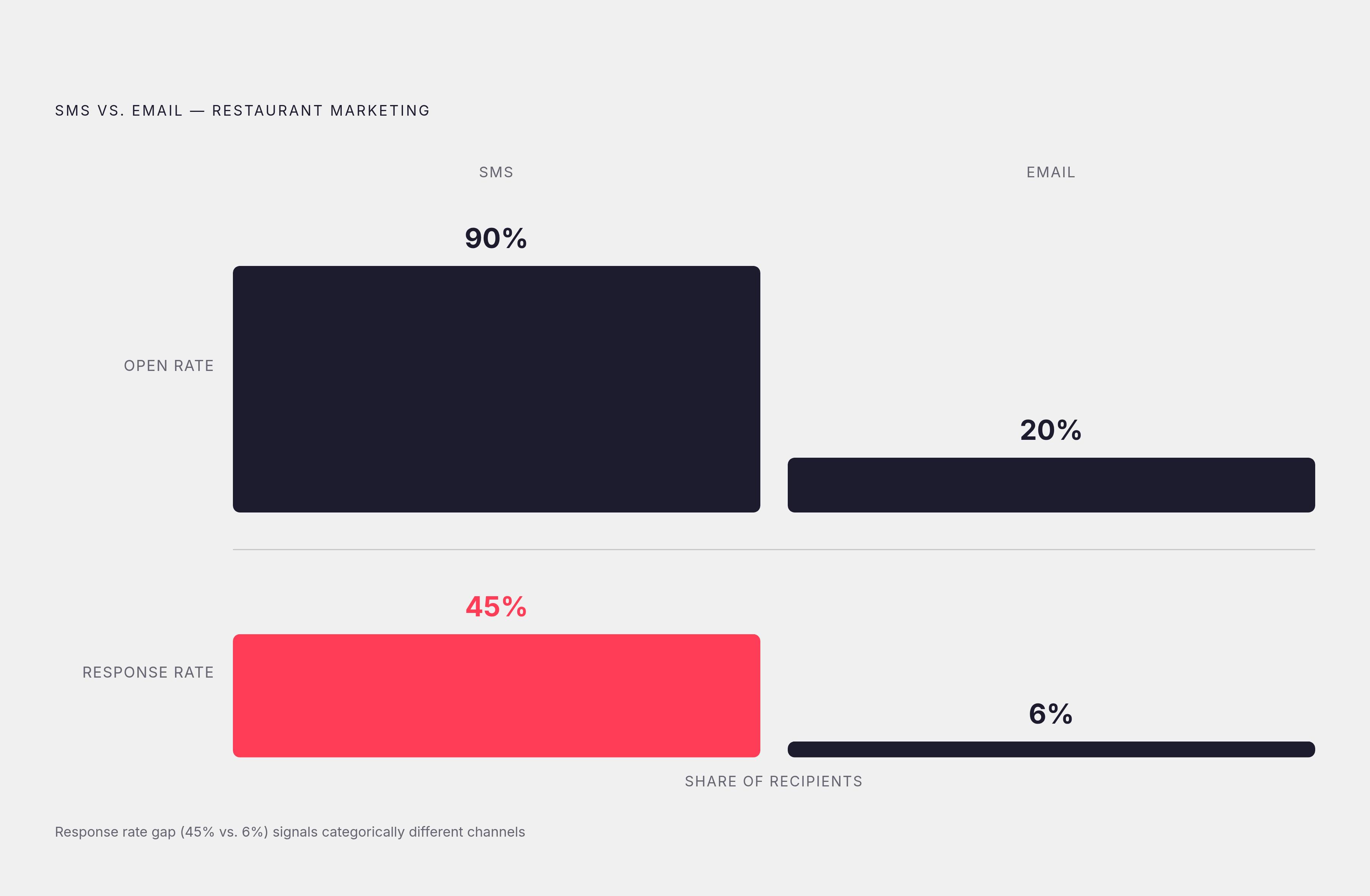
I went looking for baseline numbers first, mostly because I didn't trust my own assumptions, and they turned out lopsided in a way I didn't expect. Restaurant text messages get opened by more than 90% of recipients within 15 minutes of delivery. Email, in the same industry, sits between 18% and 22% open rates, and even then the gap between "opened" and "acted on" can stretch into hours or days. Response rates follow the same pattern: SMS drives roughly 45% response versus 6% for email. The two channels operate in different categories entirely.
But the advantage is conditional, and it took some staring at the data to see it clearly. A lunch promo landing in someone's pocket at 11:45 a.m., right as they're deciding between leftovers and takeout, hits at exactly the right pressure point. The same promo at 8 a.m. is just noise, competing with sixteen other notifications before the person's had coffee. Timing, more than content, is what separates a message that converts from one that gets ignored, and the rest of this piece is about setting that clock correctly.
The decision windows that make restaurant SMS timing work
Guests don't wake up already knowing what they're eating for dinner. They move through stages: considering, narrowing, committing. SMS only has leverage in the first two. Once someone's ordered a burrito bowl through an app, no text on earth is redirecting that transaction. It's already gone.
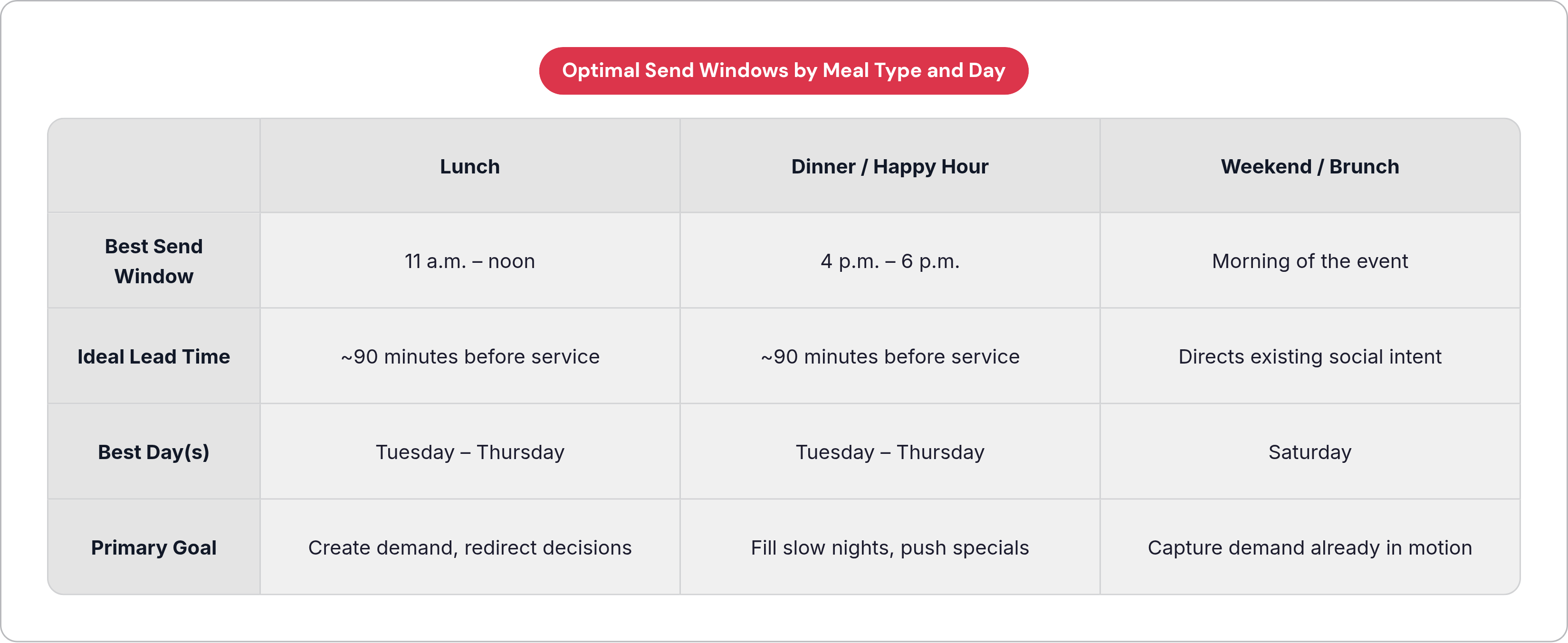
So when is someone considering but not yet committed? For lunch, that window runs roughly 11 a.m. to noon. People are getting hungry, checking the clock, glancing at their calendar to see how much time they've got. An offer that lands here can genuinely redirect behavior, because the decision is still open, still up for grabs.
Dinner runs later, from about 4 p.m. to 6 p.m., prime territory for happy hour pushes, daily specials, or a nudge about table availability. Operators across the industry keep converging on the same rule of thumb: a message sent roughly 90 minutes before a meal period performs best, landing right as people start thinking about food but before they've locked in a plan.
Outside these windows, sends tend to flop. Early morning and late evening texts don't just get ignored, they train subscribers to tune you out generally. Mute a few 6 a.m. buzzes about brunch specials, and the next relevant text gets muted too, out of habit, whether it deserves to be or not. Bad timing carries a compounding cost: a wasted send today, plus erosion of the channel's future effectiveness.
The practical move is almost boringly simple. Schedule around meal periods, not around whatever slot happens to be free on the marketing calendar. If that means the newsletter-style blast doesn't go out at 10 a.m. on a random Wednesday because it's convenient, so be it. Convenience isn't the metric.
Which days produce the best results and why they vary by meal type
Day-of-week logic complicates things, and it should, since a text with no urgency behaves nothing like one demanding action in the next hour. Research from Omnisend points to Tuesday and Saturday, specifically the noon-to-1 p.m. window, as the highest-converting slots broadly. That finding fits best with messages that don't need an immediate yes: a loyalty program invite, a survey request, something with no clock attached.
Midweek, Tuesday through Thursday, tends to produce stronger engagement for slow-night traffic generators and weekday promotions. People are in routine mode. They're not planning anything special, which, oddly enough, makes them more receptive to a reason to break the routine. "Come in tonight, half off apps" lands differently on a Tuesday than it does on a Saturday, when the person already has three plans and a reservation somewhere else.
Weekends flip the logic. They suit brunch pushes, happy hour reminders, event-based messaging, anything where the guest already expects to be doing something social. On a Saturday, the job is directing demand that already exists toward you specifically, rather than creating demand from scratch.
This is where the "slow Tuesday" principle comes in. A restaurant with a historically dead Tuesday night wastes the opportunity by blasting the whole list on Saturday, when the dining room's already full anyway. A Tuesday afternoon text aimed at filling that specific gap works better: used this way, SMS becomes less of a megaphone and more of a traffic valve, steering demand toward the hours that actually need it. That's a different mental model than most operators start with, and it's the one that moves revenue.
One seasonal wrinkle: during holiday periods, subscriber receptivity climbs, which allows a bit more frequency without spiking opt-outs. Treat that as a temporary allowance, though, not a new baseline. The core rules don't take December off.
How often to send without burning through the list you built
Here's where the industry gets weirdly unified: two to four texts per month per subscriber. That number shows up across nearly every credible source on the topic, well below the two-to-four-per-week or one-per-day cadence some marketers push "to stay top of mind."
Why so conservative? Because over-messaging has a real cost, not an abstract one. Roughly a quarter of consumers say they'd stop supporting a brand entirely if they felt overwhelmed by its marketing messages. That's a lost customer, permanently, over what was probably a Tuesday coupon that didn't need to exist.
The signal to actually watch is opt-out rate. Running consistently above 2% per campaign means something's broken: either the list is getting hit too often, or the content isn't worth the interruption. This number doesn't lie the way open rates can. Someone opting out is making an active decision that the relationship isn't working for them anymore.
One outlier's worth mentioning, mostly so I can talk you out of copying it. Some sources suggest one to two texts a week can work, and it can, but almost certainly only for a highly engaged, recently opted-in segment. Think of the subscriber who just joined a rewards program and is still excited about it. Apply that cadence to a general list, and you'll be explaining a spiking unsubscribe rate to your GM on a Monday morning.
Frequency, at bottom, is a relevance question wearing a numbers costume. A subscriber who opted specifically into a happy hour list can handle more texts than someone on the general list, because every message they get is something they actually asked for. Gong Cha's Tea-xt Club backs this up: a 42,000-person list holding under 1% unsubscribe is worth far more, long-term, than a list of the same size that's been blasted into apathy and stopped reading months ago.
Segmenting by behavior so timing and frequency rules can flex for different audiences
The single most common mistake in restaurant SMS is running one send schedule for the entire list. It sounds efficient, but it forces a frequency that's too low for your regulars and too high for someone who visits twice a year.
Real segmentation looks at dining frequency, preferred meal period, average visit recurrence, event attendance, whatever food preference signals show up in past orders. Someone who orders lunch every Tuesday and someone who shows up once a quarter for a birthday dinner shouldn't get the same four texts a month. Applying identical treatment to both just amounts to noise applied unevenly.
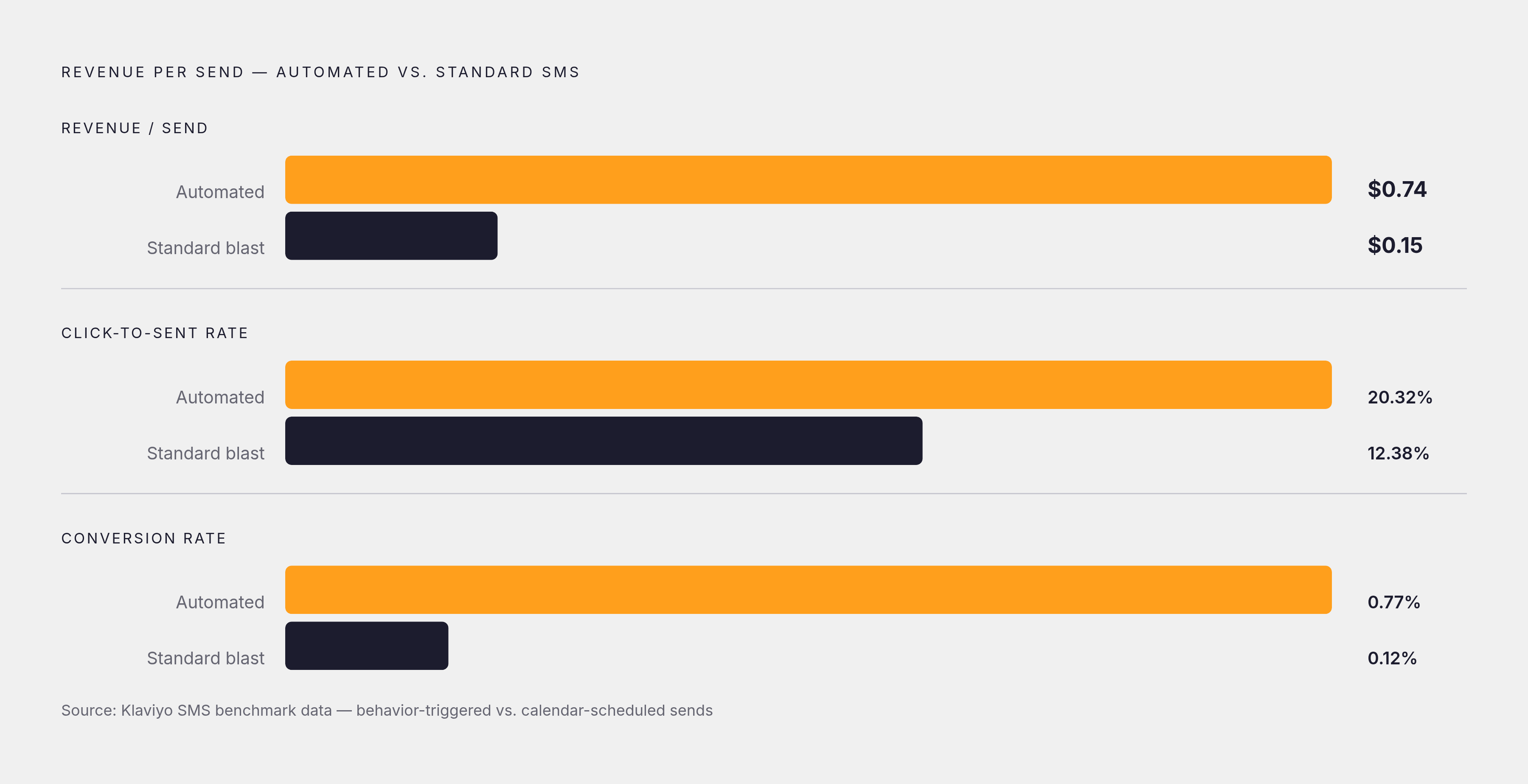
Behavioral triggers tend to beat calendar blasts, and by a wide margin. An automated message tied to "it's been 30 days since your last visit," or "your birthday's in five days," or "you just hit VIP tier," is more precise than a scheduled Tuesday send, and takes less manual effort to run. Omnisend's 2025 data backs this up sharply: automated SMS earned $0.74 per send, against $0.15 for standard campaign blasts. Nearly five times the revenue per message, driven by relevance and timing working together, not sheer volume of texts going out.
Gong Cha's program, documented by Peblla in 2025, is the case study worth remembering here. Across 65 U.S. stores, 42,000 opt-ins produced a 27% lift in repeat orders and a $1.87 increase in average check, all while keeping unsubscribes under 1%. The list stayed healthy because VIP segmentation kept every message contextually appropriate to the person on the other end of it.
Message type matters as its own segmentation layer too, separate from audience. A reservation reminder, a promotional offer, and a re-engagement nudge each carry different optimal send windows and different tolerance thresholds. Lump all three into one monthly frequency budget without distinguishing them, and you'll misjudge how much room you actually have to work with.
Structuring the message mix so every send earns its place in the subscriber's month
A list that only ever hears about discounts is, somewhat ironically, harder to win back than one fed a varied diet of messages. Train subscribers to expect nothing but "20% off," and they'll tune out anything that isn't a coupon, including the messages that actually matter, like event invites or reservation confirmations.
A reasonable framework splits the mix roughly into a substantial share promotional (offers, limited-time deals), a roughly equal share transactional (reservation confirmations, order status updates), and a smaller portion engagement-oriented content (birthdays, surveys, event invitations). None of these percentages are gospel. The balance itself is the point: no single category should dominate a subscriber's month.
Transactional messages play by different timing rules entirely. A reservation reminder gets optimized around a few hours before the actual reservation, because its job is confirmation and no-show reduction, full stop. Cramming it into the 11 a.m. lunch-decision window makes no sense; the job is different, so the clock has to be different too.
Fabio Viviani Hospitality is a useful real-world anchor for how this scales. Using SevenRooms' text marketing across seven venues, the group generated $220,000 in revenue from 3,635 guests over four months, then scaled to $432,000 across 5,726 covers and 1,784 reservations over six months. Numbers like that only hold up if message relevance survives the jump in volume, which is the actual challenge of scaling any SMS program past boutique size.
SevenRooms' platform data shows average reservation revenue of $1.64 per text sent, against an industry average of $0.12. That's more than a tenfold gap, and it's explained by message type and timing precision doing the heavy lifting that raw volume never could.
The practical move: map every message type to its appropriate window, assign it a slot in the monthly frequency budget, and only then start scheduling. Building the calendar first and figuring out relevance later is backward. It shows every time.
Measuring whether the timing is actually working, not just assuming it is
If you're only tracking open rates and click-throughs, do you actually know whether your SMS program works? Probably not, or at least not in the way that matters to a restaurant's bottom line.
Open rates and clicks are proxies. They tell you someone looked, not that someone showed up, sat down, and ordered the branzino. Without attribution tied to an actual visit or an actual check, an operator might see Tuesday sends outperforming Saturday sends in clicks and still have no idea which one, if either, filled a table.
The fix is attribution built into the send itself: unique promo codes tied to specific campaigns, dedicated landing pages with UTM parameters, POS-side redemption tracking that connects a code back to a specific check. None of this is exotic. It's mostly discipline, the kind that gets skipped when a team is moving fast and just wants the text out the door before the lunch window closes.
Two metrics actually tell you whether timing and frequency are calibrated: opt-out rate (anything consistently above 2% per campaign is a red flag) and revenue per send. Everything else, open rate included, is a proxy standing in for one of those two truths.
Omnisend's 2025 figures make the case vividly. Automated SMS hit a 20.32% click-to-sent rate and a 0.77% conversion rate, while standard campaign messages managed 12.38% clicks but only 0.12% conversion. That gap between automated and blast-style campaigns comes down to context and timing doing work that a generic send can't fake its way into.
For restaurants specifically, the real conversion event is a body walking through the door, not a thumb tapping a link. SMS attribution has to close the loop at the point of sale, not just at the landing page.
A well-run SMS program is a system, and a fairly logical one once the pieces are in place. Figure out which send windows produce actual visits. Figure out which message types generate the most revenue per send. Reallocate the monthly frequency budget toward whatever's actually working, and drop what isn't. Do that consistently, and the channel starts behaving like the precision instrument it had the potential to be all along.