UTM Tracking Setup for Restaurant Campaigns
UTM parameters bridge the gap between ad platforms and restaurant revenue data.

E-commerce companies know which ad caused which sale because the entire transaction, from click to purchase confirmation, happens inside a single browser session on a single platform. Restaurants don't have that luxury. A customer sees an Instagram ad on Tuesday, thinks about it, and walks in Friday evening. The ad platform recorded an impression. The POS recorded a cover. Nothing natively connects the two.
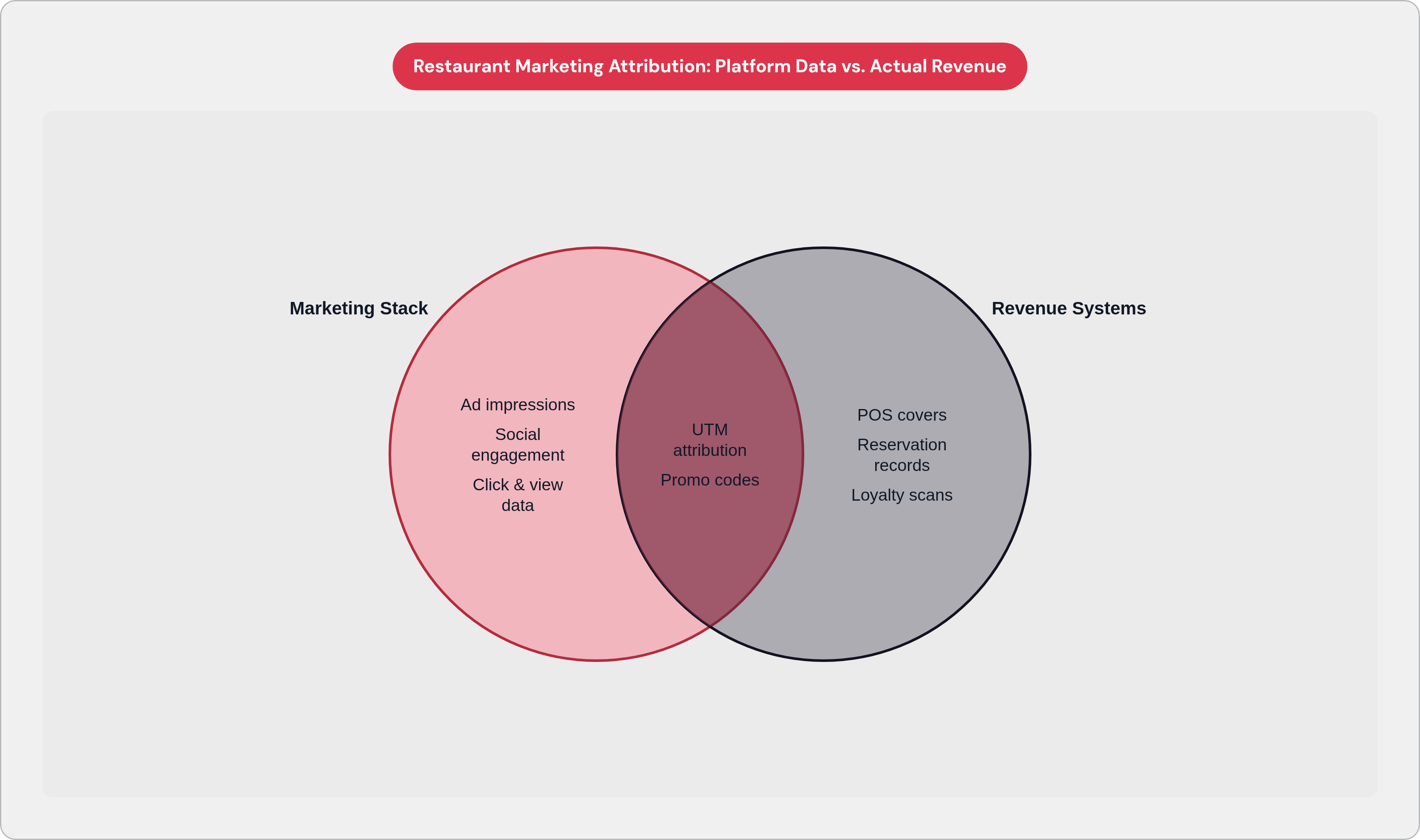
That structural split is the source of the measurement gap. The marketing stack, comprising ads, social, and the website, generates click and view data. The reservation system and POS record revenue. These two systems don't speak to each other by default, and neither platform is particularly motivated to build that bridge. Meta has every incentive to make its own reported metrics look favorable. Platform-reported reach and engagement figures are real numbers measuring real activity; they are simply measuring activity inside a walled garden that benefits from generous interpretation.
The stakes compound quickly. A full-service restaurant averaging fifty-five dollars per visit, with a guest who returns four times annually, generates two hundred twenty dollars in yearly revenue from one relationship. Apply a fifteen percent net margin over three years and that guest represents roughly ninety-nine dollars in actual profit. Multiply that across fifty new guests acquired in a month and the untracked acquisition value becomes significant. Now factor in the well-documented pattern that most first-time restaurant guests never return for a second visit. The guests who do return are disproportionately carrying the revenue model. Knowing which ad, on which platform, with which creative brought those people in is among the most reliable ways to replicate the result.
Without that knowledge, the campaign that worked and the campaign that didn't look identical in the post-mortem. Two invoices for the same amount. No way to know which one was worth paying.
UTM parameters are the first accessible tool for bridging those two systems. They don't close the gap alone, but nothing downstream functions without them.
Why sloppy naming conventions break attribution before it starts
GA4 treats every UTM value as case-sensitive. "Facebook," "facebook," and "FB" are three separate traffic sources in the same report. Three team members tagging links across a campaign season without a shared convention will produce a dataset that is, for practical purposes, unreadable. The attribution isn't lost because of a technical failure; it's fragmented by inconsistency, which is a different and considerably more frustrating problem because it was entirely preventable.
The fragmentation patterns are predictable. Platform names drift across months: "Meta" one week, "facebook" the next. Campaign name fields left blank because someone was moving fast. Human-readable labels with spaces, which GA4 encodes as %20 in the URL and makes reports harder to parse. Campaign names with no date or seasonal identifier, so the "summer-promo" from two years ago and this year's version merge into a single undifferentiated entry in the acquisition report.
That raises a question: if the patterns are this predictable, why do teams keep repeating them? Usually because no single person owns the naming convention. So no convention actually exists. It exists in theory, or in a Slack message from eight months ago, or in someone's head who has since left the company.
The fix is a shared document, not a new tool. A short, agreed-upon list of rules written before the first campaign launches. All lowercase, consistently. Hyphens instead of spaces or underscores, because hyphens read cleanly in both GA4 reports and raw URLs. A closed vocabulary for utm_source: instagram, facebook, tiktok, google, email, and nothing else regardless of what feels intuitive in the moment. A campaign name format that encodes both the initiative and the year: valentines-2025, summer-launch-2025, happyhour-fall-2025. One person or one living document owns this list. Every inconsistency, in my experience, traces back to the absence of that ownership.
Building the parameter hierarchy for a typical restaurant campaign
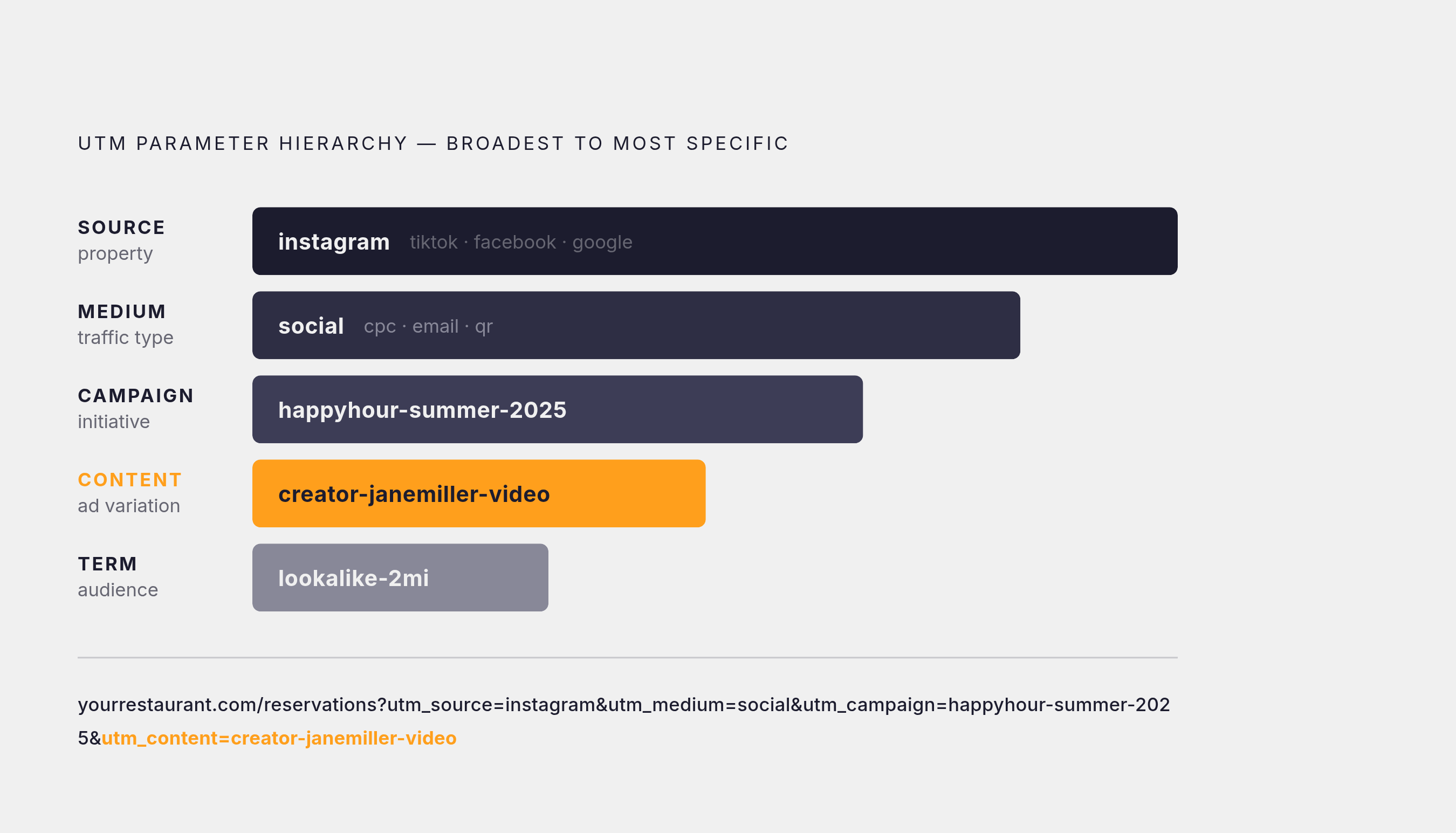
Think of the five parameters as nested layers, moving from broadest to most granular: source, medium, campaign, content, term. Each layer adds a dimension of precision without making the others redundant.
Source and medium together define the channel. utmsource names the specific property where the link lives: instagram, tiktok, facebook, google, mailchimp. utmmedium names the traffic type category, and this distinction matters more than it might seem. The medium is not the platform name repeated; it is the category of how the traffic arrives. Social, cpc, email, qr. A QR code printed on a table tent is its own source-and-medium pair: utmsource=tabletent, utmmedium=qr. A boosted Facebook post is utmsource=facebook, utmmedium=cpc. The source tells you where; the medium tells you how.
Campaign names should function as reusable identifiers, not creative copy. "happyhour-summer-2025" is a campaign name. "Come+enjoy+our+amazing+summer+happy+hour" is a copy brief that wandered into the wrong field and will make the GA4 report look like a ransom note.
utmcontent is the underused parameter that returns the most value for creative decisions. It distinguishes individual ad variations running within the same campaign: carousel-pasta versus video-burger versus static-cocktail. It also distinguishes a local creator's post from the restaurant's own branded content running the same offer in the same campaign window. A fully tagged URL looks something like this: yourrestaurant.com/reservations?utmsource=instagram&utmmedium=social&utmcampaign=happyhour-summer-2025&utm_content=creator-janemiller-video. That single link tells GA4, without ambiguity, that this session came from Instagram, via a social placement, within the summer happy hour campaign, specifically from a video Jane Miller produced. That is the granularity that makes a creative debrief actionable rather than anecdotal.
utmterm, built originally for Google Search keyword tagging, is less critical for most restaurant social campaigns. It can be repurposed to tag paid social audience segments if the team wants that additional layer: utmterm=lookalike-2mi for a campaign targeting a two-mile lookalike audience, for instance. Useful, but optional. The other four are not.
Where to place UTM-tagged links across a restaurant's active channels
The second most common attribution failure, after inconsistent naming conventions, is reusing the same tagged URL across multiple placements. The entire point of the parameter structure is that every distinct placement gets its own distinct tag. One URL for everything defeats the system before it starts.
On Instagram, the link in bio is typically the highest-traffic organic entry point and needs its own tagged URL. A Stories link sticker, where traffic volume justifies the distinction, can carry a separate source value. Every paid ad variation gets its own utm_content value corresponding to the specific creative being tested.
TikTok follows the same logic: link in bio tagged with utmsource=tiktok and utmmedium=social for organic; paid TikTok ads switch to utmmedium=cpc, with utmcontent identifying the specific creator or video asset. Facebook page CTA buttons, boosted posts, and Facebook offer ads each warrant distinct utm_content values even when they drive to the same landing page. The page CTA and the boosted post reach different audiences through different placements. Conflating them produces data that obscures which placement is actually working.
Email campaigns are straightforward in concept and frequently botched in execution. utmmedium=email, utmsource equals the email service provider or list name. Every linked element in the email, the menu link, the reservation button, the promotional CTA, gets its own utm_content tag. One email with three links sharing the same UTM string is one of the more reliable ways to make email attribution completely useless.
Physical touchpoints deserve more attention than most teams give them. A QR code on a table tent or window cling is a trackable channel: utmmedium=qr, utmsource identifies the physical location. Because QR codes are permanent once printed, the practical implementation uses a URL shortener or redirect layer so the destination and its parameters can be updated without reprinting.
Creator content requires specific treatment. Each creator's link should carry a utm_content value identifying them by name or handle. This is the layer that allows a restaurant to compare not just traffic volume per creator but traffic quality: how many sessions initiated a reservation, and how many reservations completed. View counts are a metric the platform provides. Conversion rates by creator are a metric the restaurant builds for itself.
Connecting UTM data to actual reservations and revenue in GA4
UTMs bring traffic into GA4 tagged by source, but source data is only meaningful when paired with conversion events. GA4 calls these key events, and for a restaurant, the minimum viable configuration covers a small number of high-signal actions: reservation button click, online order initiation, order confirmation page view if online ordering is active, and phone number click or direction request as proxy signals for foot traffic intent.
In GA4, the Traffic Acquisition report under the Acquisition section shows sessions broken out by utmsource and utmmedium. Adding utm_campaign as a secondary dimension surfaces campaign-level performance within each channel. That combination is where the measurement starts producing usable intelligence rather than vanity counts.
Some reservation platforms extend this logic into the booking system itself. OpenTable's marketing tracking feature generates URLs with tracking parameters that connect reservation data back to the originating digital channel. Any reservation platform that allows custom URLs in its booking widget can receive UTM-tagged entry links; the critical question is whether the platform passes UTM data through to its own reporting or drops it at the widget boundary. Worth confirming before assuming the data is flowing.
For campaigns where the reservation path runs through a physical visit rather than online booking, unique promotional codes per channel serve as a parallel offline attribution layer. INSTA10 versus TIKTOK10 at the point of sale is imprecise. But imprecise is considerably more useful than nothing, and it at least confirms the channel connection when no digital reservation trail exists.
What good looks like in practice: a creator's tagged link drove forty reservation page visits, eighteen clicked into the booking widget, nine reservations completed. That is a conversion funnel the restaurant can act on in the next planning conversation. It is a fundamentally different kind of information than a view count, and it came from configuration, not from purchasing a new platform.
The attribution ceiling UTMs hit and what sits above it
It is worth being direct about what UTMs cannot do, because misunderstanding the ceiling causes operators to either over-trust the data or abandon the infrastructure because it appears incomplete.
UTMs track browser sessions and link clicks. They do not prove that the person who clicked the ad is the person who walked in. Several specific gaps are worth naming. Dark social: someone screenshots the TikTok video, shows it to a friend, and both of them walk in three days later without clicking a tagged link. No UTM fires. Cross-device: the user sees the Instagram ad on mobile, makes the reservation on desktop two days later. Default GA4 session attribution doesn't connect those two events. Assisted conversions: GA4's default attribution model gives full credit to the last touchpoint before conversion, which means the creator ad that introduced a guest to the restaurant receives nothing when that guest later searches the restaurant's name on Google and books from the search result.
That last-click default tends to overvalue Google Search and undervalue brand-awareness social campaigns. A restaurant reading its attribution data at face value may conclude that search is driving all new guest acquisition, cut the top-of-funnel social spend that was actually generating those searches, and then wonder why search performance declines the following quarter. I've watched this cycle play out more than once. Multi-touch attribution models distribute credit more honestly across the full path, but they require more data volume and configuration to be reliable at a single-location restaurant's traffic scale.
But what if the ceiling is acknowledged rather than ignored? Several methods extend attribution beyond what UTMs can see. Meta and Google both offer store visit tracking, which uses mobile location data to estimate visits by users who were exposed to ads. The methodology is directional rather than precise, but directional is useful. Loyalty program scans at the point of visit tie a known guest identity to a known acquisition channel if the loyalty signup was itself UTM-tagged. Footfall attribution technology, which cross-references geolocation data against ad exposure, requires a third-party data layer but produces the most direct connection between ad impression and physical visit.
Why start with UTMs if the ceiling is real? Because every one of these more sophisticated methods requires knowing which channel drove the original visit. The foundation still has to exist before any higher floor is possible.
What consistent UTM data makes possible for campaign decisions
The operational question UTM data answers, and that platform dashboards cannot, is which specific channel, campaign, and creative drove visitors who actually converted, not just visitors who saw the ad. That distinction is the entire value proposition.
Budget reallocation decisions become legible. A local creator's tagged link drives a higher reservation conversion rate than the restaurant's own branded posts running the same offer in the same window. Instagram Stories traffic converts at a materially different rate than feed posts. The agency-managed Google campaign generates more sessions than any social channel but fewer reservation completions per session than the email list. None of these conclusions are available from platform dashboards. All of them are available from a GA4 account where UTMs were implemented consistently from the start, or from a purpose-built layer on top of it, which is the core function of Feastalytics, a restaurant analytics platform that unifies POS, delivery, and marketing data to tie specific campaigns directly to in-store sales revenue.
Some argue that for a single-unit restaurant running modest ad budgets, this level of rigor is disproportionate to the stakes. It's a fair objection at the margins. But consider the actual cost: the naming convention document takes one afternoon to write, the UTM tags themselves take seconds to generate using Google's free Campaign URL Builder, and the GA4 event configuration for reservation tracking is a one-time setup. The ongoing cost of consistent UTM implementation is negligible. The ongoing cost of operating without it is the same measurement gap the industry has tolerated for decades: paying for campaigns that are either working or not, with no reliable way to distinguish between them.
The deeper value is cumulative. A single tagged campaign produces a data point. A year of consistently tagged campaigns produces a pattern. Two years produce a basis for forecasting. The restaurant that built that foundation can walk into a planning conversation with actual evidence about what its specific audience responds to, on which platform, at which point in the consideration cycle. The restaurant that skipped the tagging brings the Meta dashboard printout and a general agreement that engagement was solid.
The tagging is not the insight. But without it, there is no path to one.