UTM Tracking Strategy for Restaurant Campaigns
Track which campaigns actually fill tables by tagging every link with UTM parameters.

There is something almost comedic about a restaurant operator spending five figures on a TikTok influencer campaign and then answering the question "did it work?" with a shrug. Not because operators are careless, but because the infrastructure to answer that question was never put in place. UTM parameters are that infrastructure. They are unglamorous, they are a decade and a half old, and they are the single most accessible form of first-party attribution data available to any business running digital campaigns. No third-party cookie required. No platform permission. Just a string of text appended to a URL.
UTM stands for Urchin Tracking Module, a name inherited from Urchin Software, which Google acquired and eventually rebuilt into what became Google Analytics. The five parameters, source, medium, campaign, content, and term, each carry a specific piece of information into whatever analytics platform the restaurant uses. The source identifies where the traffic originated (instagram, tiktok, google). The medium describes the traffic type (paid-social, influencer, email). The campaign names the specific initiative (summer-patio-launch, grand-opening-june). The content distinguishes individual creatives or placements within the same campaign. The term, least relevant to restaurant social campaigns, is primarily a paid search keyword field. Together, when clicked, these parameters are logged as a session in GA4, which now runs on over 14 million websites and commands more than 80 percent market share among analytics platforms, according to W3Techs's 2026 data. The infrastructure, in other words, is already everywhere. The question is whether restaurant operators are actually using it.
Most are not.
Why Restaurants in Particular Are Flying Blind Without UTMs
The average independent or emerging-chain restaurant runs marketing across Meta ads, TikTok, Google, email, loyalty push notifications, and, increasingly, creator partnerships. Each channel is a separate silo. Meta reports impressions and link clicks. The POS records covers and revenue. Nothing in the middle connects which ad filled which table. That gap is not a technology problem; it is a tagging problem.
It is worth considering why this matters more for restaurants than, say, a DTC brand. A DTC operator can fire a purchase event in their e-commerce platform the moment the credit card clears, and every UTM-tagged session that preceded it has a clear outcome attached. The restaurant's conversion event, a person sitting down and ordering food, happens offline, in a physical room, often days after the initial digital touchpoint. That asymmetry makes the upstream data, the UTM-tagged click, more valuable, not less, because it is often the only trackable signal in the chain.
Organic social reach has declined substantially over the past several years, a pattern well documented among restaurant marketers, which means virtually every meaningful social impression now involves some paid distribution. The stakes of attribution have risen proportionally. And yet over 30 percent of campaigns across industries are deployed without any UTM markup, leaving those operators unable to accurately attribute revenue or analyze ad performance. For a restaurant spending the commonly benchmarked three to six percent of sales on marketing, even a modest fraction of untracked spend, compounded across twelve months of campaigns, becomes a meaningful number.
The fallback is the "how did you hear about us?" question, asked at the host stand or buried in an email receipt. It is anecdotal, unreliable, and impossible to aggregate into anything that resembles campaign-level intelligence. Guests who found the restaurant via a creator reel they saw three weeks ago do not remember. Guests who clicked a Meta ad remember even less. The question feels like data collection. It is not.
How Untagged Campaigns Corrupt the Decisions That Follow
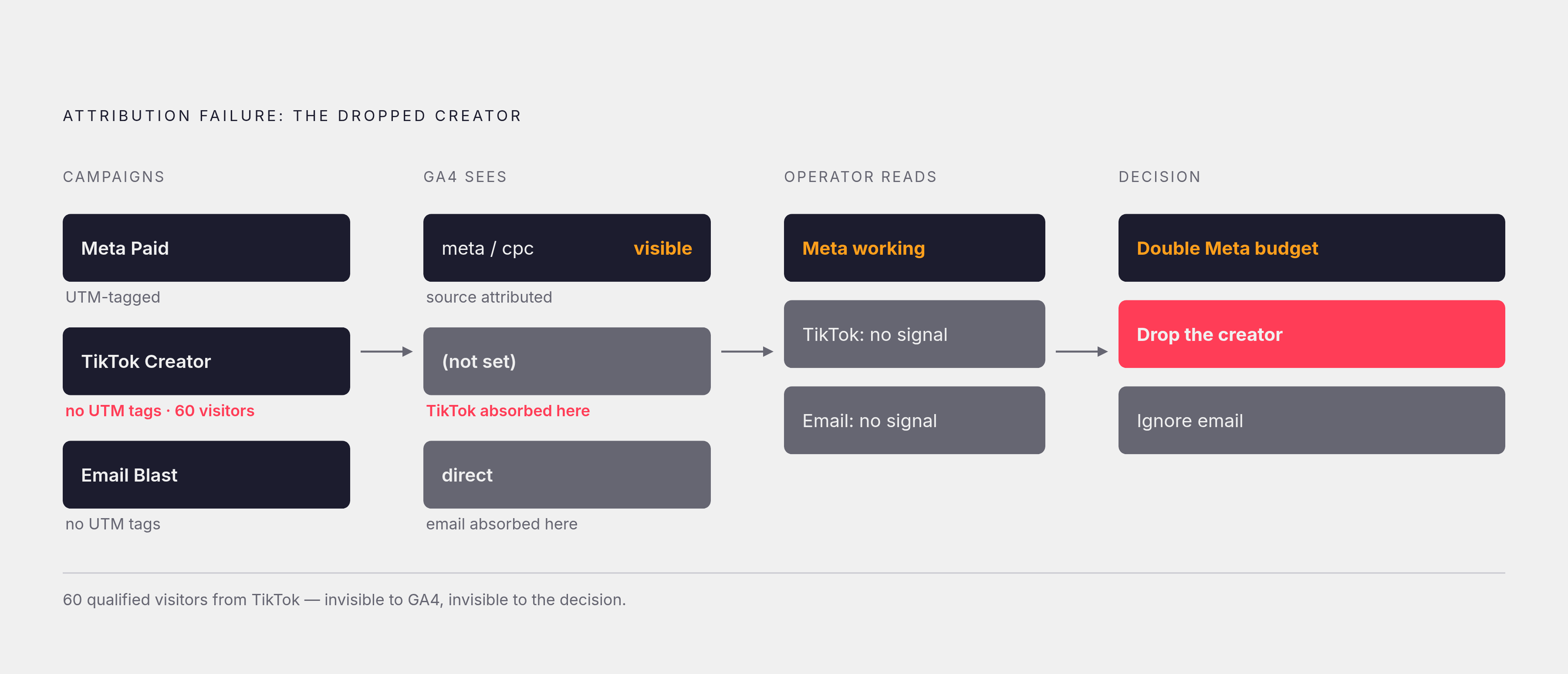
Here is where the problem compounds, and this is the part operators underestimate. The absence of UTMs does not just produce a data gap. It produces corrupted data, and corrupted data is worse than no data, because operators act on it.
Why exactly does this happen? Consider the mechanics. A restaurant runs three campaigns simultaneously: a Meta paid campaign with proper UTM tags, a TikTok creator post with no tags, and an email blast with no tags. GA4 shows strong traffic from Meta. The TikTok creator post and the email, arriving untagged, are lumped into "direct" or "(not set)." The operator, reading the report, concludes Meta is working and TikTok is not. They reallocate budget accordingly. The creator who actually drove sixty qualified visitors to the reservation page gets dropped from the roster.
This is the "doubling down on what's broken" failure mode. It is not hypothetical; it is the default outcome when only some campaigns are tagged. Industry estimates suggest that 20 to 30 percent of ad budgets can be wasted due to poor targeting and lack of optimization; bad attribution data accelerates this by pointing additional budget toward the wrong channels with false confidence.
Two other contamination vectors are worth naming because they are common and rarely discussed. The first: tagging links within the restaurant's own website or app with UTMs. This overwrites the original session source and creates phantom traffic attribution. If a guest arrives from a creator post and then clicks an internally tagged link to see the menu, GA4 may log the session as originating from the internal source rather than the creator. The second: link-forwarding contamination. A tagged creator post link, shared beyond its intended audience via text message or group chat, carries the original UTM string to people who were never part of the campaign's target distribution. Traffic appears to arrive from the creator when it actually arrived from a friend's iMessage. These are not edge cases. They are the predictable result of improvised UTM strategy.
Building a UTM Naming Convention That Holds Up at Scale
GA4 is case-sensitive. "Instagram" and "instagram" are two separate traffic sources in its reporting engine. One team member capitalizing a source name fragments the data permanently, splitting what should be a single channel into two partial records that can never be cleanly merged. This is the kind of detail that sounds pedantic until you are six months into a campaign cycle trying to understand why your instagram traffic numbers look inconsistent.
Research from CXL Institute found that teams with standardized UTM naming conventions saw a 29 percent improvement in campaign attribution accuracy. The mechanism is obvious once you consider it: consistency is the precondition for aggregation, and aggregation is the precondition for any meaningful comparison across campaigns.
The rules are not complicated, but they must be enforced.
Use lowercase throughout. Hyphens between words, not spaces (spaces break URLs in unpredictable ways) and not underscores (which are harder to parse in reports). Source should name the property, not the format: instagram, tiktok, google, mailchimp; avoid "social" as a source, because "social" tells you nothing a decision can be made from. Medium names the traffic type: paid-social, organic-social, email, influencer, sms. Campaign names the initiative in human-readable terms: summer-patio-launch, valentines-prix-fixe, grand-opening-week. Content differentiates the creative: creator-jenna-eats, video-v1, carousel-v2.
Before the first campaign launches, build a shared naming convention document, a spreadsheet or a Notion table, with pre-approved values for source and medium. Every team member and every creator partner tags from the same document. No improvisation. When a campaign runs across multiple months or gets a creative refresh, use a date suffix or version number rather than reusing the same campaign name; otherwise, historical performance comparisons blur in ways that are genuinely difficult to untangle retroactively.
UTM builder tools exist and reduce human error substantially. Google's native builder is free. The specifics of which tool a team uses matter less than the discipline of using one consistently, every time, for every link.
Structuring UTMs Specifically for Creator and Influencer Posts
Creator content presents a particular structural challenge. A single creator might post a reel, a story with a swipe-up, a bio link update, and a reshare of the reel over the course of a week-long campaign. Each of those touchpoints is a separate URL entry point. Each one needs its own tag, because each format drives meaningfully different traffic behavior.
The recommended structure for a creator campaign: use the creator's handle or an abbreviated version as the source (creator-jenna-eats, creator-dmv-foodie), set the medium to influencer to keep creator traffic distinctly separated from paid-social and organic-social, name the campaign by the initiative (grand-opening-june2025), and use the content field to specify the post format (reel, story-swipe-up, bio-link). This structure allows a restaurant to compare, at a granular level, whether Jenna's reel or her story drove more qualified traffic, and whether the reel outperformed a different creator's reel in the same campaign.
One rule that cannot be overstated: build the tagged link and deliver it to the creator fully assembled. Do not ask a creator to construct a UTM string. The risk of capitalization errors, typos, and structural mistakes is not a hypothetical concern; it is a near-certainty when someone whose expertise is content, not analytics infrastructure, is asked to manually append query parameters to a URL.
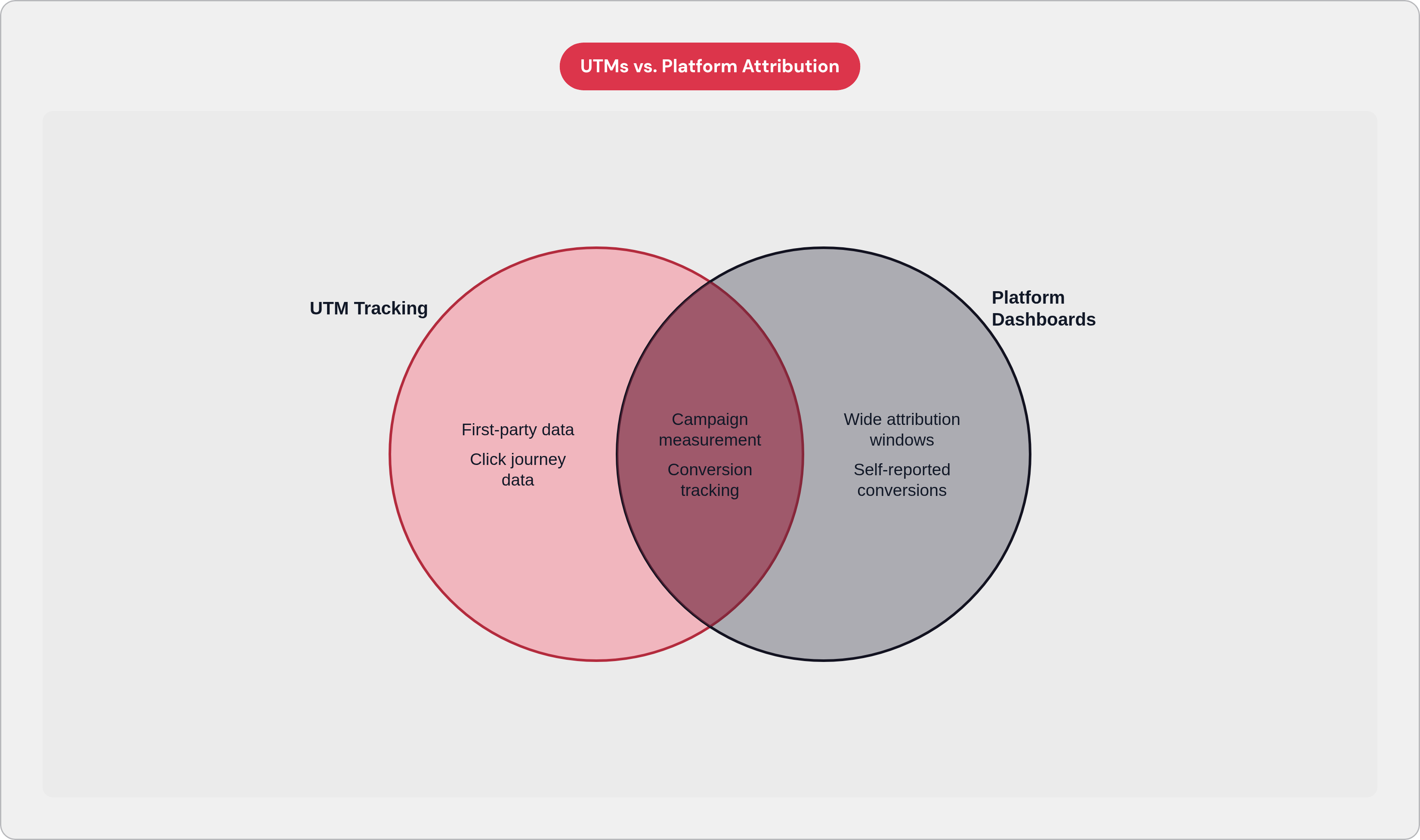
That raises an important question about the relationship between UTMs and promo codes in influencer campaigns. They are not substitutes. They measure different things. A UTM tag tracks the click journey from the post to the landing page. A promo code, unique per creator and tied to a POS line item, records the in-store redemption. For any conversion-focused creator campaign, both should run in parallel. The UTM answers "did they click?" The promo code answers "did they come in?" Together, they triangulate from browser behavior to actual covers.
For top-of-funnel awareness campaigns, UTM links are the primary measurable output; traffic volume and landing page behavior are the signals available. For bottom-of-funnel campaigns driving reservations or walk-ins, UTM data on clicks must be paired with a downstream conversion event or the link to revenue remains structurally incomplete. This is where UTMs reach their ceiling as a standalone tool, a point that deserves its own section.
Where UTM Data Lives and How to Read It in GA4
In GA4, UTM data surfaces primarily in the Traffic Acquisition report, where sessions are broken down by session source and medium, and then by session campaign. A well-tagged restaurant campaign produces rows that look like distinct, comparable units: instagram / paid-social attributed to summer-patio-launch, creator-jenna-eats / influencer attributed to grand-opening-june2025, mailchimp / email attributed to weekly-specials-june. Each row is a separate, intelligible line. Rather than a blended mass of "social." Rather than a bucket labeled "direct" containing three campaigns and a dozen walk-ins who typed the URL from memory.
When the restaurant's reservation system or online ordering widget fires a GA4 conversion event on completion, UTM data can be tied to that conversion. This is the most valuable report a restaurant can build. It answers not just "who came to the site" but "who came to the site and booked." The gap between those two questions is where most restaurant marketing analysis gets stuck.
One comparison worth understanding explicitly: Meta's native dashboard and GA4 will typically report different conversion numbers. Meta and TikTok's native platforms claim credit for any conversion that occurred after an ad impression, whether or not the user clicked anything. Their attribution windows are wide, their models are self-serving, and their numbers will consistently tend to exceed what GA4 records via UTM. UTM data is the operator's independent check. If Meta claims 80 conversions and GA4 shows 22 UTM-attributed sessions reaching the reservation page, that gap is a measurement question worth interrogating, not a number to split the difference on.
Branded short links deserve mention here as a practical hygiene consideration. They conceal the raw UTM string from the visible URL while preserving all tracking data in GA4, and Rebrandly's data suggests they increase click-through rates meaningfully compared to generic shorteners. The attribution benefit and the performance benefit are both real; the implementation cost is low.
The Ceiling UTMs Hit and What Closes the Gap to the Dining Room
UTMs answer a specific question: which ad or creator post drove a click, and whether that click reached a reservation page or some other useful destination. They cannot answer whether the person who clicked actually walked in, when they came in, what they ordered, or whether they returned.
Consider the most common path to a restaurant visit in 2025. A guest sees a creator reel, saves it to their Instagram collections, tags a friend in the comments, and walks in eleven days later after their friend confirms they are free Saturday. At no point in that journey is a tagged link clicked. The POS records the cover. The campaign gets no credit. That guest is invisible to UTM tracking, not because the tracking failed, but because the conversion event, a person eating dinner, occurred entirely outside the browser environment.
This is the structural asymmetry that makes restaurant attribution genuinely harder than e-commerce, and anyone claiming otherwise is selling something.
What bridges the gap in practice is a combination of instruments, none of which is perfect alone. Unique promo codes per creator or campaign, when tied to a POS SKU, produce a hard in-store signal that is campaign-attributable. Reservation system attribution, when the guest books online via a UTM-tagged link and the booking ID can be matched to a POS visit, creates a cleaner closed loop. Foot traffic attribution tools, which use mobile device signal matching to link ad exposure to a physical visit, have become increasingly accessible to operators below the enterprise tier.
And then there is the more comprehensive approach: connecting POS revenue data directly to the campaign that drove it. Some restaurant analytics platforms that unify POS, delivery, and marketing data are built for exactly this, closing the attribution loop that UTMs open but cannot complete independently. The logic of the system depends on UTMs as the first handoff; the tagged link is what gives a downstream tool a campaign to attach the in-store visit to. Without the UTM, the matching has nothing to reference. With it, the chain from a creator post to a specific dollar of in-store revenue becomes, at least partially, traceable.
UTMs are made meaningful by these downstream tools, rather than made redundant.
A Practical UTM Setup a Restaurant Can Implement Before the Next Campaign
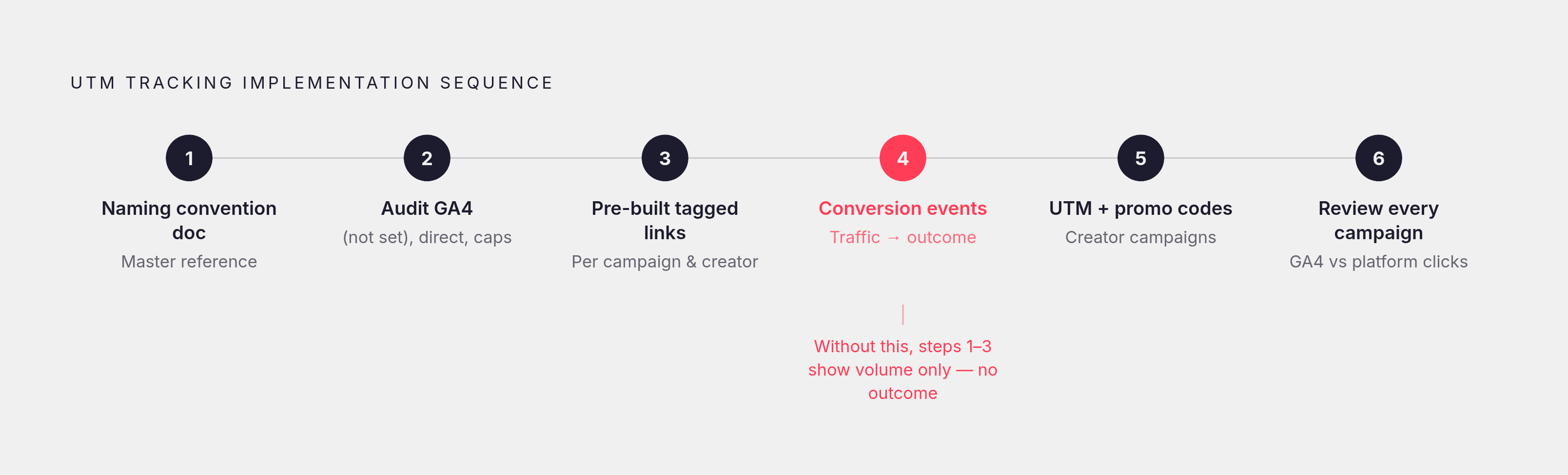
This is the part where the theory has to become a Tuesday afternoon task, so here is the sequence in plain terms.
Step one: Build the master naming convention document before touching a single URL. Define the allowed values for source, medium, and campaign format. Store it somewhere every team member and every creator partner can access. This document is the single source of truth, and its authority has to be non-negotiable.
Step two: Audit existing campaigns. Pull the Traffic Acquisition report in GA4 and look for "(not set)," "direct," and capitalization variants of the same channel name. These are the leaks in the current data. Naming them is the first diagnostic step.
Step three: Create pre-built links for every active campaign and creator. Use a UTM builder, generate the full tagged URL, shorten it with a branded shortener, and deliver the finished link. The creator receives a complete link and is asked only to post it. They are asked to construct nothing.
Step four: Set up conversion events in GA4. Identify what a conversion looks like for this restaurant, whether that is a reservation form submission, a coupon page view, or a click-to-call, and confirm GA4 is firing an event on each one. Without conversion events, UTM data shows traffic volume but omits outcome. Traffic volume without outcome is, to be direct about it, not very useful.
Step five: Pair UTMs with promo codes for creator campaigns. The code captures the in-store moment the UTM cannot. Together they triangulate from click to cover, which is the closest a restaurant can get to closed-loop attribution without more sophisticated POS integration.
Step six: Review after every campaign, not quarterly. Compare GA4 UTM-sourced sessions against platform-reported clicks and flag campaigns where the gap is large. Use that gap to interrogate the platform's claims rather than accept them.
The longer-term payoff is this: as UTM data accumulates across campaigns, it builds a channel-by-channel performance record. Which creator drove the most qualified traffic. Which medium converts at the highest rate. Which campaign concept earned a repeat. That record is the evidentiary foundation on which the next budget decision gets made with something other than instinct.
It is not a glamorous foundation. But it is the one that actually holds.