Incrementality Testing in Restaurant Advertising
How to measure whether restaurant ads actually drive sales, not just intercept existing customers.

Incrementality testing measures the causal impact of a campaign by comparing two groups: one exposed to the ad, one withheld from it. The difference in behavior between those groups, all else held equal, is the incremental lift. That lift is what the campaign actually caused, not what it merely accompanied.
This is a fundamentally different question from attribution. Attribution asks which ad gets credit for a conversion. Incrementality asks whether the conversion would have happened without any ad at all. Those two questions sound related but produce very different answers, and conflating them is where most restaurant ad budgets quietly go sideways.
Two designs dominate in practice. The first is a holdout or ghost-ad approach: a matched audience segment never sees the campaign, and their behavior during the flight becomes the counterfactual baseline. The second is a geo-based split, where test markets run the campaign and control markets don't, with foot traffic or transaction volume compared across both. For restaurants, inherently local businesses with inherently local customers, the geo split usually fits more naturally.
The metric that emerges from either design is incremental return on ad spend, iROAS: revenue causally attributed to the campaign divided by what the campaign cost. Why does this number routinely diverge from the ROAS a platform dashboard reports? Because platform ROAS includes everyone who converted after seeing the ad, including guests who were coming regardless. iROAS includes only the ones the campaign actually moved. The gap between those two figures is, in practice, the gap between what operators think their advertising is doing and what it is actually doing.
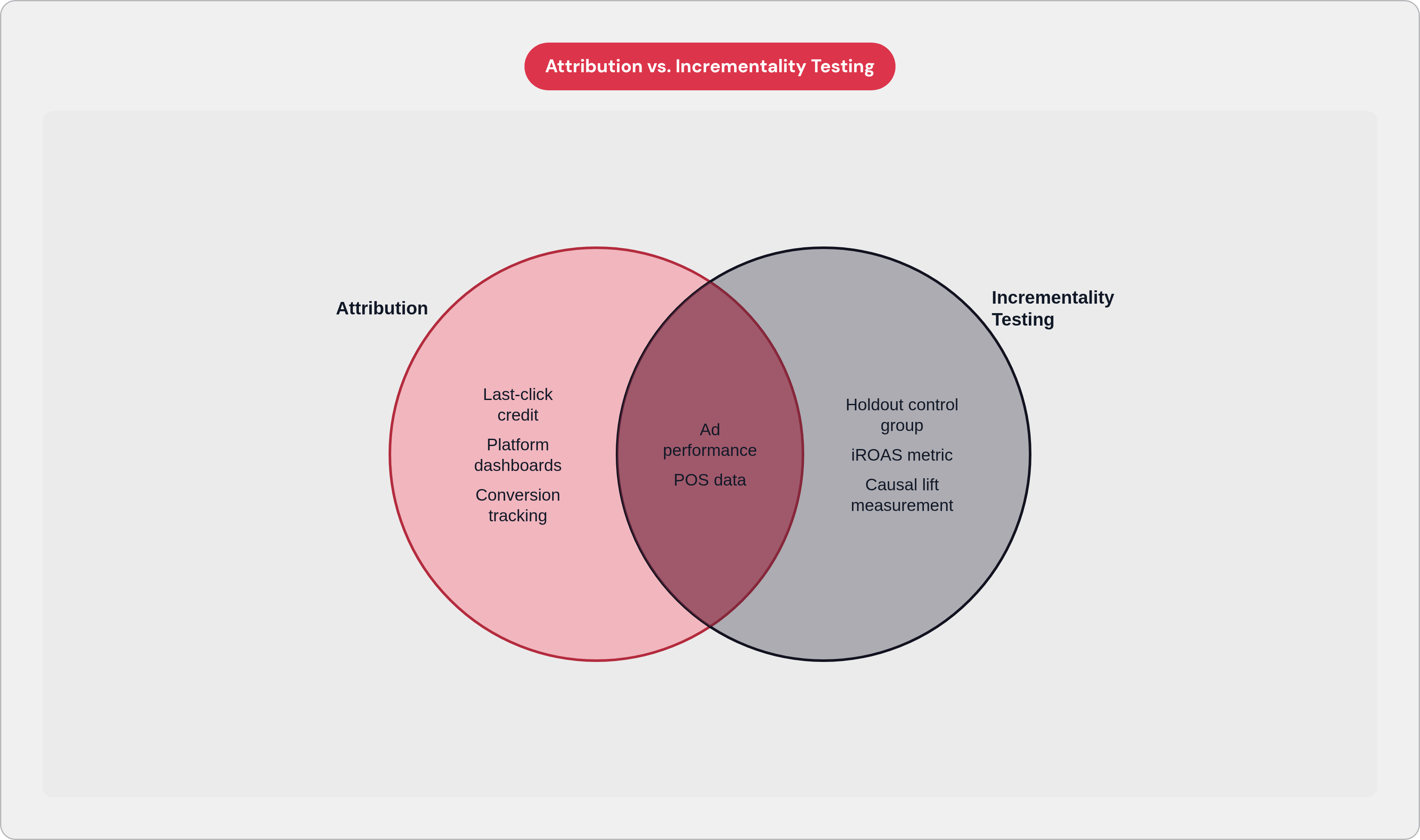
How the Test-vs-Control Method Translates to a Restaurant's Physical Reality
Restaurants are local. That is mostly a constraint, but for incrementality testing it is an advantage. The control "market" doesn't require a separate media region or a different country. It can be a neighboring zip code, an adjacent neighborhood, or a comparable daypart slice within the same trade area.
A practical single-location test looks like this: define an exposed group of customers within a target radius who are served the campaign, then define a control group matched on demographics, baseline visit frequency, and proximity, withheld entirely. Run both through the same calendar window to neutralize seasonality. Then measure from the POS, not from the platform dashboard.
That last point is not a stylistic preference. The POS is ground truth. Feastalytics, a restaurant analytics platform that ties marketing campaigns directly to POS sales data, is built on this same principle. Any test that cannot connect ad exposure to an in-store transaction is measuring the wrong thing.
Operators without enterprise-grade data infrastructure have practical shortcuts available. Card-linked offers and promo codes close the loop cleanly: a redeemed code is a confirmed, attributable visit requiring no pixel and no integration. Meta and Google both offer store-visit measurement tools using location signals from opted-in mobile users, which can provide directional signal, but the methodology is proprietary and administered by parties with a vested interest in favorable outcomes. Treat those tools as one input among several, not as verdicts.
TikTok has partnered with third-party location intelligence providers to measure exposed-versus-control foot traffic as its ad ecosystem matures, which is worth watching. But the honest framing for operators across all of these platforms is consistent: foot traffic attribution reported by a platform is signal. A real incrementality test requires a withheld control group the platform cannot reach, let alone claim credit for.
The Branded-Search Problem as a Worked Example of What Incrementality Reveals
Most operators find branded search campaigns intuitive. Someone typed your restaurant's name into Google. Your ad appeared. They came in. The reported ROAS looks excellent. What is there to question?
Incrementality testing answers that directly: a guest who already typed your name into a search engine was, in all likelihood, coming regardless of whether your ad appeared. They had already formed intent. The ad intercepted a conversion already in motion, then took credit for it.
Stella's geo-based incrementality testing data, drawn from roughly 225 DTC brand tests run between August 2024 and December 2024, found that branded search produced a median iROAS well below breakeven, the lowest of any channel tested, while the full-portfolio median was meaningfully positive. The channel that looked safest in the dashboard was, in incremental terms, among the least defensible. However, Stella has not published this data in a peer-reviewed or independently audited format, and operators should treat it as directional rather than definitive until the methodology is disclosed in full.
That should give any operator pause. Not because branded search is generally indefensible — competitive defense has real value in certain contexts — but because the gap between platform-reported ROAS and true incremental ROAS is widest precisely where performance looks best. Ads intercepting existing intent score beautifully in attribution models. They don't move the needle.
The restaurant parallel is direct. A loyalty email to regulars that drives a Tuesday visit reads as a marketing win. But would those regulars have come Tuesday without the email? Incrementality testing asks that question honestly, and the answer is frequently uncomfortable. That discomfort is actually the point: it separates ads that caused behavior from ads that merely accompanied it. The difference, in budget terms, is not trivial.
Why Platform Measurement Systematically Overstates Campaign Impact
Platforms measure within their own ecosystems. Meta reports on people who saw Meta ads. Google reports on people who clicked Google ads. Neither has visibility into what the other drove. Neither has an institutional incentive to report zero impact. This is not a conspiracy; it is a structural conflict of interest baked into how the measurement is designed, and it produces predictably flattering results.
Last-click and last-touch attribution models compound the problem by assigning full credit to the final touchpoint before conversion. For restaurants, that final touchpoint is often a branded search or a direct reservation link, which erases every upstream influence that built the intent. A TikTok video sparks curiosity. An Instagram story reinforces it. A Google search closes it. Last-click gives Google one hundred percent of the credit. TikTok and Instagram cannot argue back because they lack access to that data.
The store-visit measurement tools platforms offer use location signals from opted-in users, estimating both the exposed group and the organic baseline from proprietary methodology. Both numbers are estimated. The methodology is not independently auditable. And the entity reporting the result is the same entity selling the ad. That should at least give an operator pause before treating the number as settled.
The practical consequence is that operators who trust platform-reported metrics are optimizing campaigns to look good in dashboards, not to fill more seats. Gartner's 2025 CMO Survey found that roughly 59% of CMOs reported lacking sufficient budget to execute their strategy; operators should verify this figure directly with Gartner, as survey findings of this kind vary by edition and sample. For restaurants operating on thin margins, every dollar misallocated because of inflated platform metrics is a real operational cost, not an abstract measurement error.
What a Valid Incrementality Test Requires to Produce Trustworthy Results
The control group must be withheld entirely. Not a smaller budget. Not a different creative. A matched population that never sees the campaign. That distinction is the entire test. If there is no clean holdout, there is no test; there is just attribution with a longer name.
Matching quality determines whether results are actionable. Test and control groups must be comparable on baseline visit frequency, geography, demographics, and known seasonal behavior before the campaign launches. A control group that was already visiting less frequently than the test group is a confound, not a control.
Duration and sample size matter more than most operators realize. Too short a window conflates a single busy weekend with campaign lift. Too small a holdout produces noise that can't be acted upon. Two to four weeks is a reasonable floor; lower-traffic dayparts may require longer windows to accumulate meaningful signal.
The measurement instrument must be independent of the platform being tested. POS transaction data, promo code redemptions, and card-linked offer data all qualify. The platform's own conversion API does not. Pre-test baselining is non-negotiable: record traffic and transaction data from both groups for an equivalent period before launch, because the control group's behavior during the campaign is only interpretable if you know how closely it tracked the test group before the campaign began.
Statistical significance is not an academic nicety; it is the threshold that separates a finding from a coincidence. Operators don't need to run the math themselves, but they should require any vendor or agency to report confidence levels alongside lift figures. A result with no confidence interval attached is not a result.
One red flag worth naming explicitly: any measurement vendor who won't disclose methodology, or whose control group is also receiving organic content from the same campaign, is not running a real incrementality test. They're running an attribution study and calling it something more rigorous. The rebranding is the tell.
How Restaurants Without Data Science Teams Can Run or Commission Meaningful Tests
Meaningful incrementality testing does not require a data science team. It requires a control group and a POS, both of which most operators already have.
A lightweight test any operator can run: pick two comparable weeks, or two comparable locations if you're multi-unit. Run the campaign to one group, withhold it from the other. Compare cover counts or transaction totals from the POS at the end of the window. A promo code unique to the campaign is a clean, low-tech attribution anchor requiring no pixel and no agency relationship.
When commissioning a vendor or agency to run a more rigorous test, four questions establish whether the engagement is structurally sound. How is the control group constructed and withheld from the campaign? What is the measurement source, platform data or independent transaction data? What confidence level is reported alongside the lift figure? Can you show me the pre-test baseline for both groups? A vendor who can't answer all four with specificity is worth reconsidering before you sign anything.
The goal is not academic rigor for its own sake. It is directional confidence sufficient to move budget. One restaurant in tracked data lifted return on ad spend by a factor of ten within six months by doubling down on channels the incrementality data supported and reallocating away from what it couldn't defend; the source of this tracked data should be identified and the methodology disclosed before this result is cited as evidence. Whether that result generalizes or not, the method does: run the test, read the signal, move the money. That is not a sophisticated strategy. It is a feedback loop applied consistently, which turns out to be rarer than it should be.
A practical kill criterion: a channel that produces no measurable lift across multiple test windows, even qualitatively, is a candidate for reallocation regardless of what the platform dashboard reports. The dashboard, to be blunt, does not get a vote.
What Incrementality Testing Changes About How Operators Should Read Their Results
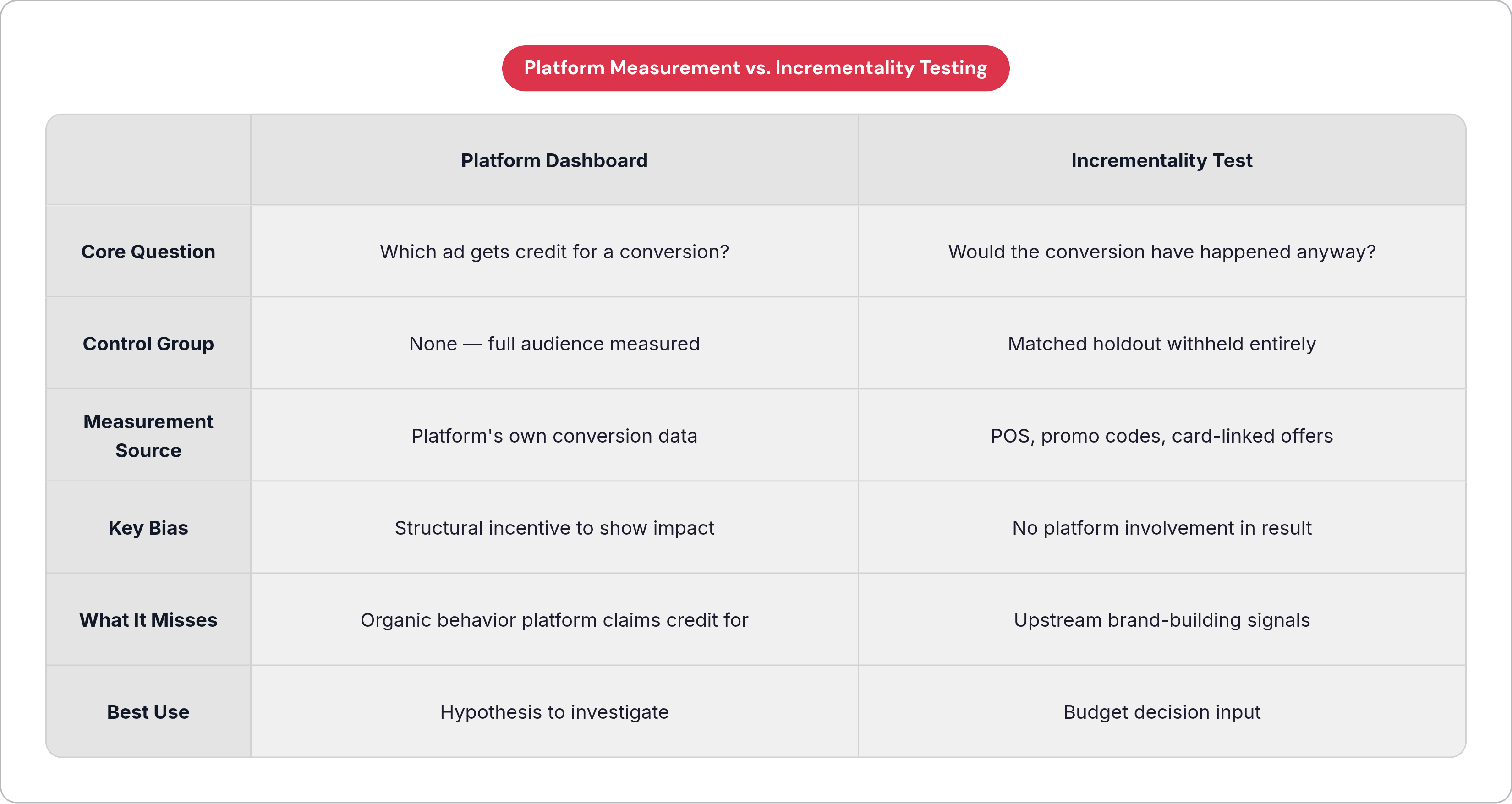
The shift incrementality testing demands is fundamentally conceptual. Stop reading platform dashboards as scorecards. Start treating them as hypotheses requiring independent confirmation before they inform a budget decision.
High platform ROAS on a channel that fails an incrementality test is not a win; it is evidence the platform is claiming credit for organic behavior that would have occurred anyway. Low platform ROAS on a channel that produces measurable incremental lift is not a failure; it is driving new guests that last-click models simply cannot see. Learning to hold both of those realities simultaneously is most of what incrementality discipline asks of an operator.
It is also worth considering what incrementality results look like compounded over time. A single test tells you whether one campaign worked. A testing cadence tells you which channels, creatives, and audiences tend to cause visits versus merely accompany them. That accumulated knowledge is a durable operational asset, and unlike a campaign, it doesn't expire at the end of the month.
Deloitte Digital's 2025 State of Social research found that restaurants with active social media strategies reported an average 9.9% increase in direct revenue attributable to social efforts in 2024; operators should consult the Deloitte Digital 2025 State of Social report directly to verify the figure and the attribution methodology underlying it. Incrementality testing is what separates operators who can verify a number like that from operators who have to take it on faith and hope the platform isn't flattering itself.
The question every ad dollar deserves an honest answer to is simple: did this bring in guests who wouldn't have come anyway? That answer is only available when the measurement is designed to produce it. Designed to answer the question honestly — not to confirm the spend, not to make the dashboard look good. Most restaurant advertising, at present, is not designed that way. Incrementality testing is a more tractable fix than the margin problem, which is fortunate, because the margin problem isn't going anywhere.