Building a Restaurant SMS Subscriber List
Trace text signups to actual revenue by building your list with attribution in mind from day one.

Restaurant SMS marketing is one of the few channels where a single customer action, a text opt-in, can be traced in a straight line to a table filled and a ticket rung. The problem most operators encounter is that they build the list without designing that line first, then wonder why subscriber counts grow while revenue attribution stays invisible.
That gap is worth examining carefully, because the mechanics of SMS make it structurally more accountable than almost anything else a restaurant operator spends money on. Social platforms report impressions; the POS reports covers; nothing connects them. SMS can connect them, but only if the list is built with that connection in mind from the beginning.
What follows is an attempt to think through how that actually works, channel by channel and decision by decision, starting with the numbers operators tend to cite and ending with the ones they should actually be watching.
What the Numbers Actually Say About SMS ROI, and What Restaurants Should Ignore
ROI estimates for SMS marketing span a wide band: figures in the range of $21 to $41 per dollar spent appear regularly, with some seasonal campaigns reporting significantly higher returns. Operators should resist anchoring on the top of that range. The more useful question is which conditions produce which outcomes.
One distinction that rarely surfaces in the headline figures is the gap between broadcast campaigns and automated, triggered messages. Automated SMS messages, think reservation reminders, post-visit follow-ups, birthday offers, generate meaningfully more revenue per send than broadcast campaign messages. That ratio is not a minor operational detail; it determines how a restaurant should architect its entire program. Broadcast campaigns (flash offers, slow-night specials) have their place, but they carry less revenue weight per message than automated sequences tied to guest behavior.
It is also worth noting where most headline SMS ROI data originates: e-commerce. The largest published studies cover thousands of online retail brands, where the mechanism is cart recovery and purchase completion. Restaurants should treat that data as directional. The analog for a restaurant is not abandoned cart recovery; it is an unconverted dine-in occasion. Similar principle, different trigger, and the conversion path runs through a physical door rather than a checkout button.
A more conservative and defensible benchmark is that businesses broadly attribute a meaningful share of revenue to SMS marketing, not a transformative majority, but enough to justify dedicated infrastructure. The volume trend reinforces the urgency: SMS message volume rose substantially in 2024 and again in 2025. Operators who wait are not entering a nascent channel; they are entering an increasingly crowded one with a later-mover disadvantage in subscriber acquisition.
The Compliance Foundation Every List-Building Effort Must Be Built On
Before any of the tactical decisions about opt-in placement or offer structure matter, there is a legal framework that determines whether the list is an asset or a liability.
The Telephone Consumer Protection Act requires prior express written consent for promotional SMS messages. Having a customer's phone number from a loyalty program, an online order, or a reservation system does not constitute permission to market via text. That distinction surprises a lot of operators, particularly those who assume that a transactional relationship implies a marketing one. It does not.
Valid opt-in means an explicit, affirmative action taken by the customer to agree specifically to receive marketing texts from your restaurant. Double opt-in, where the customer takes an initial action and then confirms via a reply text, is the cleanest standard and the most defensible if challenged. Every signup method must include clear disclosure of message frequency and content type.
The financial stakes are not abstract. TCPA violations carry fines per message, and a single mass send to an improperly sourced list represents an existential risk for an independent restaurant operator. This is not a compliance lecture; it is an arithmetic observation.
That raises an important question: is compliance purely a legal burden, or does it serve a strategic function? It is both. Subscribers who navigate a proper opt-in flow are signaling genuine interest. The list that comes out of a rigorous consent process is smaller than one assembled by importing phone numbers from every adjacent database the operator controls, but it is also more engaged from day one. Compliance, counterintuitively, is a quality filter.
Practical note: SMS platforms built for the restaurant and retail space, including tools integrated with ordering platforms like ChowNow or marketing stacks like Mailchimp, carry built-in consent capture flows designed to satisfy TCPA standards. Use them. General advice, including this article, is not a substitute for platform-level compliance architecture.
In-Store Opt-In Touchpoints and Which Ones Actually Convert Dine-In Guests
The guiding principle for in-store opt-in placement is deceptively simple: the best moment to capture a subscriber is when the guest has already decided they like the experience. You are not asking them to commit to a future relationship with a restaurant they are uncertain about; you are capturing sentiment that already exists.
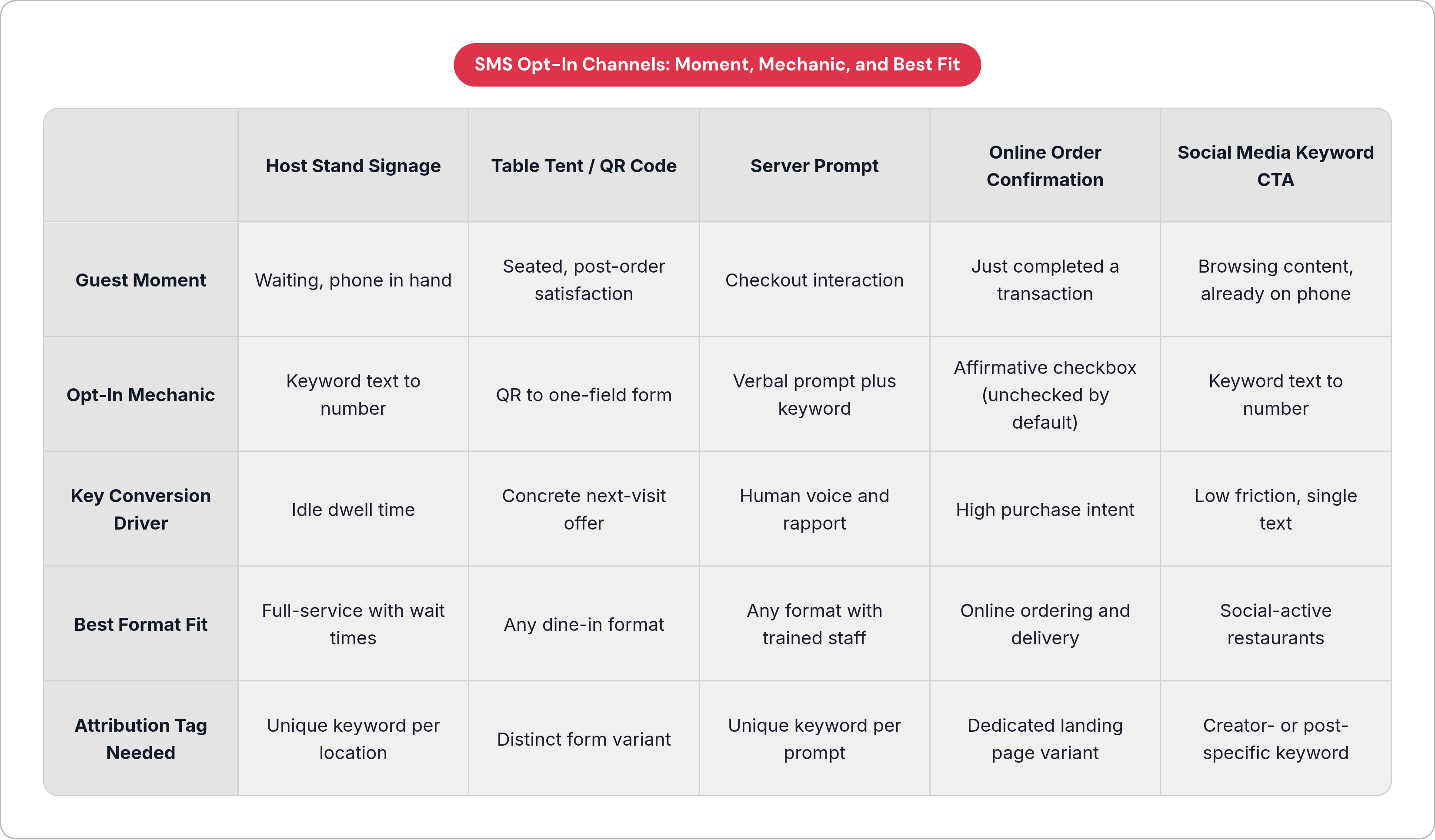
Host stand signage catches guests during wait time: idle, attentive, and phone already in hand. A keyword-based signup, "Text VIPGUEST to [number]," requires no form, no link, and no friction beyond a single text. This works best for restaurants with meaningful wait times or a visible queue; if guests walk directly to a table, the dwell time evaporates.
Table tents operate differently. The guest is seated, the order is placed, and the decision to stay has been made. A QR code linking to a one-field opt-in form, paired with a specific, tangible offer redeemable on the next visit, captures a guest at or near peak satisfaction. The offer matters: "exclusive deals" is too vague to motivate action; "15% off your next visit" is a concrete promise. The distinction affects conversion rates in ways that are not subtle.
Server and cashier prompts introduce a variable that passive signage cannot replicate: a human voice. A brief, trained prompt at checkout, delivered naturally rather than robotically, has measurable lift over signage alone. The training investment is modest; the incremental conversion is not.
Receipts and takeout bag inserts operate at lower intent and lower friction simultaneously. The guest is leaving and probably distracted. These touchpoints are better suited to high-frequency formats, fast casual, pizza, lunch counters, where the path back to the restaurant is short and the offer of a "next order" discount lands in a relevant mental frame. For special-occasion dining, where return visits are measured in months, the mechanic is less effective.
One operational note that most guides skip: tag every in-store touchpoint distinctly at signup. Host stand, table tent, and cashier prompt should each generate a unique keyword or form variant. The reason becomes clear later, when you are trying to understand which subscribers actually return.
Digital and Off-Premise Opt-In Channels That Extend the List Beyond Walk-In Traffic
The limitation of in-store opt-in is obvious: it only reaches guests who are already in the restaurant. For a list to grow at meaningful scale, it needs channels that operate independently of foot traffic.
Online ordering confirmation pages and post-order emails represent high-intent moments. The guest just spent money. They are in a transactional mindset and are receptive to a next-visit or next-order offer. The compliance note here is critical: a pre-checked SMS opt-in box on a checkout form does not satisfy TCPA requirements. The action must be affirmative, and the checkbox must be unchecked by default. Operators who shortcut this create a list that is both legally exposed and behaviorally disengaged.
Social media keyword calls-to-action, a post or bio directing followers to "Text TACOS to [number] for a free side," drive off-platform subscribers without requiring a link click. The mechanism is frictionless by design: the potential subscriber is already on their phone, and a single text is a lower commitment than a form. This channel connects directly to the creator content thesis explored later, but it functions independently as well.
Email list cross-promotion is underutilized. Email subscribers have already demonstrated trust and interest in the restaurant. A dedicated email explaining the SMS list's distinct value proposition, framing it as a different tier of access rather than a channel substitution, will convert a meaningful share of that existing audience. The framing matters: "Our texts are for same-day specials and flash offers; the email newsletter is monthly." Different cadence, different content, different reason to opt into each.
Reservation and loyalty program integrations create natural opt-in candidates at the point of enrollment, provided the consent capture is a separate, affirmative checkbox and never assumed from the transactional relationship itself.
Website pop-ups tied to specific offers and Google Business Profile posts with keyword-based CTAs round out the digital footprint. The latter is particularly interesting: a guest searching the restaurant on Google is already expressing intent, and a keyword CTA in a Business Profile post captures that intent before it dissipates.
Across every digital channel, the same source-tagging discipline applies. Distinct keywords or landing page variants per channel allow acquisition to be traced back to its origin. This is the digital equivalent of a UTM parameter, and without it, the operator is back to the same measurement gap they started with.
Why a Small, Tagged List Outperforms a Large, Undifferentiated One
Two cases from outside the restaurant industry make this argument more clearly than any framework could.
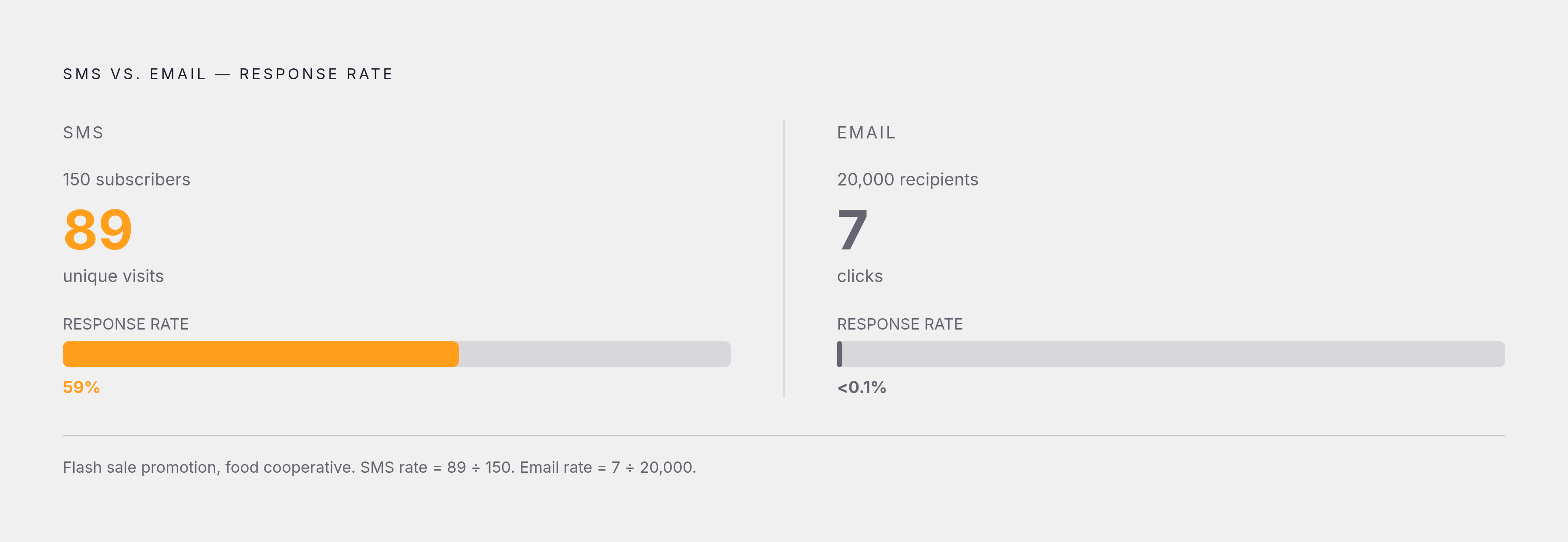
A food cooperative with roughly 150 opted-in SMS subscribers sent a flash sale promotion and drove 89 unique visits to the sale page. The same promotion sent to an email list of approximately 20,000 generated 7 clicks. The ratio is not a statistical curiosity; it is a structural observation about what consent and relevance actually produce.
Marczyk Fine Foods, a specialty grocer, texted 150 subscribers about a cherry pie special ahead of the Fourth of July. Pre-orders moved from 1 to 36 in 36 hours. A small, local, highly relevant list converted into same-day revenue in a format that any restaurant operator would recognize immediately.
Both cases share the same architecture: small list, specific local offer, immediate response. The restaurant analog is not approximate; it is exact.
But what if the list is large and tagged? That is where segmentation becomes the operative variable. Subscribers who opted in at the host stand exhibit dine-in behavior; they respond differently to a "reserve your table tonight" message than subscribers who opted in via a takeout bag insert. A catering page opt-in signals corporate or event spend, an entirely different offer track. Segmented sends yield higher open rates and measurably lower unsubscribe rates, not because the messages are better written, but because they are more relevant to the recipient's actual relationship with the restaurant.
The list inflation trap is real, and the incentive structure around it is perverse. Platforms and agencies often report subscriber count as a headline success metric because it is the most visible number. Operators should push for engagement rate and redemption rate as the primary measures. A list of 500 subscribers who redeem at 20% is worth more, operationally and financially, than a list of 5,000 who open occasionally and act rarely.
One point raised in favor of a larger list is that it provides optionality, that even a passive subscriber will activate eventually. But the cost of carrying disengaged subscribers is not zero: it includes elevated opt-out rates, degraded sender reputation, and the legal exposure that comes from importing contacts without verified SMS consent. The math does not favor volume over quality.
How to Structure Offers That Make Opt-In Worthwhile and Redemption Trackable
The opt-in offer is a contractual implication, not a discount line item. When a guest signs up because the table tent promised 15% off their next visit, they have also formed an expectation about every message that follows. The offer sets the tone for the entire subscriber relationship.
Offer types that connect directly to in-store visits share a common characteristic: they require the subscriber to physically appear in order to redeem. Same-day flash specials, half-price appetizers until 8 PM on a Tuesday, work because urgency is the mechanism. The subscriber cannot bank it; they have to act now or lose it. Next-visit discount codes redeemable only at the POS create a natural attribution point: the code used at checkout traces back to the text that delivered it. Early access to limited items, a seasonal menu preview before it sells out, preserves margin while delivering genuine value because scarcity, not discount depth, is the value proposition. Birthday and anniversary offers are automated, triggered, and typically among the highest-converting message types because they feel personal even when they are not.
Timing is a design element, not a scheduling afterthought. Sending at 11 AM for lunch consideration, or between 4 and 5 PM as dinner decisions form, determines whether the offer lands inside a decision window or outside it. A well-structured offer sent at the wrong time is still a missed opportunity.
Closing the attribution loop requires a mechanism that most operators skip. A unique redemption code per campaign ties the POS transaction to the specific text that drove it. Without that link, the operator knows the text was sent and knows the table was filled, but cannot prove the connection. That is the same measurement gap that makes paid social frustrating: the spend is visible, the outcome is visible, the causal link is not.
The principle is identical: every marketing action needs a traceable path to an in-store outcome. The tools differ; the logic does not.
Frequency discipline deserves explicit attention. A meaningful share of consumers who unsubscribe from SMS cite message volume as the reason. Over-messaging is how a high-quality list degrades. Two to four messages per month per segment is a defensible ceiling for most formats, adjusted downward for less-frequent visitor occasions. The instinct to send more when results are slow is usually exactly wrong.
Using Local Creator Content to Accelerate List Growth and Pre-Qualify Subscribers
The structural problem with influencer marketing for restaurants is geographic mismatch. A creator with a large following generates impressions and engagement, but a follower in another city who watches a reel about a restaurant's new dish contributes nothing to in-store revenue. The impression is real; the commercial value is not.
A local creator, one whose audience is physically concentrated near the restaurant, solves this by collapsing the distance between the content and the cash register. Their followers can actually walk in. That is not a minor distinction; it is the entire argument for prioritizing local reach over aggregate reach.
How does creator content feed list-building specifically? A creator posts about the restaurant and includes a keyword call-to-action: "Text BIRRIA to [number] for a free side on your first visit." Followers who opt in are pre-qualified by geography and by interest. They arrived via a trusted recommendation, not a cold advertisement. They already know what the restaurant offers. That subscriber is more likely to redeem than one acquired through a generic paid acquisition campaign, because the creator has already done the pre-selling.
Paid amplification of creator content extends this logic. Boosting a creator's post to a geo-targeted audience, a defined zip code radius around the restaurant, converts organic reach into a structured acquisition funnel. The paid spend drives the view; the creator's voice drives the trust; the keyword CTA captures the subscriber. Three distinct functions, one campaign.
That raises an important question about attribution. A subscriber acquired via a specific creator post can be tagged by source at the point of opt-in. If that subscriber later redeems an in-store offer, the operator can trace the revenue back through the full chain: creator content, paid amplification, SMS opt-in, POS redemption. The SMS list becomes one node in a measurable acquisition system rather than a standalone database with an unknown origin story.
The data point worth anchoring to: a meaningful majority of surveyed restaurant operators identify promoting in-person events on social media as the most effective tactic for driving visits. Pairing a creator event post with an SMS opt-in CTA combines both approaches into a single campaign without duplicating the execution cost.
Measuring Whether the SMS List Is Actually Filling Tables, Not Just Growing
Growth metrics and revenue metrics are not the same thing, and the gap between them is where most SMS programs quietly fail.
The metrics that matter for a restaurant SMS program are not subscriber count and open rate, though both are useful as leading indicators. The metrics that matter are redemption rate per campaign, revenue per message sent, and, where the attribution infrastructure exists, POS-verified visits attributable to a specific send. Everything else is a proxy.
Redemption rate per campaign answers the most direct question: did the offer move people from their couch to a seat in the restaurant? If the redemption rate on a flash offer is consistently low, the problem is either the offer itself, the timing, the relevance to that subscriber segment, or some combination. The rate is diagnostic, not just evaluative.
Revenue per message sent allows comparison across campaign types and, critically, across segments. Automated triggered messages outperform broadcast campaigns on this metric, but the gap varies by restaurant type, offer structure, and list quality. Tracking it over time reveals which campaign architectures produce returns worth repeating and which consume send volume without proportional revenue.
POS-verified attribution, linking a specific text to a specific transaction via a redemption code, is the measurement standard that eliminates inference and replaces it with evidence. It is also the standard most operators do not implement, because it requires coordination between the SMS platform and the POS system that is slightly less convenient than sending a broadcast and watching covers go up. The inconvenience is the cost of actually knowing what worked.
Why exactly does this matter beyond intellectual tidiness? Because the operator who cannot demonstrate that the SMS list is filling tables is running a marketing program on faith. That is fine until the program needs to justify its budget, until a partner or investor asks for the return, or until the list starts degrading and the operator cannot diagnose why. Measurement is not a reporting function; it is the feedback mechanism that makes the program improvable.
The list that is growing but not converting is not an asset. It is a deferred liability: a database of people who will eventually opt out, lower sender reputation scores, and obscure the signal from the subscribers who actually drive revenue. The goal was never a large list. It was a traceable path from a text message to a table filled, and then the discipline to follow that path backward to understand exactly which decisions created it.