Building an SMS Subscriber List for a Restaurant
Quality subscriber data and source tagging matter more than list size for restaurant SMS campaigns.

SMS marketing numbers look almost unfair relative to other channels: open rates near 98%, most messages read within minutes, conversion rates in restaurant campaigns that consistently clear 15%. Email rarely breaks 28% on opens. But here is the thing nobody says loudly enough: a high open rate on a list of people who will not set foot in your dining room is not a marketing win. It is an expensive illusion — like winning a race no one else entered — and a surprisingly easy one to maintain when you are only looking at open rates.
That distinction matters more for restaurants than for almost any other business category. An ecommerce brand can convert a subscriber anywhere in the country at any hour. A 60-seat neighborhood restaurant needs that subscriber to show up on a Tuesday at 6 PM. The mechanics are different, and the tactics should be too.
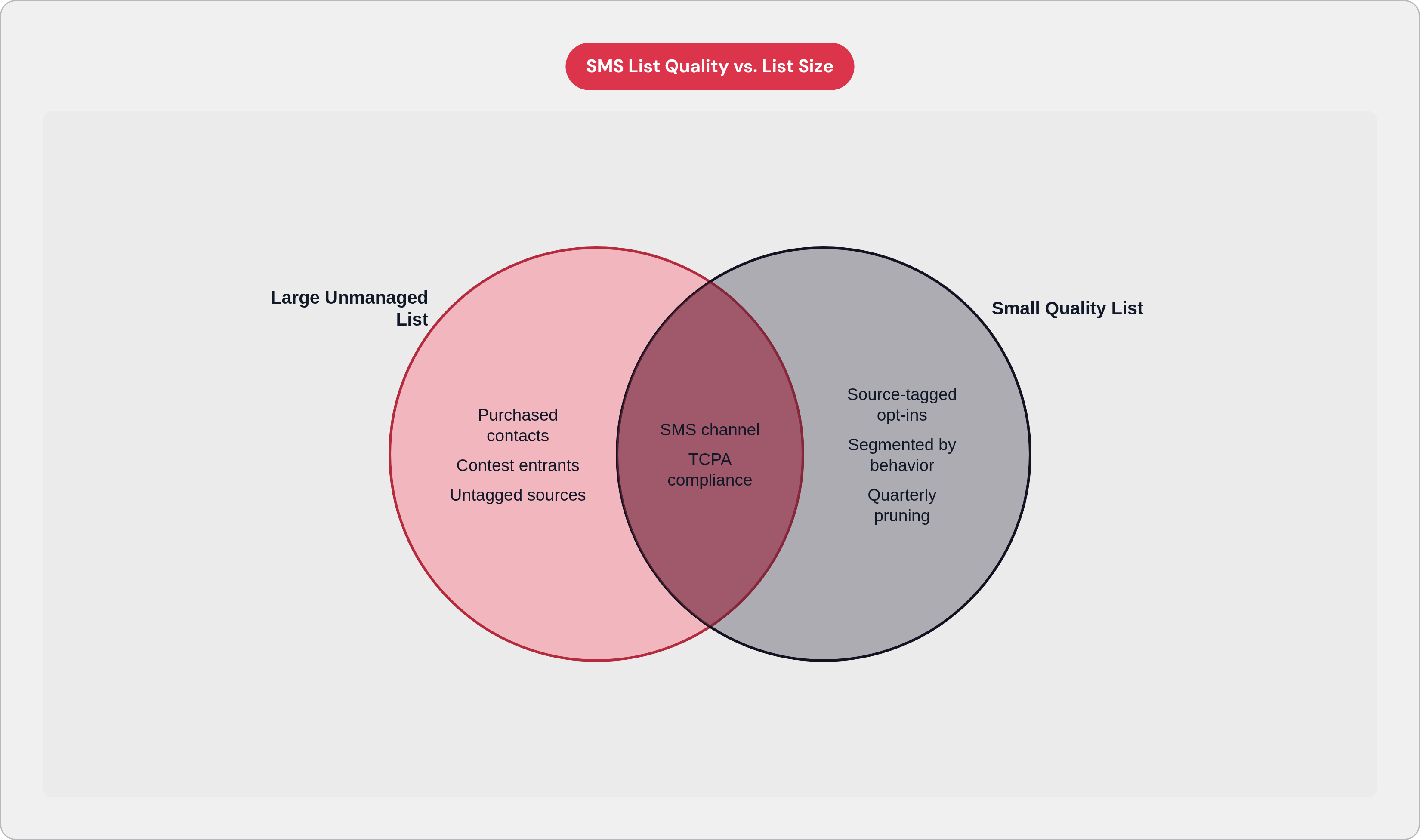
So what actually makes a list a liability? Three things, and none of them are subtle once you know to look.
Purchased or imported contacts. This is both a legal exposure under the Telephone Consumer Protection Act and an immediate trust violation. People who did not ask to hear from you are unlikely to visit; they will report your texts as spam and potentially trigger regulatory scrutiny.
A large, untagged list with no record of where subscribers came from or what they ordered. Without source data, you cannot know which message works for which customer. You are broadcasting into a room with the lights off, which is rarely a good strategy.
Subscribers who were implausible guests from the start. Someone who entered a contest, grabbed a one-time discount, and moved two states away is on your list and costing you money per send. They will skew your metrics downward and make it difficult to assess what is working.
The U.S. SMS marketing market is projected to reach $12.6 billion by 2025, growing at roughly 20% annually. That is infrastructure, not novelty. And as of 2025, 84% of consumers have opted in to receive SMS from at least one business, which means the opt-in is no longer a high-friction ask. That actually makes the consent more meaningful, and downstream, the list more valuable. But value is conditional on quality. A smaller, well-tagged, consented list outperforms a larger pile of undifferentiated contacts. Everything that follows is built on that premise.
Collect Opt-Ins at the Moments Guests Are Already Engaged
A guest who pulls out their phone to scan a QR code while waiting for their check is communicating something: they liked the experience enough to invite future contact. That self-selection is the whole game. Every other subscriber, the one who entered a sweepstakes or clicked a link in a sponsored post from a brand they barely recognize, carries far less intent. The moments when guests opt in are not interchangeable, and treating them as such is where the list quality problem begins.
In-store collection touchpoints should be designed around peak satisfaction. A table tent or QR code in the check presenter is the lowest-friction option available: the meal is over, the experience is fresh, the guest is predisposed to say yes. A text-to-join keyword at the host stand or register, something like "Text PASTA to 12345 for a free appetizer on your next visit," works particularly well for quick-service formats where guests are already holding their phones. POS integration at checkout embeds the opt-in into the payment flow, requiring no additional behavior from the guest.
Digital touchpoints follow the same logic. The online ordering confirmation screen is one of the best collection points available: the guest is mid-transaction, already engaged, and an opt-in offer lands without friction. A reservation confirmation message is another chronically underused vehicle; the guest is already expecting a text, so appending opt-in language adds almost no psychological weight.
Social media is more variable. A profile link or Stories prompt directing to an opt-in landing page can work, but the conversion rate depends heavily on the quality of content driving the traffic. This is where creator-driven campaigns become structurally important, which we will return to later.
One practice operators consistently skip and later regret: tag every opt-in source at collection time. Whether a subscriber came in via QR code, online ordering, or a creator's post changes how you should message them, what offer makes sense, and how you interpret their engagement later. Retroactive segmentation is harder and less accurate. Source tagging at the point of collection is the foundation of every intelligent send that follows, and skipping it is the kind of decision that feels inconsequential until you need the data.
Compliance is not a footnote. The TCPA requires express written consent before any marketing text. A double opt-in confirmation, where the subscriber replies to confirm enrollment, is the standard. Document the consent method for every contact.
Using Incentives to Grow the List Faster Without Cheapening the Offer
What does an incentive actually select for? That question is worth sitting with before designing one.
Consider a family-owned Italian restaurant that grew its SMS list from zero to 1,200 subscribers in three months by offering a free appetizer to any guest who joined. Within six months, those subscribers averaged 2.3 additional visits, which more than offset the appetizer cost. The list grew fast, and it paid back. But why it worked is the more interesting question. The appetizer required a return visit, which filtered the subscriber pool toward guests already inclined to come back. Someone hunting a freebie with no intention of returning would find the mechanics inconvenient and skip it. The incentive was, by design, a repeat-visit filter. That is the architecture that made it function as a quality control mechanism rather than a giveaway.
That principle should govern incentive design across every collection point. The offer should carry high perceived value but manageable cost: a free dessert, a drink upgrade, priority access to a busy weekend reservation. What it should not be is a deep discount that trains subscribers to expect a deal before they visit. Deep discounting is a short-term list growth tactic with a long-term revenue problem embedded in it. The guests it attracts are often the guests you least want: discount-sensitive, low-loyalty, quick to unsubscribe once the offer dries up.
The incentive also does not need to be uniform across channels. The offer at the table, rewarding a guest who already visited, can differ from the offer in a creator's post, which is introducing someone new to the restaurant. Source tagging makes those differences trackable, so you can evaluate which incentive type produces subscribers who return versus subscribers who just claimed something free. That distinction is where the real optimization happens.
What actively attracts the wrong subscriber? Giveaways and contest entries with no purchase requirement. They inflate the list, tank engagement rates, and skew conversion data in ways that make the whole program look worse than it actually is.
Segmenting the List So Messages Reach the Right Guest at the Right Moment
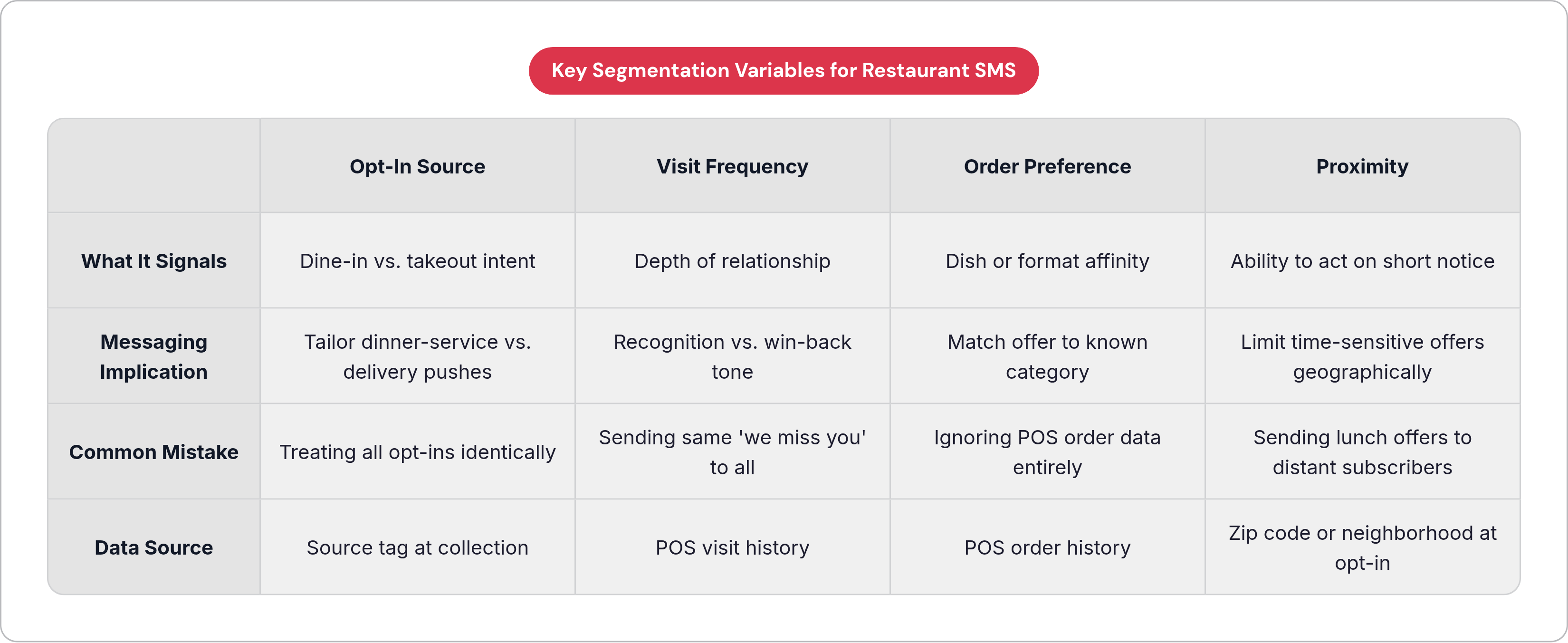
The conversion data on segmentation is instructive, and occasionally humbling if you have been sending blasts to everyone. A fast-casual chain that sent a targeted text to customers who habitually ordered salads achieved a 22% conversion rate. The same message sent to the full list produced 8%. That is not a marginal improvement; it is the difference between a campaign that pays for itself and one that barely registers. The question worth asking is: what exactly explains that gap, and which segmentation variables are actually accessible to a typical restaurant operator?
Opt-in source is the most accessible and the most underused. A guest who opted in at the table has demonstrated in-person dining behavior. A guest who opted in during online ordering defaults to takeout. Those two subscribers tend to respond differently to the same dinner-service push, and treating them identically wastes data you already collected.
Visit frequency is the next most useful variable. A guest who comes weekly is a different relationship than someone who visited once for a birthday dinner. The weekly guest needs to feel recognized; the one-time visitor needs a compelling reason to return. Sending both the same "we miss you" message reads as tone-deaf to one of them.
Order history or category preference, if your POS makes it accessible, adds another layer. Even a simple dine-in versus takeout split changes message relevance. A rainy-day push for a warm dish plays differently to someone who has only ever ordered delivery than to a regular who sits at the bar.
For operators near office corridors or residential neighborhoods, proximity matters. A lunch-hour offer makes geographic assumptions; if you are not sending it to people who can act on it in 45 minutes, the conversion rate will reflect that.
Start simple. A two-segment split, new subscribers and repeat guests, outperforms one undifferentiated blast to everyone. The segmentation can grow in complexity as the data accumulates. But the source tag applied at the moment of opt-in is what makes any of it possible.
When and What to Send: The Message Types That Actually Drive Visits
Timing is not a soft preference; it is a conversion variable, and treating it casually is one of the more expensive habits in restaurant marketing.
For the lunch crowd, a send around 11 AM catches guests in the window when they are actively deciding where to eat. For dinner, the 4 to 5 PM window captures the decision moment before plans solidify. Sending a dinner promotion at 8 PM is not marketing; it is notification archaeology.
Automated messages, triggered by guest behavior rather than a scheduled campaign, consistently outperform standard blasts on a per-message revenue basis. A re-engagement text sent to a subscriber who has not visited in 60 days, triggered automatically when that threshold hits, earns significantly more per send than a broadcast campaign. The trigger makes the message feel less like marketing and more like recognition, which is a meaningful distinction from the guest's perspective.
For actual campaign types: a same-day slow-fill text with a time-bound offer, "Free chips and salsa today only, 5 to 8 PM," addresses a real operational problem without training guests to wait for permanent discounts. The scarcity is genuine and the window is short. A text noting that you have 12 portions of a limited dish left tonight works the same way: urgency that is earned rather than manufactured. Reservation reminders are chronically underused. A meaningful percentage of restaurant reservations go unused, and a morning-of confirmation text materially reduces no-shows. That is inventory management, not marketing. Weather-triggered messages connect communication to a felt need, and contextual relevance converts.
Frequency discipline is where operators eventually stumble. Two to four messages per month tends to maintain engagement without triggering opt-outs. A large share of people who unsubscribe from SMS programs do so because of message volume. Over-sending does not just annoy subscribers; it destroys the list you built.
What not to send: vague brand messages with no call to action, announcements that require nothing from the recipient, any blast that goes to the full list regardless of relevance. Every message should justify itself with a specific action it is designed to prompt.
Connecting SMS Sends to In-Store Revenue: Closing the Measurement Gap
Most restaurants send a campaign, check the open rate, and call it a win. Opens do not fill seats, and they certainly do not pay food cost. The measurement gap between "this text got read" and "this text drove revenue" is where SMS programs quietly die, often without the operator fully understanding why.
The ROI figures attached to SMS marketing are striking, reaching $21 to $41 per dollar spent under normal conditions. But those figures mean nothing if you cannot connect a specific send to a specific night's cover count. This is not an unsolvable problem; it is just an unsexy one that requires deliberate infrastructure.
The attribution methods available to most operators are not sophisticated, and they do not need to be. Unique promo codes per campaign are the most direct instrument: each send gets its own code, redeemed at the POS, and the code tells you exactly which message drove which visit. For online reservation links embedded in texts, UTM parameters in the URL show which campaign drove the booking. For small operators without digital reservation systems, training staff to ask and log how a guest heard about an offer is low-tech and useful.
The measurement gap is structurally wider for restaurants than for ecommerce because the purchase happens offline. A Meta or TikTok campaign reports clicks and views; the POS reports revenue; and in most restaurant tech stacks, nothing connects the two. SMS is only as valuable as the attribution infrastructure behind it.
This is where platforms designed for restaurant attribution become operationally significant. Feastalytics, for example, builds its attribution logic around connecting content or ad exposure, including SMS-linked creative, to a recorded in-store visit at the POS. That infrastructure makes per-campaign ROI visible from a single view, rather than requiring an operator to reconcile platform-reported metrics against handwritten server notes. When you can see which message drove which visit and what that guest spent, the optimization decisions become considerably less ambiguous.
How Creator Content Accelerates List Growth and Feeds the Top of the Funnel
A restaurant's SMS list solves a retention and activation problem. It does not solve a discovery problem. Guests cannot opt in to hear from a restaurant they have never heard of, which is obvious until you watch an operator invest heavily in SMS infrastructure while wondering why the list is not growing.
A large majority of diners report that social media presence influences their restaurant choices, with the effect especially pronounced among younger cohorts. Creator content is where initial guest discovery increasingly happens. But what makes a creator partnership actually move people off social media and into a subscriber list?
Local concentration. A creator with 10,000 followers who all live within 15 minutes of the restaurant is more valuable than a national food account with half a million followers scattered across time zones. The former audience can walk through the door. The latter can only watch — and as they say, you cannot eat a screen.
Micro-influencers, generally defined as accounts in the lower-to-mid follower range, generate meaningfully higher engagement rates than macro accounts, and for a local restaurant, that engagement is geographically concentrated in exactly the audience worth acquiring. The math favors local depth over national reach.
That raises an important question about campaign design: how do you convert reach into owned subscribers rather than just impressions? The answer is a specific, low-friction call to action embedded in the creator's post: "Text [KEYWORD] to [number] for 15% off your first visit." The keyword is unique to that creator, so each opt-in is attributable to a specific partnership. A story swipe-up or link-in-bio directing to an opt-in landing page achieves the same result with a mobile-first audience.
One case worth noting: an influencer campaign tied to the "Brand to Table" model drove over 1,000 new followers to a New Jersey restaurant, demonstrating the pipeline from creator content to measurable guest acquisition. The key variable is whether awareness converts downstream into subscribers and, eventually, visits. Without a trackable opt-in mechanism in the creator's content, the reach tends to stay on the platform and evaporate there.
Consumer trust in creator recommendations is high; a significant majority of consumers report trusting influencer recommendations at a level comparable to personal referrals. A creator directing their audience to opt in is handing the restaurant a warm introduction. That is qualitatively different from a cold ad impression, and the conversion rates tend to reflect it.
Keeping the List Healthy Over Time: What Operators Get Wrong After the Initial Build
The initial build gets all the attention. The ongoing management is where most programs quietly degrade, and usually for entirely preventable reasons that only become visible months later when the metrics stop making sense.
A list decays. Guests move. Preferences change. A subscriber excited about a monthly dinner-for-two offer in January has relocated by June. Inactive subscribers drag down deliverability scores, skew conversion metrics, and cost money on every send. The signs are readable: conversion rates falling on campaigns that used to perform, opt-out rates creeping up, a widening gap between list size and actual visit attribution.
When those signals appear, the instinct is usually to send more or send louder. That is the wrong response, and it accelerates the decline.
Quarterly audits of inactive subscribers are necessary. Any subscriber who has not engaged with three consecutive sends should receive a re-engagement campaign before being removed. Something direct: "We have not seen you in a while; here is a reason to come back." If they do not act on that, suppress them. The list most likely to drive revenue a year from now is the most intentionally maintained one, not the largest one. This is counterintuitive for operators who have spent months growing the list and now feel like they are shrinking something they worked for.
One argument holds that aggressive pruning undermines growth metrics, and there is some truth to that. A shorter list looks worse in a dashboard. But what does it actually mean for a list to look healthy while performing poorly? It means the vanity metric and the performance metric are pointing in opposite directions, and you are optimizing for the wrong one.
Opt-out processing must be prompt. The TCPA specifies a compliance window, and slow processing is both a legal risk and a trust violation. Contacts who request removal and continue to receive messages become complainants, not subscribers.
The compliance landscape also evolves. Consent documentation is not a one-time exercise. The record of how, when, and through what mechanism each subscriber opted in needs to be maintained and accessible. That documentation is the legal foundation the entire program rests on, and it needs to hold up under scrutiny, not just at launch.