SMS vs Email Marketing for Restaurant Guest Engagement
SMS reaches guests in moments they act; email builds relationships that sustain them.
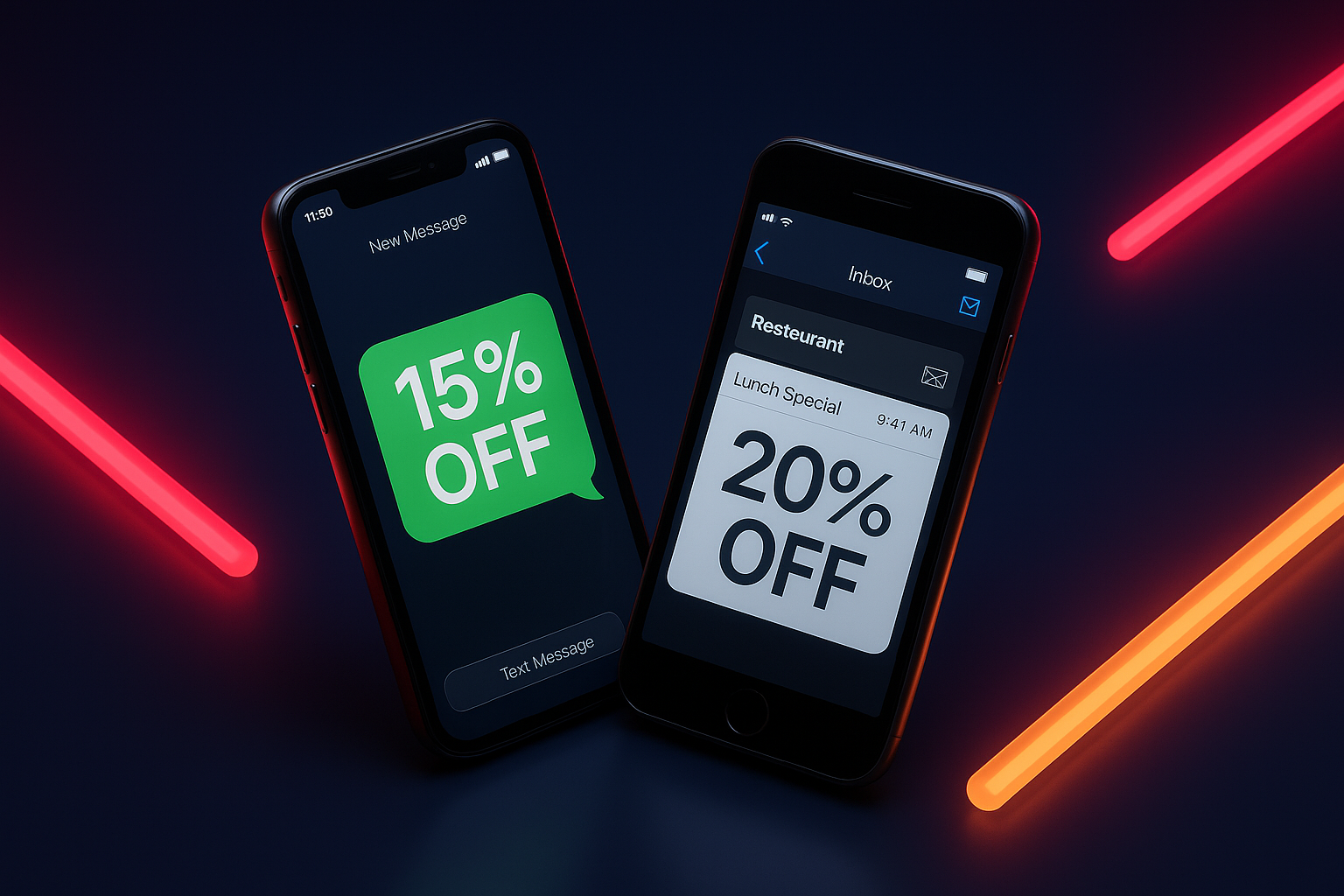
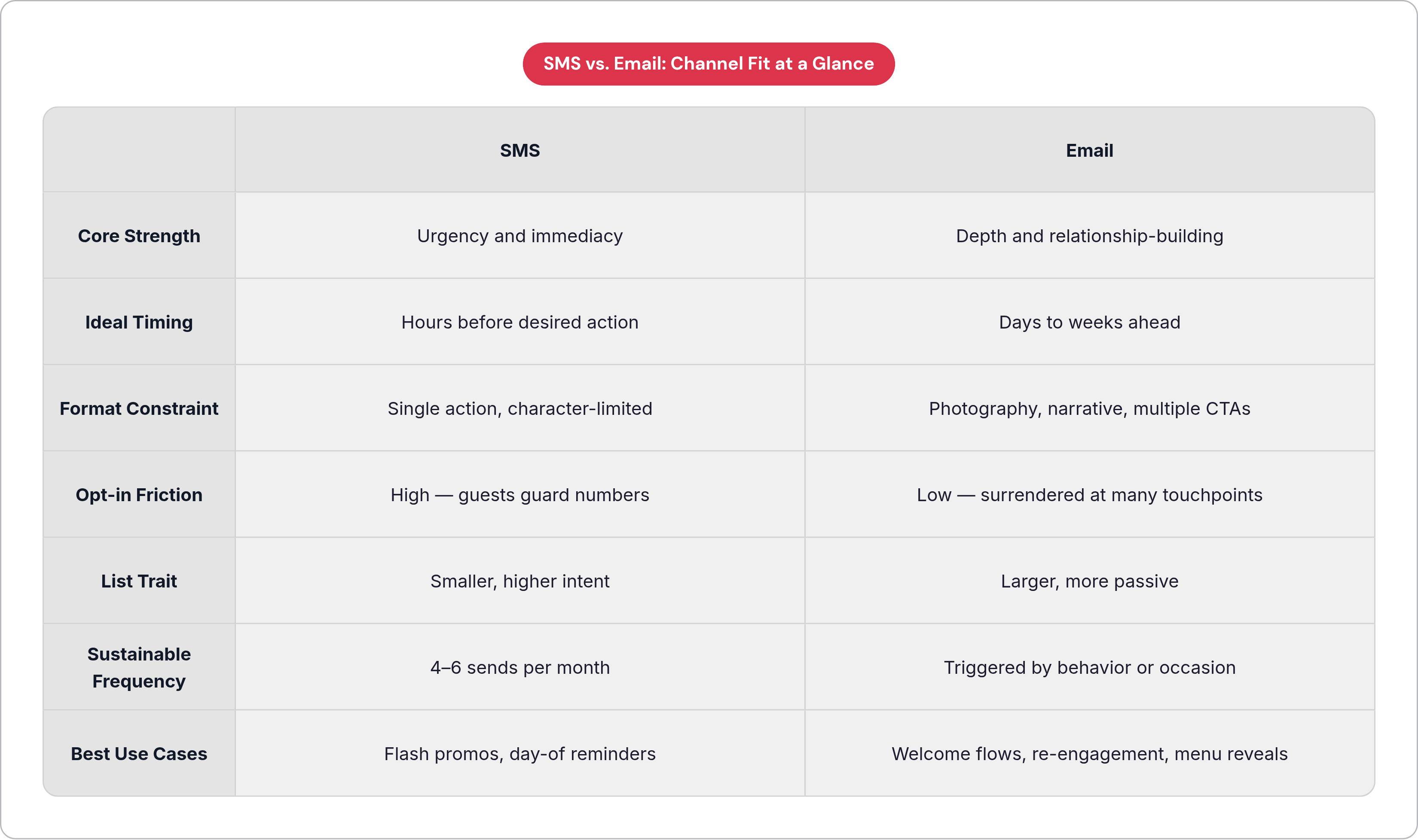
SMS lives in genuinely intimate territory. Think about what else occupies a person's text inbox: their spouse, their kids, the group chat from college that never quite died. When a restaurant lands there, the guest registers it at a different frequency than a promotional email, and that intimacy is the channel's entire value proposition. It's also exactly what makes misuse so costly.
Email carries a different implicit contract. Opening an inbox is a decision, not a reflex. Guests have already accepted that promotional email lives in that space, which means they hold less expectation of immediacy and considerably more tolerance for density, length, and multiple calls to action within a single send. Nobody is startled by a newsletter the way they're startled by a text from an unknown sender.
The immediacy gap between these channels is not marginal. Research on SMS read rates consistently shows that the overwhelming majority of text messages get opened within three minutes of delivery, while email sits until a subscriber decides to confront their inbox, which for many people means never, or at least not on the day the message was relevant.
But what if the noise environment matters more than open timing? Most commercial inboxes are so saturated with promotional messages that even a well-crafted send competes against dozens of others in the same folder. SMS inboxes see far less commercial traffic, so a text faces fewer rivals for attention by default. Guests haven't conditioned themselves to ignore SMS the way they've learned to scroll past the Promotions tab without reading anything.
The consent mechanics are also meaningfully different. Guests surrender their email address at dozens of touchpoints without much hesitation: reservation systems, loyalty apps, online ordering flows, paper comment cards. Phone numbers carry a different psychological weight. Guests guard them more carefully, which raises opt-in friction substantially, but someone who gives you their number is signaling genuine interest rather than reflexive compliance. The list is smaller; the intent behind it is denser.
Format shapes use case more than most operators acknowledge. SMS forces a single clear action inside a character constraint. Email accommodates photography, narrative, multiple links, segmented content blocks, and A/B testing infrastructure. These aren't competing advantages so much as specs that define which job each tool is actually built for, and conflating them is how restaurants end up sending a three-paragraph brand story via text and wondering why opt-outs spiked.
The Moments Where SMS Converts, and Why Urgency Is the Common Thread
Every SMS use case that converts well shares one property: the window between message delivery and desired guest action is short. Not days. Hours, sometimes minutes.
A text sent at 4 p.m. offering a happy hour special works because the guest reads it before 6 p.m. and has time to act on it. The same message sent via email surfaces two days later when someone finally clears their inbox, at which point the offer is expired and the trust is slightly eroded. Reservation confirmations and day-of reminders reduce no-shows without requiring the guest to open an app or hunt for a confirmation buried three screens deep. "Tonight only" framing, post-visit review requests within 24 hours while the experience is still neurologically fresh, flash promotions with a hard expiration: all of these work because the channel and the timing are synchronized.
Bubbakoo's Burritos ran SMS campaigns that demonstrated this alignment, achieving click-through rates and per-message revenue that validated the channel for time-sensitive promotional use. The result wasn't particularly surprising in retrospect. They matched an urgent offer to the channel built for urgency.
Frequency discipline is the variable restaurants most consistently mismanage. The signal-to-noise advantage SMS holds evaporates the moment a restaurant starts sending three texts a week. Operators who find sustainable engagement typically land on somewhere between four and six sends per month, reserved for genuinely timely moments. Exceed that threshold and guests opt out, which is worse than never having them on the list, because now they've made an active decision against you. Collecting phone numbers is harder than collecting emails, too, and glossing over that difficulty doesn't serve anyone. Guests opt in when there's a clear value proposition on the other side of the ask: exclusive offers unavailable through any other channel, reservation-linked confirmations that feel functional rather than promotional, or loyalty enrollment that makes the number exchange feel like a transaction with obvious upside for both parties.
The Moments Where Email Converts, and Why Depth Is the Common Thread
Email earns its keep when the goal is to build, maintain, or occasionally repair a relationship over time, rather than move a guest from their couch to a seat within the next ninety minutes.
A welcome sequence for a new guest has actual room to work in email. The restaurant can tell its story, introduce the chef, surface the dishes that generate the most repeat visits, and set expectations for what future emails will look like. Trying to accomplish that in a text message is like explaining your personality in a captcha: technically possible, deeply insufficient.
Re-engagement campaigns for guests who haven't visited in sixty or ninety days need more than a single nudge. A lapsed guest isn't ignoring you because they forgot you existed; something shifted, whether their habits, a new competitor nearby, or an experience that landed wrong, and a one-line text isn't going to address any of that. Email gives you room for context, a genuine reason to return, and an incentive that feels considered rather than desperate.
Seasonal menu reveals, new chef announcements, event previews with reservation links: all content that benefits from photography and narrative structure. ChowNow's platform data shows what happens when a modest email list gets paired with automated behavioral triggers rather than broadcast blasts. The attributed revenue from those triggered sends consistently outperforms revenue from untargeted campaigns, with the automation handling timing so operators don't have to remember to do it manually.
Segmentation is the multiplier most independent restaurants skip. Dividing a list by visit frequency, last order date, or preferred daypart and sending differentiated messages to each segment outperforms sending an identical message to everyone. The technology to do this exists at accessible price points; the limiting factor is the willingness to set it up rather than the cost of access.
How to Sequence SMS and Email as a Single System Rather Than Two Separate Lists
The coverage logic here sounds almost obvious once stated: guests who don't open email still read texts, and guests who find texts intrusive still engage with email. Running both channels in an intentional sequence covers the behavioral range of your guest base without doubling content workload. Most restaurants don't act on this, though, because managing two separate lists inside two separate platforms with no shared identity layer makes coordination genuinely difficult.
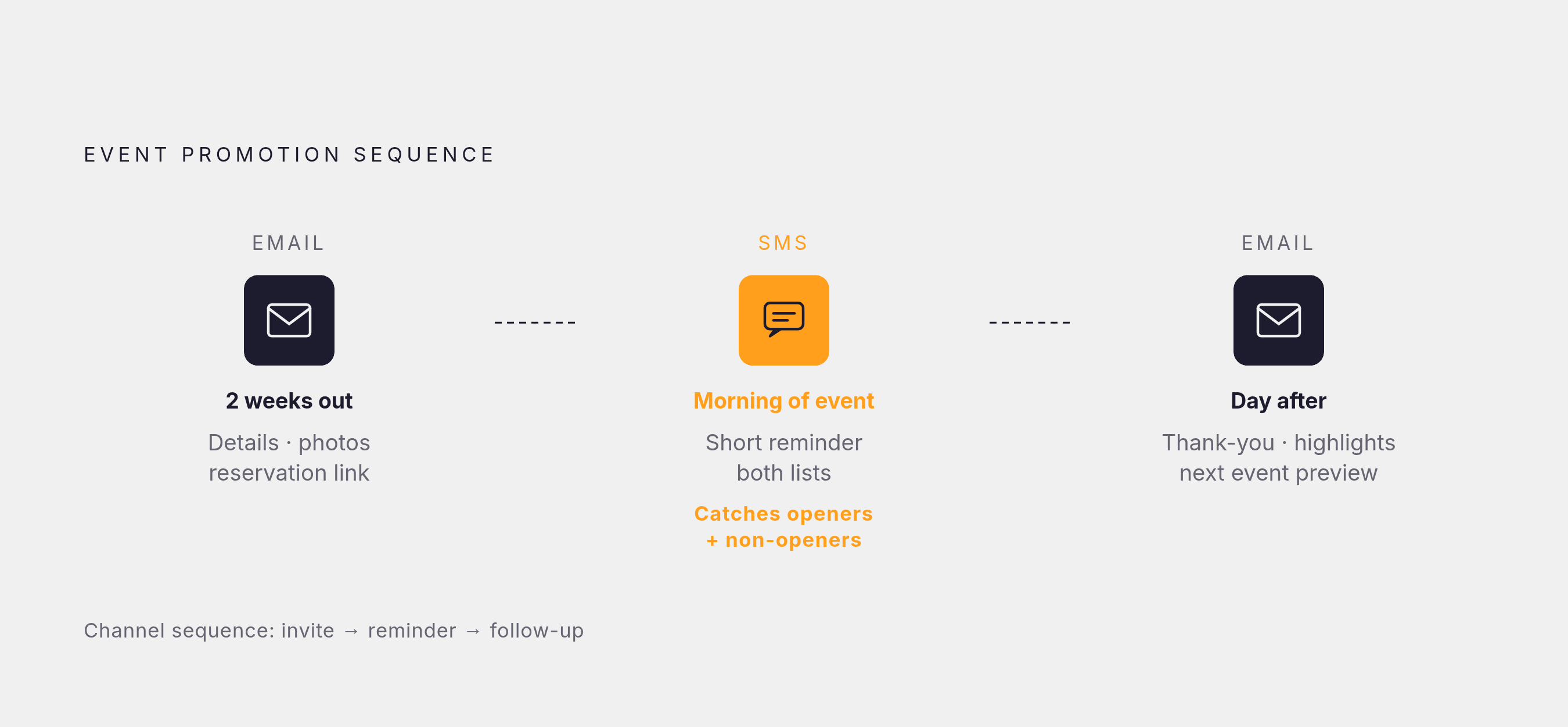
Consider an event promotion sequence. An email goes out two weeks ahead with full details, photography, and a reservation link, giving guests who plan in advance everything they need. The morning of the event, an SMS goes to everyone on both lists as a reminder, capturing the guest who saw the email but hadn't committed and the guest who never opened it. The day after, an email lands with a thank-you, a highlight from the evening, and a preview of the next event. Each channel is doing the thing it's built for, at the moment when it's most effective.
A lapsed-guest win-back sequence works similarly. Email at sixty days carries the relationship weight: context, a genuine offer, a reminder of what the guest actually liked. If that email goes unopened after a week, SMS delivers a compressed version of the same offer to the guests who didn't engage, reaching them through the channel they'll actually read. The follow-up email, once they return, closes the loop and resets the relationship forward.
Avoid sending the same message through both channels simultaneously. When guests receive identical content on their phone and in their inbox within hours of each other, they understand immediately that neither channel is being used with any intentionality, and they learn to ignore one of them, which defeats the purpose of maintaining two lists in the first place.
Unified guest data is the prerequisite that makes or breaks all of this. Sequences require the ability to connect an email address to a phone number, track which messages a guest has received, and suppress redundant sends. Operators running these two channels in separate, siloed tools with no shared identity layer are running two uncoordinated programs.
Measuring Whether Either Channel Is Actually Working for the Restaurant
The measurement gap most restaurants live in is structural: the email platform reports opens and clicks, the POS reports covers and revenue, and nothing connects the two by default. That gap lets operators convince themselves a campaign worked because the open rate looked respectable, even when nobody redeemed the offer in person.
A high click-through rate on an SMS that drove zero in-store visits is not a win. The only metric that matters is whether the message moved a guest from their phone to a seat.
Practical proxies exist for restaurants without sophisticated attribution infrastructure. Unique promo codes tied to specific campaigns connect a message to a transaction at the POS without requiring any additional technology. Reservation links with UTM parameters tell you which channel a booking originated from, which is particularly useful for event promotions running across both channels simultaneously. Segmented send windows, where a campaign goes to one half of the list on a given day and not the other, create a rough control comparison that approximates a real test without requiring formal A/B infrastructure.
The stronger standard is closing the loop at the POS entirely, knowing that a specific SMS or a specific email triggered a specific visit and a specific check. Feastalytics's attribution model does exactly this for paid social, connecting the campaign touchpoint directly to the in-store visit recorded at the POS. The same principle applied to owned channels like SMS and email transforms frequency and content decisions from intuition into defensible data. Without attribution, operators are guessing which messages work and repeating the ones that feel successful. With it, the question shifts from "did this campaign perform well?" to "did this campaign fill tables on a slow Tuesday?"
A Practical Starting Point for Restaurants That Currently Do Neither Channel Well
Most independent restaurants don't need to rebuild their marketing stack from scratch. They need to assign jobs to channels they already have partial access to and stop using those channels interchangeably.
Start with an audit of the current guest list: how many email addresses exist, how many opted-in phone numbers, and how each was collected. List quality and collection method predict engagement rates more reliably than list size does. A thousand email addresses captured through a reservation system are worth substantially more than five thousand collected through a generic giveaway entry form, because the former came with some demonstrated intent.
Pick one email use case to automate before adding complexity. The welcome sequence is the most accessible starting point because it triggers on a guest action, specifically a first purchase or reservation, rather than requiring a manual send decision. A sixty-day lapsed-guest trigger is the second-best candidate. Run one of these consistently for six to eight weeks before adding anything else to the email program.
Add SMS for a single urgency use case: the same-day slow-period fill or the reservation-day reminder. Test the channel without overextending the guest relationship or the operational bandwidth of whoever is managing the sends. Set a measurement mechanism from the first send, whether a promo code, a tracked link, or something else that connects the message to in-store behavior, even crudely.
List growth doesn't happen automatically and deserves dedicated attention. Email collection at checkout and reservation confirmation is baseline. Phone number collection requires a clear value proposition at every opt-in point because guests won't hand over their number without a reason that feels worth it.
One thing worth watching: RCS, or Rich Communication Services, combines the immediacy of SMS with the visual flexibility of email, including images, branded sender profiles, and interactive buttons inside the native messaging app. Apple's 2024 decision to support RCS removed the primary barrier to broad consumer reach. Restaurants building disciplined SMS programs now will be positioned to migrate to RCS as the format matures, rather than starting from scratch when it becomes the default.
Restraint is what makes both channels compound. SMS for genuinely timely moments, email for earning trust between visits.