Flash Sale and Limited Time Offer Campaigns via SMS
SMS reaches diners in 90 seconds, giving flash sales the speed email and social simply can't match.
SMS works for flash sale restaurant promotions because it's fast, and flash sales are, definitionally, a race against a clock. This piece walks through why that speed matters, how to build and run a campaign that actually fills seats, and why most restaurants can't tell you whether their last flash sale worked or just felt like it worked.
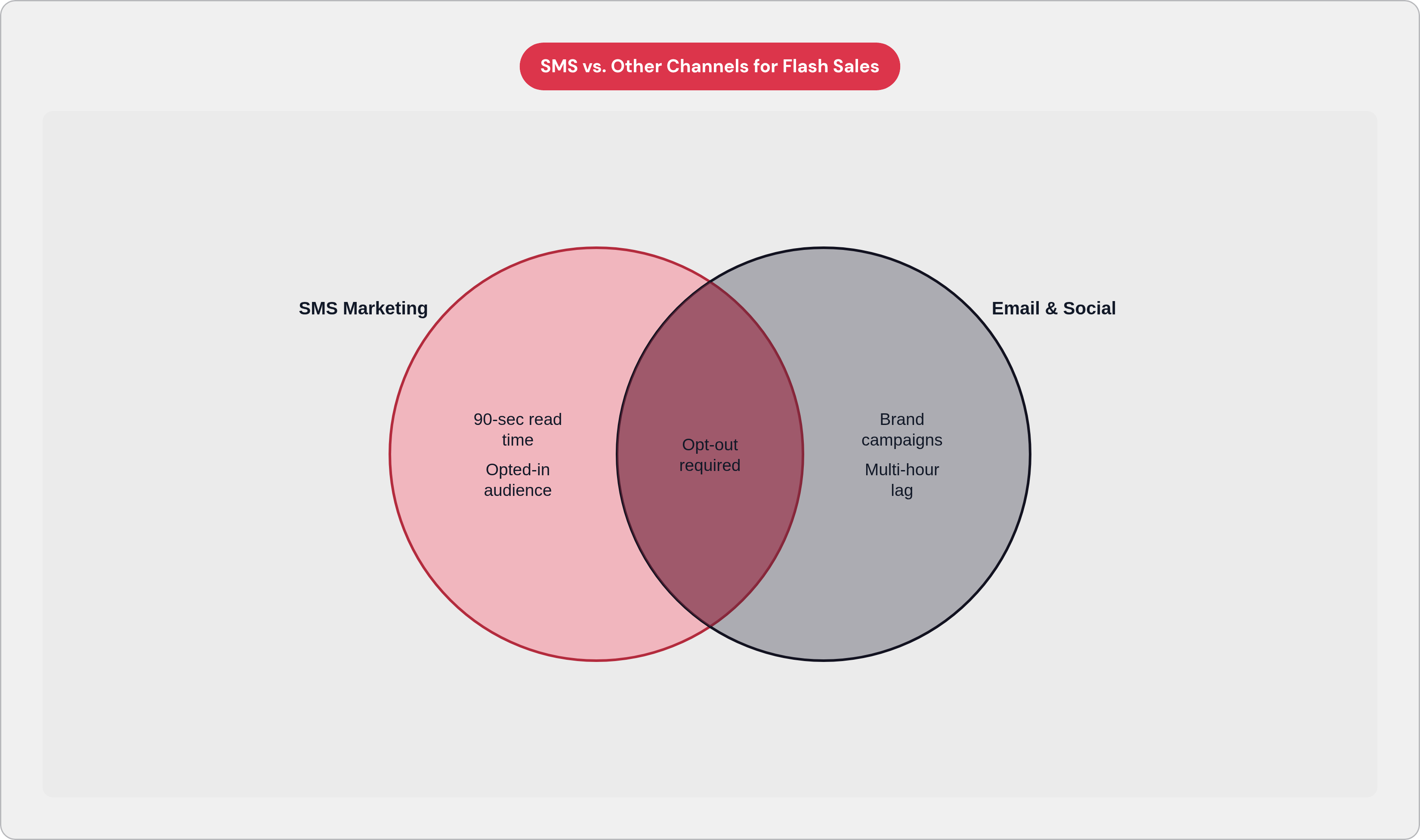
Most restaurant marketing lives in channels built for patience. Email gets checked whenever, if ever; social posts drift through a feed at the mercy of an algorithm that has its own agenda. That works for a brand-building campaign that unfolds over weeks. A flash sale, which by nature dies in minutes, not hours, needs something else entirely. A "20% off tonight only" offer sent through a channel where the average read time is measured in hours has already missed the window by the time anyone sees it.
SMS closes that gap almost by accident of its own mechanics. The average text gets read in something like 90 seconds, compared to the multi-hour lag on email. That gap represents a different category of speed, not a marginal improvement. And the numbers back this up structurally: restaurant SMS campaigns see click-through rates around 31.2%, according to an analysis of over 38 million messages across 2,847 businesses through December 2025, with the strongest performance coming from time-sensitive formats like lunch specials and happy hour pushes. I'd argue the open rate advantage gets talked about more than it deserves. Sit with the numbers long enough and the real story turns out to be timing: the message shows up and gets read before the deal expires, which is the entire ballgame for a flash sale.
Part of why SMS behaves this way comes down to structure, not just speed. A text lands in a channel the customer explicitly signed up for; there's no algorithm deciding whether it's worth showing them. It arrives at the device level, not buried in an app they have to remember to open. And because the subscriber opted in themselves, restaurant texts start with a warmer audience than a cold ad ever could. Nobody accidentally subscribes to a taco shop's text list. If they're on it, they wanted to be.
How personalization and timing shape whether a flash SMS converts
Send timing is close to the whole mechanism here. Flash sale texts sent 60 to 90 minutes before a target meal period consistently outperform sends at any other time, which makes sense once you think about it: too early and the offer feels abstract, too late and people have already made plans. A meaningful share of SMS purchases happen in the evening, when people are winding down and more open to a spontaneous decision about where to eat. That timing lines up with a dinner-hour audience in exactly the right headspace.
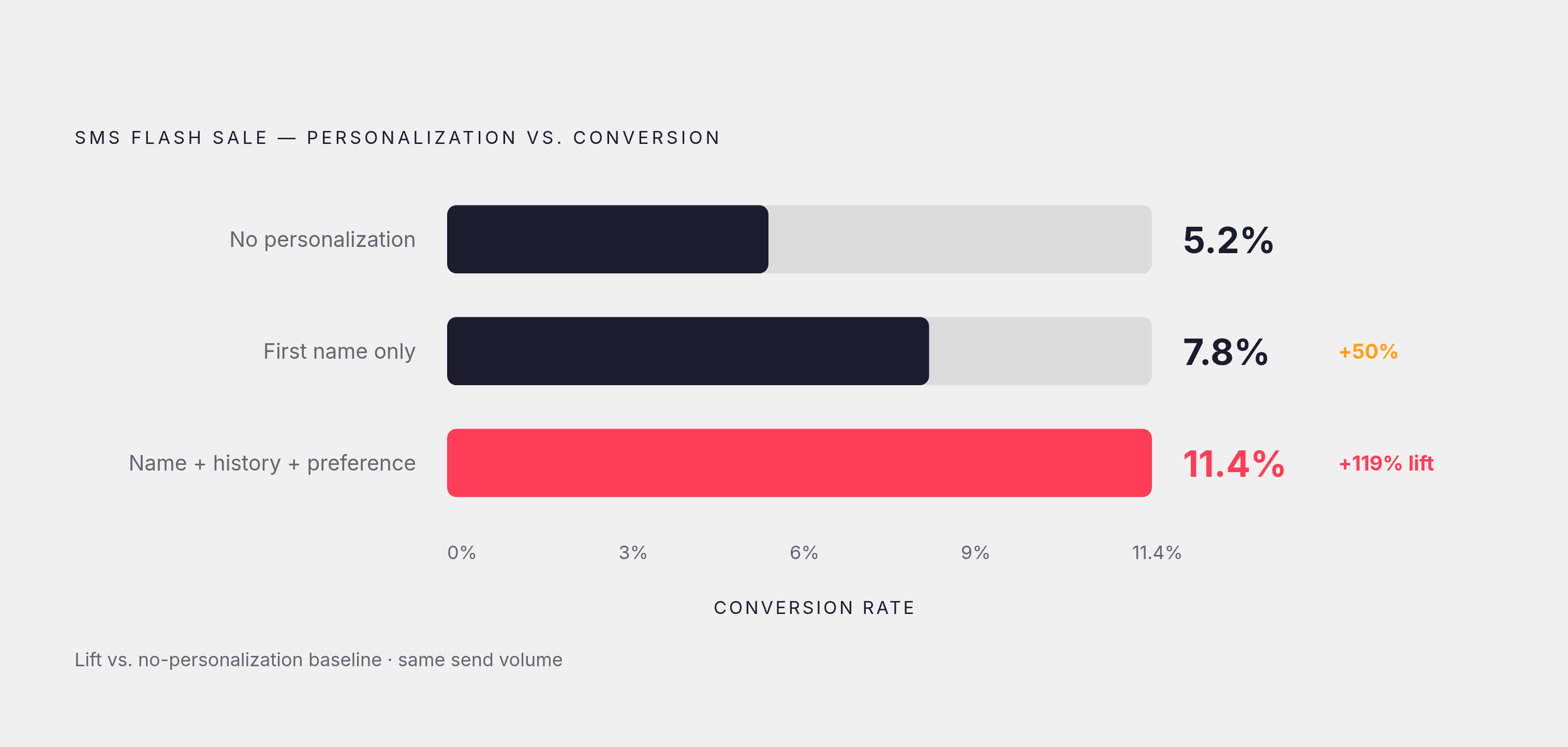
Personalization does something almost startling to conversion numbers. A generic blast with no personalization converts at about 5.2%. Add a first name and that climbs to 7.8%. Layer in multiple personalization fields, meaning something beyond just a name, and conversion hits 11.4%, a 119% lift over the generic version. Run the math on a typical flash window and that gap stops looking like a marketing nicety: it's the difference between a packed dining room and a kitchen staff standing around wondering why they prepped for a Tuesday rush that never showed.
What does "multiple fields" actually look like on a phone screen? Something like: "Hey Maria, we haven't seen you since March, come back tonight for 20% off." Or referencing what someone actually orders: "We know you love the short rib, it's featured tonight only." Or leaning into exclusivity: "Tonight only, just for regulars like you." None of this requires exotic technology. It requires a system that knows who last visited when and what they tend to order, and a willingness to write the text like a person instead of a press release.
Behavioral automation, meaning workflows triggered by actual customer behavior like time since last visit rather than a fixed calendar date, outperforms generic blasts by more than 7 times. That's a wide enough margin that it stops being a nice-to-have and starts being the whole strategy. As for the message itself: one offer, one deadline, one action. Vague urgency ("limited time!") does nothing. Specific urgency ("tonight, 5 to 8 PM") does the work. The character limit on a text isn't a constraint to fight against; it's a forcing function. A muddled flash deal fails regardless of when it lands; the format just makes the muddle harder to hide.
Building the list that makes flash sales work before the campaign starts
None of the timing or personalization advice matters if the list underneath it is dead weight. A large, disengaged list of ten thousand numbers will underperform a tight, self-selected list of eight hundred people who actually want to hear from you. That's worth sitting with for a second, because the instinct in marketing is almost always "bigger list, bigger reach." Flash sales punish that instinct.
The best starting audience is people who've already paid once: past diners, loyalty members, anyone with online order history. Building beyond that means creating real opt-in moments. A keyword-to-shortcode prompt at the register ("Text TACO to 55555 for exclusive deals") works. So does a QR code on a table tent, receipt, or menu. Reservation confirmations can double as opt-in triggers, and a website popup timed to exit intent catches people who were already thinking about the restaurant.
None of this is optional from a legal standpoint. TCPA compliance in the US requires explicit written consent before sending any marketing text, and the exposure for getting this wrong is calculated per message, not per campaign. That's the difference between a manageable mistake and a genuinely expensive one.
Segmentation is where the list starts pulling real weight. Treating a lapsed customer who hasn't visited in eight months the same as a weekly regular wastes the offer on the wrong person, or worse, annoys the wrong person. Roughly 60% of restaurant revenue comes from just a small fraction of guests, per 2024 data from Olo. A segmented list lets a flash sale go straight at that top 20% instead of spraying the same offer at everyone and hoping.
One more thing worth saying plainly: people unsubscribing from a text list is closer to a feature than a failure metric. A smaller, engaged list converts better and keeps delivery reputation healthy. Chasing list size for its own sake is a vanity project dressed up as growth strategy.
Running the campaign: what a flash sale SMS sequence actually looks like
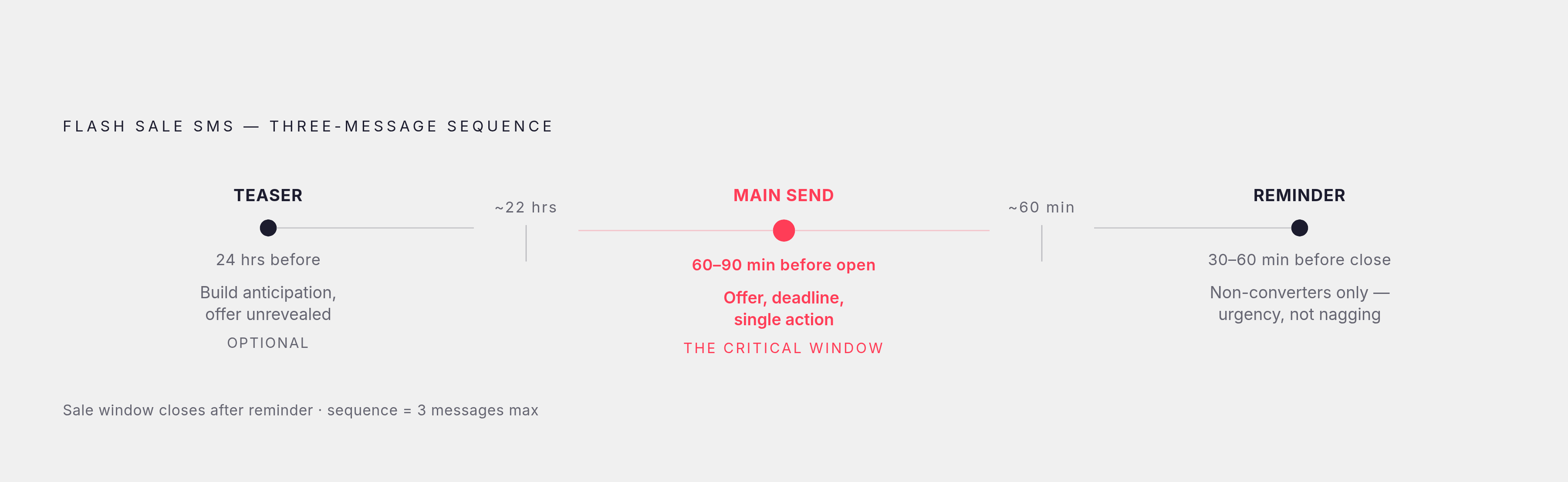
A flash sale campaign is rarely one text. It's a short sequence, and each message in that sequence has a distinct job to do. An optional teaser, sent about 24 hours out, builds anticipation without giving away the offer, which tends to lift open rates on the message that actually matters. The main send goes out 60 to 90 minutes before the window opens and carries the offer, the deadline, and the single action to take. A reminder, sent 30 to 60 minutes before the window closes, goes only to people who haven't converted yet: urgency, not nagging.
The main message needs four things and nothing extra: the offer itself, specific ("20% off your next dine-in order"), the window, specific ("tonight only, 5 to 9 PM"), the action, specific ("show this text" or "reply YES"), and an opt-out path, which is both a legal requirement and, frankly, a trust signal. A text that lets someone opt out easily reads as more legitimate.
Two-way capability matters more than most restaurants account for. Flash deals generate replies; people ask questions, confirm, sometimes just say "on my way." A platform that lets those replies pile up in an inbox nobody's watching fails the customer at the exact moment they were ready to say yes. When picking a platform, look for real-time two-way messaging, not just outbound blasting, along with behavioral segmentation and automation triggers, integration with the POS or reservation system, and transparent delivery and opt-out reporting.
As for what the offer should actually be: percentage discounts on the total dine-in bill work, complimentary items ("free dessert tonight only") work, fixed-price bundles for a slow night (a set price for two, Tuesday only) work, and scarcity-anchored offers ("first 25 tables") work particularly well because they borrow urgency from the number itself. The best flash sales target the operational gap, not just the marketing calendar; the whole point is turning a predictably dead Tuesday into a mini rush, not adding noise to a Friday that was already booked solid.
Pairing SMS with creator content to amplify flash sale reach
Here's the structural limit of SMS on its own: it only reaches people who already opted in. That's a ceiling, and it's a real one. Growing beyond the existing list means reaching people outside it, and that's where local creator content earns its keep.
Well-made local food content can drive foot traffic the same day it publishes, which lines up neatly with how flash sales operate on urgency. A substantial share of diners report trying a new restaurant after seeing a social post about it, which tells you the intent-to-visit link isn't theoretical. It's also worth noting that 52% of marketing leaders report increased scrutiny from finance on marketing spend, which raises the bar for what "reach" needs to actually produce.
For flash sales specifically, local beats large almost every time. A creator with 400,000 followers scattered across the country can't fill a dining room tonight; a creator whose smaller, locally concentrated following lives within five miles of the restaurant can. Micro-influencers, generally in a smaller follower range, tend to produce stronger engagement on local restaurant content than bigger accounts with a diffuse, geographically meaningless audience. That matters more now than it used to: in a competitive-traffic environment, hyper-local targeting stops being a nice idea and starts being close to mandatory.
The strongest version of this pairs a creator's post with the SMS send at the same moment: the subscriber gets the text, the social feed shows the visual, and the urgency lands from two directions at once instead of one. Limited-time offers are almost tailor-made for this treatment, since "this is gone in 24 hours" is a natural hook for food content anyway, no forced angle required.
Houston's Talespin Pizza offers a workable example. The restaurant partnered with local creators, including Shawn Singh and Thanh "Wayne" Dang, to spotlight its Neo-Texan pizzas, and saw a measurable jump in both brand awareness and sales. What worked here was local specificity: a creator whose audience actually eats in that neighborhood, beating generic reach for a restaurant that only serves one neighborhood.
Why open rates are the wrong metric for a flash sale campaign
Consider two campaigns side by side. A text with a very high open rate that generates zero bookings is a worse campaign than a text with a somewhat lower open rate that fills the dining room. Obviously. And yet most SMS dashboards still default to open rate as the headline number, because it's the easiest thing to measure and it always looks good.
The gap between "looks good" and "did anything" can be enormous. Reservation confirmation texts generate roughly $4.20 per message sent, while promotional texts generate around $0.18 per message, according to an analysis from Sakari. Open rates on those two message types look similar. The actual business value differs by roughly 23 times, which is a completely different conversation about what the campaign is worth.
Optimizing for opens pushes a restaurant toward more sends, bigger lists, and lower-quality offers, because those are the levers that move the open-rate number. None of them answer the question that actually matters for a flash sale, which isn't "did they open it?" It's "did they walk through the door?" The metrics that answer that question look different: redemption rate (how many offer holders actually showed up), incremental revenue per send, cost per in-store visit the campaign drove, and average check size for flash sale guests compared to a normal night.
Per Forrester's 2024 Wave report, 35% of organizations still rely on last-touch attribution as their primary model. For a restaurant, "last touch" often just means the walk-in itself, which tells you nothing about whether the text prompted it or the person was coming anyway. That's a coincidence dressed up in a spreadsheet. And the pressure to fix this is rising: 63% of marketing leaders in the 2025 CMO Survey report increased scrutiny from finance on marketing accountability. Restaurateurs feel that same pressure, usually with fewer tools to answer it.
Closing the loop between the text sent and the table filled
Here's the gap nobody likes to talk about. Meta and TikTok will tell you clicks and views. The POS system will tell you revenue. Nothing in either system, by default, connects the two, and SMS platforms have the exact same blind spot unless someone builds a bridge across it.
Attribution for a flash sale means knowing that one specific text, sent to one specific segment, at one specific time, produced a specific number of covers and a specific dollar figure. "SMS drove some traffic this month" is a statement so vague it's barely useful. Which campaign, which offer, which segment: that's the level of detail that actually informs the next decision.
The mechanism for getting there isn't exotic. Unique redemption codes per campaign let the POS tie a transaction directly back to the message that prompted it. If the flash deal drives a reservation instead of a walk-in, that reservation should carry a source tag pointing back to the SMS send. And where the POS captures guest contact info at checkout, matching phone numbers against the send list creates a visit record without needing a code at all.
Worth acknowledging: guests rarely take one clean path. Someone might see the creator's post, get the text an hour later, and walk in that evening. Attribution should credit that whole sequence, not just whichever touchpoint happened last, which is exactly why the creator-plus-SMS pairing described earlier needs unified tracking rather than two separate dashboards that never talk to each other.
The same behavioral data that drives personalization can, and should, drive measurement. If a "lapsed visitor" segment converts at a certain rate and a "weekly regular" segment converts at another, the campaign now knows which audience the offer actually moved, not just which audience received it. From there the ROI math is straightforward, if unglamorous: revenue from the campaign, minus platform fees, any creator fees, and staff time spent managing redemptions, divided by total cost. That formula only means anything if the revenue side is attributed, not assumed. Assumed revenue is just a guess with better formatting.
What a measurable flash sale result actually looks like
Across the restaurant SMS industry, automated and behaviorally triggered workflows generate roughly $42 in revenue for every dollar spent, based on analysis of over 38 million messages through December 2025. That number is real, but it's only trustworthy when the revenue behind it is actually attributed to the campaign rather than inferred from a generally busy month. A restaurant that had a good week for unrelated reasons and credits it all to one text is guessing and calling it data.
Individual campaigns with high list quality and tight attribution can land well above that industry average. Attribution systems that connect ad or message exposure directly to POS records, rather than relying on platform-reported clicks, have shown portfolios exceeding tens of millions of dollars in tracked restaurant revenue, with average campaign ROI around 4.2x and individual case studies reaching as high as 14.2x. The spread between the average and the outliers isn't random; it tends to trace back to how tightly the attribution chain was built.
For an operator running a baseline flash sale, realistic expectations look something like this: a well-timed, personalized send to a segmented list, lapsed visitors or high-frequency regulars, timed to a target meal window, with redemption tracked through a unique code at the point of sale. That's the whole system, honestly. Nothing about it requires guesswork, and nothing about it requires taking the platform's word for it. The text either filled the table or it didn't, and now there's a way to actually know which.