Segmenting Restaurant SMS Lists for Better Offer Relevance
Smarter segmentation lifts SMS revenue per message by up to 760 percent.
SMS marketing for restaurants has a math problem hiding in plain sight. The average text gets opened by 90% to 98% of recipients, which sounds like a marketer's dream until you realize most of that attention gets burned on offers half the list never asked for. Segment by visit frequency, spend, and occasion, and the channel starts paying rent. Skip it, and you're just sending very well-read junk mail.
Consider a few numbers before we get into the how. SMS open rates run 90% to 98%, compared to 20% to 30% for marketing email, and the gap in engagement speed between the two channels is significant. Response rates land around 45% against roughly 6% for email. By 2025, something like 84% of consumers had opted in to receive texts from at least one business, up from around 70% a few years back. So the audience is already there, phone in hand, primed to respond. That's the gift, and, somehow, the trap too — the rest of this piece is about how restaurants keep tripping over it.
The cost of treating every subscriber the same
Every blast list runs on the same silent assumption: that the Tuesday-lunch regular, the couple celebrating their anniversary, and the guy who wandered in once last spring all want the identical percentage-off coupon. Sending it to all three anyway is a bit like mailing the same birthday card to your spouse and your dentist; technically you got it done, but something about the gesture just feels off.
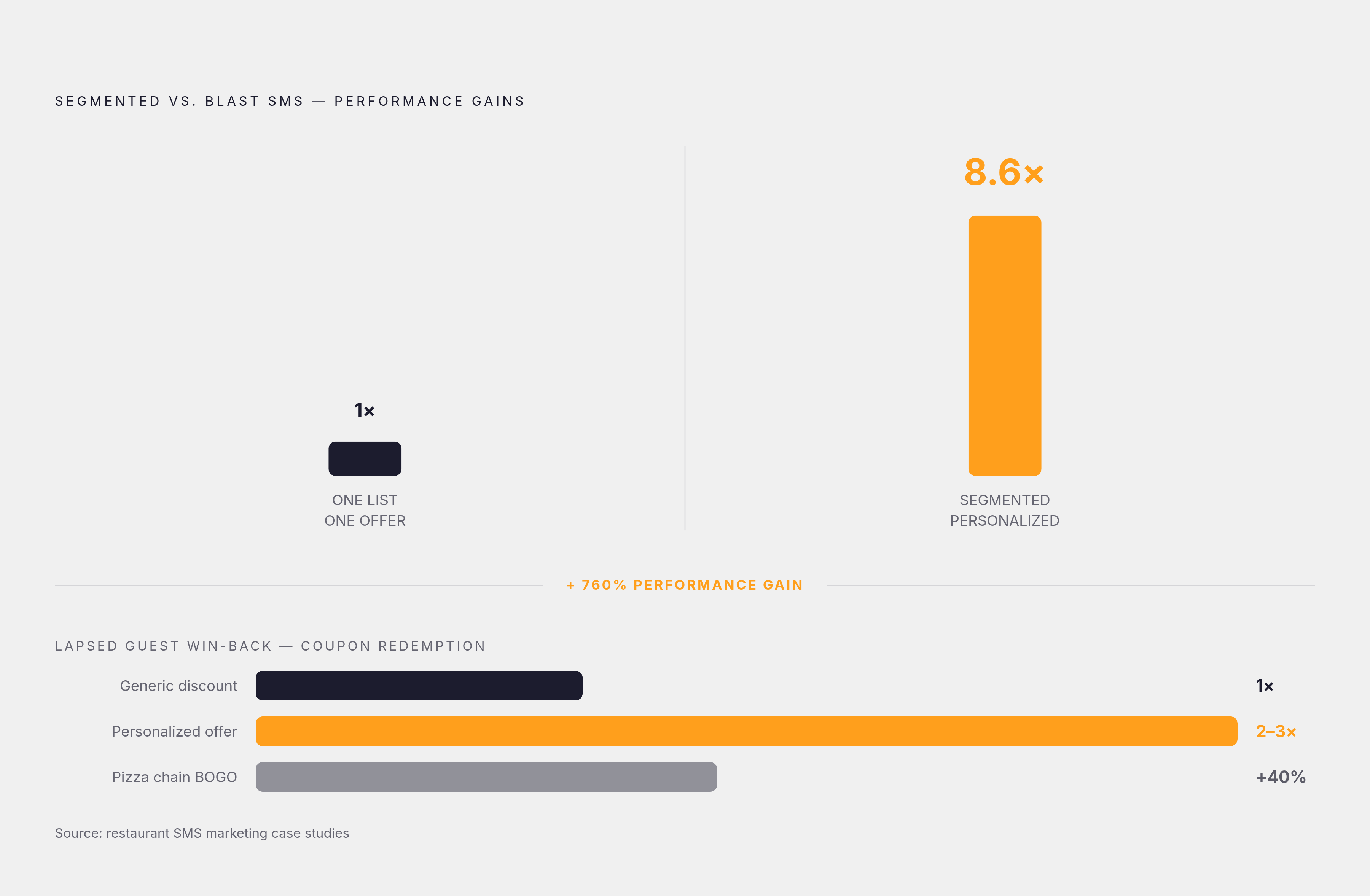
The revenue math backs this up, and it's not subtle. A smaller list that gets something actually relevant beats a mass blast to the full database, because the number that matters is revenue per message, not messages sent. When that number starts sliding, the culprit is usually list fatigue, sloppy segmentation, or just texting people more than they signed up for. Restaurants that segment their lists see performance gains as high as 760% over restaurants running one message to everybody, and that's worth reading twice. An entire business model is sitting on the table, and most operators are still running a single list because nobody's gotten around to fixing it.
Worth untangling the fatigue myth here, because operators diagnose it wrong constantly. The instinct is to assume people unsubscribe because they get texted too often. Relevance drives opt-outs more than frequency does: two well-aimed messages a month tend to produce fewer opt-outs than one poorly-aimed blast, because guests don't actually mind hearing from a place that seems to know them. What they mind is hearing from one that clearly doesn't have a clue.
Then there's the concentration problem nobody brings up at the manager meeting. A disproportionate share of restaurant revenue typically comes from a small fraction of the most loyal guests. Send one offer to everyone and you're spending identical attention and identical margin on the guest who shows up twice a year and the guest who shows up every Thursday like clockwork. That's imprecise, and imprecise costs money.
The four dimensions that make restaurant segmentation work
So how do you actually cut the list into something useful? Four dimensions do it, and restaurants already have this data sitting in their POS and CRM systems, gathering dust, whether anyone's bothered to look at it recently or not.
Visit frequency splits regulars from occasional guests from the ones who've quietly ghosted the restaurant entirely. Each group needs a different nudge to come back, and mixing them up, treating a regular like a lapsed guest or the reverse, just wastes the message on the wrong person.
Average spend per visit tells you who's paying full price for the experience and who's showing up specifically for the deal. Skip this one and you'll end up training your highest-spend guests to wait around for coupons they never needed in the first place.
Last visit date is your recency signal, the tripwire between active, at-risk, and gone-for-good. It's the earliest warning the data gives you, if you're watching it.
Item or category preferences, pulled directly from POS order history, is what turns a flat 10%-off into "your usual Friday order is back on special." A coupon reads as generic; this reads closer to a conversation.
Stack these four together and the list quits acting like one audience; it starts acting like several distinct crowds, each wanting something different from the restaurant. Treat each segment like its own small campaign, with its own redemption target and its own incremental-visit expectation, rather than a filtered slice of the same broadcast. The infrastructure gap isn't collecting new data, because most restaurants already have it sitting there. The gap is getting the POS to actually talk to the SMS platform.
What to send each segment and why the offer logic differs
Once the segments exist, the offer has to change with them, because the same coupon lands completely differently depending on who opens it. A regular reads a 10%-off text as a nice gesture. Someone who hasn't visited since spring reads the same text as a reminder they forgot the place existed.
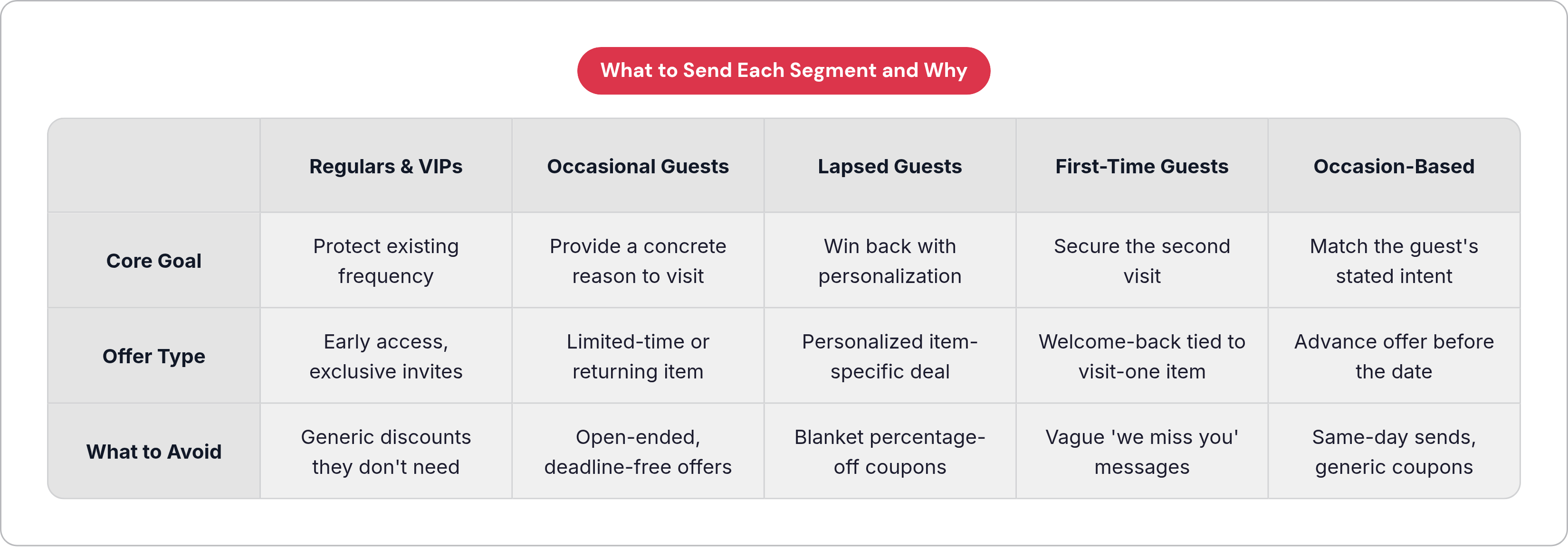
Regulars and VIPs want to feel recognized, which is a different currency entirely from a discount. Early access to a new tasting menu, a table held on a busy Friday, an invite to something the general public doesn't get: these tend to beat a percentage-off offer for this group every time. Consider the logic here. Loyalty members already visit restaurants about 22% more often per year than nonmembers and account for around 39% of total restaurant visits, according to Evokad Restaurant Email SMS Marketing. The job with this segment is protecting the frequency that's already there, rather than buying loyalty that already exists.
Occasional guests, the ones who show up but with no predictable rhythm to it, respond better to an anchored reason than an open-ended discount. A limited-time seasonal item, an "it's back" nudge about something they ordered once, gives them a concrete reason to come in this week instead of someday. Open-ended offers just sit in the inbox, unclaimed, waiting on a deadline that never shows up.
Lapsed guests are where personalization earns its keep. A win-back offer tied to a guest's actual order history produces redemption rates two to three times higher than a generic discount does. One pizza chain saw coupon redemption jump 40% after swapping a blanket promotion for a personalized buy-one-get-one built around each guest's own past orders. The generic 10%-off is the floor here; get specific about someone's favorite item and you can double or triple that number.
First-time guests deserve their own bucket entirely, because the second visit matters more than the first one ever did. A welcome-back offer tied to the exact item ordered on visit one, something the POS already captured without anyone asking, beats a vague "we miss you" every single time. Guest data platforms can flag new visitors automatically and fire off that return incentive within days, while the meal's still fresh in memory.
Occasion-based segments, built off birthdays, anniversaries, or holiday patterns pulled from reservation data, produce the highest-relevance sends of the whole bunch, because the guest already told you exactly why they show up. A birthday text sent three to five days ahead of the date, carrying an actual offer instead of a generic coupon, converts meaningfully better than the same message sent the day of. Timing matters here nearly as much as the offer itself.
Building the data infrastructure that makes segmentation possible
Most restaurants know their best guests by face, not by name, and that recognition lives entirely in a host's memory or trapped inside a delivery app the restaurant doesn't own and can't control. Building an owned subscriber list is what turns that recognition into something durable: a guest captured into a database can be segmented, messaged, and brought back on the restaurant's own terms, rather than a third party's.
The best data collection happens quietly, in the background of a visit, rather than as an interrogation at the host stand. Reservation platforms grab contact info and occasion type without anyone having to ask twice. Online ordering systems log item-level order history and frequency automatically, no extra step required. Wi-Fi captive portals trade guest contact info for network access, which most guests hand over without much friction at all. Digital receipts and table-top QR codes collect opt-ins without adding a single awkward moment to the meal.
None of it works, though, without POS and CRM integration underneath. Without that link, a text is just a broadcast into the void: it went out, maybe somebody opened it, and nobody can say what happened after. With it, every send becomes a testable hypothesis, one that either created a visit or just happened to coincide with one that was coming anyway.
There are two ways to check which is true. POS timestamp matching compares visit frequency in the 72 hours after a send against a normal baseline period, with no control group involved, just a before-and-after comparison. Control group testing is the more rigorous version: hold the message back from a random 10% to 20% of the list and compare visit rates between the group that got it and the group that didn't. If both groups show the same lift, the text didn't do much of anything; it was riding along on a trend that would've happened regardless.
This is also where the attribution logic connecting a social ad to a POS-recorded visit extends naturally over to SMS. Operators already comfortable tracking which ad filled which table can point that same discipline at which text drove which visit. The method carries over; only the channel changes.
Compliance requirements operators cannot skip
None of the above matters if the list was built without proper consent, and this part isn't theoretical legal hand-wringing. The TCPA requires prior express written consent before sending any marketing text, full stop; it's a federal statutory requirement. Violations carry damages of $500 to $1,500 per violation, per class member, which means one non-compliant blast to a sizable list can turn into an expensive afternoon fast.
Consent language has to name the specific business, state clearly that consent isn't a condition of purchase, and spell out how someone opts out. The FCC's Opt-Out Rule, effective April 2025, requires honoring revocation requests within ten business days, with no exceptions and no grace period for being busy that week.
Practically, that means every collection point, the QR code on the table, the web form, the Wi-Fi portal, needs compliant language baked in from day one. Retrofitting compliance onto a list you've already built costs a lot more, in time and legal exposure, than getting it right the first time around. There's a segmentation upside buried in here too: keeping consent records tied to each subscriber profile means an operator can show exactly which guest opted in, through which channel, and when. Compliance paperwork can double as a documented, defensible asset rather than dead weight in a filing cabinet.
How to measure whether segmented sends are actually driving incremental visits
Open rates and click-throughs are inputs; they tell you the message got seen, but they do not tell you whether anyone actually walked through the door because of it, and for a restaurant, that's the only question that settles the argument about whether any of this was worth doing.
About 79% of SMS subscribers say they're more likely to buy once they've subscribed to a business's texts, up 21% from the year before. That's a real number, but it describes subscribers as a population, not any one restaurant's specific list. The operator's actual job is narrower and considerably harder: proving their own sends are driving that behavior, rather than just riding shotgun next to it.
One clean data point worth sitting with: automated messages, the kind triggered by a post-visit window, a lapse threshold, or a birthday date, tend to generate meaningfully more revenue per send than manually scheduled campaigns do. That's a decent argument for building behavioral triggers into the system instead of counting on someone remembering to hit send every Tuesday afternoon.
Four numbers are worth tracking here, kept separate rather than blended into one tidy average that hides what's actually happening underneath. Redemption rate by segment, tracked apart for regulars, lapsed guests, and new visitors, shows which offer logic is working and for whom. Incremental visit rate, measured through control groups or timestamp comparison, tells you whether the message created a visit or just happened to show up next to one already in motion. Revenue per send is the cleanest ROI signal on the list, and it's worth comparing across segments and offer types over time instead of flattening it into a single number. Opt-out rate by segment matters too, since a rising opt-out rate concentrated in one segment is a relevance problem more often than a frequency one.
The discipline of structured measurement, tracking redemption, incremental visits, and revenue per send consistently over time, tends to sharpen ROI in ways that ad-hoc guesswork simply cannot. That's a solid argument for the discipline of measurement itself, apart from any single tactic discussed above. The same infrastructure connecting an SMS send to a POS-recorded visit can just as easily connect a paid social ad to that same visit. Build that attribution layer once, and a restaurant ends up with one unified view of which channels and messages are actually filling tables, and which ones are just generating notifications nobody bothers to act on.