SMS Automation Workflows for Restaurant Guest Journeys
Automate reservation reminders and post-visit follow-ups to cut no-shows.
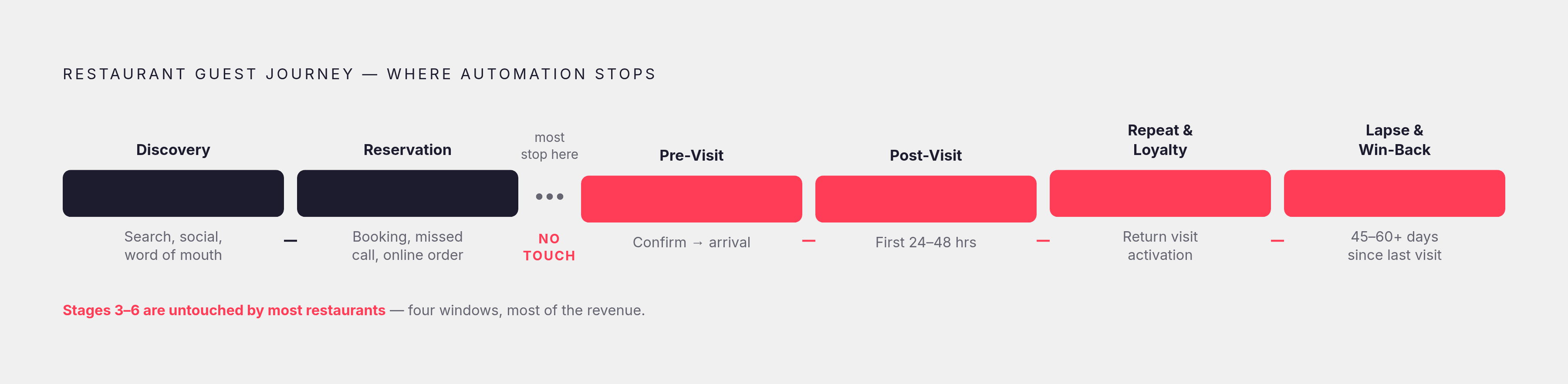
"Guest journey" is a term used across hospitality marketing to describe a literal, mappable sequence with measurable gaps between each step: discovery and first contact, reservation or intent (an OpenTable booking, a missed call, someone starting an online order and abandoning it), the pre-visit window from confirmation to arrival, the post-visit window in the first 24 to 48 hours after the meal ends, repeat and loyalty activation, and lapse and win-back for anyone who hasn't shown up in 45 to 60-plus days.
Each stage carries a different mindset. A win-back offer sent to someone who just booked a table for tonight reads as spam; the same fifteen words sent to a guest who hasn't been in two months reads as thoughtful. The reception depends on timing, not the copywriter's skill.
Here's a number that should needle every operator reading this: roughly one in five reservations goes unused, a table held and wasted for no reason anyone can point to. A well-timed SMS reminder tied to the booking stage plugs a good chunk of that leak almost automatically. Yet most restaurants running SMS today skip the pre-visit reminder, the loyalty nudge, and the win-back sequence entirely. They nail the confirmation text, then go dark until a generic "we miss you" blast shows up six months later, and then everyone's confused about why results are inconsistent, because half the journey has no touchpoints at all.
The journey framework separates automation from guesswork. A trigger replaces a timing decision that would otherwise depend on a server remembering to do something in between running food and restocking silverware. One of those scales, and the other doesn't, no matter how good your staff is.
Automating the pre-visit window: confirmation, upsell, and no-show prevention
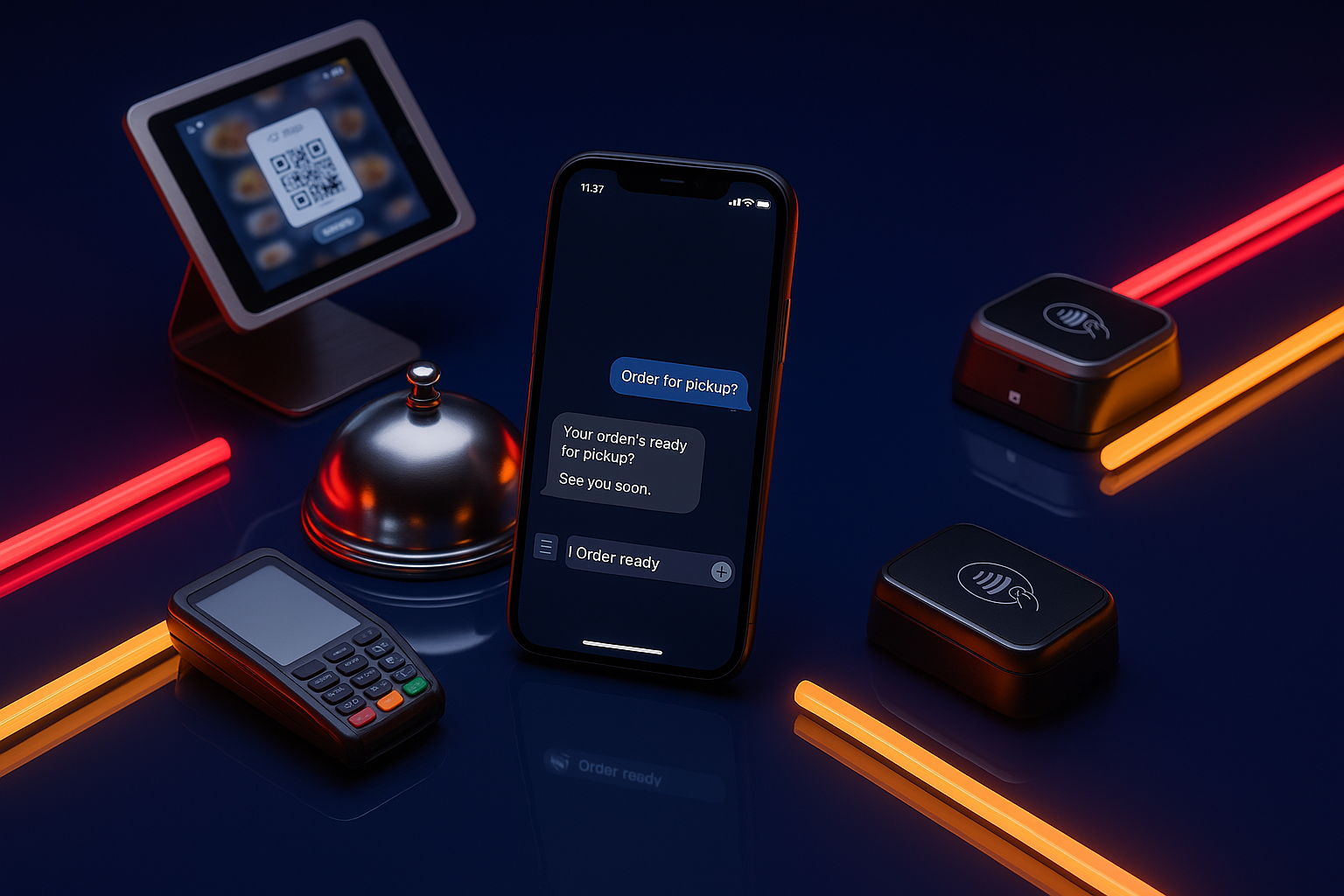
The trigger is simple: a reservation gets confirmed in the booking platform, whether that's OpenTable, Resy, or the POS itself. That event should fire an immediate confirmation SMS, and the message needs to lead with function ahead of flair. Date, time, party size, address. Only after that comes the soft upsell: "See you Friday at 8pm. Want to pre-order a bottle for the table?" One decision, low friction, and it works precisely because the guest's attention is already locked on the restaurant. You're extending a conversation they started, not interrupting one.
The reminder cadence matters more than people think. A reminder 24 hours out and another the day of cuts no-shows without feeling naggy, so long as both messages make it painless to modify or cancel. That last part is self-interest as much as generosity: a canceled table at noon can be re-released and filled by dinner, but a no-show at 7:58pm is just a hole in the room for the rest of the night.
Missed-call recovery is one of the higher-performing tactics in this category. Someone calls, gets a busy line, hangs up. Send that person a text right away, "Sorry we missed you at The Copper Mug, want to reserve a table?", and you've caught intent that would otherwise evaporate into "I guess I'll just go somewhere else." Online-order abandonment runs on the same logic. A guest who started checkout and bailed is a warmer lead than any cold prospect, and click-through on abandonment texts runs well above a standard campaign send. Once this is wired into the booking system, nobody has to remember to do any of it. Set it up once, and the system runs on its own.
The post-visit message and why timing is the entire variable
The post-visit window closes fast. A guest's opinion is soft and moldable for maybe a day before it hardens into whatever they decide to remember. Send a review request within 24 hours and it consistently beats the same request sent three or four days later, once the meal has faded into "yeah it was fine" territory.
The routing logic is the interesting part: positive sentiment gets routed to a public review link, negative sentiment gets routed to a private feedback form. SevenRooms has noted that automating this kind of follow-up recovers a meaningful share of dissatisfied guests before they ever post publicly, and everybody wants a shot at fixing the problem before it becomes one. Harvard Business School research has tied a one-star improvement on major review platforms to measurable revenue uplift for independent restaurants, which grounds what might otherwise sound like a soft "reputation matters" argument in an actual number attached to an actual star.
The same trigger can carry a light incentive to return, framed as a reason rather than a discount: "Glad you joined us, here's what's new next week." It keeps the restaurant in frame without cheapening the visit the guest just had. The mistake most restaurants make is batching this into a weekly send, which defeats the point entirely. By the time Thursday's email goes out about last Saturday's dinner, the guest has already moved on and mentally closed out the experience.
Birthday and loyalty enrollment flows: turning returning guests into committed ones
Send the birthday offer about a week before the actual date rather than on it, because people plan celebrations in advance and a same-day text arrives after the dinner reservation is already booked somewhere else. Popmenu's 2025 data shows birthday campaigns generate a strong average redemption per offer, high enough to justify the send on its own. The offer should require an in-person visit rather than delivery or online ordering, and that's an attribution decision more than a stinginess one: you want the cover count real and the data clean.
Anniversary flows, marking a year since a guest's first visit or a year since they joined the loyalty program, run on the identical logic and take less setup work since the trigger dates already live in the system.
The loyalty enrollment nudge deserves more attention than it gets. Target guests who've visited multiple times but never actually joined the loyalty program. These aren't cold prospects; they've already self-selected as interested by showing up repeatedly, and the text just closes the gap between behavior and paperwork. Loyalty members visit meaningfully more often per year than nonmembers, a well-documented pattern in restaurant retention data, which means every successful enrollment compounds and keeps paying out well after the initial signup.
The trigger itself should be behavioral rather than calendar-based. "You've been with us three times, here's what loyalty members get" performs far better than a generic loyalty blast sent to everyone with a pulse and a phone number. And once someone enrolls, their visit cadence and spend feed right back into the trigger system, so the next message they get is sharper than the last one.
Win-back sequences for lapsed guests and the urgency-based flash text
The win-back trigger fires when no visit shows up in the POS after roughly 45 to 60 days, though that window shifts depending on how often a given restaurant's guests typically return. Tone matters enormously here. "We haven't seen you in a while, here's a reason to come back" acknowledges the absence without guilt-tripping anyone into feeling bad about where they've been eating. SMS win-back substantially outperforms email win-back for lapsed guests, which tracks with everything already established about read speed and immediacy.
Run this as two or three messages, spaced roughly a week apart, with the offer escalating slightly each time before the guest gets moved into a dormant segment and left alone. Restaurants consistently leave significant revenue on the table from guests who visit once and never return. Win-back automation is aimed squarely at that particular leak.
Flash urgency texts are a different animal, tied to inventory or a slow shift rather than journey stage. Slow Tuesday at 4pm, too much inventory thawed for the weekend, a surprise thunderstorm killing foot traffic: "50 wings left, reply YES to claim yours before the kitchen closes." Urgency framing drives redemption meaningfully higher than a standard advance promo, but this only works for guests who've actually opted in, and the geographic radius needs to be tight. Texting someone forty minutes away about wings that'll be gone in twenty minutes doesn't build loyalty; it generates an unsubscribe, and a frustrated one at that.
How to measure whether any of this is actually working
Four metrics matter in the first 90 days of any workflow launch, and most restaurants only ever look at one of them.
Incremental visits is the metric that actually proves causation: lift in a treated group versus a control group that didn't get the message. Revenue per send divides total attributed revenue by messages sent, and automated SMS earns substantially more per send than broadcast campaigns, because relevance beats reach every time it's tested. Unsubscribe rate should sit well below one percent per campaign; a spike is a signal, not noise, and it's telling you the timing, the segment, or the offer missed. Channel performance compares SMS against email against push for the identical workflow, and the winner shifts depending on guest segment and message type, so there's no permanent champion here, only a current one.
Attribution is the unglamorous part nobody wants to deal with, but it's the whole ballgame. Unique promo codes, dedicated landing pages, POS-matched phone numbers: these are the real ways to connect a text message to an actual visit. Click-through rates and open rates are inputs, not outcomes. A guest who opens a win-back text and never sets foot in the restaurant generated exactly zero dollars, however good that open rate looked on the dashboard that morning.
The loyalty version of the 80/20 principle shows up here too: a small fraction of a restaurant's most loyal guests can drive a disproportionate share of total order volume, a pattern that shows up consistently across restaurant retention research. Measurement should be aimed at figuring out which workflow stage produces that high-value segment, so resources concentrate there instead of spreading evenly across everything. Restaurants that segment before sending see meaningfully better campaign performance than restaurants blasting the whole list the same message. Segmentation is the prerequisite for measurement meaning anything at all.
This is also where the attribution layer becomes the real bottleneck for most independent restaurants. The SMS platform itself usually works fine; what's missing is the connective tissue between the message and the POS record, the thing that turns a reported open rate into a confirmed cover sitting in a booth. What's missing is a reliable way to tie the send to the transaction so an operator can say, with confidence, "this text generated this visit," instead of relying on assumptions.
The technical stack that makes journey-stage SMS possible
Four systems need to talk to each other, and getting them to actually talk is where most of this stalls out. The POS, whether Toast or Square, holds transaction records and visit history; it's the source of truth for anything measuring the gap since a guest's last visit. The reservation system, OpenTable or Resy, holds booking data and drives the pre-visit triggers. The loyalty platform, Toast Loyalty, Punchh, or something similar, holds enrollment status and redemption history. The SMS or email platform, Klaviyo, Postscript, Mailchimp, SlickText, whatever's actually in use, is the thing that executes the send.
Data lives in four separate places, and nothing connects them automatically without either a middleware integration or a platform built to span multiple functions at once. That's the honest bottleneck here, more than budget or strategy. Entry-level SMS tools start around $29 a month on SlickText's cheapest tier, while enterprise POS-native tools run several hundred dollars a month or more; most independent restaurants can get real value well below the top of that range. Platforms like SevenRooms and BentoBox partially solve the integration headache by bringing multiple functions under one roof, which matters most to operators who'd rather manage one login than four separate ones with four separate passwords they'll forget.
SMS and email together generate substantially more revenue per campaign than either channel running alone, so the case for building the stack isn't just operational convenience; it's a direct ROI case. Most operators, once the integrations are actually confirmed and working, can build and launch their first two or three workflows within 30 to 45 days, nowhere near a year-long IT slog.
TCPA compliance: what restaurant operators must get right before sending a single message
The Telephone Consumer Protection Act requires prior express written consent for marketing texts. Implied consent from someone giving you their number for a reservation doesn't clear that bar, and neither does someone saying "sure, text me" over the phone. Written, documented consent is what's required, and the form collecting it has to name the specific business, state clearly that consent isn't a condition of purchase, and explain how to opt out. Skip any of that and you're exposed; damages run per message per recipient, so the exposure scales directly with list size. A small list with a compliance gap is a headache, while a large list with the same gap is a lawsuit with your restaurant's name on it.
The FCC's April 2025 Opt-Out Rule tightened things further: restaurants must honor unsubscribe requests within ten business days, and only one clarification message is allowed within five minutes of that opt-out, nothing more after that. 10DLC registration, the ten-digit long code system, is now required for most business SMS sent in the U.S. Skip it and carriers start filtering or blocking the number outright, which defeats the entire point of sending the text in the first place. Registration runs through the SMS platform itself, not independently, so picking a platform that handles this properly matters more than people assume going in.
Consent gets collected wherever a guest first hands over their number: the reservation confirmation form, loyalty enrollment, an in-store QR code, the online ordering checkout. Every one of those touchpoints needs the consent language built in at the moment of capture, not bolted on after the fact. There's a trust dimension worth naming too. A restaurant that's upfront about how it collects and uses guest data tends to see higher opt-in and lower unsubscribes down the line, because guests can tell the difference between a business asking permission and a business assuming it already has it.
What happens to restaurants that don't automate this and keep running marketing by feel
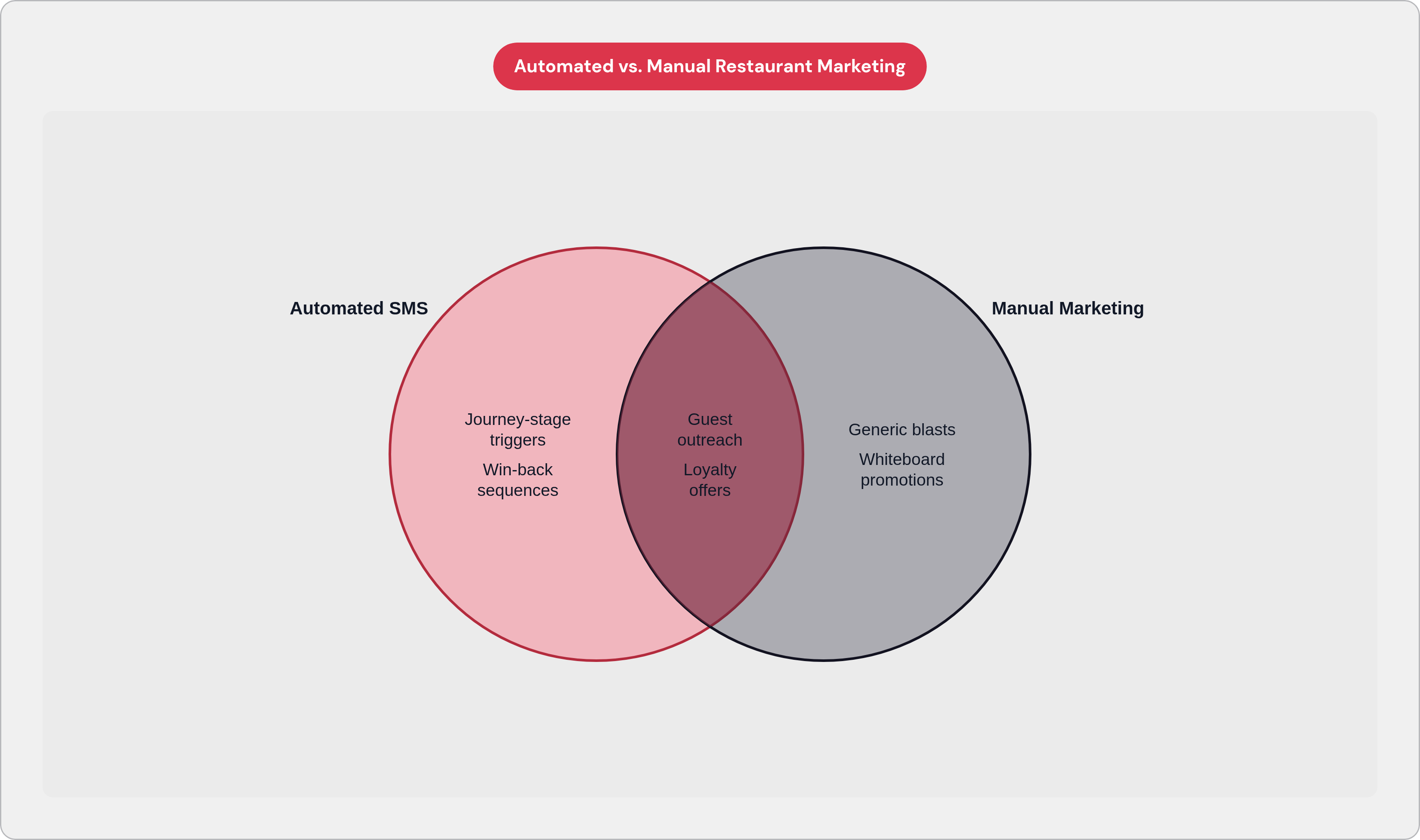
Restaurants sitting on large guest contact lists but automating none of this leave a substantial sum of annual revenue on the table, according to Popmenu's 2025 marketing benchmark. It's spread across post-visit follow-ups nobody sent, birthday offers that never went out, seasonal promotions that existed only as an idea on a manager's whiteboard. That's real money attached to messages that simply never left the building.
The manual alternative buckles under its own weight eventually. Toast's 2024 report found the vast majority of operators dealing with rising labor costs heading into 2025, and every hour a staff member spends manually tracking who's due for a win-back text or who has a birthday coming up is an hour not spent on table service, prep, or anything that actually touches the guest sitting in the dining room right now. Manual marketing competes with the labor budget for running the restaurant itself, and in that fight, the dining room wins every time; nobody's getting fired for forgetting to send a birthday text, but plenty of people get fired for a slow kitchen. Most operators, in the end, end up choosing between automation and letting the whole thing lapse into nothing.