High Converting SMS Message Templates for Restaurants
Steal these text templates to fill tables and cut no-shows using SMS's 45% response rate.
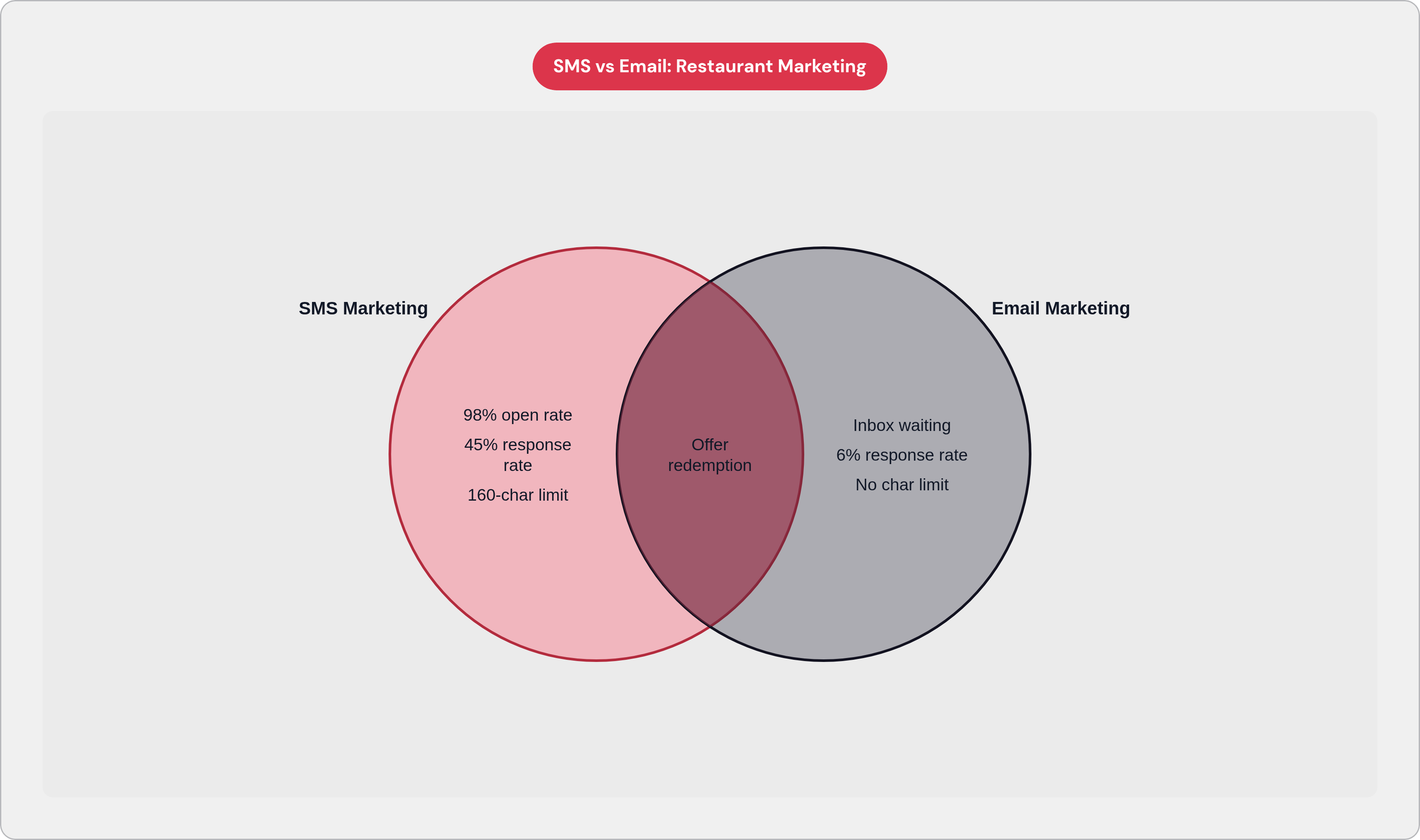
SMS is the highest-converting channel restaurants have access to right now, thanks to structure: a single clear action, a real deadline, and an offer that justifies someone getting off the couch. Open rates for text sit around 98%, with the vast majority of messages read within 15 minutes of landing, according to RedEye's 2024 data. Email trails well behind; it sits in an inbox and waits for permission that rarely comes. This piece breaks down what actually makes a restaurant text convert, with templates you can steal, organized by the job each one is doing.
Here's the part that gets skipped in most of the "SMS marketing tips" listicles floating around: response rates on text hit roughly 45%, compared to something like 6% for email. That gap is significant, and it suggests the channel is interactive by nature, giving it a presence beyond simple visibility. Someone glancing at a text is already halfway to replying, tapping a link, or walking in the door. For restaurants specifically, campaign conversion rates land in the 8 to 15% range, and when you segment the list and trigger sends off actual guest behavior instead of blasting everyone at once, that climbs to 21 to 30%. By 2025, 84% of consumers had opted into SMS from at least one business, so the audience isn't hypothetical — they already said yes. The question is whether what you send them deserves the yes.
The three structural elements every high-converting restaurant SMS shares
Every message that works is built the same way, whether it's a birthday text or a flash sale on a dead Tuesday. First, one action: book, redeem, reply. Asking for "reserve or call us or check out our new menu" all at once dilutes the ask, and texts that ask for two things get half as much of either.
Second, a deadline that's actually true. "Tonight," "this weekend," "expires Friday at 5pm" all work because they're real constraints, not marketing theater. Guests can tell when a countdown timer is fake, and once they catch you manufacturing urgency, they stop trusting the next one too.
Third, and this is the one operators underprice: the offer has to be worth the friction of physically showing up. A 10% discount code that works online is one thing. Getting someone to put on real pants, find parking, and sit down at your restaurant is a bigger ask, and the incentive needs to match that. Birthday offers redeem at roughly 3x the rate of standard promos, and that's largely because the offer size finally matches the occasion.
Timing matters structurally too. Evening send windows consistently produce the highest purchase volume for restaurant SMS, which makes sense if you think about when people are actually deciding where dinner happens. And the 160-character limit is a constraint that forces discipline, since every word that doesn't pull weight is a word that could have closed the visit. Using the guest's name, referencing their last order or their usual Thursday table, lifts response without costing you a single character of length.
What kills conversion, every time: vague copy like "come check us out," no deadline anywhere in the message, and links that dump someone on a homepage instead of a reservation page or an offer redemption screen. If your link makes someone hunt for what you actually meant, you've already lost them.
Templates for filling slow nights and last-minute seats
A quiet Thursday afternoon is a problem you could've fixed at 10am, but by 4pm the window's closing fast. These sends need to be immediate, with almost zero friction between reading and acting.
Flash offer, limited seats: "[Name], we've got a quiet table tonight and a deal to go with it — [offer]. Book by 5pm: [link]" Named guest, hard time cap, one CTA, offer stated in plain terms. No mystery, no tease.
Same-day promo, no discount: "Tonight only — [new dish / seasonal special] is on the menu. Limited covers. Reserve: [link]" Sometimes discounting isn't the right lever, especially if margins are already thin on a Thursday. Scarcity and novelty do the job instead.
Walk-in nudge for high foot-traffic areas: "Heading downtown tonight? We're open, tables available, [offer]. No reservation needed." This one strips the CTA down to nothing but showing up. If you're near a downtown corridor or a stadium district, this is the lowest-friction ask you can make.
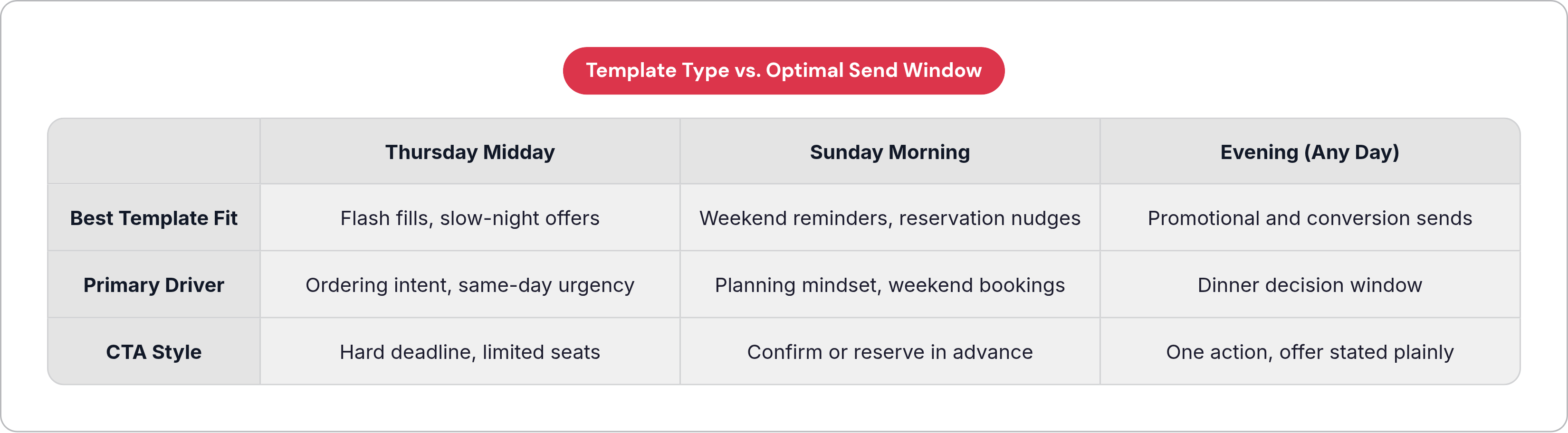
Thursday midday and Sunday morning are peak windows for ordering intent, so anchor slow-night fills there rather than firing them off whenever it occurs to you. And track every redemption against its specific send, because if you can't say which text filled which table, you're just hoping rather than running a system.
Templates for birthday and occasion messaging
Birthday sends generate roughly 3x the revenue of a standard promo, and the reason is straightforward: the occasion gives you permission to be generous without looking desperate.
Birthday offer, named incentive: "Happy birthday, [Name] 🎂 Celebrate with us — [specific offer] valid all week. Reserve your table: [link]" Say what the offer actually is, since "a special surprise" reads like a vague form email. Name the thing.
Anniversary or milestone, tied to loyalty: "One year as a [Restaurant] regular, [Name]. Here's something to mark it: [offer]. Use it anytime this month: [link]" No urgency needed here. The relationship earned the longer window.
Pre-birthday teaser, sent 5 to 7 days out: "Your birthday's almost here, [Name]. We've got something waiting — check your messages on [date]." This bumps open rates on the actual birthday text because you've already primed the guest to expect it.
None of this fires correctly if the underlying data is a mess: birthday fields, visit history, and opt-in status all have to be clean in your POS or CRM, or the automation either doesn't trigger or triggers on the wrong date. A mis-mapped field during a system migration can send a "happy birthday" text six months late, which is an easy mistake to catch if you audit the data regularly.
Templates for reservation confirmation and no-show reduction
An empty table during dinner service is a fixed-cost event: you paid for the labor, the prep, the lights, and got zero revenue back. A confirmation text is cheap insurance against that.
Booking confirmation with a two-way reply: "You're booked for Friday at 7, [Name]. Reply YES to confirm or CHANGE if plans shift." Two-way SMS creates a loop. Guests who reply are more invested than guests who just receive a one-way notice they can ignore.
Day-before reminder: "Your table is tomorrow at 7, [Name]. Reply YES to keep it or CANCEL to free the spot." The CANCEL option feels backwards at first, but a table released at 6pm the night before is resellable, while a no-show at 7:05 is a hole in your floor plan you can't patch.
Same-day reminder for large parties or ticketed events: "Tonight at 7, [Name] — party of [X] is confirmed. Parking tip: [detail]. See you soon." Practical details reduce no-shows that have nothing to do with intent and everything to do with logistics.
Worth noting: the reply data itself becomes useful. If you notice a pattern of CANCEL replies clustering on Friday nights, that's telling you something, maybe about the offer, maybe about who's actually on that segment of your list.
Templates for loyalty members and VIP guests
Loyalty members visit more often than non-members and make up a disproportionate share of total visits, per Circana's 2025 research. This is the most efficient group in your building to market to, full stop.
Exclusive early access: "Before we tell anyone else — [Name], our new [menu / event] is live for VIPs only until Friday. First access: [link]" The exclusivity is the offer here, standing on its own rather than as an add-on to a discount.
Loyalty reward redemption nudge: "[Name], you've got [X] points — enough for [specific reward]. They expire [date]. Use them: [link]" Specificity beats vagueness every time. "Enough for a free appetizer" moves people, while "You have rewards waiting" gets deleted.
High-spend guest event invite: "[Name], we're hosting a private [wine dinner / tasting / chef's table] on [date] — seats are limited and you're on the short list. Reserve yours: [link]" Don't discount your best guests. It trains them to wait for the next markdown instead of just showing up.
And segment by behavior, not just spend. A takeout regular wants convenience messaging, while a dine-in regular wants access and experience. Send the same offer to both and you'll underwhelm each of them a little.
Templates for winning back lapsed guests
"Lapsed" shouldn't be a calendar date you picked arbitrarily. It should be defined by the guest's own rhythm. A weekly regular who vanishes for three weeks is lapsed, while a once-a-month visitor isn't lapsed until three months out.
"We noticed" re-engagement: "It's been a while, [Name]. We miss your usual [dish / table / night]. Come back this week — [offer]. [link]" Referencing something specific signals you're using real data, not just running a mass blast with a name field swapped in.
Incentive-led win-back: "[Name], we want you back — here's [offer] to make it easy. Good through [date]: [link]" Keep it time-bounded. An open-ended offer just teaches people to keep waiting.
Final re-engagement before list removal: "Last chance, [Name] — [offer] expires [date]. After that, we'll stop sending texts. Still interested? [link]" This one works partly because of loss aversion: telling someone you'll stop reaching out is occasionally the thing that gets them to answer.
Automated win-back flows outperform one-off broadcasts by a wide margin on a per-recipient basis; Klaviyo's 2026 benchmark data put automated flows at roughly 30x the revenue per recipient of single sends. That gap alone should be reason enough to set the automation up once and let it run.
Templates for event- and moment-triggered campaigns
The event does the heavy lifting on urgency. Your job is just to connect it to an offer and a fast path to booking.
Sports event / watch party: "Game day is [day], [Name]. We've got [offer — wings, buckets, reserved section]. Book your spot: [link]" Wings and Rings, cited by SimpleLoyalty, drove same-day order volume by timing SMS to major sporting events. The sports calendar is basically a free, recurring urgency engine sitting there waiting to be used.
Holiday or seasonal push: "Valentine's dinner reservations are filling fast — [Name], here's early access before we open to the public: [link]" Exclusivity framing for your loyalty list, scarcity framing for everyone else. Same event, two different levers.
Local event tie-in: "Big night in [neighborhood] — pre-show dinner or post-game bites, we're right here. Reserve: [link]" No discount required. Proximity and timing are the whole offer.
Luna Grill's case is worth sitting with: they targeted SMS to guests with a history of large orders for a Mediterranean Family Meal promotion, and Evokad's data on the campaign showed a 74x return on ad spend with a 95% average conversion rate. That's what happens when behavioral targeting and a moment-specific offer land on the same guest at the same time.
How send cadence and timing affect whether these templates actually work
None of these templates matter if you burn out the list sending them. SimpleTexting's 2024 data found 61% of SMS unsubscribes happen because messages arrive too often. Your list is a revenue asset, and over-sending puts that asset at risk.
Most consumers say they're comfortable with somewhere between 4 and 6 texts a month, which is a useful ceiling to plan around rather than discover the hard way. Evening windows drive the bulk of SMS-triggered purchases, so that's your default slot for anything promotional. Thursday midday and Sunday morning are strong specifically for ordering-intent messages, so map your template types to those windows on purpose:
Flash and slow-night fills go out Thursday midday, weekend event reminders and reservation nudges go out Sunday morning, and birthday and VIP sends go out the morning of the actual date, not two days early and not two days late.
A/B test the pieces that are cheap to test: offer framing, CTA wording, the exact send hour. Small changes compound here, so treat every send as a data point instead of a one-off event you fire and forget.
Connecting SMS redemptions to in-store visits so every template has a measurable result
Everything above is just mechanics in service of one measurable question: did this specific message put a specific guest in a specific seat?
Unique redemption codes tied to each campaign are the simplest version of this. A code that only exists in the Thursday flash-sale text tells you, unambiguously, whether that text worked, no guessing involved. POS integration takes it further: if your point-of-sale system can tag a covers-and-check total back to the SMS campaign that triggered the visit, you've got a real feedback loop instead of a guess.
Without that link, cadence planning, segmentation, and clever offer framing are all just educated guesses dressed up as strategy. With it, you get to see, campaign by campaign, which template earns its spot in the calendar and which one's just taking up characters. That's the gap between a system that gets smarter every time you pull the lever, and one that never learns anything at all.