Restaurant Customer Win-Back Campaign Tactics
Personalization and timing, not discounts, recover lapsed diners.
Most restaurant operators treat a lapsed guest as a lost argument: the food disappointed, the service slipped, somebody found a better burger down the street. The data says something duller and more useful. A habit that was never locked in decays quietly, and nobody at the restaurant notices until the guest has been gone long enough to feel like a stranger.
Here is where the opportunity actually sits. Of the guests who do make that second visit, more than half go on to make a third. The attrition is not evenly smeared across the guest lifecycle like some kind of background radiation. It concentrates hard at one moment, the gap between visit one and visit two, and that concentration is what makes it fixable. A problem spread evenly across a thousand small causes is nearly impossible to intervene on. A problem stacked up at a single chokepoint is an engineering task.
So the reframe matters before a single tactic gets discussed: winning back a guest is a timing problem, not an apology tour for a bad experience most of them never had, and timing problems respond to systems, not sentiment. That is the premise the rest of this piece builds on.
Defining a "Lapsed" Guest by Individual Visit Cadence
Before any message gets sent, a restaurant has to answer an unglamorous question: lapsed compared to what? Most point-of-sale marketing tools default to a flat window, 30 days being the common one, and that single number is doing two jobs badly at once. A guest who eats at the restaurant every week and skips three in a row is already in meaningful trouble by day 21, but the 30-day rule leaves them alone for another nine days while their habit cools further. Meanwhile, a guest who only ever came in once a month to begin with gets flagged as "lapsed" and hit with a win-back email while they were never actually going anywhere.
Regulr's 2026 win-back guide puts a number on the fix: triggers calculated from each guest's own average visit interval outperform fixed-date triggers by a factor of two. The mechanism is straightforward once it's stated. Pull the visit history from the POS, calculate each guest's personal average interval between visits, and set the lapse trigger as a multiple of that interval rather than an arbitrary date pulled off the marketing calendar. The weekly regular gets flagged after missing roughly two of their own cycles. The monthly visitor gets flagged after missing two of theirs. Same logic, different clock: each guest gets caught at the point that's actually meaningful to their own habits, independent of the campaign's publish schedule.
The obvious objection: what about guests without enough visit history to calculate a meaningful average? Here the cadence model still wins, because it doesn't need much to work. A two-visit history is sufficient to estimate an interval, however rough. And a guest with no repeat history isn't a win-back candidate. A first-time guest belongs in a welcome sequence, not a lapse trigger, a distinction that matters as the next section turns to why the trigger mechanism matters so much more than the message content.
Why behavior-triggered outreach outperforms batch-and-blast by a wide margin
Once the trigger is set correctly, the next question is whether triggered outreach is actually worth building versus just blasting the whole list and hoping. The Bloom Intelligence benchmark study, which tracked tens of millions of emails sent across hundreds of restaurant locations in the US and Canada from January 2025 through August 2026, answers that question with a gap too large to round off as marginal. Triggered campaigns return guests at a rate that dwarfs blast campaigns per email sent, and the gap is visible in actual verified return visits tracked against the POS, not in vanity metrics like opens.
Which raises an odd little puzzle, one that should make any marketer uncomfortable about chasing open rates. In the Bloom data, the post-visit thank-you campaign had the lowest open rate of any campaign type in the study and the highest return-visit rate. The new-guest welcome email, by contrast, had the highest open rate of the group and ranked only fourth in getting anyone to actually come back. An operator optimizing subject lines to chase opens on these campaigns would be turning a dial that barely connects to the outcome they want.
Volume doesn't rescue the blast approach either. Batch-and-blast campaigns accounted for nearly all the email volume sent across the network, yet produced only a small share of the attributed return visits. Triggered campaigns, by contrast, made up a tiny fraction of total volume and still generated a disproportionate share of the returns credited to the network. Flip that into dollars and the gap widens further: per thousand emails delivered, blasts generated a modest amount of attributed return revenue, while win-back and welcome triggers generated an order of magnitude more. Recovered guests tend to skew toward higher-frequency spenders, so each one pulled back in carries more weight than an average new cover. None of this means blast campaigns are useless for announcements or broad awareness, and the network averages here will vary restaurant to restaurant. But as a mechanism for getting a specific guest back in a specific chair, the data leaves little room for debate about which approach deserves the engineering effort.
How to structure the three-touch win-back sequence
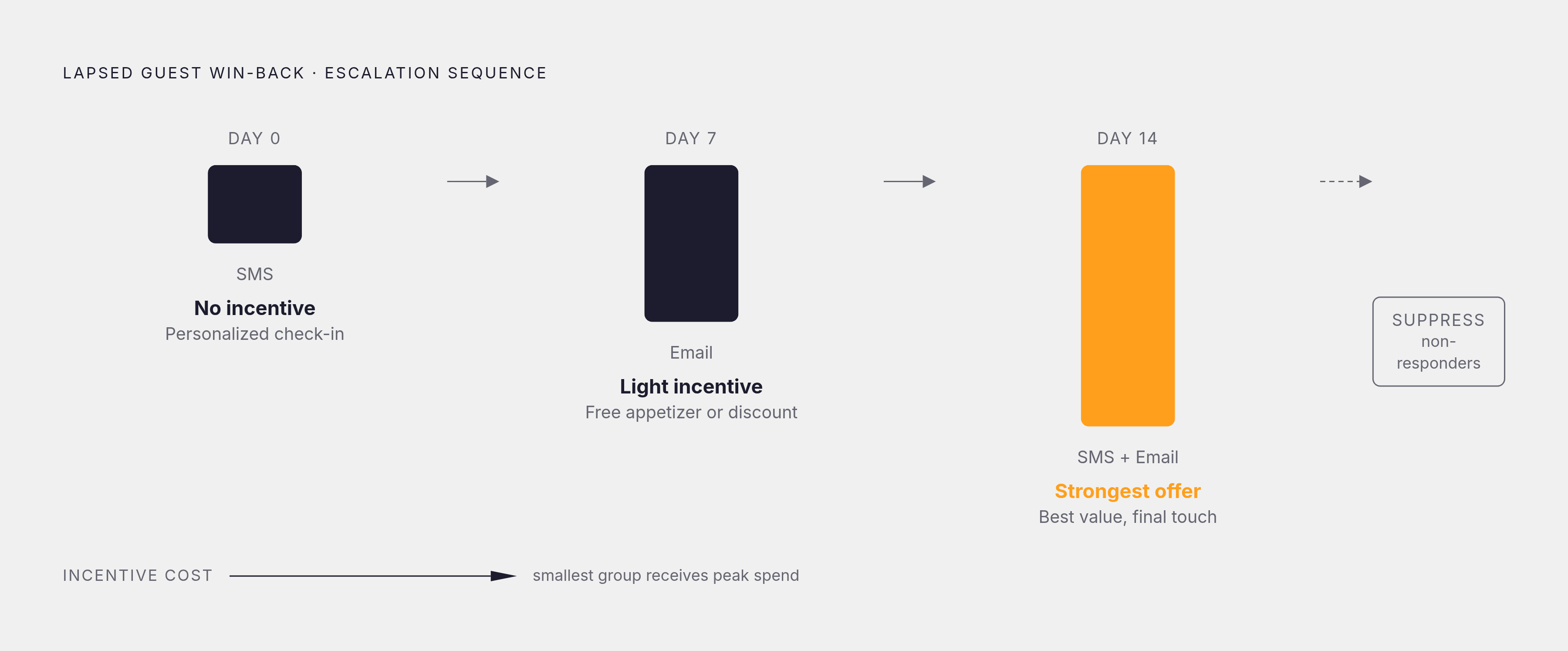
With the "why" established, the build itself follows a specific shape. Regulr's win-back guide lays out a three-touch sequence that starts cheap and escalates only for the guests who need it. Leading with the strongest discount wastes margin on guests who would have come back anyway for a friendly nudge. A graduated sequence reserves the real incentive spend for the guests who actually require it to move.
Touch 1 fires on day zero of the lapse trigger. It's a no-incentive message, a genuine check-in. Regulr's suggested framing captures the tone well: "We just added a new craft cocktail menu, and your favorite grilled salmon is still here." That single line does three things at once. It signals the restaurant remembers what this specific guest ordered, it gives them a reason tied to something new, and it asks for nothing in return. This touch exists to catch the guests whose absence was purely circumstantial: a busy month, a trip out of town, nothing that needed fixing.
Touch 2 arrives on day 7, aimed at the guests who didn't respond to the first message. This is where a light incentive enters the picture, something like a complimentary appetizer or a small percentage off, enough to lower the barrier to walking back in without handing a discount to the entire list indiscriminately. Touch 3 lands on day 14 and carries the strongest offer in the sequence, held in reserve for guests who ignored both prior touches. After Touch 3, non-responders should be suppressed. Continuing to message someone who has shown no interest in three attempts doesn't just waste a slot in the sequence, it tends to degrade deliverability and wear down whatever goodwill still exists in the relationship.
The seven-day spacing between touches isn't arbitrary. Tighter spacing starts to feel less like a thoughtful check-in and more like a restaurant leaning over the guest's shoulder, and that pressure raises unsubscribe rates and lowers net recovery. Personalization inside each touch acts as a multiplier on response: referencing the guest's actual last visit date, or the dish they tend to order, signals the message was written with them specifically in mind.
Channel choice matters too, and running the sequence across more than one channel recovers more guests than sticking to a single one. Touch 1 works well over SMS, where the messages tend to get opened quickly because they read as time-sensitive. Touch 2 suits email, where there's room to lay out the offer with more detail. Touch 3 pairs SMS with an email follow-up, covering guests whose preferred channel might not match what the first two touches assumed.
A deeper rule governs all of this: active guests and guests who were recently recovered must be filtered out before any trigger fires, or the whole sequence backfires. Nothing damages a regular's goodwill quite like being treated as a stranger who's drifted away. But a sequence this well-built is still just a sequence until someone can prove it worked. The system needs a measurement layer bolted on to do that.
How to know whether the campaign worked
A win-back sequence that can't tell a recovered guest apart from someone who would have wandered back in anyway is a sequence that can't be improved, only repeated on faith. Without attribution, there's no way to calculate what each recovery actually cost, no way to tell which touch did the work, and no way to adjust the next cycle based on anything but a guess.
Two metrics carry the real signal here. Cost per recovery, the total campaign cost divided by the number of guests who actually returned, tells an operator whether the sequence is economically sound. Subsequent visit rate, the share of recovered guests who come back again after the win-back visit, tells them whether the recovery actually stuck or whether the guest took the discount and vanished again.
Unique offer codes attached to each touch give the simplest way to trace which message did the convincing. A redemption on Touch 1's code means a plain, no-incentive reminder was enough to bring that guest back, information worth knowing because it means the restaurant didn't need to spend anything to recover them. A redemption on Touch 3's code means that guest needed the full incentive to move, and tracking that pattern across guests starts to reveal which segments respond to which level of nudge. For guests who return without ever redeeming a code, matching their visit against POS records closes the gap: if a recognized guest profile shows a visit inside the campaign window, that return is attributable even without a coupon scan to prove it.
Attribution gets harder once paid social enters the mix. Platforms like Meta and TikTok report clicks and modeled conversions, not tables actually filled with people who showed up and ordered food. Running a win-back push through paid social without an independent measurement layer, meaning unique codes, reservation source tracking, or POS match-back, means trusting a platform's self-reported numbers for a claim the platform has no way to verify on its own.
None of this is a one-time setup. Regulr recommends reviewing the sequence monthly: adjusting the lapse trigger interval as more visit history accumulates, recalibrating the incentive level at Touch 2 and Touch 3 based on what's actually converting, and shifting the channel mix if one channel is consistently outperforming the others. Attribution is what turns a single successful campaign into a system that keeps getting sharper, rather than a lucky result nobody can explain or repeat.
What to do with a guest once they come back
Recovering a guest and then doing nothing with that win is close to running the entire sequence for nothing. Without a deliberate follow-up, the guest who came back once simply resumes the same drift that pulled them away the first time, on the same clock, headed toward the same lapse trigger a few months later.
The retention ladder explains why this moment deserves real attention. A guest who makes a second visit already carries a stronger chance of making a third than a brand-new guest had of making a second. That makes the freshly recovered guest, the one who just walked back through the door because of a win-back sequence, arguably the highest-leverage person in the building at that exact moment. The hard part, getting them back, is done. Keeping the momentum afterward just takes not letting the thread drop.
A visit-milestone email, the kind that fires automatically when a guest hits a defined visit count such as the fifth or tenth, returns guests at a rate far above what a blast campaign manages. That milestone only becomes reachable, though, if someone is actively moving the recovered guest up the ladder one visit at a time rather than letting them settle back into irregular, unprompted visits. Loyalty program enrollment or re-engagement is the mechanism that keeps that counting visible to the guest as well as the restaurant.
There's a second multiplier sitting right behind the first: a recovered guest who has a genuinely good visit is primed to leave a review, and that review becomes a small piece of organic discovery for new guests who've never set foot in the restaurant. Timing matters here. The review request should land after the visit that follows the win-back, not the win-back visit itself, so it reaches the guest once trust has had a chance to rebuild rather than immediately after a discount-driven return.
Operationally, none of this should require someone manually flipping a switch. The same automated infrastructure that fired the win-back trigger should hand the guest directly into the standard retention stack, the post-visit thank-you, the milestone emails, without a separate step in between. That handoff closes the loop the whole piece has been tracing: a trigger built on the guest's own cadence, a sequence that escalates only as needed, attribution that proves what worked, and a retention system waiting on the other side to make sure the recovery wasn't just a one-night return.