Seasonal and Event Paid Ad Planning for Restaurants
Plan seasonal restaurant ads six to eight weeks early, not the week before.

Seasonal and event peaks are the highest-stakes moments for restaurant ad spend, and they're also the moments when operators are least likely to have any mechanism in place to verify what that spend produced. The campaigns get assembled in a hurry, under the kind of time pressure that makes measurement feel like a problem for next week, and next week never comes because the next peak is already on top of them.
When nobody builds a way to measure what happened, the platforms happily fill the silence. That's not a minor rounding error worth shrugging off. A restaurant conversion doesn't happen at the click. It happens at a table the platform cannot see, rung up on a POS system the platform never touches. Every dashboard showing "47 conversions" is reporting an event that took place inside Meta's or Google's own walled garden, not an event that took place inside the restaurant.
That disconnect costs more at peak than it does on a slow Tuesday. Peak budgets are bigger, the expectations riding on them are higher, and the two ways to be wrong both get more expensive. The other is running a discount that doesn't bring in a single new guest but trains forty regulars to wait for the next coupon before booking again. Both failures are invisible without measurement, and both get bigger every time the restaurant treats a seasonal peak the way it treated the last one: full improvisation, with the receipts sorted out never.
How platform costs and ad auction mechanics shift during high-demand periods
The cost of reaching a diner is not fixed. The auction didn't get worse. Everyone else showed up to it.
Search costs illustrate this clearly. The restaurant bidding on "Valentine's dinner reservations" on February 10th is bidding against every competitor who had the same idea at the same moment, in a market where demand just tripled and supply (ad inventory) didn't.
Meta adds a second layer to the same problem: the learning phase. Launch that learning phase during peak week and the algorithm is optimizing at the exact moment it's paying the highest prices of the year for the privilege. A campaign that needs to perform on Valentine's weekend cannot be built the week before Valentine's Day, because a week isn't enough time for the algorithm to stop guessing before the most expensive auction window of the quarter opens.
Google and Meta aren't interchangeable here, even within the same seasonal push. Google captures intent that already exists, the person already typing "Valentine's dinner near me" into a phone at a stoplight. Meta builds desire in people who haven't started thinking about where to go yet. Treating those as two buckets that can absorb the same spend at the same time lets a campaign both meet demand and create it.
Building the campaign structure before the season arrives, not during it
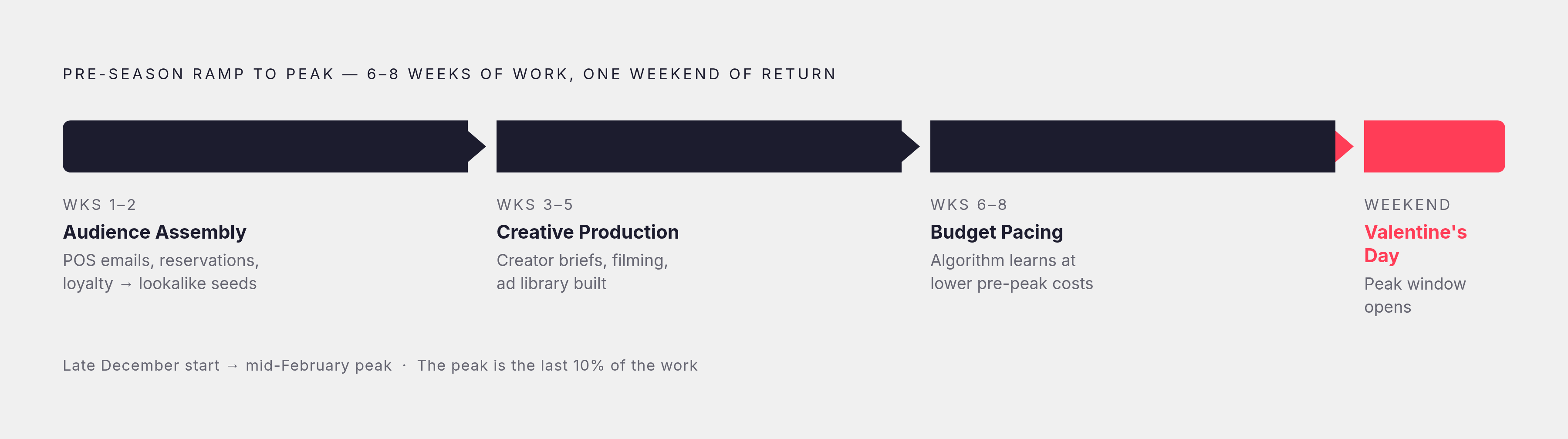
If a campaign gets measurable returns, it treats the six to eight weeks before a peak as the actual campaign, and the peak window as the payoff of work already done. For Valentine's Day, that clock starts in late December. For a summer festival that draws crowds in June, the clock starts in May. None of those three jobs can be rushed, because each one needs the platform's algorithm, the creative library, or the operator's own data pipeline to mature on a timeline that doesn't compress just because the calendar is tight.
Audience assembly comes first, and it starts with data the restaurant already owns: emails from the POS, past reservation lists, loyalty program members. That list becomes the seed audience for lookalike targeting, which matters more than it might sound.
Creative and offer design happen in parallel. If the restaurant isn't yet known for a daypart or occasion, say brunch for a dinner-focused spot, this is where Meta's demand-generation strength can earn its keep.
Budget pacing follows the same build-then-scale logic. The same total dollar amount, split this way across two phases instead of dumped in all at once on the Friday before the peak, produces a better result because the second half of the spend is buying efficiency the first half already paid to build.
Embedding measurement before the first dollar is spent
Attribution has to be decided before launch, as an infrastructure decision, because the data it depends on can only be collected while the campaign is actually running. If you try to reconstruct attribution after the fact, the raw material isn't there anymore.
This gap between a social impression and a POS transaction is the problem this piece solves. To close it, you layer signals you control on top of, not instead of, whatever the platform reports. A few of these cost nothing and take minutes to set up. Guest recall isn't perfect, plenty of people will say "the internet" when they mean a specific ad, but for a defined event campaign built around one clear promotional angle, that signal is reliable enough to act on directionally.
UTM-tagged links on every piece of paid social creative, routed through a reservation page tracked with Google Analytics 4, connect an ad click to a reservation without needing the platform's own attribution to confirm it happened. The signal only fires when someone actually clicks through, which is exactly the behavior that matters for attribution anyway.
A Meta Pixel on the reservation confirmation page still earns its place, because it feeds Meta's own optimization engine post-click behavior to learn from. But the operator's source of truth should be the GA4 event paired with the POS match, not the number Meta's Pixel reports back, because Meta has every incentive to credit itself generously. The POS match-back step closes the loop completely: compare the guest email collected at booking against the POS record of what that guest actually ordered and paid for. None of this requires enterprise software. It requires collecting an email at the point of reservation and someone, at some point after the campaign, sitting down and comparing that list against a POS export.
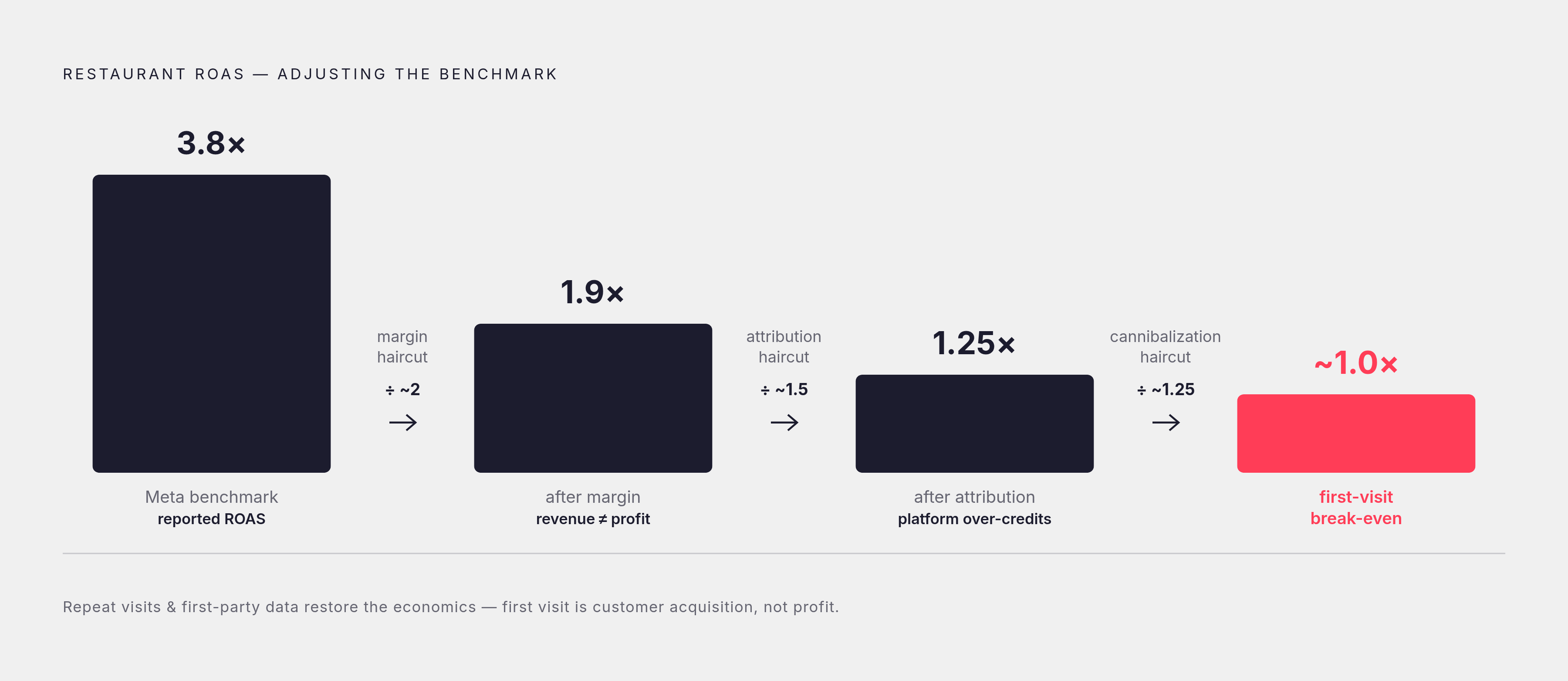
All of this infrastructure exists to produce one number that actually means something: total revenue verified at the POS, divided by total ad spend. Before trusting any published ROAS benchmark for planning purposes, run it through three adjustments: a margin haircut (restaurant revenue isn't restaurant profit), an attribution haircut (platforms over-credit their own role), and a cannibalization haircut (discounts move existing regulars around as often as they bring in anyone new). If you apply those three haircuts to Meta's widely cited restaurant ROAS benchmark, you land close to break-even on a guest's first visit. That's precisely why repeat-visit economics carry so much weight in this business, and why first-party guest data, the same list that seeds the lookalike audience back in the build phase, turns out to be the asset that actually changes the math. If you have this infrastructure in place, you aren't guessing at the next campaign, you're deciding, with evidence, what to double down on.
Using local creator content as the seasonal ad's raw material
Creator-led content tends to outperform brand-produced creative in paid seasonal campaigns, and that has less to do with organic reach than with how good the resulting paid ad is. At matched cost, creator-sourced footage buys more attention than a brand's own camera crew does, so you get a cost-efficiency tool as much as a content strategy.
A food creator's value here comes from local specificity, not from raw follower count. A food creator whose audience sits in the same city as the restaurant is reaching people who can physically walk through the door that weekend. For a seasonal push specifically, the creator brief should tie directly to the occasion, a Valentine's tasting menu, a holiday cocktail, a one-night festival special, so the resulting content is inherently time-stamped and lands with full relevance for people actively planning around that date.
Creator content fits into a seasonal paid campaign in two ways. One way is to source footage directly for the restaurant's own ad account, cut into paid formats the operator controls and can A/B test against other creative, the way Edinburgh cocktail bar The Botanist used creator-led Spark Ads on TikTok to generate over 700 bookings and 1.5 million views, reporting a 29.74x return on ad spend from the campaign. The other is as a Spark Ad or partnership ad run through the creator's own account but boosted with the restaurant's budget, which preserves the creator's native engagement patterns while still functioning as paid media.
You don't need a production budget most independent restaurants don't have to get this content. At the nano and micro tier, creators with a modest but genuinely local following, a gifted meal in exchange for content is often enough, so you can build a seasonal content library without any cash outlay. Finding those creators is mostly a matter of searching location-based hashtags on TikTok and Instagram for people who already post regularly about dining in that specific city or neighborhood, then checking engagement, comments, saves, shares, rather than follower count, since that's the signal that actually correlates with an audience that acts on what it sees.
Whichever route the content takes, you still have to run it through the same UTM tagging and POS match-back discipline laid out in the measurement section. A Spark Ad with 1.5 million views means nothing to the restaurant's bottom line until it's traced to a reservation and a receipt, the same as any other paid creative.
Allocating budget across a seasonal calendar rather than reacting event by event
Treating every seasonal peak as its own isolated fire to put out is what keeps restaurant ad spend stuck at the level of guesswork, because each campaign starts from zero instead of building on what the last one measured. A planned annual calendar changes that: it lets what gets learned at Valentine's Day inform what happens at Mother's Day, instead of resetting the operator's knowledge to nothing every six weeks.
The restaurant year has a fairly predictable shape to it: Valentine's Day, Mother's Day, summer local events, back-to-school shoulder periods, fall harvest promotions, and the Q4 holiday cluster. Meta spend should generally lead Google spend in the pre-season phase, with the ratio tilting toward Google as the date approaches.
Segment and goal matter here as much as timing. Applied to specific occasions, that logic plays out concretely: a restaurant already known for brunch should defend that ground on Google heading into Mother's Day, while a dinner spot trying to build a name for itself in a new category should lean on Meta to build that desire before the season even opens.
Picture a peak landing on the second Sunday in May. Creator content for that occasion needs briefing and filming well before the pre-season build phase even starts, both because the operator will be buried in peak operations by the time the campaign needs assets and because every other restaurant in town is competing for the same handful of local creators' calendars. The build phase, learning phase, and measurement setup then follow in sequence over the preceding six to eight weeks, with the Meta-heavy early weeks giving way to a Google-heavy final stretch as the date closes in, and the measurement close happening the week after, not three months later when nobody remembers which creative ran on which day.
Reading campaign results to decide what scales
Building measurement into a seasonal campaign isn't about producing a tidy report to file away.
The Media Efficiency Ratio, verified POS revenue divided by total ad spend, gives you one platform-agnostic number that holds up across campaigns and across seasons. One with a weak MER gets restructured or dropped entirely, and that's a legitimate outcome of measuring honestly, not a failure of the process.
Creative performance data carries value well past the season it was collected in. Knowing which specific piece of creative drove the most verified visits, and from which audience segment, becomes the brief for the next creator partnership. That's how measurement compounds over time: each campaign generates the inputs that make the next one sharper, rather than every season starting the research over from scratch.
The cannibalization check belongs at the close of any campaign that featured a discount. Compare the guest email list you collected during the campaign against the existing guest database. If most of the people who redeemed the offer were already regulars, that heavy overlap means the promotion shuffled revenue between visits instead of creating any new revenue, so that finding should change the offer structure before you run the next similar campaign.
Four things carry forward into next season's plan: the audience segments that actually converted, the creative approach that produced the strongest verified visit rate, the platform mix that produced the best MER, and the lead time that let the algorithm clear its learning phase before peak costs hit. Those four inputs are the planning brief for the next cycle, and they're the entire argument of this piece compressed into one list. A seasonal peak isn't just a revenue opportunity to chase once a year. Measured properly, it's a data-collection event, and the operator who treats it that way walks into next year's Valentine's Day with a plan. The operator who skips the measurement step gets to do it all again from zero.