Measuring the Impact of Creator Content on Restaurant Visits
Restaurants can now measure which creator posts actually drive reservations, not just views.
Restaurant marketing has a discovery problem that already got solved and an attribution problem that hasn't. Diners are finding restaurants through creator content at a scale the industry has never seen, but almost none of that discovery gets connected back to the table where the check gets paid. This piece walks through why that gap exists, what the research actually says creator content does to visit behavior, and the specific mechanics operators use to trace a post to a seated party rather than just a view count.
Why most restaurants cannot connect a social view to a physical visit
Half of marketers, across every category, still cannot prove return on investment from influencer marketing, according to Shopify. That's the industry-wide floor before anyone even adjusts for the extra wrinkle that restaurants deal with: the thing being sold is not a click-through purchase, it's a body walking through a door and sitting down. The IAB's State of Data 2026 report found that 75% of US buy-side leaders say their core measurement approaches are underperforming. So this is not a restaurant-specific failure. It's a structural one that restaurants happen to feel more acutely than most.
Why does it hit restaurants harder? Because the systems involved were never built to talk to each other. Meta and TikTok report views, saves, and clicks. A POS system reports covers and revenue. Nothing sits in between those two data sets by default, which means a restaurant can watch a video rack up a huge number of views and have zero idea whether that translated into four tables or zero.
Platform-reported numbers are also self-interested measurement. Meta's attribution tools count what Meta can see, and what Meta can see stops dead at the edge of the platform. It cannot record someone getting off the couch, driving fifteen minutes, and ordering the short rib. The walk from feed to front door is invisible to the tool that showed the ad in the first place.
Attribution and incrementality are not the same question, a distinction that gets flattened constantly in casual marketing conversation. Attribution asks who was exposed to a post and later visited. That's observational, not causal, and it has a specific blind spot: it happily counts the regular who eats there every Thursday anyway and would have shown up with or without the post. Their visit looks like a win. It isn't one, because nothing changed.
Incrementality asks the harder question, whether the campaign caused visits that would not have happened otherwise. Answering that requires a control group, people who weren't exposed to the campaign, to compare against. Most restaurants run neither method with any rigor. What they're actually doing, if being honest about it, is looking at reach numbers and hoping correlation quietly does the work of causation. It doesn't, and the bill for that hope shows up later as marketing budget with no story attached to it.
None of this requires a massive technology purchase to fix, either. It's a framing problem before it's a budget problem. Operators need to know which signals to trust before they can act on any of them, and right now most are treating every number on a dashboard as equally meaningful, which is a little like treating every noise in a kitchen as equally urgent. Some of it is the fryer timer. Some of it is just the dishwasher.
What the evidence says creator content actually does to in-store behavior
Start with the strongest anchor available: a July 2025 study in Cogent Business & Management, surveying 331 respondents and using the Elaboration Likelihood Model, found that a restaurant influencer's credibility, authenticity, interactivity, and playfulness significantly shaped followers' attitudes toward the restaurant, and that visit intention in turn significantly predicted actual visits. That's a peer-reviewed finding, not a vendor's case study designed to sell a subscription.
The mechanism behind it explains why this content type outperforms a lot of traditional advertising. The Elaboration Likelihood Model splits persuasion into two routes: central processing, where someone evaluates the actual substance (is the food good, is the source credible), and peripheral processing, where surface cues do the work (a nice-looking plate, a likeable personality on screen). Generic restaurant advertising mostly only has the peripheral route available to it. Creator content, when it's working, fires on both at once. That's a meaningfully different persuasion mechanism, not just a stylistic difference in format.
The commercial data lines up with the academic finding. Campaigns built around local food creators have reported roughly 8x return on investment alongside measurable jumps in reservations within days of a post going live, according to Moburst (2026). The "within days" detail creates a short latency between exposure and visit, which is exactly the kind of window that makes measurement possible. If the lag were three months, tracing cause and effect would be close to hopeless.
Separately, 91% of brands using influencer marketing report that creator content outperforms traditional digital ads on ROI, per Harmelin Media's 2025 Media Trends Research, and consumers say they're notably likely to act on influencer content specifically about food and beverage, a pattern consistent with the scale of engagement Evok Advertising documented across food and beverage creator posts. Food and beverage, in other words, converts content into action at a rate most other categories would love to have.
But a caveat needs to be said out loud, because it's the hinge the rest of this article turns on: "drives ROI" and "drove this specific visit last Tuesday" are different claims. The population-level evidence for creator content's effect on dining decisions is strong and getting stronger. What's still missing for most operators is the per-campaign, per-restaurant version of that proof, the kind that says this post, from this creator, filled these four tables. That's the harder problem, and it's the one the rest of this piece is built around solving.
Why local creators produce signals that are actually traceable to your restaurant
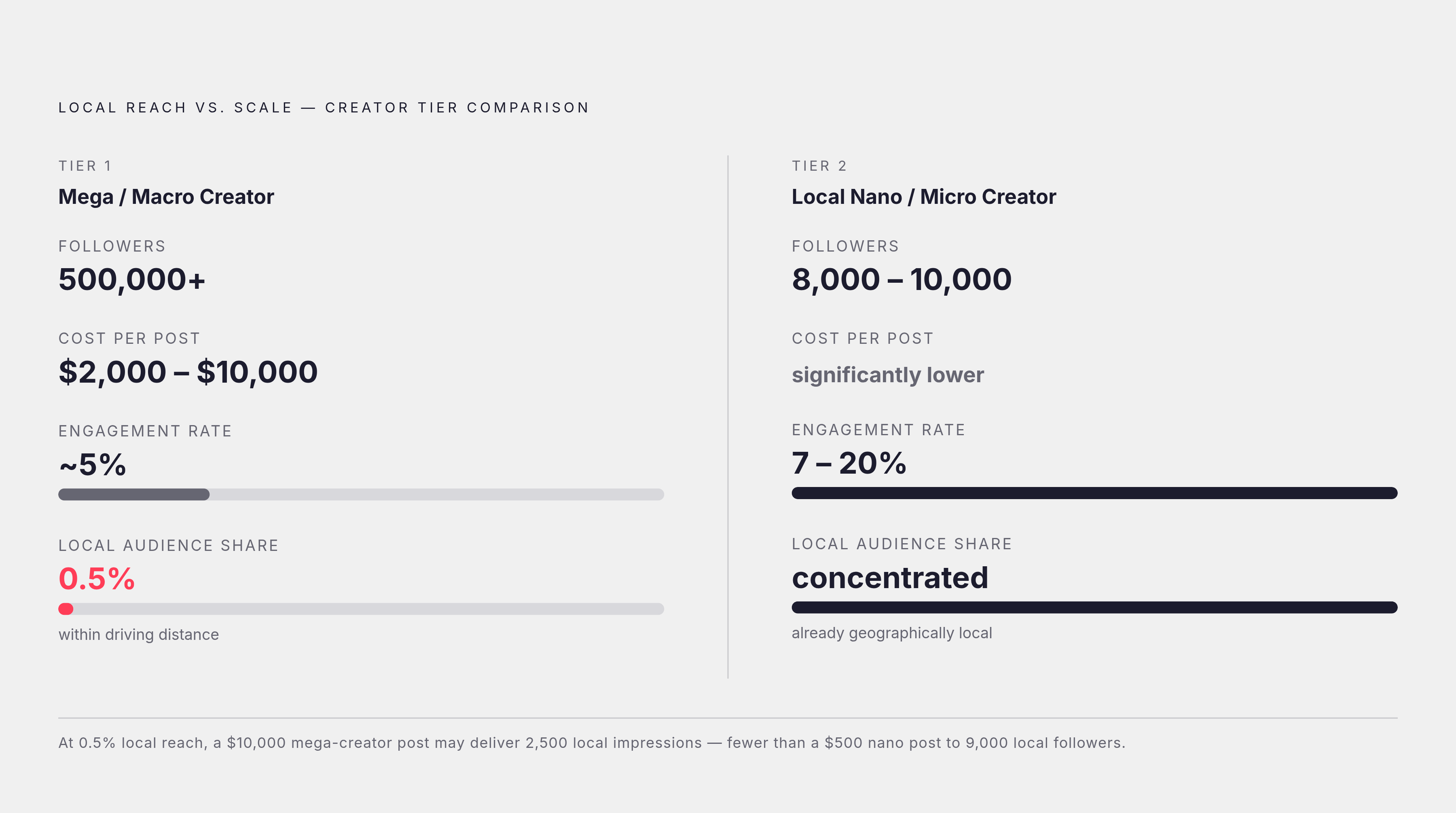
A mismatch sits here. A creator with 500,000 followers might charge somewhere between $2,000 and $10,000 for a single post, according to Restaurant Velocity, and reaches an audience scattered across the country, of which maybe 0.5% live within actual driving distance of the restaurant. That's a lot of money paying for a lot of people who will never, under any circumstance, walk through the door, because they live nine states away and the short rib photo, however good, is not worth a plane ticket.
A local creator running 8,000 to 10,000 followers tells a different story. Nano and micro influencers post engagement rates between 7% and 20%, per Getcraver, against a ceiling closer to 5% for macro and mega accounts. And 73% of brands now say they prefer working with micro and mid-tier creators specifically because the engagement-to-cost ratio is stronger, according to Later's 2025 Influencer Marketing Report.
This isn't just an efficiency story, it's an attribution story, and that's the part operators tend to miss. When a creator's audience is geographically concentrated, a visit spike in the days after their post is far more likely to be real signal than statistical noise. There's no need to filter a national audience down to find the local sliver that matters, because the audience already is the local sliver.
The logic extends further: spreading a budget across several local nano creators rather than concentrating it on one larger account tends to preserve that geographic concentration and the trust that comes with it. Smaller creators carry more concentrated local reach and, generally, a higher level of trust with the people following them. Micro-influencers generate up to 60% more engagement than macro accounts, per Evok Advertising, and engagement is the precursor behavior that eventually shows up as a real, measurable action at the register.
Restaurants increasingly favor ongoing creator relationships over one-off posts, and that shift makes attribution cleaner, not just cheaper. A follower who sees the same creator mention a restaurant three times over six weeks is behaving differently than someone who caught a single video once and scrolled past. Repetition builds intent in a way a single exposure rarely does.
Picking which creator to work with is already a measurement decision, dressed up as a creative one. Who gets hired determines how traceable the resulting visits will even be, before a single dollar of ad spend gets tracked.
The specific methods restaurants use to connect a creator post to a table filled
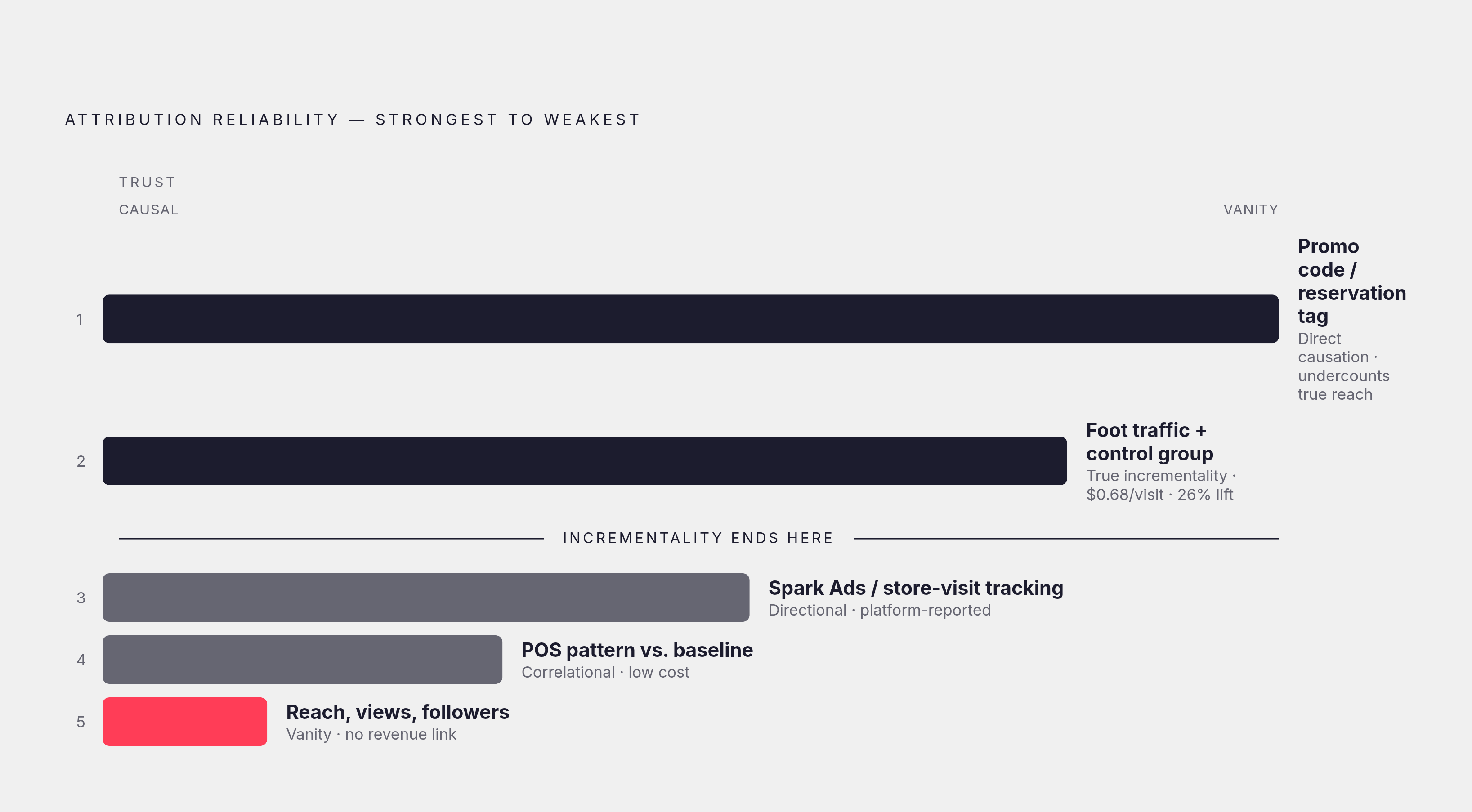
Promo codes and reservation source tagging. Give a creator their own discount code or booking link, and every redemption becomes a direct, unambiguous signal in the POS or reservation system. It's the cleanest attribution method available and it requires no third-party software at all. It only captures the fraction of guests who remember to actually use the code, so it understates the true reach of the campaign. Treat it as a floor, never a ceiling.
Foot traffic attribution platforms connect an online ad exposure to a physical visit by matching the device ID that saw the ad against the device ID that later crossed into the restaurant's geofenced location. The stronger versions of this compare an exposed group against a genuine unexposed control group, measuring incremental lift rather than raw visit counts, which is the difference between attribution and incrementality made operational.
The case studies here are concrete enough to name. A national dining chain launching a seasonal item measured a 26% incremental visit lift against a 23% benchmark, translating to roughly 285,000 incremental visits attributable to the media (InMarket). Other Foursquare Attribution campaigns have similarly documented meaningful visit lifts among exposed users versus control groups across a range of quick-service concepts. Papa Murphy's, working with agency Barkley through Foursquare Attribution, landed a 2.11% conversion rate at a cost of $0.68 per store visit. And a Reddit campaign for a QSR's new menu item, also measured through Foursquare Attribution, drove 2.5% more visits than the control group. What ties all four together is the control group itself, which is exactly the methodological step most independent restaurant operators skip entirely.
Platform-native store visit tracking is offered by both Meta and Google for businesses that clear a minimum volume threshold, using device location data to infer post-ad visits. Read this as directional, a rough compass heading, not a definitive figure carved in stone. And there's a real gap in what it covers: an organic TikTok post boosted through a Spark Ad becomes trackable inside paid dashboards, but the same post left unboosted and fully organic isn't tracked by platform tools at all. That gap is exactly why paid amplification matters, a point that resurfaces later.
POS pattern analysis against post timing. Even without any attribution software, an operator can simply compare cover counts, average ticket, and new-customer rate in the days following a specific post against an honest baseline period. It's correlational rather than causal on its own, but it's a useful, low-cost way to decide whether a signal is worth the trouble of building proper attribution around. Pair it with a creator-specific promo code and the correlational fog starts to clear.
Repurposing creator content as paid, tracked ads. 41% of brands say repurposing creator content inside paid ads outperforms studio-produced creative on ROI, according to the IMH Influencer Marketing Benchmark Report (2025). Content that already proved itself organically, run again with paid targeting layered on top, turns an anecdotal win into something measurable, because paid amplification unlocks geo-targeting by zip code or radius and real conversion tracking that an organic post simply cannot offer.
How to read the signals after a campaign runs
The operational version of the attribution-versus-incrementality distinction matters most right here, once the campaign is over and the numbers are sitting in front of someone. Most restaurant-accessible tools hand over attribution: who was exposed, who later showed up. Incrementality, the harder and more valuable question of who showed up because of the exposure, requires either a real control group or a platform built to construct one.
Some signals deserve trust. Promo code redemptions are causal, even if undercounted, a real floor rather than a flattering ceiling. Reservation source tags are reliable, provided the tagging was set up correctly in the first place (a surprising number aren't). Platform-reported store visits are directional at best, and deserve a skeptical discount, especially for anything organic and unboosted.
Other signals flatter without meaning much. Raw post reach or view count is context, not a result, in the same way that a restaurant's total foot traffic on the sidewalk outside says nothing about how many of those people actually walked in. Follower growth after a post is a vanity metric with no fixed relationship to revenue, unless those new followers happen to live nearby and eventually convert into a visit. A thousand new followers in another time zone changes nothing about tonight's reservations.
Operators who systematize this, actually allocating budget toward what measurably works and cutting what doesn't, see sharper returns. One restaurant lifted return on ad spend tenfold over six months simply by doubling down on tracked channels and pruning the ones that weren't earning their keep (Kard, 2025). Separately, operators using structured measurement templates saw a 35% increase in marketing ROI compared to ad-hoc efforts (Kard, 2025). The value compounds not because any single campaign is a home run, but because the process gets repeatable.
What to do when a signal is genuinely ambiguous? Run the same creator, or the same content format, again with a tighter tracking setup before deciding to cut it loose. One data point isn't a pattern, it's a rumor. Two or three data points start to look like an actual decision worth making. The practical cadence, then, is to track each campaign individually, compare across campaigns over time, and slowly build a working profile of which creator type, content format, and posting frequency reliably produces traceable lift at that specific restaurant, on that specific block, for that specific menu.
Building the feedback loop that turns one good campaign into a repeatable system
The absence of measurement isn't just a reporting inconvenience, it's a compounding disadvantage. Every campaign that runs untracked leaves the operator exactly as uninformed as before it started, with nothing banked to inform the next decision. Money spent, lesson not learned, repeat next quarter.
The feedback loop that fixes this has a fairly clean shape to it. Pick local creators whose audience geography actually overlaps the restaurant's trade area. Assign each one a distinct tracking mechanism, a code, a link, a Spark Ad, a tagged reservation source, something. Record baseline covers and revenue before anything launches, not after, because a baseline measured retroactively is really just a guess wearing a lab coat. Measure the lift in visits and revenue during and after the campaign window. Score each creator by cost per attributed visit or cost per attributed dollar of revenue. Then reinvest in whichever creators and formats scored well, and stop or renegotiate the ones that didn't.
Repurposing creator content into paid ads is what actually closes this loop, because paid amplification is what supplies the tracking layer that organic posts never had to begin with. The creative already resonated with a local audience once, organically. Running it again with geo-targeting and conversion measurement attached doesn't dilute that resonance, it just finally gives it a paper trail.
83% of marketers say sponsored influencer content generates more conversions than brand-organic posts, according to Sprout Social's Q1 2025 Pulse Survey. That gap, between what an organic post achieves and what the same content achieves once paid amplification and tracking get layered on, is roughly where most restaurant operators are quietly leaving measurable return on the table.
Visibility without measurement isn't marketing. It's decoration. A creator post that fills a feed but can't be traced to a filled table is a cost sitting on a spreadsheet, not an investment earning its way back. The operators who close this loop, even a rough version of it, are the ones positioned to scale what's actually working and cut what's just noise, rather than treating every dollar of marketing spend as a coin flip dressed up in a content calendar.
None of this requires a long contract or a marketing department the size of a small airline. The minimum viable version is a promo code, a local creator whose audience actually lives in driving distance, and the discipline to check the numbers a week later instead of assuming the views meant something they never promised to mean.
Sources
- 7 Restaurant Marketing Strategies That Drive Measurable ROI in 2025 | Kard
- Restaurant Influencer Marketing in 2024 | Evok Advertising
- 85 vital influencer marketing statistics for your 2026
- Influencer Marketing ROI in 2026 | Moburst
- Influencer Marketing ROI 2026: Benchmarks, Stats and How to Track Returns
- shopify.com
- tandfonline.com
- researchgate.net