Repurposing UGC in Restaurant Paid Ads
Customer content outperforms polished ads because diners trust what other diners post.
Restaurant marketing has a trust problem, and the fix is sitting in everyone's camera roll. Operators pay real money for polished photo shoots and produced video, but diners don't pick where to eat based on brand creative. They pick based on what other diners post, and closing that gap between spend and influence is the entire subject here.
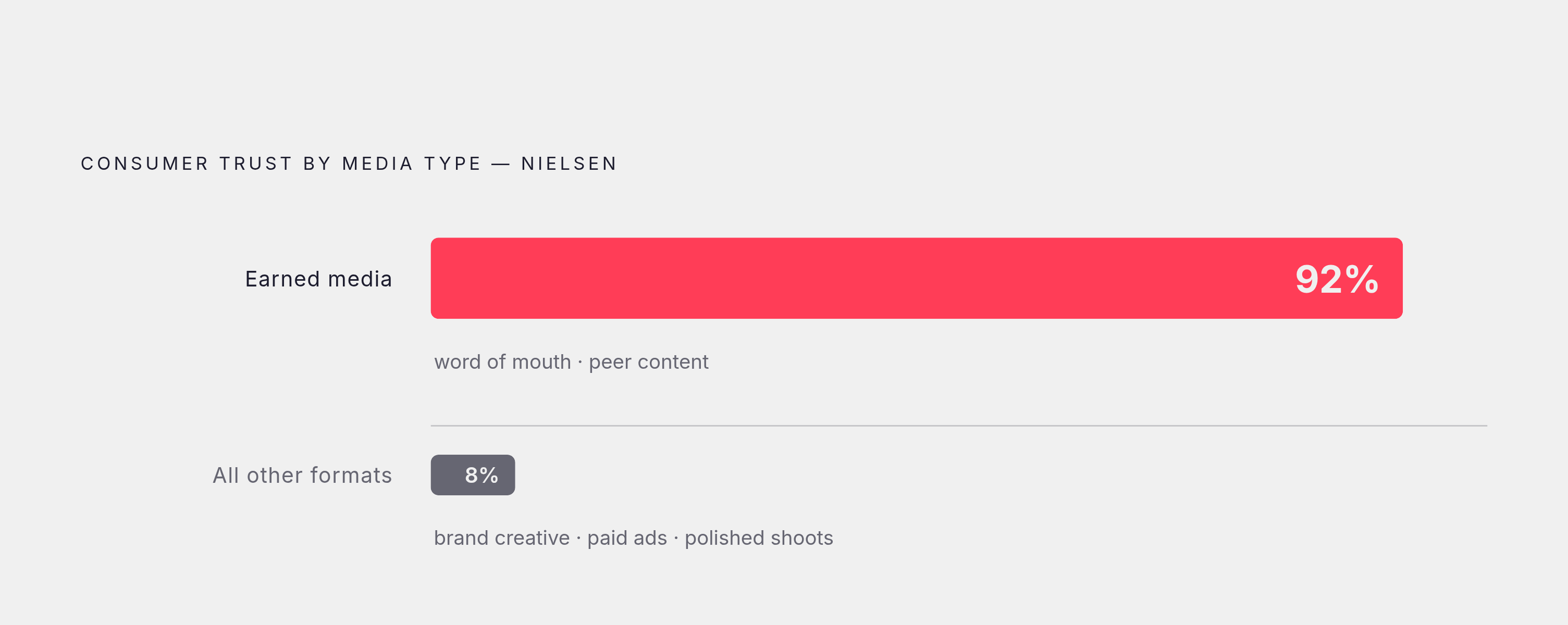
Nielsen has found that 92% of consumers trust earned media, meaning word of mouth and peer content, over every other ad format. That number alone should reorganize how a restaurant spends its marketing budget, and mostly it hasn't. Paying for a photo shoot when a customer's iPhone video already outperforms it is a habit nobody's questioned yet, inherited from an era when "professional" and "trustworthy" meant the same thing to a diner scrolling Instagram at 9pm deciding where to eat. It's a habit nobody's questioned yet, inherited from an era when "professional" and "trustworthy" meant the same thing to a diner scrolling Instagram at 9pm deciding where to eat.
So if that trust is already sitting in tagged posts and comment threads, the real question is whether operators are putting it in front of the right people at scale. That's what paid distribution is for, and that's what the rest of this piece walks through.
What counts as strong UGC for paid ad use
Not every customer video is ad-ready, and treating a tagged-posts folder like a trophy case instead of a casting call is where a lot of restaurant marketing goes sideways. Screenshotting everything with the logo in the corner is a hoarding habit that happens to feel productive, right up until someone has to dig through four hundred saved Stories to find one usable clip. It's a hoarding habit that happens to feel productive, right up until someone has to dig through four hundred saved Stories to find one usable clip.
Strong UGC shares a few traits, and they're less about production value than about a kind of accidental honesty. There's a visible, unforced reaction, the kind of face someone makes when a bite is better than expected. The food or the room is the actual subject of the shot, with the restaurant incidental in the background rather than a person posed in front of a sign like it's a school photo. Audio holds up, whether that's ambient dining-room noise or a creator narrating their own reaction, and the clip still reads clearly with the sound off, which matters more than most people assume given how much social video gets watched muted on a train or in a waiting room. It's shot vertically and close, since that's already the native shape for Reels and TikTok, so there's no reformatting tax to pay later.
Before spending a dollar promoting anything, check whether the original post already has legs: saves, shares, replies. Organic traction is a free preview of paid performance, and skipping that check is probably the single most common mistake in this whole process, because it means paying to find out something the post already told you for free.
What to pass on is just as identifiable, and here's where the discipline actually gets tested. Heavily filtered or over-edited posts lose the raw texture that makes UGC read as real in the first place, which is a little ironic given that the whole point of using it is that it doesn't look manufactured. Skip content where the restaurant is barely visible, where lighting is bad enough that it degrades further once compressed for ad delivery, or where the caption and vibe clash with the message meant to run in a paid slot.
Get written permission before anything goes into paid rotation, no exceptions. A quick DM exchange or a documented reply thread covers it. No legal production required. But skipping this step is the kind of shortcut that turns into a headache exactly when the campaign starts working, which is the worst possible time to discover a creator never actually said yes.
One more filter, and it's the one operators forget most: geography. Content from a creator whose actual followers live near the restaurant behaves differently than content from someone three states away, because a nearby audience can act on what they're seeing tonight. Discovery only becomes a visit when the person discovering it can actually get there before the kitchen closes. A gorgeous clip from a creator in one city does nothing for a restaurant in another city except look nice.
Where to find restaurant UGC worth repurposing
Start with what's already sitting in the account, because most restaurants are undermining their own supply by not bothering to look. Tagged posts and Stories on Instagram and TikTok are the most consistent well for independent operators, and a branded hashtag tied to the restaurant name or a signature dish keeps that content sortable instead of scattered across a feed nobody searches. Google and Yelp review photos get overlooked constantly, but there's occasionally a genuinely strong shot buried inside a three-star review that would work fine as a static ad or a carousel frame. Mining a bad review for good creative isn't something most people think to do, which is exactly why it's worth doing.
Beyond passive collection, there's active but low-friction prompting. A table tent or a line in the receipt copy inviting guests to share does more work than most operators expect, and it costs nothing. Specificity beats a generic ask: "tag us" gets ignored, but "show us your first bite" gives someone a concrete thing to film. Seasonal photo contests tied to a limited-time dish create their own urgency and deadline, which tends to produce a burst of submissions rather than a slow trickle.
Proactive creator work is a different motion entirely, and it's the one most independent operators skip because it sounds expensive. It usually isn't. A nano or micro creator based in the restaurant's own neighborhood, someone who already posts food content to a modest but local following, is a more dependable source of usable footage than a wide outreach blast to bigger names chasing a bigger check. Bigger isn't better here, closer is. A single hosted visit with filming rights built into the arrangement produces content purpose-built for paid use, rather than something stumbled into later and hoped to be usable.
For reaching younger diners, TikTok matters in a very literal way: 41% of Gen Z diners use the platform specifically to search for and discover restaurants. A local creator's TikTok post is functioning as search infrastructure at that point, not just entertainment, which changes what a restaurant should actually want out of the relationship.
When organic supply runs thin, which happens, briefing a local creator to shoot in an unscripted, native style closes the gap. It sits somewhere between manufactured content and strictly organic, but it performs like the real thing in a paid feed. Purists might object to calling this UGC at all. The algorithm doesn't care about that distinction, and neither does the diner scrolling past it.
UGC Creative's Outperformance of Polished Brand Ads in Paid Placements
An AppsFlyer report found that creative quality accounts for 70 to 80% of Meta ad performance, not budget size and not targeting precision. Sit with that for a second, because it means the single biggest lever an operator can pull is changing what the ad actually shows. It's changing what the ad actually shows. UGC happens to be the asset that wins that fight, largely because it doesn't look like it's trying to sell anything, and a viewer's guard doesn't go up the way it does for a lit, color-graded restaurant commercial.
Why does the format carry that much weight? Because it fits the environment it runs in. A UGC clip in a Reels feed doesn't announce itself as an ad, and that omission produces a trust transfer: the viewer isn't registering a brand's claim about its own food, they're registering another person's actual reaction to it. For restaurants specifically, content that looks like something a friend posted taps directly into the exact format diners already use to find new places to eat. That's the same behavior, just monetized, and it's a direct result of that fit. It's the same behavior, just monetized.
One brand's TikTok dance challenge is the reference point everyone in this space eventually cites, and for good reason: over 250,000 video submissions and 500 million views in six days made it the most successful TikTok brand challenge in its market. at that point. What that campaign really did, beyond the viral moment itself, was hand Chipotle an enormous library of organic creative it could later push through paid channels. Lower production cost paired with a format diners already trust doesn't just lower cost per click, either. It lowers the cost of the actual thing a restaurant wants, which is a filled seat, not a completed view.
Adapting UGC for Meta: formats, audience structure, and suppression settings
Meta's targeting infrastructure is still the most developed on any social platform, aided by Custom Audiences, Lookalike Audiences, and Advantage+ automation working together. The targeting is the easy part, relatively speaking. Matching UGC to the right format inside that system is where the craft actually lives, and it's the part most restaurants skip past to get to the boring safety of a designed graphic.
Reels ads are close to plug-and-play if the source footage was shot vertically on a phone already, since that's the native shape of the placement. Story ads featuring UGC tend to outperform branded creative in the same placement, but only if kept short, around 15 seconds or under, because Stories punish anything that overstays its welcome. Feed carousels work well for a sequence: a plated dish, then the dining room, then a crowd shot, building a small narrative arc across frames instead of asking one image to do all the work. In cold prospecting specifically, a single strong customer food photo will often beat a designed graphic, which is a slightly uncomfortable thing for anyone who paid for a photo shoot to hear.
Audience structure should follow a logic instead of a hunch. Cold audiences, built from Lookalikes off past visitors or an email list, need the trust-building UGC does well, because a stranger has no reason yet to believe the food's as good as it looks. Warm audiences, people who already engaged with organic posts or visited the website, can handle a tighter message: an offer, a reservation nudge, something with more urgency behind it. For a single-location restaurant, geographic radius is a targeting essential, the first filter that gets applied before anything else does.
To be blunt, Meta's delivery system defaults to optimizing for clicks and engagement, because that's what it can measure fastest. Left alone, it'll happily rack up cheap engagement that never turns into a filled table, and most operators never notice because the dashboard looks busy. Push the campaign objective toward something that actually matters, a reservation, a directions request, an in-store visit signal, rather than letting the platform chase its own easiest metric. And when testing creative, the right question isn't whether UGC beats a branded ad. That's the more productive question. It's which authentic asset wins against another authentic asset, and that's a much more useful test to run.
Adapting UGC for TikTok: the meaning of "native-style"
TikTok's cost profile is among the cheapest in social advertising, but low CPMs only hold if the creative actually behaves like TikTok content. Take a polished ad built for another platform and drop it into TikTok's feed, and performance falls off a cliff, because the algorithm and the audience both smell a repurposed asset from a mile away. This is the mistake that gets made constantly: treating TikTok as a distribution channel for an asset built somewhere else, instead of treating it as its own production brief.
Native-style means a few specific things, and none of them involve a tripod. Footage should look like it came from a regular person's camera roll: some shake, ambient noise, a candid voiceover. Sound carries more of the weight here than on almost any other platform, since TikTok's culture runs on audio, so a creator's genuine narration or a strong ambient kitchen clatter does more work than any text overlay ever will. Leaning into a current sound or format template helps too, which is part of why organic creator content often arrives pre-formatted for the moment it's posted in, rather than needing to be retrofitted after the fact. And the opening two seconds decide almost everything, because TikTok's feed behavior means a slow start doesn't survive the scroll.
Creative burns out fast on this platform, so TikTok functions best as a top-of-funnel awareness engine rather than a channel where one hero video runs indefinitely. That means restaurants need a rotating supply of UGC they keep refreshing until each asset stops working, cycling in new creative rather than retiring a single beloved clip to the hall of fame.
Chipotle appears again here for a reason that is specific rather than incidental. Beyond #GuacDance, the company's campaign with creators Alexis Frost and Keith Lee around a fajita quesadilla shattered Chipotle's digital sales records and drove a surge in quesadilla orders in the period that followed. That's UGC sourced from real creators functioning as the actual engine of a paid campaign.
The sequencing that tends to work: TikTok surfaces the discovery, Meta retargets the intent that discovery creates, and Google catches whatever bottom-of-funnel search behavior the social activity generates. Each platform does the job it's actually built for. Trying to make one platform do another's job, asking TikTok to close like Meta or Meta to discover like TikTok, is where a lot of this spend goes to waste.
Structuring campaigns so UGC drives in-store visits rather than just views
Strong creative solves half the problem and quietly creates the other half. A restaurant can run beautiful UGC ads, rack up views and clicks, and still have no idea whether any of it filled a table, because nothing in the campaign connects the ad to the visit. That gap, not creative quality, is where most restaurant marketing budgets actually die.
Fixing it starts before the campaign launches, not after. Define the actual conversion event up front, whether that's a reservation booking, a coupon redemption at the register, a directions request, or a POS-tracked visit, and build the ad toward that outcome specifically rather than toward a click or a completed video view. Then wire in a bridge that makes the connection traceable: a unique offer code tied only to that ad, a landing page linked to the reservation system, or a geofence that confirms someone who saw the ad actually showed up. None of this is exotic technology. It's discipline more than tooling, and it's the discipline most operators skip because the campaign is already live and skipping felt faster at the time.
A few attribution methods are within reach even for a single-location operator. Offer codes are the simplest: a code that exists in only one ad, redeemed at the register, draws a straight line from spend to visit. Reservation platforms can track source through UTM parameters or a pixel, so the booking itself carries the attribution data. Third-party foot traffic measurement is the more sophisticated option, and it's not theoretical: a Foursquare campaign run with a quick-service chain recorded a 23% lift in in-store visits among people exposed to the ad versus a control group that wasn't. Where it's possible, tying the ad view directly to a recorded POS transaction is the cleanest measurement available, since it skips relying on a platform's own self-reported numbers.
That last point matters because Meta and TikTok report against their own optimization goals: clicks, views, engagement, not tables filled. Treating those numbers as a stand-in for revenue is how restaurant ad budgets quietly turn into guesswork dressed up as strategy, and the dressing is convincing enough that most operators never check underneath it.
Once an operator can actually see which UGC asset, which creator, and which platform produced real visits, the next round of spend gets easier to allocate, and the underperforming stuff gets cut instead of running on inertia. That's the whole payoff, and it's a modest one to describe for how much it changes: it separates a campaign that feels like it's working from one that's actually documented to be.