Restaurant Retargeting Ad Strategy
Retargeting works for restaurants only when campaigns optimize for actual diners, not clicks.

Restaurant retargeting built on e-commerce logic fails because it optimizes for the wrong event. A click, a form fill, an online order confirmation: none of these pay the rent. The only transaction that keeps a restaurant open is a body walking through the door and sitting down at a table, and that event happens somewhere no pixel can reach.
Picture the operator who does everything the ad platform suggests. The pixel goes on the website. The retargeting audience gets built from site visitors. The CTA points to an online menu or a reservation page. Click-through rate climbs and the dashboard turns green, so the campaign gets marked a success. Tuesday night arrives anyway, and the dining room is half empty. What happened in between those two facts is the entire subject of this piece.
E-commerce retargeting works because it closes a loop entirely inside the browser: show a shopper the shoes they looked at, follow them around the internet until they buy, attribute the sale the moment the transaction clears online. The whole system runs on data that the platform itself can see start to finish. A restaurant transaction breaks that loop at the front door. The ad platform reports a click; the point-of-sale system reports a cover; nothing connects the two, so the operator genuinely cannot say whether the campaign filled seats or just generated cheap clicks from people who never intended to show up.
Rezku's 2026 restaurant marketing guide makes a version of this case directly: retargeting ads aimed at people who already visited a restaurant's website convert at a significantly higher rate than ads shown to cold traffic. An operator who hears "retargeting converts better" and stops there has heard half the sentence.
The objective setting compounds the mismatch. Sovran's 2026 Facebook Ads guide names defaulting to the "Traffic" objective as one of the most common mistakes restaurant marketers make, because that objective is built to generate clicks from browsers, not diners who intend to sit down and order. Sovran's recommendation is to align the campaign objective to an outcome that actually happens in the physical world. That single setting, buried in an ad manager menu most operators never revisit, decides whether the whole campaign is chasing the right ghost.
Identifying a warm restaurant audience
A warm restaurant audience is not the same thing as a warm e-commerce audience, and confusing the two is where most of this goes sideways. Someone six blocks away who merely glanced at a homepage is warmer than that distant viewer, but still a step behind someone who did something that signals they were actually weighing a decision.
What counts as that signal? A visit to the specific menu page, not just the homepage, suggests someone was picturing an actual order. If someone clicks through to a reservation widget or an hours page, it suggests they were checking whether tonight works. Someone who followed the account after seeing a paid post has taken a small but voluntary step closer. And someone who already exists in the point-of-sale guest database has done the one thing no ad campaign can manufacture: they have already paid once.
Each of these people has already done the hardest part of the entire marketing funnel: showing up inside the restaurant's orbit. Letting that person drift back out without a reason to return is the single most expensive kind of waste in restaurant marketing, because acquiring their attention the first time already cost money, whether that cost showed up as an ad spend line or as the server who refilled their water glass.
RocketPages' retargeting playbook breaks warm audiences into distinct buckets: menu viewers who never booked, social engagers, past online orderers, and email subscribers. Each bucket has a different relationship with the restaurant, and each one needs a different message, a point the next section builds directly on.
One segment deserves its own category: the lapsed guest. Someone who sat down at a table six months ago is not cold in any meaningful sense. They have already converted once, and a prior conversion is the strongest single predictor of a future one. But what they need to see is not what a menu-page browser needs to see. The browser needs a reason to choose this restaurant over the next one. The lapsed guest needs a reason to remember why they chose it the first time.
Segmenting warm audiences by where each group stands
If you treat every warm contact as one undifferentiated pool, you lose the advantage that warmth was there to provide. An ad that makes sense for someone who ate here last Friday makes no sense for someone who glanced at a menu page two months ago and never returned, and sending them the same message is close to sending them no message.
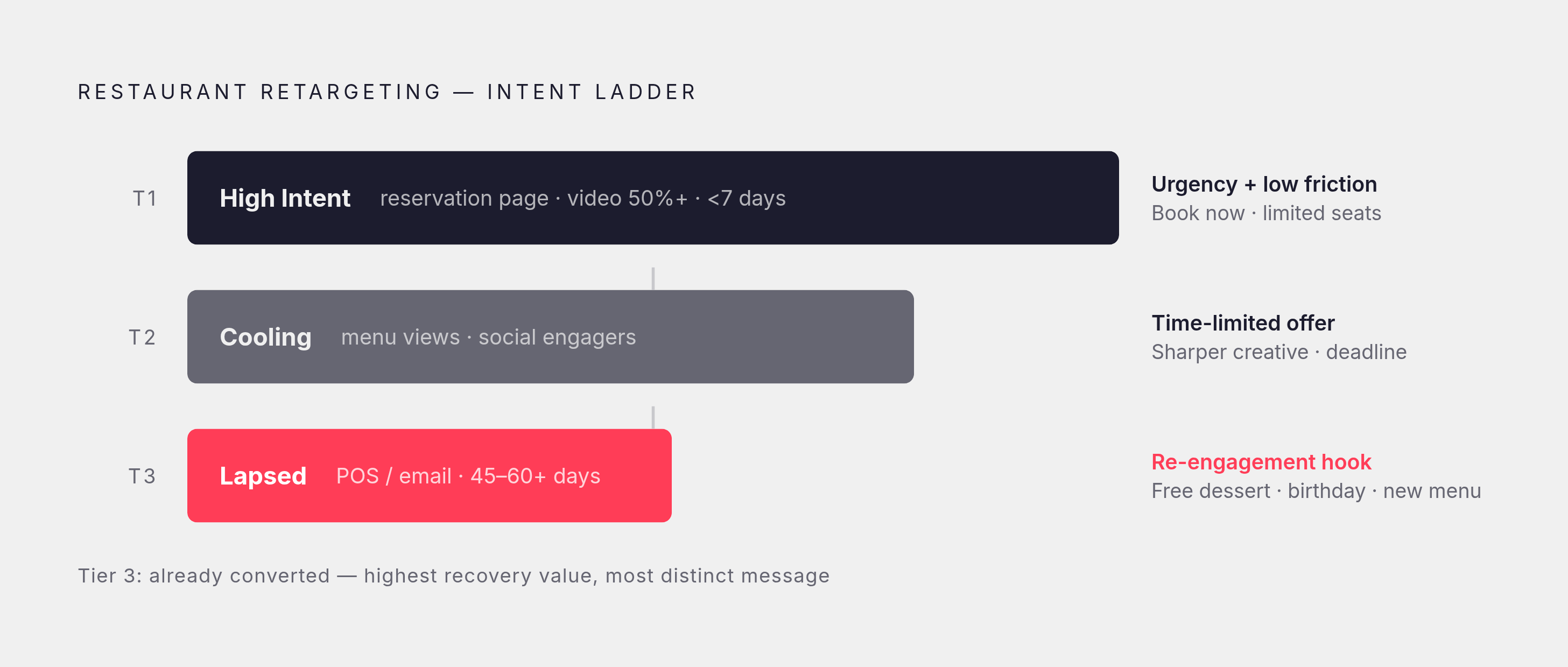
A simple three-tier structure can handle most of what a restaurant actually needs. Tier 1 covers high-intent, recent activity: someone who visited the reservation page, watched a substantial chunk of a video, or engaged meaningfully with a post within roughly the past week. This group needs urgency and a low-friction next step, because their interest is still live and hasn't had time to cool.
Tier 2 covers moderate intent that's cooling. A time-limited offer or a sharper creative angle does more work here than it would for Tier 1.
Tier 3 covers lapsed guests: people who exist in the POS database or the email list but haven't walked in for 45 to 60-plus days. The relationship already exists; what's missing is a trigger. Rezku's 2026 guide points to an automated win-back message, a "We Miss You" incentive sent once a guest crosses that extended window without returning, as one of the clearest examples of how POS data turns a generic campaign into a surgical one. The right offer for this tier is a genuine re-engagement hook, a free dessert, a birthday reward, a preview of a new menu item, instead of a blanket discount that teaches guests to wait for the next price break before coming back.
Lookalike audiences serve as a bridge between the warm core and new acquisition. Sovran's guide notes that uploading a customer email list to build a lookalike audience, paired with geographic targeting, often outperforms interest-only targeting aimed at strangers who merely like a food category. Lookalike audiences built from that list let retargeting logic extend reach outward from a proven base instead of staying purely defensive, which matters because it means the warm audience built in this section pays for itself twice: once by converting directly, and once by teaching the algorithm what a good customer looks like nearby.
None of this requires an engineering degree to set up. UTM parameters on every link let behavior map back to the specific campaign that produced it. These are setup steps, not the strategy itself. The strategy is the segmentation logic above them: different people, different stages, different messages.
The creative sequencing logic that moves someone from awareness to walking in
Targeting decides who sees an ad. Creative decides whether that ad does anything once it arrives. A perfectly segmented Tier 1 audience shown a generic, poorly sequenced ad behaves no differently than cold traffic shown the same thing. The sequencing argument in this section carries as much weight as everything in the two sections before it.
Three campaigns, built concurrently rather than one after another, map to the stages already defined. The 2026 Meta playbook notes that video outperforms static images by a meaningful margin for restaurants, and since most people scroll with sound off, it recommends you design those videos for muted viewing with text overlays. The people who watch that video past the meaningful threshold, or who engage with the post around it, don't disappear into the void. They graduate directly into the Tier 1 or Tier 2 retargeting pools you saw earlier. Awareness spend isn't a sunk cost chasing impressions; it's building the exact retargeting asset the next campaign depends on.
The Conversion campaign, aimed at the warmest tier, carries a different job: remove the last bit of friction standing between interest and a booked table.
What should each person actually see? Social proof does heavy lifting at the conversion stage, because reviews, press features, and awards reduce hesitation right at the moment someone is deciding. RocketPages points to a line like "Rated Best Brunch Spot 2025 by Local Eats" as a working example of how third-party validation functions here: it's not the restaurant bragging about itself, it's someone else vouching for it, which lands differently.
Creative fatigue is the problem running through all of this: the same ad, shown to the same person too many times, eventually stops working and starts costing more for the same result. The exact interval matters less than treating creative as something with a shelf life that eventually runs out.
Certain habits undercut the whole structure regardless of how good the sequencing logic is. If generic food photography looks interchangeable with every other restaurant's feed, it doesn't distinguish anything. Campaigns optimized for engagement, likes and comments, rather than for conversions or reach, optimize for the wrong signal. And boosting a post through the simple Facebook Boost button skips the targeting precision that a properly structured campaign in Ads Manager provides.
Offers deserve a light touch in this mix. Experience-based and event-based creative, a seasonal menu launch, a live music night, a chef's table, should make up more of the rotation than straightforward price promotions.
Where local creator content fits into the retargeting stack
Local creator content is the raw material that feeds the Awareness campaign, which in turn builds the warm audiences every later stage depends on, not a separate marketing initiative running alongside the retargeting system described above.
A creator's post that already generated strong organic engagement is content the target audience has demonstrated, in public, that it responds to. And a creator's unscripted reaction to a dish, caught in the moment, doesn't read as an ad in the way a commercial-style restaurant video does. Deloitte Digital's State of Social research found that 65% of consumers follow food and lifestyle topics on social media, the largest community among those surveyed, and restaurants reported an average 9.9% increase in B2C revenue tied directly to their social strategies in 2024, with social-first brands seeing a larger average increase of 14.1%.
Follower count is the wrong number to chase when picking a creator for this purpose. Whether a creator's post turns into covers depends on how much of that creator's audience sits inside the restaurant's service radius. A creator with a modest following concentrated in the surrounding neighborhood will likely drive more foot traffic than a creator with a much larger following scattered across the country, because the second creator's audience mostly can't act on the content even if they wanted to.
The mechanism that connects this back to retargeting is direct. Creator content run as paid awareness builds a pool of people who watched the video or engaged with the post, and that pool moves straight into the Tier 1 retargeting audience defined earlier, ready for a consideration-stage follow-up ad. The creator investment effectively pays twice: once through organic reach at the moment the post goes up, and again as the seed for a retargeting audience that didn't exist before.
Spark Ads on TikTok apply the identical logic in a slightly different wrapper: rather than building a separate ad unit from scratch, the platform promotes an already-proven piece of organic creator content with paid spend, preserving the authentic feel that made it work in the first place while extending its reach to nearby people who haven't seen it yet. None of this is a separate line item fighting the retargeting budget for attention. It's an earlier stage of the same pipeline.
The click is the wrong conversion to optimize for
A campaign with strong click-through rates that can't be tied to an actual in-store visit is an expensive way to generate website traffic that may or may not have put anyone in a chair.
This gap doesn't close just because you build the targeting and creative sections above correctly. Meta reports clicks. The point-of-sale system reports revenue. Without a deliberate layer connecting the two, an operator running a well-segmented, well-sequenced campaign is still guessing which specific ad drove which specific guest through the door on which specific night. The system can be built exactly as described in every section above and still produce a dashboard that looks identical to a failing campaign, because the dashboard was never measuring the thing that actually matters.
The ad platform has every incentive to report favorable figures back to the person paying for the campaign, and its attribution window and underlying logic were built for brand advertisers and online retailers, leaving a restaurant operator trying to figure out which Tuesday-night ad filled which specific table with reason enough to question where the platform-reported numbers come from.
Closing that loop requires tracking that follows intent past the click and into an action the restaurant itself can verify. When a Meta Pixel sits on the reservation page and inside the online ordering flow, it captures the moment a click turns into something trackable, a submitted reservation, a placed order, instead of stopping the measurement at the ad platform's edge, turning a campaign built on sound segmentation, sound sequencing, and sound creative into one that can answer the question every operator is really asking: not how many people clicked, but how many of them showed up.