Seasonal Promotions and Paid Ads for Restaurants
Most seasonal restaurant campaigns mask thin profit margins beneath inflated dashboard metrics.

Seasonal promotions give restaurants the one thing paid advertising always needs and rarely gets for free: a reason people already believe. Nobody has to be convinced that Valentine's Day dinners are a thing, or that a fall menu deserves a few photos of squash. That built-in demand makes seasonal campaigns easy to greenlight and easy to justify after the fact, which is exactly the problem. That same urgency makes a campaign feel obviously worth running, but it also makes it easy to skip the harder question of whether it actually worked. Digital platforms report clicks and views, point-of-sale systems report revenue, and nothing in between connects the two, so a Valentine's Day campaign that "performed well" on Meta may have simply filled tables that would have been full anyway, on a night when every restaurant in town is full anyway.
Run the numbers on a typical discount-led campaign and the gap gets harder to ignore. Once margin, platform over-attribution, and cannibalization get factored in, the honest multiplier for promo-led paid channels is around 0.14. That means a campaign reporting a tidy multiple-times return on the ad platform's own dashboard might be converting into real profit at something closer to a small fraction on the dollar once food cost, labor, and the guests who would have shown up anyway get subtracted out.
The timing makes this worse before it makes it better. Ad prices on Meta climb sharply in the fourth quarter, which happens to be peak seasonal promotion season, the exact window when holiday menus, gift cards, and private dining pushes are competing for the same impressions as every other retailer and restaurant group running a Q4 push. That squeeze compresses already thin margins on any campaign that isn't tied to real incremental revenue, so a seasonal push can turn into an expensive bet on vibes. None of this means seasonal campaigns are a bad idea.
What honest measurement of a seasonal campaign requires
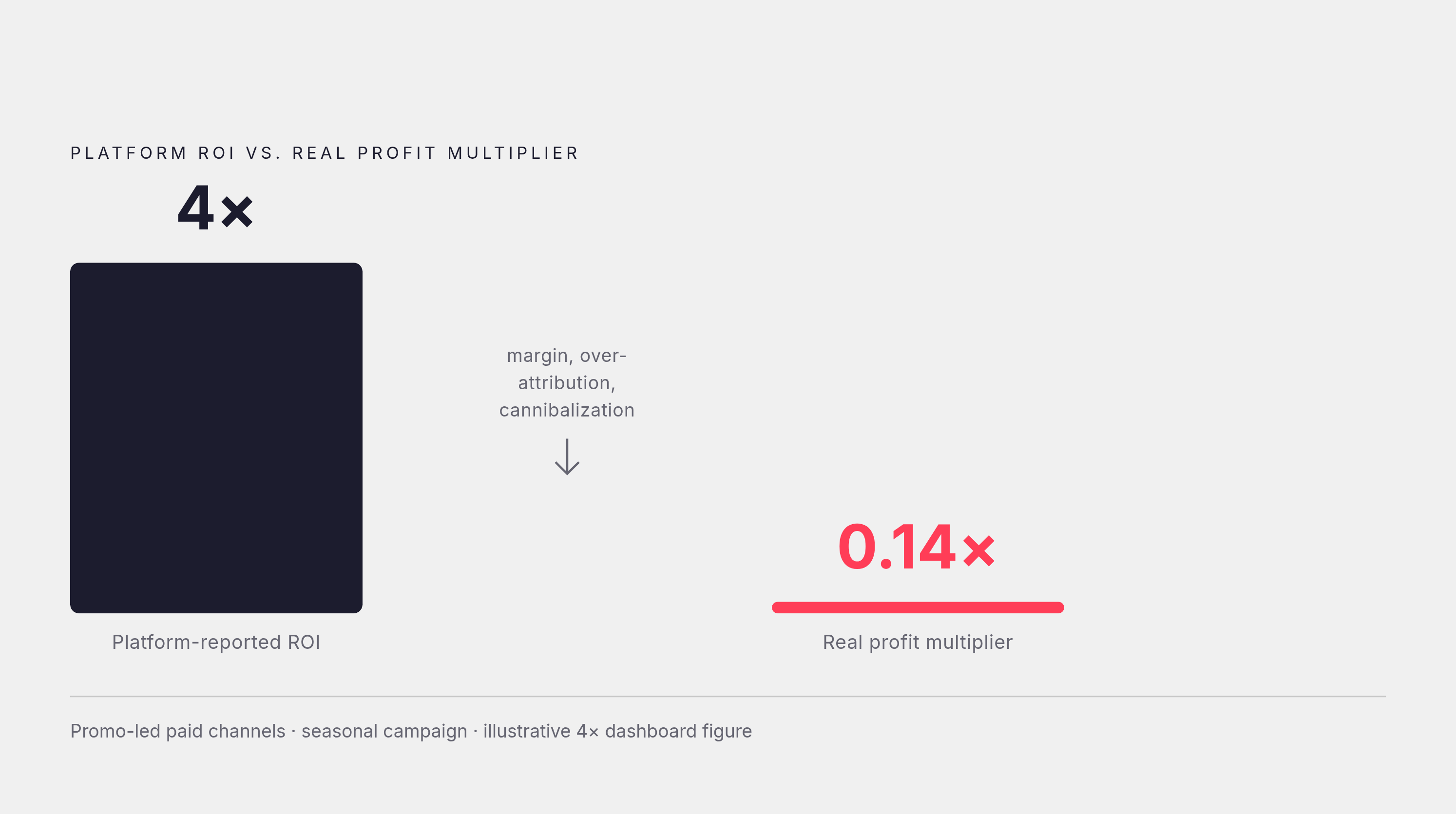
Restaurant marketing ROI gets overstated almost by default, and the reason is simple: most operators measure revenue when they should be measuring incremental profit attributed to specific ads. Revenue is easy to see. The gap between what revenue shows and what profit actually did is large enough to flip a "winning" campaign into a loser, and it stays invisible until someone does the math.
The math itself is not complicated. Real ROI on a seasonal promotion is net profit divided by total campaign cost, where total cost includes ad spend plus the food, labor, and operational costs of running the promotion, not gross revenue divided by ad spend alone. Once the discount, the extra kitchen labor on a busy night, and the cost of the ingredients in a promotional dish get subtracted, the real number might be a modest fraction of profit on that same spend, which is still a return, just not the one the dashboard advertised.
Getting an honest number requires deciding what "working" means before the campaign launches, not after. A vague goal like "drive more revenue" can't be measured against anything, because almost any number can be made to look like lift if the comparison is loose enough. Counting only the revenue directly tied to the campaign, rather than total revenue during the promotional window, separates a real ROI number from a flattering coincidence. A restaurant that was already trending up for reasons that have nothing to do with the promotion will otherwise credit the whole bump to the campaign.
How to set up a seasonal campaign so measurement is possible from day one
Most seasonal campaigns fail at measurement because the data was never connected. Marketing reports show clicks and impressions. The host stand shows walk-ins. The POS shows revenue. All three systems can be running correctly and still never meet in a way that reveals what the campaign actually drove, because the attribution problem is a design problem that gets solved before the campaign launches or it doesn't get solved.
The first decision is picking one primary KPI per seasonal campaign, whether that's reservations, covers on a specific shift, or sales volume on one seasonal menu item, and instrumenting that KPI before a single ad goes live. Trying to track everything usually means tracking nothing well. The second decision is tagging every social post and ad with UTM links, so that by the time the campaign is live, traffic sources are already identifiable inside analytics rather than something someone tries to reconstruct two weeks later from memory and guesswork. Adding a simple source question at the host stand, such as how a guest heard about the restaurant, or assigning a unique offer code per channel, lets in-person visits get traced back to a specific ad or a specific creator post.
Once the campaign runs, the comparison that actually means something is reservation or POS data matched against the campaign window: the same days and shifts this year against the same days and shifts last period, and ideally against a location or week that ran no campaign at all as a control. Those figures are directional rather than exact, and operators should treat them as a floor on actual visits, not a ceiling. The cleanest attribution setup available to an independent operator combines four pieces: a Meta Pixel on the reservation page, UTM-tagged links tracked in Google Analytics 4, host-stand source tracking, and POS match-back against guest email addresses.
None of it means anything without a baseline. Without that baseline, there's no way to tell whether a bump in covers came from the promotion, from a slow news cycle that sent more people out to eat, or from a competitor down the street closing for a kitchen fire. The promotion gets the credit either way if nobody checked.
How Meta, TikTok, and Google each behave differently in a seasonal campaign
Meta, TikTok, and Google each do what, and the budget split should match the moment.
Google captures intent that the season itself already generated. Someone typing "Valentine's Day dinner near me" into a search bar is several steps closer to booking a table than someone scrolling past a holiday-themed Reel between videos of someone else's dog. Google's seasonal advantage is documented in a concrete way: a Performance Max campaign tracked against actual transactions, rather than impressions, produced a cost-per-visit number that made the underlying economics clear. Every seasonal campaign should be held to transaction-level tracking, not a click count dressed up as a conversion.
Meta is built for reaching people who aren't yet searching for anything, which makes it effective for announcing a new seasonal menu, a holiday event, or a limited-time offer to people within a tight radius of the restaurant, and keeps the ad from going stale in under a week. Creative that points to a trackable destination, like a reservation link carrying a UTM tag, consistently outperforms awareness-only creative, because it produces a measurable conversion event instead of just another impression that nobody can account for later.
TikTok does something closer to word of mouth at scale. It surfaces the seasonal story to people who weren't actively looking for a restaurant but get pulled in by what they see, which makes it especially useful for launching a new seasonal menu or showing off a dish built to look dramatic on camera. Spark Ads boost existing organic creator content instead of running separately produced ad creative, tend to perform better on the platform because they feel native, and point to the next lever: the creators making that organic content.
Why local creators are especially powerful for seasonal promotions specifically
Local creators do something produced ad creative structurally cannot: their audiences are physically concentrated near the restaurant, and their recommendation carries social proof that a paid ad, however well made, simply doesn't have. A friend saying "you have to try this" lands differently than a brand telling you the same thing, even when the brand is right.
For seasonal campaigns, a geographically concentrated audience converts into actual covers, while a widely scattered audience of the same size does not. A creator with a large but geographically scattered following delivers impressions that can't convert into tables, because most of those people live nowhere near the restaurant and never will. A creator with a smaller, locally concentrated following delivers people who could plausibly walk in that same week. What matters isn't how big a creator's audience is, but what share of that audience actually lives in the city or metro area: a creator whose followers are mostly local, with real engagement instead of inflated follower counts, will drive more actual covers from a seasonal campaign than a bigger creator whose audience is scattered across the country.
Food and beverage is one of the fastest-growing categories in influencer marketing, and seasonal restaurant content does well when the format matches how the platform is actually used. The gifting model fits this well: a local creator gets the seasonal menu experience, posts about it organically, and the restaurant's cost is the food and labor behind that meal. Paid amplification, whether that's Spark Ads on TikTok or simple boosting on Meta, then extends that organic post to a targeted local audience well beyond the creator's own followers.
The scale this approach can reach is worth sizing up with a real example, even outside the restaurant's own backyard. When Episcope Hospitality launched a venue in Phoenix's Biltmore District, it leaned on thirty creator partnerships instead of produced advertising, and those partnerships reached 2.22 million people while driving an 817% increase in engagement over three months. That's not a number an independent restaurant should expect to replicate on a single seasonal push, and it isn't meant as a template to copy move for move. It shows that the concentration and authenticity principles behind creator marketing can scale across thirty separate relationships.
None of that creator activity becomes measurable without the attribution groundwork already covered: a unique offer code per creator, UTM-tagged reservation links in a bio or story, and POS match-back against the campaign window. With that infrastructure in place, an operator can see which creator's post actually turned into covers. Without it, creator spend sits in the same measurement gap as every other untracked ad dollar, no matter how good the content looked.
How to read the results of a seasonal campaign and decide what to repeat
The operators who get better at seasonal marketing every year don't run smarter campaigns from the start. They're treating each campaign's results as a permanent record, because a Valentine's Day campaign measured honestly against a real baseline this year becomes the benchmark that makes next year's decision obvious.
The test that cuts through the noise is simple to state, if not always simple to sit with: compare net profit, after every cost involved, to what the same period looked like before the campaign, measured against the specific metric chosen at the outset. If revenue moved but profit didn't, the campaign filled covers at a cost that canceled out the gain. If a campaign boosts sales volume without improving cash flow, it isn't a strong investment, no matter how good the numbers look on a platform dashboard built to flatter its own performance.
From there, the read branches into three outcomes. If incremental profit exceeded campaign cost and a meaningful share of the new guests came back on their own afterward, repeat and scale that channel and creative approach next season. If neither revenue nor profit moved at all, the seasonal creative likely never reached new demand, or the attribution gap was too wide to see whatever effect existed, which means the fix is in the measurement setup, not in spending more money chasing the same blind spot.
Retention deserves as much attention as acquisition in this read. A seasonal promotion that brings in first-time guests who never come back again is a cost with a receipt attached, not an investment in the business. Tracking the repeat visit rate among guests acquired during a seasonal push separates a promotion that actually built the business from one that just filled seats for a single shift and moved on.
The real payoff of doing all this appears across multiple campaigns measured against each other, and shows up concretely when a local creator's post outperforms a produced Meta video by a factor of two, turning the next budget decision into something built on evidence. Closing the loop between social spend and POS revenue is information an independent operator needs to stop repeating the same expensive mistake every season and start scaling the specific promotions, channels, and creators that actually filled tables at a profit.