Third Party Delivery App Advertising for Restaurants
Delivery apps now sell restaurants ads to boost visibility alongside taking commissions on orders.
Delivery platforms are no longer simple logistics middlemen. They have turned themselves into media companies that happen to deliver food. Restaurants that signed up for DoorDash, Uber Eats, or Grubhub years ago to get access to order volume are now finding those same platforms selling them a second product: visibility. That's not a side hustle bolted onto the delivery business. In June 2026, DoorDash folded DoorDash, Wolt, and Deliveroo into a single Global Commerce Media Platform serving more than 400,000 advertisers, and Uber Advertising crossed a two-billion-dollar annualized run rate. They are the numbers of an ad business, not a logistics balance sheet rounding error.
The mechanism is simple enough to say in one sentence: the platform monetizes the same customer relationship twice, once through the commission it takes on the order and again through the fee it charges to move a restaurant's listing higher in the search results inside its own app. Picture a toll road that also sells billboard space along the shoulder. The restaurant already pays to use the road. Now it can pay again to be the sign drivers see first. Food delivery retail media, as the category is now called, comes with its own sponsored listings, display units, and offsite audience tools built on the platform's first-party order and location data. None of this happens on a neutral marketplace. The restaurant is buying placement inside a system where the platform sets the auction rules, holds the customer data, and writes the report card on how well the ad worked. That last part means the restaurant is being graded by the same party selling the test. The next section prices out that arrangement before you spend a single ad dollar.
What restaurants pay before a single ad dollar is spent
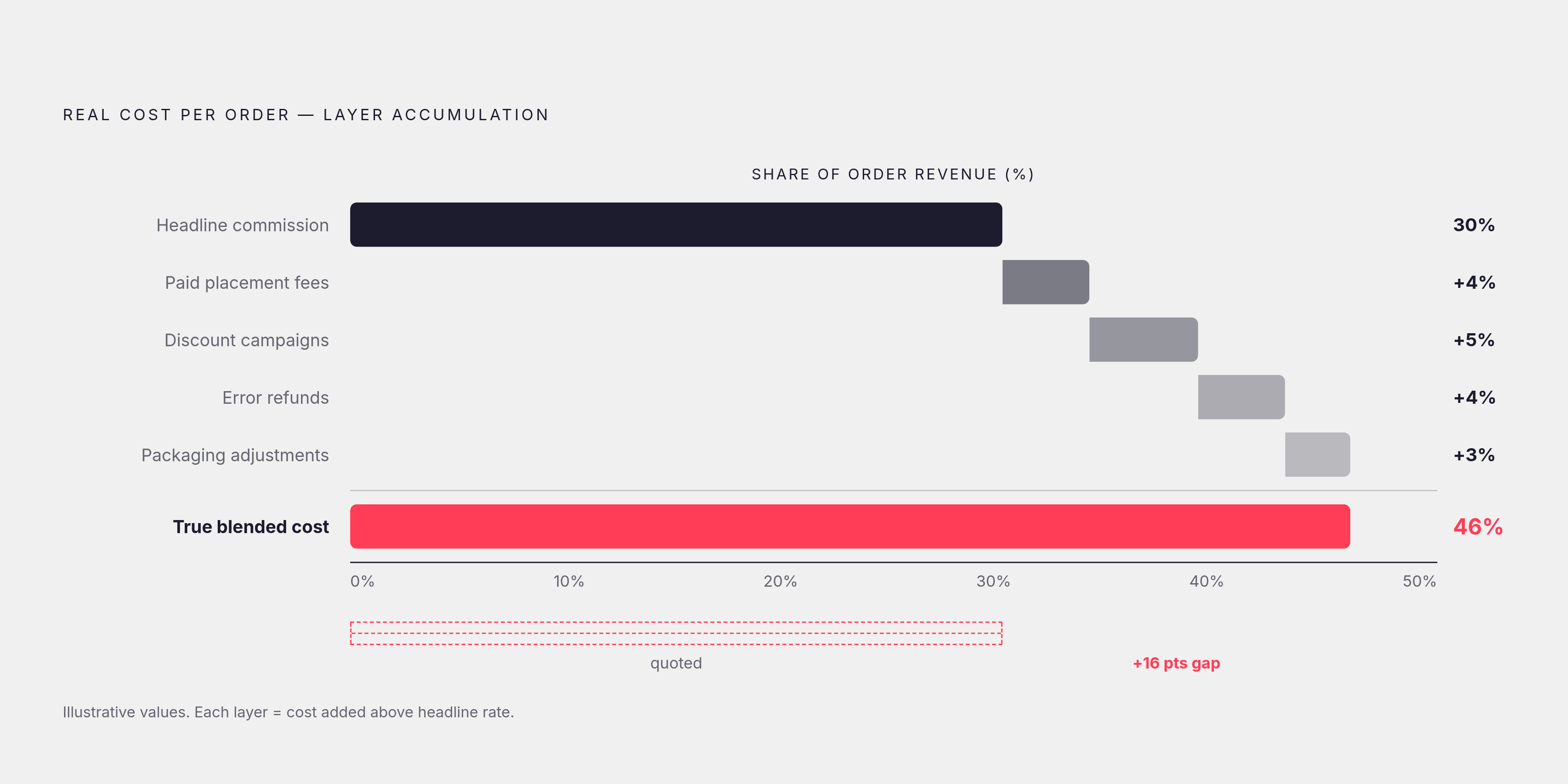
The commission rate printed on a delivery platform's sign-up page is not what a restaurant actually pays, and treating it as the full cost produces a rosier picture than the ledger supports. BeyondMenu's 2026 analysis lists the pressures that stack on top of the headline commission: paid placement inside the app, required participation in discount campaigns, delivery error refunds the restaurant has no control over, and packaging cost adjustments. Each one adds weight to the same side of the scale, and none of them appear in the number a sales rep quotes during onboarding.
A second cost occurs when a customer orders through a marketplace app, which teaches that customer to open it again next time, not to call the restaurant or visit its website. So the commission isn't just a transaction fee, it's also tuition the restaurant pays to train its own customers toward somebody else's front door.
Because of that, a restaurant needs one number before it can judge whether paying extra for a promoted listing makes any financial sense at all: the true blended cost per order. That figure is the total fees paid in a given period divided by the total revenue earned through the platform in that same period, expressed as a percentage. It is almost never the same as the commission rate quoted on the contract, and it is almost always higher. Only once that blended cost is pinned down does it make sense to ask the next question: what does stacking an ad spend on top of it do to the margin left on each order? That question is the subject of the rest of this piece.
The ad formats delivery platforms sell
With the cost baseline established, the actual menu of advertising products can be laid out, because each one works differently and charges differently. Sponsored listings sit at the entry point of the ladder. They run as a second-price auction among restaurants competing for higher placement in search and category results inside the app. DoorDash prices this as a second-price cost-per-acquisition model, so the restaurant pays only when a customer clicks the ad and then places an order. Uber Eats prices the same kind of placement as cost-per-click, so it charges for the click whether or not an order follows.
Timing changes how well these placements convert. Grubhub tells coffee shop merchants to bid up visibility late at night, because it says those orders convert better then, when they catch customers who are pre-ordering the next morning's coffee. A lunch-hour placement and a dinner-hour placement are not interchangeable either, because purchase intent shifts with the time of day you open the app. And because the format runs as an auction, the price a restaurant pays for a given rank isn't fixed. It moves with what every other restaurant in the same category is bidding at that moment. Two restaurants in different neighborhoods can pay very different prices for what looks like the same placement.
Sponsored brand and display formats sit above sponsored listings, and these richer units include homepage and category placements built to claim more screen space than a single search result. DoorDash's Spotlight format, launched in June 2026, belongs to this tier. DoorDash describes it as a new premium homepage ad format built around a large, immersive creative canvas for static display and short-form video, a step up from a line of text in a results list into something closer to a billboard inside the app.
Offsite audience extensions take the platform's reach beyond its own app. These use the platform's first-party data on logged-in diners, built from years of order and location history, to place restaurant ads on the open web or on connected TV. The restaurant's ad follows the customer home, in other words, long after the app is closed.
Promotions and discount tools don't work like the display formats above them. These are platform-run discount offers, free delivery windows, percentage-off deals, that the restaurant funds in whole or in part, often with the incentive of better algorithmic placement attached. Because the restaurant absorbs both the cost of running the promotion and the margin loss from the discount itself, this format behaves less like a media buy and more like a subsidy the restaurant pays to stay visible.
What ties all of these formats together, and what the platforms can argue honestly in their own favor, is the quality of the measurement. Because the entire path from impression to click to order happens inside one logged-in app session, delivery platforms can report same-session attribution that is cleaner than what most advertisers get from an off-platform display campaign, cleaner than tracking a click on a Meta ad through to an in-store visit days later. That's a real advantage. But clean attribution inside the app only proves the ad was there when the order happened. It says nothing about whether the order would have happened anyway. That gap, between attribution and incrementality, is where the next section starts digging.
What the platforms report as ROI
The ROI figures delivery platforms report for their ad products are real numbers, not inventions, but they measure something narrower than what a restaurant operator actually needs to know. They measure what the platform's own systems can see and credit to themselves. They measure nothing about what would have happened to that order without the ad running.
The best public evidence for these ad products working comes from inside the platforms themselves. Enterprise brand merchants running Grubhub campaigns between September 2024 and January 2025 reported substantial incremental ROAS and meaningful incremental sales growth. The co-owner of one Thai restaurant cited a sales increase of 30 to 40 percent. Another restaurant, a pizzeria, reported a 15 to 20 percent order increase. Those are two different metrics, sales for one restaurant and orders for the other, so they aren't directly comparable to each other, but both are specific, named, and attached to real businesses.
None of that makes the numbers fabricated. But the numbers are best-case: they come from enterprise-scale merchants with resources smaller operators may not have, and the platform doing the selling measures them. So you should ask three questions before you adopt those results as a benchmark.
The revenue's incrementality versus cannibalization comes first. A promoted listing that surfaces a restaurant to a customer who was already planning to search for it and order from it takes credit for a sale the restaurant would have gotten anyway. The ad looks like it worked. The register would have rung the same amount without it.
You also need to ask whether the revenue stays margin-positive once you add the ad cost on top of the commission you already pay. If a restaurant already hands over a high commission rate and then pays again for placement, those ad-driven orders need a meaningfully higher average order value, or the restaurant loses money on the very orders the dashboard is celebrating.
Who owns the new customer once the order is placed comes third. First-time customers represent a genuine win for discovery. But if the platform keeps the customer's contact information and order history, and the restaurant has no way to reach that person again directly, the restaurant has paid to acquire a customer it can't retain without paying the platform a second time.
The platforms' same-session attribution is a fair and honest way to measure whether a click turned into an order inside the app. What it cannot measure is the counterfactual, what the customer would have done if the ad had never been shown, and that counterfactual is the actual number a restaurant operator needs before deciding whether to keep paying.
Building a restaurant-side ROI evaluation the platform dashboard cannot give you
A restaurant operator weighing whether to keep buying platform ads needs to run calculations the dashboard was never built to show, adjusting for three things: margin, incrementality, and who owns the customer at the end of the transaction.
Start with the true blended cost per order established earlier: take the total fees paid and divide by total platform revenue in the same period. That figure is the floor every ad-driven calculation has to clear before it counts as a win.
From there, test for incrementality directly rather than trusting the platform's attribution report. Run a controlled comparison: track order volume during a period when a sponsored listing is active against a baseline period in the same daypart, the same day of the week, adjusted for seasonal swings. If volume doesn't move between the two periods, the ad is paying for clicks from customers who would have found the restaurant regardless.
Next, you separate discovery orders from repeat orders inside the platform's own data. DoorDash's disclosures report that first-time customers account for over 20 percent of sales tied to Spotlight placements, and that more than 31 percent of sales from Sponsored Listings come from customers new to the merchant. That split matters directly: discovery orders are the strongest case for spending ad dollars on a platform, since they bring in customers the restaurant didn't have before. Repeat orders served up through a sponsored listing make the weakest case, since the restaurant is paying to reach someone who would likely have ordered from it anyway.
Finally, account for who owns the customer once the transaction closes. If you order through a marketplace app, the platform gets the customer's data, not the restaurant. No email address, no phone number, no order history, no standing permission to reach out again lands with the restaurant. Third-party delivery customers come back to the marketplace app, but customers who order directly come back to a restaurant's own website or app. So a customer acquired through platform advertising carries structurally less long-term value than one acquired directly, because the restaurant can't reactivate, reward, or retain that customer without paying the platform again for the privilege.
Put the whole evaluation into a single formula: take attributed delivery revenue during the ad period, subtract attributed delivery revenue during the baseline period, multiply that difference by the margin percentage, then subtract the ad spend. What's left is the incremental margin the campaign actually produced. A positive number earns another round of spending. A number at or below zero means the campaign is being subsidized by the restaurant, not the other way around. The figures that go into this formula belong to each restaurant's own books. No dashboard fills them in for free.
When platform advertising makes strategic sense
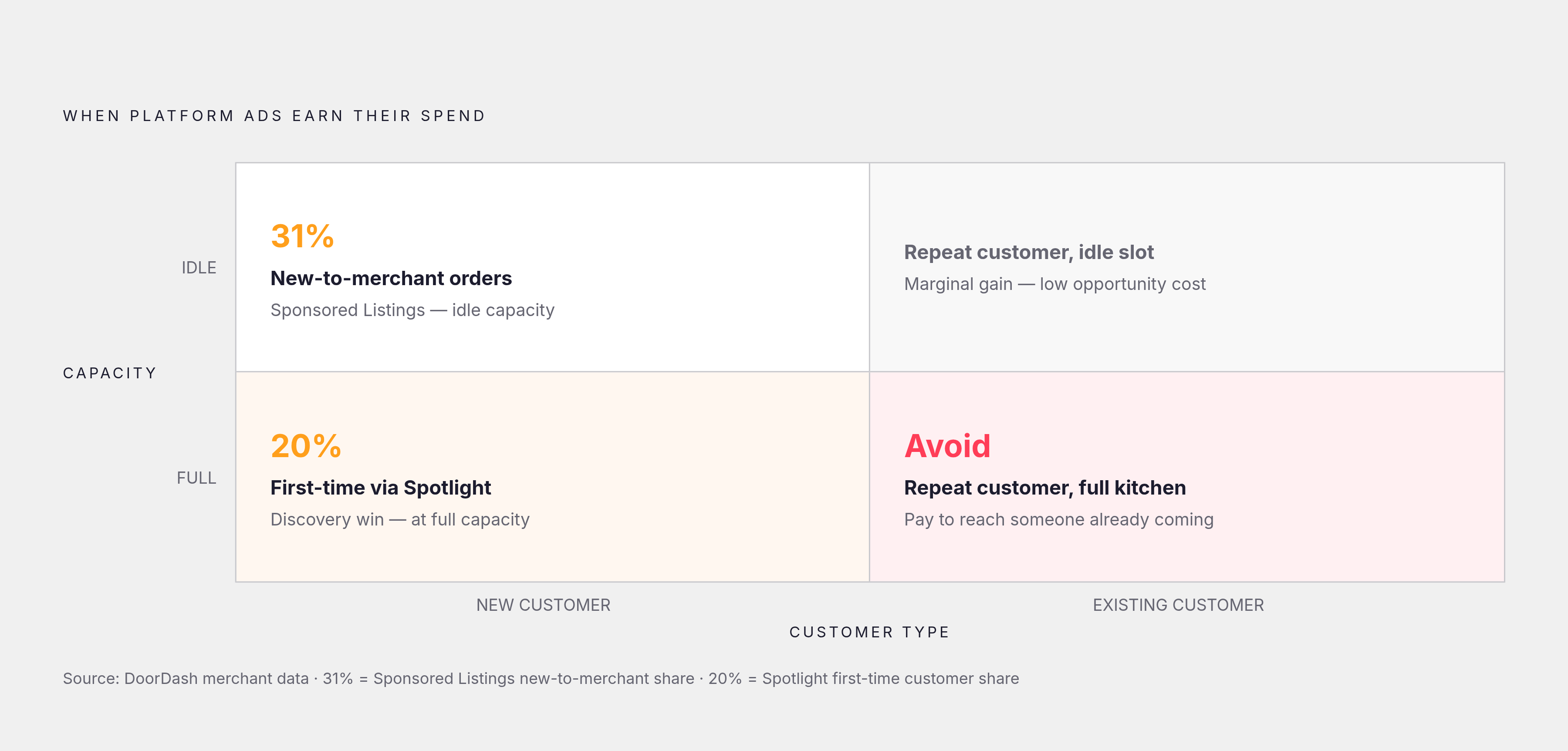
Running the framework from the last section through real conditions produces a clear split: delivery app advertising has a defensible job to do in some situations, and it digs a deeper hole in others. Running the framework comes down to one question: is the restaurant buying new customers, or paying twice to reach customers it already has?
A few situations tilt toward using the ads. A new restaurant, or an existing one opening in an unfamiliar market, can use the platform's existing audience to do discovery work that would otherwise require real money spent on channels the restaurant doesn't yet know how to run. A kitchen with idle capacity during a slow afternoon or late evening can accept a lower effective margin on an order filled through a promoted listing, because an order at a discount beats an empty ticket rail, and Grubhub's own late-night coffee guidance shows how precisely you can target these dayparts. And a restaurant weighing a second location or a catering push can treat the platform's order-geography data as a cheap stand-in for market research it would otherwise have to commission separately.
Other situations tilt the other way. A restaurant already dependent on commission volume, paying for promoted listings just to hold a ranking it would lose the moment it stopped bidding, has stepped into the dependency trap BeyondMenu's 2026 analysis describes directly: the volume keeps coming, but the volume stops translating into meaningful profit. A restaurant funding platform discount promotions purely to boost its algorithmic ranking is paying twice over, once for the promotional cost and again for the margin it gives up on every discounted order, for a ranking boost that fades the moment the promotion ends. And a restaurant with an established base of repeat customers on a given platform, running sponsored listings that surface it to its own regulars, is paying to reintroduce itself to people who already know where to find it.
The hybrid approach most operators land on treats the platform as a discovery channel and nothing more: use it, and selectively pay for placement, to bring in customers who haven't found the restaurant yet, while building a direct ordering channel, its own website or app, that captures repeat business without handing a cut to the platform every time a regular orders dinner. One channel does the work of finding new customers. The other does the work of keeping them.