Birthday and Anniversary Programs for Restaurant Guests
Occasion rewards drive higher redemption and group visits than standard promotions.

Birthday and anniversary programs turn a personal milestone into a restaurant choice, often bringing a whole table with it. Their advantage over generic promotions in group-dining revenue becomes a business result only when restaurants connect enrollment, delivery, attribution and follow-through into a measurable system.
Why birthday and anniversary visits are structurally different from ordinary guest visits
A birthday belongs to one guest, but the restaurant serves the celebration. The person redeeming the reward almost never dines alone, so one complimentary item can bring several additional covers paying full price. An anniversary works the same way, as a shared occasion shapes where people meet. The commercial unit is therefore the table. Judging the visit only by the cost of that person’s reward misses the reason the program can work.
The restaurant also starts with intent it did not have to create. A birthday or anniversary is a fixed annual event that the guest already plans to celebrate. The restaurant’s task is to capture that decision, whereas a generic promotion must supply a reason to go out in the first place. A standard discount may attract only one or two guests, or pull forward a visit that would have happened anyway. Occasion visits are not immune to that cannibalization, but their group-dining structure gives them a stronger starting case.
The occasion recurs, the reason to celebrate is known, and the restaurant can examine what happens around it. Emotional meaning explains why the guest cares.
Why redemption rates for occasion rewards dwarf those for standard promotions
Paytronix’s 2026 Loyalty Report identifies occasion rewards, including birthdays, anniversaries and milestone triggers, as the highest-redemption interactions in loyalty programs. That directional gap matters more than an unsupported headline percentage. It suggests that offers tied to a guest’s life work differently from those tied only to the restaurant’s promotional calendar. A loyalty budget that treats them as interchangeable overlooks that difference.
Consider what a generic offer asks the guest to do. The guest must remember it, decide that the discount is motivating and act within a window the restaurant has chosen. The guest’s own calendar gives them a reason to go out, so the occasion reward can help them choose where to eat. There is less distance between receiving the message and having a reason to use it.
The behavioral mechanisms are loss aversion and the goal-gradient effect. A named birthday reward feels like something specific to miss. As the occasion approaches, the decision becomes more immediate and the reward more relevant to completing the celebration plan. That explains why a timely occasion offer can command attention and why occasion rewards deserve their own place in the loyalty budget.
What a well-designed occasion program actually looks like operationally
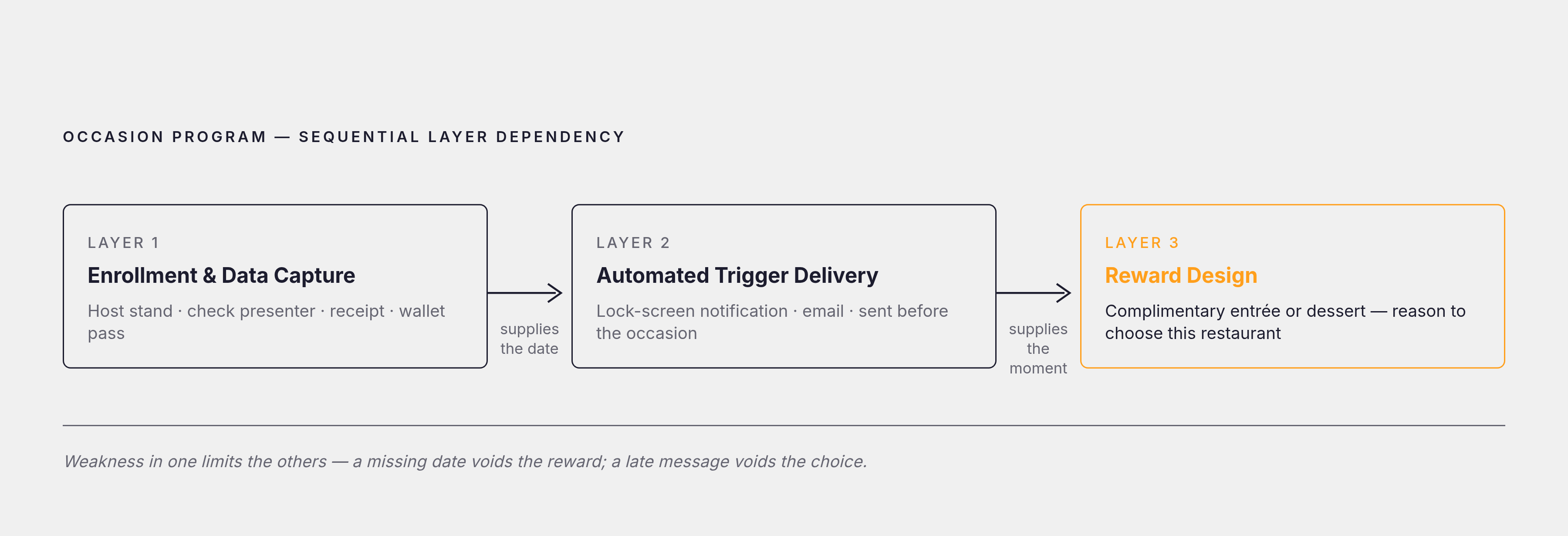
A functional occasion program has three operational layers, which are enrollment and data capture, automated trigger delivery, and reward design. Each has a separate job, and weakness in one limits the others. A compelling reward cannot compensate for a missing birthday. Complete guest data cannot compensate for a message that arrives after the celebration has been booked. The sequence matters because each layer supplies what the next one needs.
The first layer establishes who the guest is and when the occasion falls. Guests can enroll at the host stand, through the check presenter or on the receipt, with staff using a simple script. Digital wallet passes, including Apple Wallet and Google Wallet, remove the need to download a separate app. Paytronix’s 2026 Loyalty Report finds that enrollment through payment integration can substantially outperform traditional punch-card or app-based approaches. Making it easier to join helps the program reach more occasions, because that reach depends on how well enrollment works.
The second layer sends the reward before the occasion so staff do not have to remember each date. Automated delivery makes that timing repeatable as the enrolled base grows. A wallet notification can surface on the lock screen, while an email may sit in a promotional folder.
The third layer gives the guest a reason to choose this restaurant. A complimentary entrée or dessert can feel celebratory in a way that a modest discount does not. A thin offer can undercut the emotional reason to gather there. Tiered programs can also add an occasion reward to existing status benefits. Together, these layers turn an emotional event into something the restaurant can deliver consistently and measure repeatedly.
How to measure whether an occasion program is actually producing incremental revenue
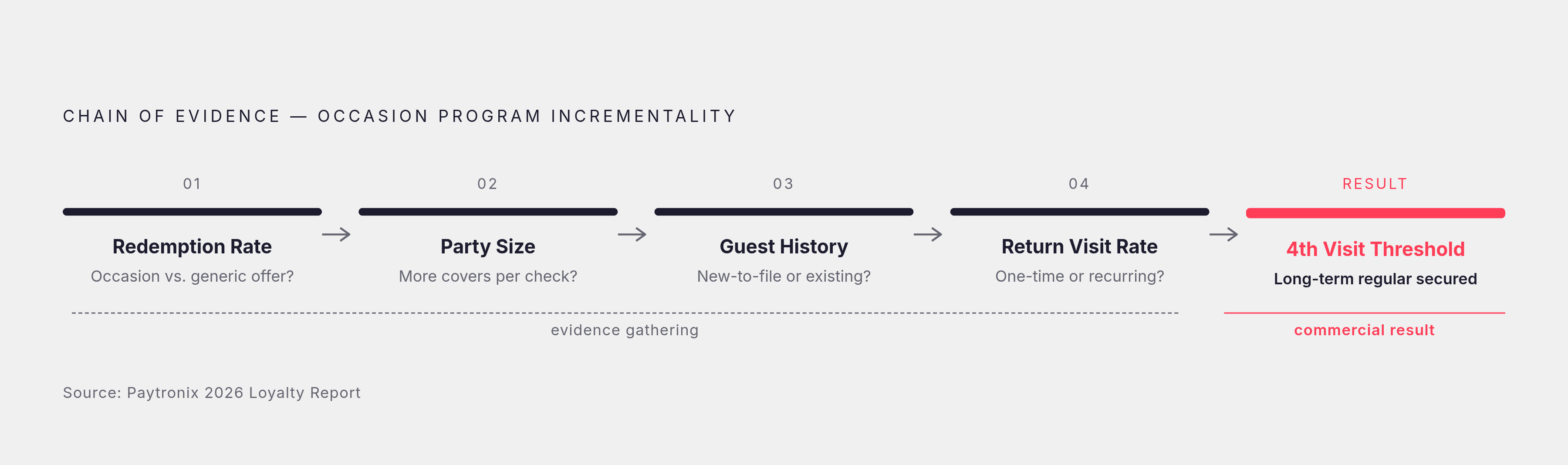
A redemption proves that the reward was used, while proving that the reward caused the visit requires separate evidence. That distinction is the central test of an occasion program. If a regular would have celebrated at the restaurant anyway, a free entrée reduces the value of a visit the restaurant already had. Crediting the whole check to the program would confuse activity with additional revenue.
Start with enrolled members and non-enrolled guests. Compare their visit frequency, average ticket and member share of total sales, then compare the incremental revenue with what the rewards and software cost. Paytronix’s 2026 Loyalty Report draws on data from more than 800 client brands and hundreds of millions of guest profiles and finds that loyalty members spend materially more per visit than non-members. That makes spend lift an important reason to examine loyalty investment. It does not mean that every difference between members and non-members was caused by a particular birthday reward.
For the occasion program itself, redemption rate by reward type shows whether the behavioral advantage is appearing. Birthday and anniversary rewards should substantially outperform generic promotional offers. If they do not, the reward or its delivery timing needs attention. Comparing party size at occasion tables with baseline tables then tests whether these rewards bring in groups. More covers per check would support the argument that the reward is bringing a gathering.
Return visit rate supplies the next part of the evidence. A guest who redeems once and never comes back has a different value from one who becomes a regular. That is why new-to-file guests need to be distinguished from existing regulars, with particular attention to whether the former return at a meaningful rate. Otherwise, a restaurant can mistake giving discounts to familiar guests for bringing in new ones. The relevant comparison is not just who used the reward, but what changed in their relationship with the restaurant afterward.
Attribution and incrementality answer related but different questions. Attribution connects the reward to the transaction, while a baseline helps assess how much of that transaction represents business that would not otherwise have occurred. Neither a redemption count nor total occasion-table sales settles both questions. Together, reward use, party size, guest history and later visits give the restaurant much more to go on when judging the program. Measurement is therefore not a report produced after the work, but the means of deciding what to improve next.
Why occasion programs underperform when social and paid channels don't support them
Even a well-run occasion program mainly reaches people who already know the restaurant. It cannot, by itself, keep expanding the pool of guests who might enroll and later celebrate there. Paytronix’s 2026 Loyalty Report describes loyalty as table stakes in most segments. The competitive advantage therefore depends partly on the size and quality of the enrolled base. That makes discovery a part of the loyalty system.
Social content can introduce the restaurant in the context of the decision the guest will eventually make. A candle-lit birthday table or a couple celebrating an anniversary shows what an occasion there might feel like. This content helps guests decide if the restaurant is right for a special night before they start looking for a place. Locally sourced creators matter because their audiences can include people within the restaurant’s trade area.
Paid social amplification can then put that creator content in front of nearby people who have shown interest in dining occasions. The purpose is to connect discovery with reservation intent and, eventually, enrollment. Measuring only the first click cuts that chain short. To see more of the business the content brings in, the restaurant can track the social impression through the first visit, enrollment, occasion redemption and later returns. Without that connection, a restaurant may know which content attracted attention but not which content attracted guests who became valuable members.
The same gap appears at redemption if the restaurant cannot connect loyalty activity to the check. Feastalytics is one option for unifying transaction data with loyalty redemptions, allowing operators to tag birthday-triggered transactions and measure lift against a baseline. That connection helps distinguish additional revenue from visits the restaurant may simply have subsidized. It also places social acquisition and occasion rewards in the same measurement frame, where the value of discovery can extend beyond the first visit.
Turning a one-time celebration into a long-term guest relationship
The occasion visit is a starting point for a relationship. A birthday may give a guest a reason to try the restaurant, but repeated visits turn that introduction into a habit. The strongest outcome is therefore not a high redemption count in isolation. It is a guest who returns more often and spends more over time. That shifts the program’s purpose from distributing rewards to acquiring and retaining regulars.
Paytronix’s 2026 Loyalty Report identifies a “Fourth Visit Principle” as a key program-design threshold. A guest who visits four times is statistically far more likely to become a long-term regular. The reward has opened the door, but it has not completed the work. Follow-through gives the restaurant a way to build on the experience while measuring whether that relationship develops.
A follow-up message one to two weeks after the occasion can acknowledge the guest without immediately offering another discount. Its function is recognition, signaling that the restaurant remembers a person. For guests who lapse, win-back automation can identify those approaching their next annual occasion who have not visited in months. A re-engagement prompt before that occasion gives the restaurant another chance to win the table before a competitor does.
A complimentary dessert without data capture, attribution or follow-up may generate goodwill, but it leaves the commercial result largely unknown. With data from enrolled guests, automated triggers, links between channels and follow-up after the occasion, an operator can measure and improve that result. Without them, the program is like a slot machine, with each reward another pull and a busy table taken as proof that the strategy works. A birthday or anniversary program can remain a perk, or it can become a system.