Building a Restaurant Email List From Scratch
Restaurants need a direct contact system that social algorithms cannot control.

Building a restaurant email list from scratch is less about writing promotions than installing a system that keeps guest relationships from disappearing after payment. The task is to capture contact details at moments when trust is already high, then connect those details to useful, timely messages. When this works, the restaurant has a direct line to guests that no social algorithm can take away.
Why guests disappear and why restaurants can't stop it without a system
A restaurant can serve hundreds of guests a week and know almost none of them by contact. A walk-in guest arrives, eats, pays and leaves, with no record the restaurant controls. Good food and attentive service may earn another visit, but they leave the operator no way to invite one. Most restaurants capture fewer than 2% of walk-in emails because no passive mechanism is in place.
Other channels can disguise that gap without closing it. Instagram and Facebook followers look like a reachable audience, yet organic posts reach only a small fraction of them, and an algorithm change or account suspension can cut off access. Third-party delivery and reservation platforms capture guest data for their own relationship with the customer. The restaurant may have served the meal but still have no control over the contact. More promotion can close that gap only if the visits it brings lead guests into a capture system.
What an email list actually is and why it is a different category of asset
An email list is a portable record of people the restaurant can contact directly, with permission. Social followers stay on someone else’s platform, while an email list can move with the restaurant when it changes tools. A social algorithm does not decide which subscribers qualify to see a message, and the email relationship does not impose a commission when someone orders. Inbox delivery still requires technical care, but that is different from renting access to an audience.
Paid traffic stops when the spending stops, so the restaurant has to pay again to get more attention. A list keeps the contacts the restaurant earned through past service and marketing, so the next campaign has people to reach again. Its value therefore extends beyond the promotion that first attracted a subscriber. Each new contact who has a reason to hear from the restaurant adds value to future campaigns without the restaurant paying again for that person’s attention.
The capture hierarchy and where emails come from
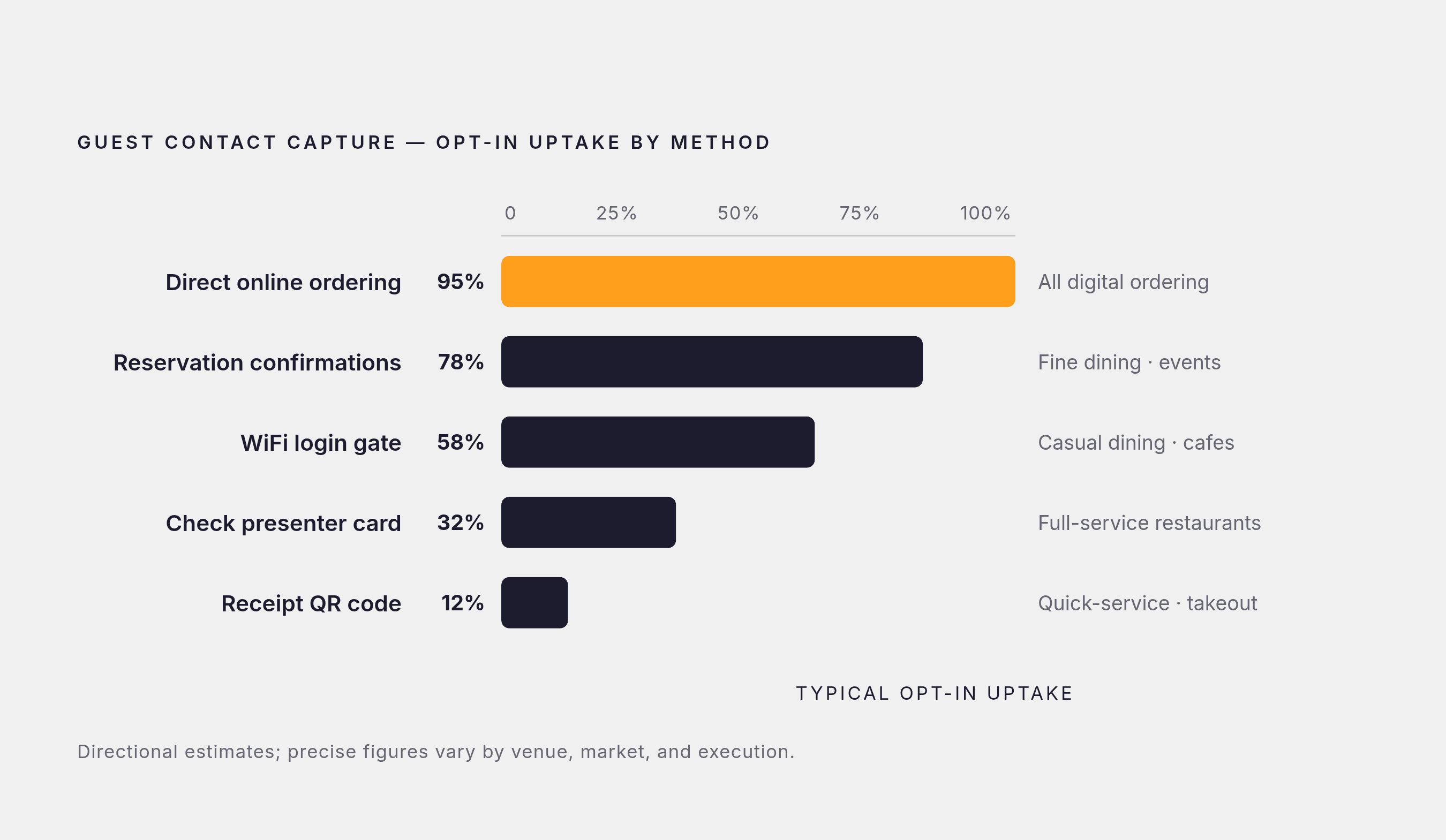
The first useful exercise is to walk mentally through the operation and notice where guests already exchange information. A loyalty sign-up, a WiFi network and an online ordering page are all potential capture points. Guests tend to opt in at very high rates through reservation confirmations, which work especially well for fine dining and event venues. WiFi login gates offer high uptake for casual dining and cafes. Check presenter cards tend to get fewer opt-ins than these, with moderate uptake in full-service restaurants, while receipt QR codes tend to get fewer still and work well for quick-service and takeout.
These are directional comparisons. Direct online ordering brings in the most contacts with the least effort because it automatically captures name, email, phone and order history. The website and social profiles can also turn browsing into a contact through an offer-led sign-up pop-up, an Instagram link-in-bio or a pinned Facebook post. Existing phone order logs, paper reservation books and legacy loyalty exports may contain contacts that have never been connected. Importing those records via CSV can bring them into one system, although having a contact detail is not the same as having permission to market to it.
WiFi login capture is the passive method to install first
For a restaurant serving dine-in guests, guest WiFi is the clearest first installation. It is the capture method that works continuously without staff involvement after setup. The guest wants to get online, and giving an email address is a simple thing to do in return. Nobody has to remember what to say to sell a sign-up between clearing plates and finding the card machine.
Returning guests can reconnect automatically without entering their details again, so the system can start to track how often they visit. Those repeat connections give the restaurant a way to send later messages based on what guests do. But the captive portal must sync with a marketing platform so that the collected addresses can be used. A list stuck in the router is a filing cabinet with an antenna, with no way to keep in touch with guests.
Birthday capture and the offer that earns an opt-in
WiFi gives guests the internet access they need, while a birthday offer gives them a personal reason to subscribe. It is the highest-converting active capture tactic because the benefit is relevant to the individual and tied to a clear occasion. The exchange is concrete, namely first name, last name, email and birthday in return for a complimentary item. For the restaurant, that means a defined, modest food cost. For the guest, it means knowing what sharing those details will bring.
The birthday itself does much of the persuasive work. Everyone has one, recognition matters, and the offer reaches someone already inclined to celebrate. The restaurant becomes a place where the guest might celebrate. The same principle explains why “10% off your next order” outperforms a vague request for updates, while a birthday dessert outperforms both. Specificity makes the exchange legible, helping attract people who have a genuine reason to hear from the restaurant.
Compliance and deliverability make the list usable
Before activating those contacts, the restaurant needs to settle two different questions, which are permission to send and proof of sender identity. GDPR also requires affirmative opt-in from EU contacts, while CCPA gives people who live in California rights over their data, including the right to opt out of data sale or sharing. These are not interchangeable rules. A checkbox at checkout or WiFi login that records the timestamp of consent provides a practical foundation for documenting the opt-in. Imported contacts need the same attention to permission rather than an assumption that an old record is automatically marketable.
Authentication handles the separate problem of whether inbox providers can trust the sender. SPF is a DNS record listing the servers authorized to send on behalf of the restaurant’s domain. DKIM adds a cryptographic signature that lets receiving servers verify the authorized sender and detect changes in transit. DMARC tells receiving servers what to do when authentication checks fail and provides aggregate reporting on the results. Without these records, bulk messages can go to spam or be rejected, making the capture work irrelevant to the guest.
Google and Yahoo require all three for bulk senders. Starting DMARC at “p=none” allows monitoring before a stricter policy is enforced. This is an initial infrastructure job, but not a permanent exemption from maintenance. Adding a review platform or another marketing tool can mean emails come from a source that the current setup does not cover. Authentication needs to keep pace with the tools sending on the restaurant’s behalf.
Turning the list into repeat revenue through automation and segmentation
Once permission and delivery are in place, the question becomes what should cause a message to be sent. Automation makes the answer a repeatable rule. DoorDash’s internal data from March 2024–March 2025 shows that, on average, new and returning customers ordered more often at restaurants using automated email campaigns through its Commerce Platform. The mechanism matters more than a larger address count. A message that fits the guest reaches them when it matters, without someone having to prepare each send by hand.
The welcome series starts immediately after sign-up, when attention is highest, and delivers the promised offer while setting expectations and introducing the restaurant’s story. A birthday sequence uses the captured date to send the complimentary offer with a redemption window. A post-visit follow-up asks for feedback, prompts a review and keeps the relationship active after a confirmed visit. A lapsed-guest win-back responds when someone has not visited or ordered within a defined window, giving them a specific, time-limited reason to return.
Removing unresponsive addresses improves deliverability and the performance of later sends, while a smaller list of engaged buyers outperforms a large collection of disengaged contacts. Segmentation then makes messages more precise. A guest who repeatedly orders burgers is a better candidate for a new burger promotion than the entire list. As visit and order data accumulate, the restaurant can target from known preferences.
How social content and local creators feed the list rather than replace it
A local creator campaign can generate foot traffic and engagement while leaving the restaurant with no contact details from those new guests. The next campaign then has to win their attention again. Local creators can help bring in guests because the people who follow them live near the restaurant and are likely to visit. That proximity makes them a more relevant source of potential subscribers than broad awareness alone.
Every piece of paid or organic social content needs to send people to a destination that captures their contact details. That destination can be an online ordering page that collects email at checkout, a reservation link with a post-booking opt-in or a loyalty sign-up carrying a specific offer. Attribution then addresses the harder question of which content brought which guest. Without a connection between content, capture and visits, the restaurant may see business arrive without knowing what earned it.
Feastalytics is one option that unifies POS, delivery and marketing data, connecting emails captured through online ordering with in-store purchase behavior to identify subscribers most likely to convert on future campaigns. It also pairs locally sourced creators with attribution connecting a social view to a physical visit recorded at the POS. Such a connection lets acquisition and retention inform each other, so the restaurant can recognize both where guests came from and what they do next.
The operational minimum for building a list this week
Starting does not require a large budget or a technical team. The minimum is one passive capture method, one clear offer and a connected platform. Choose a WiFi login gate or an online ordering opt-in according to how most guests interact with the restaurant. Pair that with a birthday reward or a specific first-visit discount that gives people a reason to subscribe. The starting system can be installed before the next service without equipping every possible touchpoint at once.
Existing records provide the first audience, so import phone logs, reservation books and loyalty exports via CSV before waiting for new sign-ups. Check for permission to send even when a contact is already stored. Configure SPF, DKIM and DMARC before the first campaign, and have the welcome, birthday and lapsed-guest win-back sequences live at launch. Post-visit messages and further capture points can follow as the list grows. This keeps the initial job small while connecting collection, consent, delivery and a reason to return.
The final test is whether a new contact can move from capture into a useful message without a manual handoff. If addresses collect in one place while offers and order records sit elsewhere, the system is not yet connected. Once it is, each service can add to an audience the restaurant controls, and each later visit can make that audience better understood. The list available in six months begins with the system installed today. Waiting means another week of guests served without a direct way to bring them back.