Turning Negative Reviews Into Retention Opportunities
Responding quickly to complaints about wait times and service stops customers from leaving for good.
A restaurant does not lose a guest on the day that guest decides to leave. The evidence of that loss, paradoxically, comes wrapped in the language of anger: a one-star review. And 2026 is the year that evidence became impossible to ignore, because the guests are leaving faster than most operators have bothered to calculate.
Why restaurant guests are leaving faster in 2026 — and what that means for operators
The annual churn rate in restaurants runs 78.8%. That is not a typographical error, and it is not a figure reserved for struggling concepts in competitive urban markets. It is the industry average, which means the typical restaurant replaces nearly eight out of every ten guests each year. Most operators do not feel this number as a single shock. They feel it as a slow bleed: the Tuesday regular who stopped appearing, the office party that booked elsewhere last quarter, the four-top that used to order the same three bottles.
What changed in 2026 is that the bleed became visible in a new way. The 2026 Phygital Index Report found that nearly half of diners say their favorite restaurant changed over the past year, a significant jump from the year prior. The word "favorite" does the heavy lifting here. These are not one-time visitors who drifted away after a disappointing brunch. These are people who held the restaurant in enough regard to call it their favorite, and then reassessed.
Why does this matter in revenue terms? Because most restaurant revenue comes from repeat guests. Churn is not a marketing metric. It is a margin metric. Every lost regular must be re-acquired at full price, through advertising, discounts, or the slow work of word of mouth, and the cost of that re-acquisition lands directly on the bottom line. A restaurant that loses a regular does not just lose a future visit. It loses the profit from that visit and then pays again to find a replacement.
The instinct when a regular disappears is to blame pricing, or the quality of the food, or a competitor who opened down the street. The evidence points elsewhere. Most complaints that precede a guest's departure are about service speed and operational consistency, not the food itself. The guest who leaves a bad review is not saying goodbye. They are giving you the reason they are about to.
How negative reviews function as an early-warning system, not a reputation event
A pattern of negative reviews predicts a revenue decline before it shows up in the POS. Read that sentence again, slowly, because it changes what a review is. The review is a diagnostic, not a verdict. It is the check-engine light, not the tow truck. A guest writes "waited 45 minutes for a table we reserved" and the operator sees a public relations problem to be managed. They should see a scheduling failure that has not yet fully expressed itself in the numbers.
The standard operator response to a bad review is defensive or cosmetic. But the review is not a reputation event. It is the earliest available record of an operational failure. The guest is doing something remarkable: they are telling you, in writing, what broke before they stopped coming entirely.
The content of most negative reviews makes this clear. An analysis of Google reviews across multiple restaurants found that waiting time dominates negative feedback far more than food quality. That is the inverse of what most operators assume. The review is pointing at a solvable problem, and it is pointing at it in a language the operator can act on.
If the complaint is about wait times, the fix is a scheduling or floor-management decision, not a recipe change. That reframe is the entire point. The operator who treats both as equivalent damage to be apologized for misses the signal embedded in the distinction. The lead time is meaningful. It is a window, and most restaurants leave it closed.
What most restaurants actually do with negative reviews — and why it fails
Most unhappy guests who leave a review receive no response. This is not a guess. Research covering tens of thousands of reviews shows restaurants reply to fewer than a third of all reviews, and the rate for negative reviews is only marginally better. Roughly seven in ten unhappy guests are left without any acknowledgment. The silence converts a recoverable complaint into a confirmed departure.
That silence is not passive. The guest who takes the time to write a review has already done something the vast majority of unhappy customers never do. They have created a record. To ignore that record is to tell them, in the clearest terms a business can use, that the record was not worth reading.
Even operators who do respond often fail for a different reason. Industry research shows that a large share of unhappy customers will return if their issue is resolved promptly. The complaint moment is a second chance, not a write-off. But only if the response creates a reason to come back.
The industry's measurement gap makes this worse. So the retention opportunity is invisible in every dashboard they use. The metric they optimize tells them nothing about the thing they are losing.
Reading a negative review as operational data: what to look for and how to categorize it
Before a restaurant can act on a negative review, it needs a consistent way to classify what the complaint is actually about. The fix depends entirely on the category. "We need to do better" is not a change that can be made on a Thursday morning.
Three broad categories cover most negative feedback. The first is operational failures: wait time, order accuracy, pacing, temperature of food. Waiting is mentioned in 41% of negative reviews, making these the most common and the most fixable. The second is service failures: staff attitude, feeling ignored, lack of acknowledgment. The third is expectation mismatches, where the guest's mental image of the restaurant, built from social media, a creator post, or a friend's recommendation, did not match reality. These are often not failures at all. They are marketing alignment problems.
The categorization step matters because it creates a path from complaint to action. The review stops being an isolated grievance and becomes a data point in a series. And that series is legible.
The review is one of the few moments a guest tells you directly what went wrong rather than simply not returning. Strategy frameworks for restaurant retention consistently identify using data to catch inefficiency before the customer does as a distinct discipline. The spreadsheet is how you learn to listen to them in aggregate. It does not need to be sophisticated. It needs to be done consistently.
The response window: how timing and channel determine whether a complaint becomes a recovery
A timely, channel-appropriate response to a negative review dramatically increases the probability that the guest returns. The number behind that claim is worth stating plainly: restaurants that respond to all reviews see a 35% higher customer return rate. And the window to capture that probability is short. Responding to a one- or two-star review promptly creates a meaningfully higher probability of the reviewer returning and revising their rating upward. The recovery value collapses the longer a response is delayed.
Why does timing matter so much? Because the guest's emotional state has a half-life. A complaint written while the frustration is fresh carries the possibility of resolution. Speed is not courtesy. It is retention strategy with a deadline attached.
The channel architecture matters as much as the speed. Not a discount blast to a segment. An acknowledgment of the specific experience they described.
Some brands have built this architecture at scale. Chicken chains and burger chains actively monitor and respond to reviews on Google and Yelp, creating a visible pattern of accountability that influences future guests reading reviews, not just the guest who left one. Subway captures feedback immediately through receipt-based surveys, linking a complaint to a specific visit while the experience is still fresh. None of these is a model to copy wholesale. They are existence proofs that the system is practical at various scales, from quick-service chains to multi-unit franchises.
There is also a preventive use of the channel architecture. The complaint gets handled, not archived. One less one-star post, one less silent departure.
What a recovery response actually says — and what it should never say
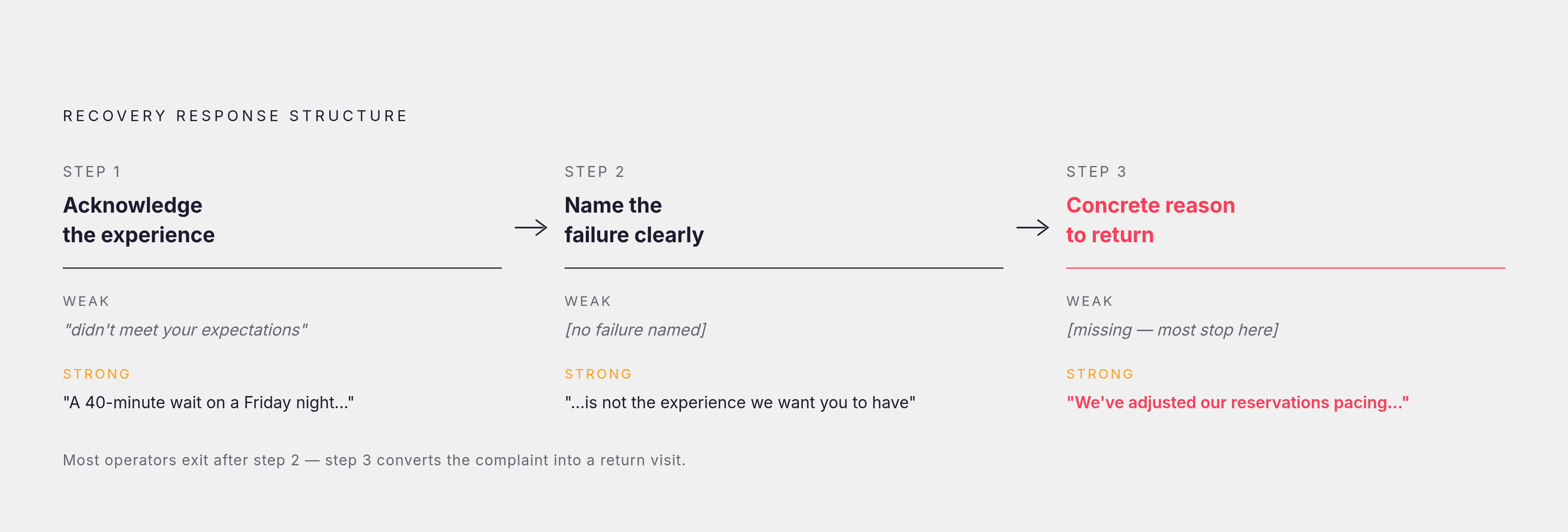
The words in a recovery response determine whether the guest feels heard or handled. Guests who feel handled do not return. The guest reads it and knows, at a level they may not articulate, that nothing will change.
A response that converts a complaint into a recovery touchpoint does three things in order. It acknowledges the specific experience. Not "we're sorry you felt that way," which is an accusation wearing an apology as a disguise. The guest does not need a paragraph about your point-of-sale outage. They need to know you see the failure clearly. And it offers a concrete reason to return, one tied to the failure itself.
Consider the contrast. Weak response: "We're sorry your experience didn't meet your expectations. We strive to provide excellent service and hope you'll give us another chance." Strong response: "A 40-minute wait on a Friday night is not the experience we want you to have. We've adjusted our reservations pacing and we'd like to have you back on us. Here's what that looks like." One of these names what went wrong. The other performs regret.
What should a recovery response never do? And it should never use templated language that applies to any complaint interchangeably. The guest described a specific experience. A generic response tells them you did not read it.
The emotional retention logic is simple. A guest who feels known and valued does not leave for a competitor offering a discount. The response has to build that feeling, not simulate it with a coupon code. It takes two minutes longer per response. Those two minutes are the difference between a guest who returns and a guest who does not.
Closing the internal loop: turning the complaint into a change the next guest experiences
A negative review that generates a recovery response but no internal action is a cost, not an investment. The guest may return, the rating may recover, and the same operational failure will happen to the next guest, who may not bother to write a review before leaving for good. The retention opportunity is only fully captured when the operational cause is addressed. This is the step most operators skip, because it requires crossing from the marketing or front-of-house function into operations. It is also the only step that prevents the same review from appearing again next month.
The categorization work from the reading step now connects to an owner and a timeline. The review category determines who owns the follow-up. The review log becomes a standing agenda item, not a one-off discussion after a particularly bad week.
The signal value of reviews is highest when they are read in aggregate over time. Four complaints about cold dishes in a month is a kitchen process signal. But that signal only registers if someone is watching the channel, which is the difference between feedback collection and operational improvement. The restaurant that collects the reviews and does not connect them to a change has built a very expensive suggestion box. The restaurant that reads the pattern and adjusts the kitchen has built a retention engine.
What makes the internal loop so hard to close is not the complexity of the work. It is the crossing of domains. Closing the loop requires a simple accountability structure, one that names the owner and the deadline on the same line as the complaint. That is not an operations problem. It is a management problem, and it is solvable on a Thursday morning.
Connecting complaint recovery to the first-visit-to-regular pipeline
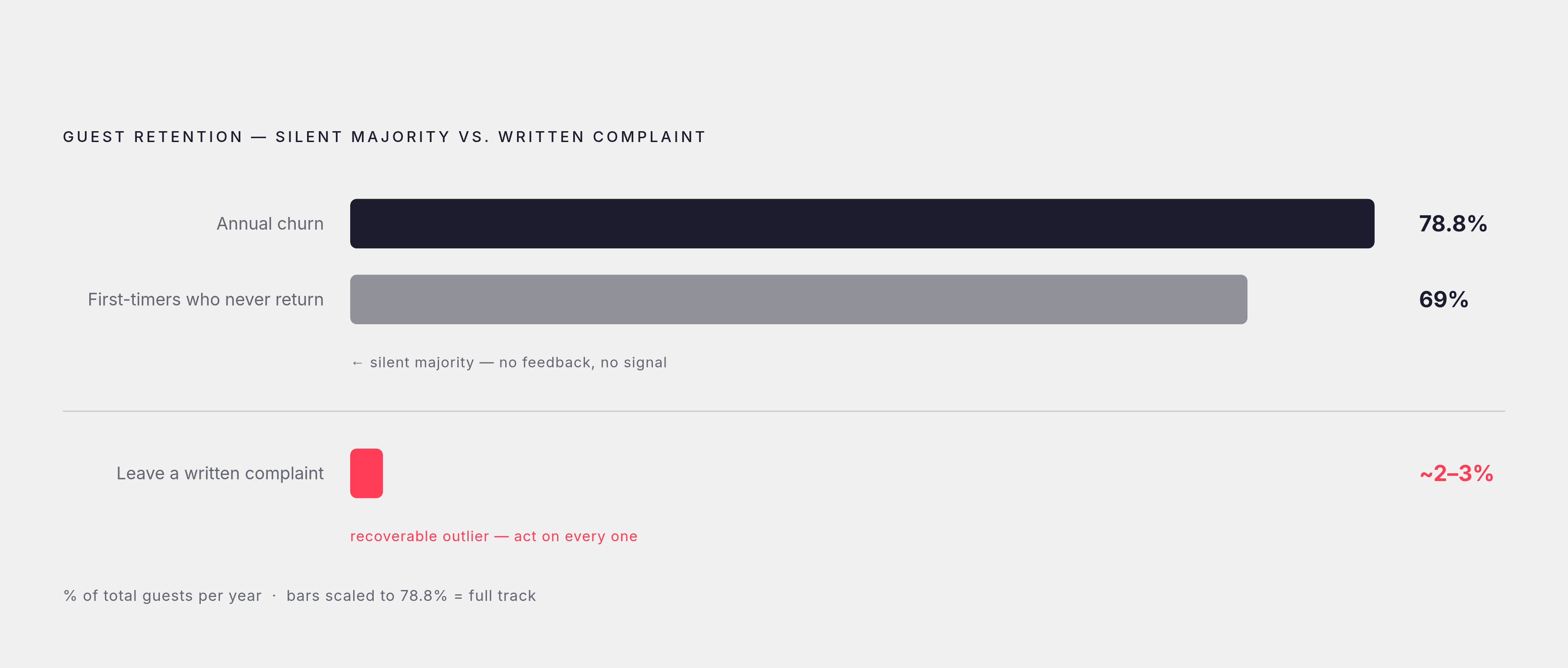
The gap between a first-time visitor and a repeat guest is the most expensive gap in a restaurant's revenue model. A large majority of first-time visitors do not return. The number is stark: 69% never progress beyond one-time visitor status. So the guest who leaves a negative review is actually providing more recoverable information than the silent majority who simply never come back. The complaint is a gift, if you are willing to receive it that way.
The second-visit frame reorients the recovery response. The goal is not to protect a star rating or satisfy the reviewer in the abstract. It is to get that specific guest back in the door, because converting them from a one-time visitor to a two-time visitor is the inflection point for long-term retention. The math here is unreasonably good. The marginal cost of turning that one-time visit into a relationship is a fraction of the cost of finding another first-timer.
One casual dining operator, cited in the research, obsessed over first-visit feedback for six months and roughly doubled their repeat rate. The recovery demonstrated that the restaurant values them specifically. That feeling compounds.
A restaurant that has built a complaint recovery system has operational feedback working. The same measurement gap that makes negative reviews invisible as retention signals also makes ad spend invisible as a driver of those visits. Nothing connects the two.
When a guest comes in on a creator's recommendation and has a bad first experience, the recovery response matters. Local creator campaigns are particularly vulnerable to this blind spot: the economics are favorable, with geographically concentrated audiences delivered at a cost competitive with paid local advertising. But the value is invisible without a system that connects the social view to the in-store visit.
Together, these two systems do what neither does alone. They make every guest touchpoint, from the creator post that drove the first visit to the recovery response that earned the second, part of a measurable, improvable cycle rather than a series of disconnected gambles. The complaint is not the end of a relationship. It is the beginning of a conversation the restaurant is finally equipped to have.