Post-Visit Follow Up Sequences for Restaurants
Automated follow-ups within two weeks drive repeat visits before the window closes.
A restaurant spends real money getting a first-time diner through the door, then lets that relationship expire quietly. Most of those diners never come back. This article walks through the post-visit follow-up sequence that closes the gap between a first meal and a second visit before the window permanently shuts.
Why the window between a first visit and a second visit closes faster than most operators realize
The revenue math of a restaurant runs on retention, not acquisition. The acquisition cost of a new diner is a total loss unless that guest comes back. Every dollar spent on ads, influencers, or promotions is wasted if there is no system to bring that person through the door again.
The window for that second visit is surprisingly short. If a guest does not return within two weeks of their first meal, they likely never will. A restaurant that does not act within those fourteen days is not losing a potential regular. It is forfeiting one.
The failure is structural, not accidental. Restaurant operators are not lazy. They are running operations without a system that captures guest identity and acts on it automatically before that window shuts. When the bartender quits, the relationship leaves with them.
The scale of the leak is easy to underestimate. A 200-cover dinner shift passes hundreds of guests through the door, and the typical operation walks away with a handful of new contacts, most captured by accident. The rest walk out into the night, carrying their future visits with them.
That raises an important question: what does the system that closes this gap actually look like? Not a loyalty card left in a fishbowl. It is a defined sequence of triggered communications, each with a specific job, timed to the moment when a guest is most likely to return. And it starts with understanding what a follow-up sequence actually is.
What a post-visit follow-up sequence is and how it differs from a generic email blast
A post-visit follow-up sequence is a set of triggered communications timed to guest behavior, purposeful at each step, and measurable against in-store outcomes. It is not a batch promotion sent to everyone on a list. A sequence asks a better one: what has this guest actually done, and what is the right next message for that specific state?
Each flow exists for a different guest state: new, celebratory, lapsing, recently served. Conflating them into a single promotional blast defeats the purpose of all four. A first-time diner who needs a gentle invitation to return is not the same as a regular who has gone quiet for six months, and sending both the same 20-percent-off coupon is a good way to waste the message on both.
The critical technical distinction is where the sequence triggers from. POS integration is what enables visit-triggered automations, post-visit follow-ups, and lapsed guest detection based on actual transactions rather than guesswork. Without it, a restaurant is automating based on email activity: a much narrower and self-selecting slice of its actual guest base.
The good news is that this capability has moved downstream. Platforms including Toast and Square now plug directly into POS data, and marketing automation tools like Klaviyo integrate with both to receive that POS data. An independent operator with no in-house marketing team can run the same automated sequences that national chains once deployed with large martech budgets. What remains is the operational discipline to build the sequence correctly.
Email and SMS are complementary channels within the sequence, not interchangeable. Email handles depth, context, and storytelling. The sequence works best when the two channels are coordinated, each doing the job it is built for.
But a sequence that fires on no one is worthless. Before walking through the steps, an operator needs a guest database to run them against. That is the prerequisite work, and it happens to be where most restaurants leak the most value.
How to build the guest database the sequence runs on
A post-visit sequence is only as powerful as the guest database feeding it. Building that database systematically across every touchpoint is the operational work that makes everything else possible. Without it, all the automation in the world is just a well-designed engine with no fuel.
The highest-yield capture points are not mysterious. Wi-Fi captive portals convert the free-network expectation into a clean opt-in at scale. Digital receipt opt-ins capture the highest-intent moment of the visit: a guest paying for an experience they just had is primed to say yes to staying in touch.
Where most restaurants leak contacts is in the gaps between systems. A unified guest database fed by every system the restaurant already uses turns that fragmentation into a single profile the marketing sequence can actually act on. The fix is not necessarily expensive new software. It is intentional configuration of the systems already in place so data flows to one destination rather than sitting in five separate silos.
One might argue that list size is the goal, and that is precisely backwards. A list of guests who have actually dined at the restaurant will outperform a much larger purchased list. A smaller list of real guests beats a larger list of strangers every time.
Compliance is non-negotiable. The legal obligations here are not bureaucratic footnotes. Get them right before the first message goes out, because retrofitting consent after the fact is expensive and unreliable. With the database in place, the sequence can begin. The first message goes out the same day the guest leaves.
The same-day thank-you: what the first message accomplishes and how to write it
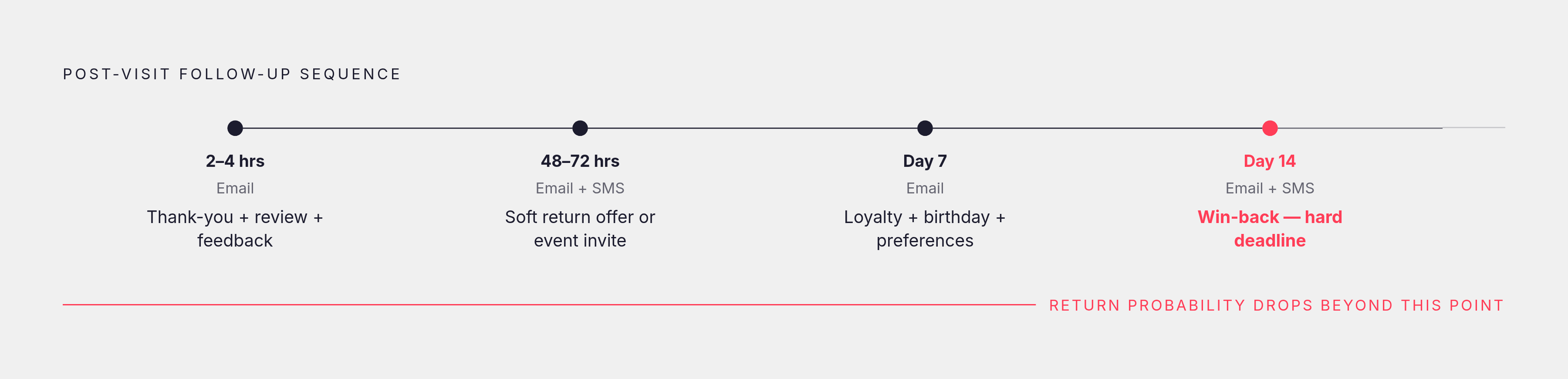
Post-visit follow-up emails sent within 24 to 48 hours of a meal are the right outer boundary. The inner boundary of two to four hours after the visit is the ideal window for review generation while the experience is fresh. The longer the gap between the meal and the ask, the fainter the recollection and the lower the response.
This message has three jobs. Third, give unhappy guests a private feedback path that intercepts a public complaint before it posts. A simple question, "How was your experience?", routes guests before they self-select to Yelp.
The fork matters because of what it prevents. A guest who had a bad experience is going to tell someone. Giving them a private channel inside the email means that someone is the restaurant, not the entire internet.
The payoff is measurable. A reputation is not built in a single burst. It accumulates, message by message, review by review.
The message itself should be short, warm, and personal. That is the entire email. Anything more is padding, and the guest will feel it. Not everyone opens the first email. The sequence accounts for that at the next step.
The 48-to-72-hour follow-up: introducing a reason to return before the window closes
The second message in the sequence arrives two to three days after the visit and shifts from gratitude to invitation. Its job is to give the guest a specific, low-friction reason to book a return visit while the memory of the meal is still positive. But they will, unless the sequence gives them a reason not to.
This is the right place for a soft offer: a seasonal item, an upcoming event, a dish they have not tried, or a time-limited reason to return. The offer framing matters enormously. A guest who learns to expect coupons will wait for the next one before returning, which is a slow bleed on margin.
Restraint is the discipline here. Give the guest a single reason to return and a single path to act on it. That is the whole assignment.
For guests who did not open the first email, this is the trigger point for an SMS follow-up. Short, direct, and linked to a booking or ordering page. Two channels, two speeds, one goal: get the guest back before the window closes.
Day seven arrives. The guest still has not returned. The sequence changes register again.
The one-week check-in: loyalty enrollment and the case for capturing more data before it goes cold
By day seven, a guest who has not returned is not necessarily lost. The restaurant is no longer asking for a second visit. It is asking for permission to keep knowing this guest.
This is the right moment to invite loyalty enrollment, birthday capture, or preference collection. The guest has had a positive experience and a week to let it settle. They are more likely to engage than they would have been in the first 24 hours, when the first email arrived and the ask would have felt premature. Timing is everything in this sequence, and day seven is the moment when data capture stops feeling like a transaction and starts feeling like a relationship.
The data captured here pays for itself immediately. Birthday data captured at this step fuels the birthday flow, and a birthday email sent five to seven days before the date consistently produces among the highest redemption rates of any restaurant email type. That is not a marginal improvement. It is a completely different tier of performance.
The loyalty case is just as strong. Loyalty program members make meaningfully more restaurant visits per year than nonmembers, according to Circana's 2025 analysis of receipt data from four large U.S. restaurant loyalty programs. In a shrinking market, the guests who identify with a restaurant are the ones still showing up.
The guest profile built at this step, covering visit date, preference signals, birthday, and contact preferences, is the data infrastructure every subsequent touchpoint depends on. A guest who enrolls in a loyalty program at day seven is no longer a first-time visitor in the system. They are a named, profiled, reachable regular in the making. Some guests will not engage with any of this. That is where the two-week message comes in, and it is the last reliable moment in the early-stage sequence.
The two-week win-back: what to do when the guest has gone quiet
If a guest has not returned or engaged by day fourteen, the sequence needs to introduce genuine urgency. The two-week mark is the outer edge of the "second visit" window identified by The Culinary CMO. Beyond this point, the probability of return drops substantially. This message is the last reliable moment in the early-stage sequence, and it should read like it.
The offer at this stage should be meaningful enough to create action but structured to avoid training guests to lapse in order to receive a reward. A time-limited invitation works better than an open-ended discount. Segment win-backs to guests who genuinely have not engaged rather than blanket-sending to the full list.
Some guests will not come back no matter what the message says. No sequence, however well-built, recovers every lapsed diner. A win-back that annoys the other nine into unsubscribing is a net loss, even if the open rate looks good. After two weeks, the post-visit sequence ends. A different system takes over.
The ongoing lapsed-guest flow: reactivating guests who went quiet after the two-week window
The lapsed-guest flow is a separate, always-on system, not a continuation of the post-visit sequence. It serves a longer-horizon retention problem: guests who fell through the early sequence, or who lapsed after becoming regulars. A guest who has been gone for two months should not receive the same message as one who has been gone for five days.
Calibrate the inactivity threshold to the restaurant's natural visit frequency. The threshold is not a universal constant. It is a function of how often a loyal guest actually shows up, and it differs wildly by concept.
The lapsed-guest flow is a two-email sequence. The subject line and opening of the lapsed-guest email are the most important variables. "We saved you a table" outperforms a generic promotional subject because it personalizes the gap without lecturing the guest about their absence.
Avoid guilt-based framing. A seasonal menu item, a new dish, or an event invitation works better than a blanket percentage-off coupon. Desperation reads as desperation, and it repels the guests it is meant to attract.
Win-back campaigns that combine email and SMS outperform either channel used alone. SMS nudges for non-openers at the 48-to-72-hour mark are the same coordinated logic applied at a longer time horizon. The channel choreography from the early sequence scales out, and the results hold. Building all of this without measuring it would be guesswork. The final piece is attribution.
Measuring whether the sequence is actually working: the metrics that connect messages to tables
A post-visit sequence that cannot be connected to in-store outcomes is indistinguishable from a sequence that is not working. The metrics that matter are visit-based, not message-based. Open rates and click rates are engagement signals, not revenue signals. They tell you whether a guest noticed the message, not whether they came back and spent money.
The only measurement that closes the loop between a message and a table is POS-connected attribution. Knowing that a guest who received the two-week win-back email came back, and what they spent, is the difference between running a system and running a hope. For operators on generic email tools without that integration, campaign-specific promo codes and verbal inquiry at reservation or payment, a simple "how did you hear about us?", constitute a workable minimum attribution stack.
The attribution gap compounds over time. Decisions made on incomplete data, such as cutting a win-back flow because open rates look low, or keeping a discount offer because clicks are high, systematically optimize for the wrong outcomes. This is where proprietary attribution infrastructure, which connects the digital message to the physical POS transaction, gives operators who build or buy it a genuine advantage over those relying on platform-reported metrics that stop at the click.
Automated flows specifically outperform batch sends on the metrics that matter. Automated email flows achieve meaningfully higher click rates than one-off campaigns and a dramatically higher placed-order rate, according to Klaviyo's 2026 benchmark across a large sample of brands. The data says what the logic already suggested: a system beats a spray.
The sequence described here is not a one-time project. The guests are already walking through the door. The question is whether the restaurant captures them before they walk out again.