Online Reviews and Their Role in Restaurant Retention
Reviews filter guests before they arrive, shaping which restaurants make the shortlist.

Online reviews shape restaurant retention before the first visit, during the chance to recover a disappointed guest, and when a regular considers returning. Their value is therefore larger than their role in attracting new customers. Managed with those three moments in mind, and measured against actual visits, reviews become a retention tool.
Why most restaurants lose guests before retention strategies ever apply
The dining room looks full, the regulars smile, and retention seems to be working. Yet the guests an operator recognizes are not a reliable picture of everyone who has visited. Bloom's 2026 benchmarks show that a small segment of frequent guests generates a disproportionate share of visits. Those guests can make it harder to see the larger group who come once and never return. A busy room is evidence of demand, but not necessarily of guests moving from a first visit to a second.
Most restaurant guests are gone after that first visit, and most churn makes no announcement. Dissatisfied guests often leave without complaining, reviewing, or speaking to a manager, so their absence is the only signal. Guests who do return tend to do so soon, with most return decisions made in the 30-day window after the first visit. A welcome message sent weeks later may already be late. Loyalty programs and re-engagement campaigns deal with a later problem unless the restaurant first does the harder work of earning visit two.
How reviews function as a pre-visit filter, not just a post-visit artifact
That second visit depends on a first visit that many restaurants never get the chance to earn. Reviews help shape a guest's shortlist before they reach the dining room. A rating is not always a gentle influence that makes one option slightly more appealing than another. It can function as a cutoff, excluding a location before its food, service, or atmosphere gets a hearing. The review may follow one guest's meal, but it precedes another's decision.
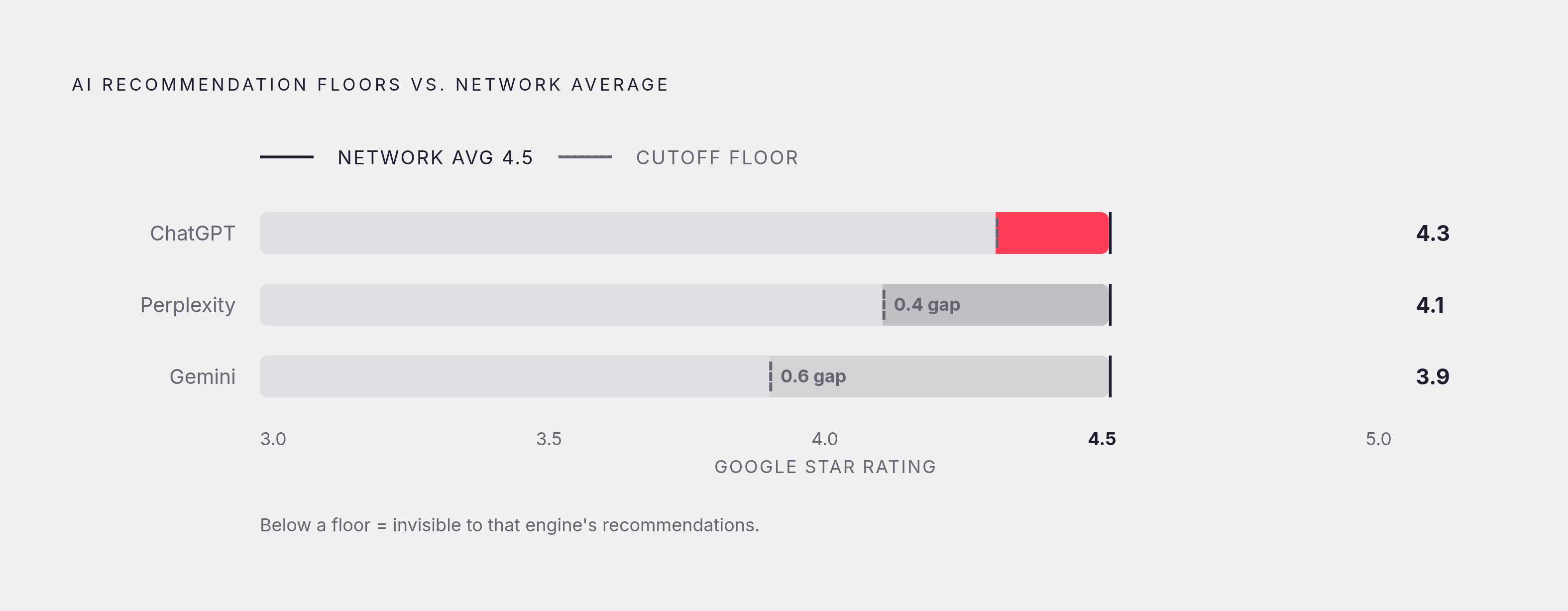
ChatGPT primarily recommends restaurants averaging around 4.3 stars or higher, while Perplexity's observed floor is about 4.1 and Gemini's is about 3.9. These engine-specific thresholds illustrate the same filtering problem. Below an engine's floor, a restaurant may drop out of its recommendations altogether. Guest shortlists can apply a similar rule, leaving an operator competing for attention only after clearing the rating hurdle.
The platform also changes the picture a prospective guest sees. Li & Hecht's 2021 study found that restaurant ratings on Google Maps run higher than those on Yelp, while Yelp also carries a higher share of negative reviews. Reservation platforms such as OpenTable represent a different context because reviewers booked and dined. Food can make the case for a return visit only after the review profile has helped secure the first one.
What the rating distribution actually looks like across platforms and why the average flatters operators
In Bloom's 2026 benchmarks, the network average Google rating is 4.5 stars. That makes 4.5 a benchmark for comparison with a restaurant's peers. It is also different from the engine-specific recommendation floors. The average is for the network, while a threshold marks the point where a single location risks being left out.
Neither number, on its own, shows how ratings vary from one location to another across a portfolio. A blended average can conceal weaker locations behind stronger ones, even though guests decide whether to visit a particular restaurant. Counting locations that fall below the thresholds guests actually use provides a better diagnosis. A portfolio cannot lend its best location's stars to its worst one at the moment a guest searches.
OpenTable and Tock skew high because every reviewer booked and dined, while Yelp skews lower and contains more negative reviews. The same restaurant can consequently look reassuring in one setting and unappealing in another. Judging the portfolio only through Google overlooks those differences, just as judging it only through an average overlooks individual locations.
The distribution of responses is revealing, too. Bloom's 2026 benchmarks show that 3-star reviews receive the lowest reply rate of any star level. These are mixed experiences rather than clear endorsements or outright rejections, yet they draw the least attention.
The review response gap and what it costs in the 30-day window after a first visit
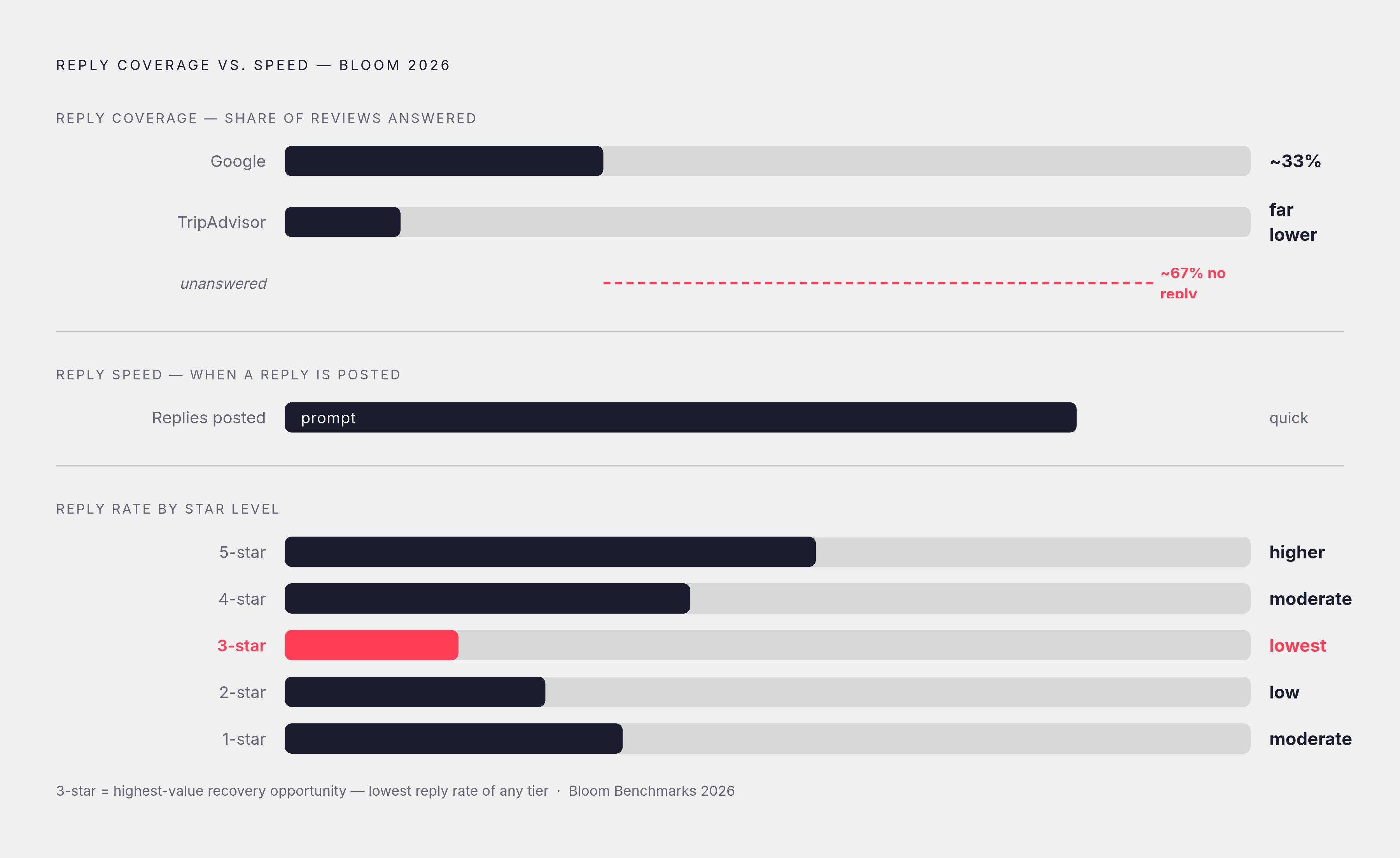
The response pattern turns that diagnosis into an operational choice. Bloom's 2026 benchmarks show that most replies across its network land quickly when they are posted at all. Yet only roughly a third of Google reviews receive any reply, and TripAdvisor response coverage is far lower. A restaurant can be prompt with the reviews it answers while leaving most guests without a response.
That distinction matters because the relevant clock starts with the visit. Most return decisions happen within the first 30 days, so an unanswered review during that period is a missed chance to address the experience before the guest moves on. Faster handling of an already well-covered minority does not solve that omission. Silence requires no staff time, but it also makes no attempt to recover the guest.
A public reply has another audience beyond its author. It may persuade the original reviewer to reconsider, while showing future readers that the restaurant takes responsibility for a disappointing experience. That second effect matters especially on Yelp, where the share of negative reviews is higher. A complaint left alone and a complaint followed by a useful response tell different stories about the same failure. The reply cannot undo the meal, but it can change what the unresolved complaint communicates.
Automated reply rules can help more reviews get answers without a manager having to work through each one by hand. Bloom's data shows that automation drives response timing, while the answer's usefulness still depends on the template. The measurable gap is unanswered feedback during the recovery window, while the revenue cost depends on which guests could have been brought back.
Why the 3-star reviewer is the most valuable recovery opportunity a restaurant has
Within that unanswered feedback, the 3-star reviewer deserves particular attention. A 1-star reviewer is often venting, while a 5-star reviewer has already expressed satisfaction. The guest in the middle has tried the restaurant and found something to talk about without going to either extreme. The guest most likely to be missed is also the one the restaurant has the best chance of winning back.
A 3-star review may point to slow service, a dish that let the guest down, or noise that spoiled an otherwise good visit. Those specifics distinguish a repairable failure from a vague impression that the restaurant simply was not right. They also give the operator something concrete to answer. The guest has done more than assign a score by explaining what stood between the meal and a better experience.
A useful response should acknowledge that particular failure and name what the restaurant will do or has already done about it. A generic apology misses the information the guest supplied, while a vague assurance can look like deflection to future readers. Recency also matters because the recovery window is short. A reviewer left unanswered for three weeks may already have made the next dining decision. Prioritizing recent mixed reviews gives the response a chance to arrive while reconsideration is still possible.
Staff bandwidth is a real constraint, but the choice need not be between a wholly custom letter and silence. Even a templated reply that names the specific issue is better than leaving it unaddressed. For undecided readers, that exchange also becomes public evidence of hospitality under pressure. A restaurant handling a mixed experience well can communicate more about its care than an unbroken row of praise.
How reviews signal to returning guests that a restaurant is still worth their loyalty
Recovery is not the last point at which reviews influence retention. For someone who already knows the restaurant, the review profile can serve as reassurance. The guest is no longer deciding whether the place has ever been good. The decision is whether it is still worth choosing now. That makes recent feedback relevant even when the guest has a favorable memory of an earlier meal.
A profile filled with months-old reviews and little recent activity can weaken that reassurance. A restaurant that was good six months ago may have changed since then, and a quiet profile tells guests little about how it is now. Review velocity therefore matters as well as the rating. A high score with little recent activity can look less alive than a slightly lower score with new reviews and replies.
Recent responses also show that management is still paying attention to what guests say. They extend hospitality into the digital space a guest checks before booking, rather than leaving it confined to the previous visit. Bloom's 2026 benchmarks show why this reassurance deserves attention by identifying the disproportionate visit volume generated by the most frequent guests. Keeping that reassurance in place for those guests helps protect a large part of the restaurant's business.
Tillster's 2026 retention data found that nearly half of diners said their favorite restaurant changed in the past year. That finding makes loyalty look less like a possession and more like a choice that remains open. If nearly half reconsidered their favorite restaurant, the review profile is part of the evidence against which that choice can be reconsidered.
Connecting review management to in-store revenue and why measurement closes the loop
Taken together, these stages explain why review management belongs in retention operations. They do not, on their own, establish which action produced a return visit. A restaurant can answer reviews regularly and still have no way to tell whether its replies brought guests back. It can have the same uncertainty about a campaign or a local creator post. Activity becomes a retention system only when the operator can connect it to visits and revenue.
The measurement gap lies between what a platform reports and what happens at the point of sale. Views, clicks, and impressions describe digital attention, while visits, check size, and repeat behavior describe the business that follows. Neither side substitutes for the other. A reply that receives attention is not automatically evidence of a recovered guest. Without that distinction, review management can remain an expense justified by plausible, unmeasured benefits.
Closing the gap requires connecting digital touchpoints, including review replies, local creator posts, and paid ads, to physical visit data captured at the POS. Attribution then allows the operator to examine which responses led to return visits and which first visits developed into repeat business. The same discipline can show which paid ads brought guests with lasting lifetime value. Budget decisions can consequently rest on the restaurant's own visit and revenue data rather than only on a platform's self-reported metrics.
For independent and growing restaurants, the practical foundation is a first-party data system built around POS integration, loyalty capture, and review tracking. This level of attribution need not remain limited to enterprise chains with dedicated data teams or require a large budget. Its purpose is to make the retention argument testable at the restaurant level. Reviews help shape who comes in, who is won back, and who keeps returning. Connecting those moments to actual visits is what turns reputation management from maintaining appearances into managing repeat business.