Restaurant Loyalty Program Structures and Tradeoffs
Loyalty members now drive 39% of restaurant visits, but program design matters more than adoption.

Restaurant Loyalty Program Structures and Tradeoffs.
Why 39% of restaurant visits now come from loyalty members
Per Circana and Nation's Restaurant News data published 2025–2026, 39% of US restaurant visits now come from loyalty members, roughly double the 2019 share. In quick-service, the number is starker: 52% of QSR customers already belong to at least one restaurant loyalty program, meaning an operator without one is competing against a rival's rewards app every time a hungry person decides where to go. Adoption has followed close behind. That is a lot of programs launched in a short window, and volume like that tends to outrun quality.
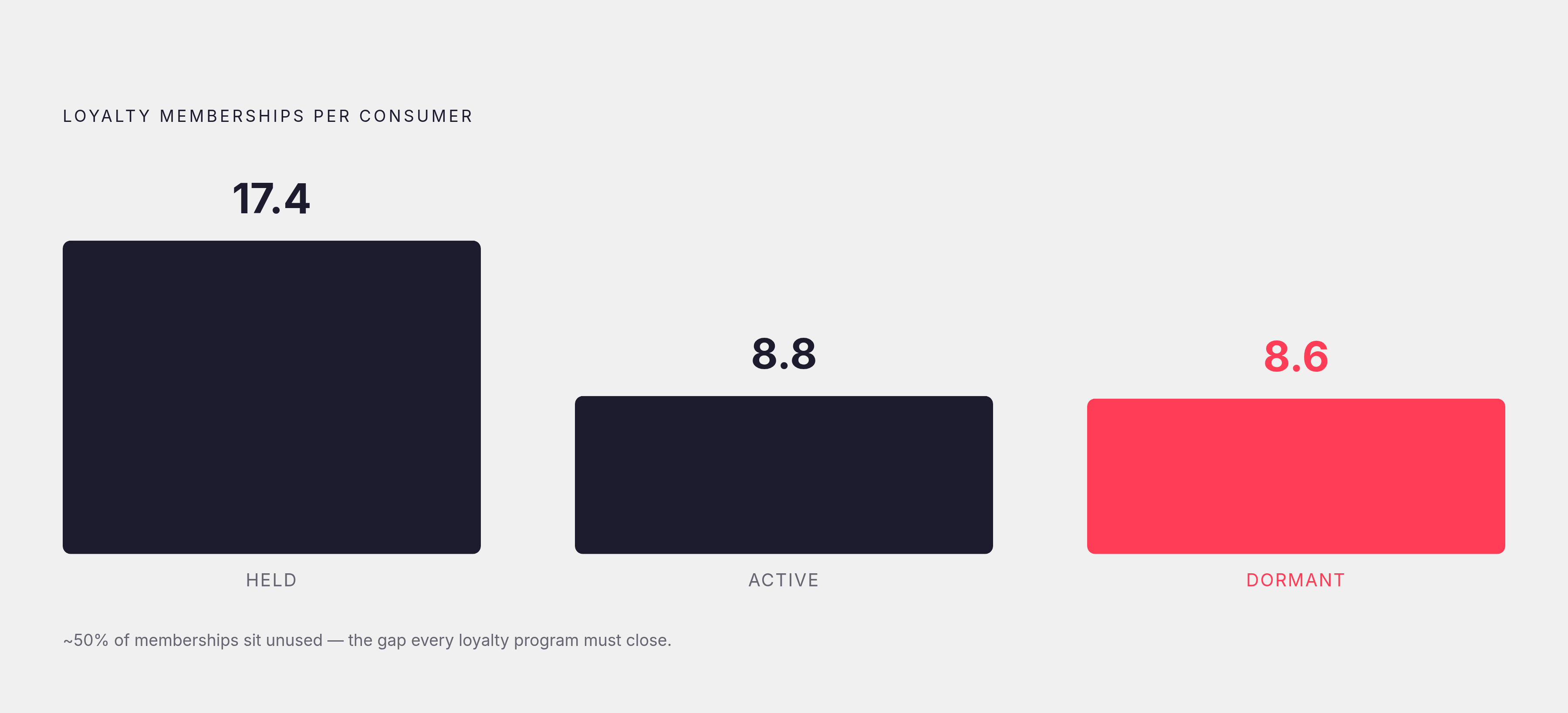
More loyalty programs exist than get used. The average consumer holds 17.4 loyalty memberships across every category, restaurants included, but actively uses only 8.8 of them. Half the ecosystem is dead weight, cards nobody scans and apps nobody opens. So the operative question for anyone building or rebuilding a program in 2026 isn't whether loyalty works in the abstract. It's which structure, given a specific customer base, average check, and ability to track what the program actually produces in revenue, actually lands in the active half instead of the dormant one. That's the comparison this piece works through: points, visit-based, tiered, paid, and hybrid, each judged on cost, engagement, and whether you can measure what it produced. 67% of all restaurants have launched programs, and 61% of operators offer one, with 46% planning to update or enhance in 2025, according to the National Restaurant Association, yet adoption has outpaced design quality Restaurant Loyalty Program ROI: Data to Know as an Operator.
What loyalty programs return, read through honest averages
Start with the topline number, because it's a genuinely good one. Antavo's Global Customer Loyalty Report for 2026 found 92.7% of loyalty program owners reporting positive ROI, averaging a 5.3x return. A separate analysis from Restroworks landed close by, 90% positive ROI at 4.8x. That's a strong enough signal that "does loyalty work" isn't really the debate anymore.
But averages flatten timelines, and timelines matter enormously here. First-year programs tend to show modest lift in average order value, while programs running three years or longer show meaningfully stronger results. Operators who pull the plug before the 18-month mark are frequently judging a program on its worst, least-compounded data. What does an enrolled member actually do differently? Visit frequency rises 22%, average ticket rises 18%, and loyalty members overall spend 12% to 25% more annually than people outside the program Restaurant Loyalty Program ROI: Data to Know as an Operator. Layer in the retention math from Bain & Company by way of Harvard Business Review: a 5% bump in retention can raise profits somewhere between 25% and 95%, and replacing a guest costs 5 to 25 times more than keeping one Restaurant Loyalty Program ROI: Data to Know as an Operator. Small retention gains, in other words, are disproportionately valuable. A healthy program should aim for something like a 1:3 ratio between acquisition cost and lifetime value.
None of this means every program earns its keep. Dissatisfaction with fast-food and fast-casual loyalty programs nearly doubled in 2026, jumping to 28% from 15% the year before, and the pattern behind failing programs is almost always the same: data gets collected and never used, or the reward structure is so opaque nobody can tell what they're earning. Which raises the real methodological trap here. It's tempting to credit a loyalty program for every dollar a member spends, but a lot of that spending would have happened with or without the rewards card in their wallet. The honest version of ROI measurement compares enrolled members against a comparable set of non-members on visit frequency, ticket size, and share of total sales, then weighs that lift against what the rewards and the software actually cost. Skip that comparison and the 5.3x figure is a guess wearing a decimal point.
Points-based programs: the most flexible structure, and its cost
Points programs are the format most people picture when they hear "loyalty program." Customers earn points on every purchase, redeem them for rewards, and the operator controls the earning rate, the redemption thresholds, and what's on the reward menu. That configurability is the whole appeal. Points reward every transaction rather than just milestone ones, they build habit through visible accumulation (watching a balance tick upward is its own small dopamine hit), they flex to fit restaurants with wildly different check sizes, and they plug into most digital platforms and POS systems without much friction.
The tradeoff lives in the gap between configurability and clarity. A structure this flexible is invisible to the guest right up until it isn't, and the moment earning feels slow or redemption feels like it's always one purchase away, members check out mentally even if they never formally unenroll. That matters more than it sounds, given that 85% of loyalty members say they join primarily to save money.
Running a points program isn't free, either. It requires a digital platform, whether that's a dedicated app, direct POS integration, or a third-party provider, and that typically runs in the low hundreds of dollars per month depending on scale. What that spend buys is data: visit frequency, average spend, redemption rate, which members have gone quiet. That's a meaningful return on the software line item, since a points program tied to digital infrastructure is one of the few structures that tells you, in granular detail, whether it's working. Unredeemed points sit on the books as a liability, and a program with no expiration policy or no nudge toward redemption can accumulate a surprisingly large unrealized balance over time.
Visit-based and punch-card programs: lowest barrier, least data
Punch cards are the format loyalty forgot to modernize, and there's something almost charming about how little they ask of anyone. No app, no login, no technology at all if you're running the classic hole-punch version. Zero software cost, zero enrollment friction, and a value proposition so legible a guest can see, literally, how many punches stand between them and a free meal.
That simplicity comes at a cost, though, and the cost is total blindness. A paper punch card captures no contact information, no visit history, no spend data. There's no way to identify your best customers, no way to reach anyone between visits, and no audit trail, which makes physical cards easy to duplicate or fudge. That's not a measurement gap to close later. It's a structural blind spot baked into the format.
Where does that leave the format? Quick-service and counter-service spots with frequent, simple, low-variance transactions, where the goal is reinforcing a habit rather than building a customer database, still get real value out of it. For anyone who's outgrown the shoebox-of-punch-cards phase, digital visit-tracking apps preserve the same one-glance simplicity while adding actual data capture, and that's usually the sensible first upgrade before wading into tiers or subscriptions.
Tiered programs: how aspiration drives frequency until the structure becomes its own obstacle
Tiers add a psychological ingredient points programs mostly skip: status. Spend more or visit more often and a guest climbs from bronze to silver to gold, and each rung up is visible. A silver-tier regular can see exactly what gold gets and adjust behavior accordingly. That's a genuinely different lever from simple accumulation. Points appeal to a customer's desire for a discount; tiers appeal to a customer's desire to be recognized as a regular, a different emotional transaction entirely.
A specific reason explains why tiers shape which guests get identified and rewarded. Toast and Resy's 2026 data found that a venue's most loyal 7% of guests can drive up to half its total order volume. A tiered structure is essentially a machine built to find that 7% and give them a reason to keep returning. That's a small slice of the customer base carrying an outsized share of revenue, and tiers are the format explicitly designed to court it.
Fit depends heavily on check size. Full-service restaurants with higher average tickets tend to do well here, because the spend gap between tiers can be large enough to feel meaningful to the guest. At QSR price points, though, tier thresholds built around dollars spent can feel remote, maybe even unreachable. Quick-service tiers often need to key off visit count instead. Tiers also require real infrastructure. No punch card is tracking silver versus gold status, so this format demands a digital platform, clean tier-benefit messaging, and consistent data capture across every visit. Done well, it segments the customer base automatically, which makes targeted win-back campaigns (a lapsed gold member is a very different marketing target than a first-time bronze one) far easier to run. Done poorly, with tier gaps that feel arbitrary or a top tier whose perks underwhelm, the whole aspirational engine stalls out, and tier design is genuinely where most of these programs go wrong.
Paid and subscription programs: the structure that demands the clearest value proposition
Subscription loyalty flips the entire premise. Instead of the restaurant paying out rewards in exchange for behavior, the customer pays upfront, monthly, for guaranteed ongoing value: unlimited sides, members-only pricing, a set credit toward food and drink. The fee itself does something useful beyond the revenue it generates. It self-selects for high-frequency guests, since nobody pays a recurring charge for a restaurant they visit twice a year.
Paytronix's 2026 trends research found that quick-service subscription models generate meaningfully higher customer lifetime value than traditional loyalty formats, and one example from that research makes the mechanics concrete. El Lopo's $89/month subscription offers $100 in food-and-drink credits plus exclusive perks, a roughly 10:1 stated value proposition that does the enrollment math for the customer before they've finished reading the offer. That's the whole game with subscriptions: the value has to be immediately obvious, because unlike a points balance that slowly accumulates goodwill over months, there's no slow ramp keeping a skeptical member enrolled while they figure out whether it's worth it.
That immediacy connects directly back to why 85% of members join loyalty programs in the first place, to save money. A subscription that puts the savings right up front, the way El Lopo's math does, lines up with that motivation. One that buries the value in fine print does not, and will churn accordingly. Subscriptions fit best at restaurants where a guest can realistically capture the stated value inside a single month, high-frequency spots rather than occasion-driven destination restaurants where a once-a-quarter visit can never justify a monthly fee. The upside on measurement is real. A subscription tells an operator exactly who is paying, how often they show up, and what they redeem, which makes churn a direct, trackable performance metric rather than a vague impression. The risk sits on the margin side: any program returning 10% or more of spending back in value can become unsustainable as ingredient and labor costs rise, so operators need to model reward cost against the incremental revenue a subscriber actually generates, not just tally up the monthly fees collected.
Hybrid structures: combining elements to match how your customers behave
Most mature programs, in practice, aren't purely one format. A hybrid might run a base points-earning layer on every transaction, add tiered status that unlocks better earning rates for regulars, and offer an optional subscription tier for the highest-frequency guests on top of that, with each layer built to catch a different kind of customer behavior.
Gamification often rides on top of whatever base structure is running underneath. That's not a standalone program; it's an overlay that works on points, tiers, or subscriptions alike.
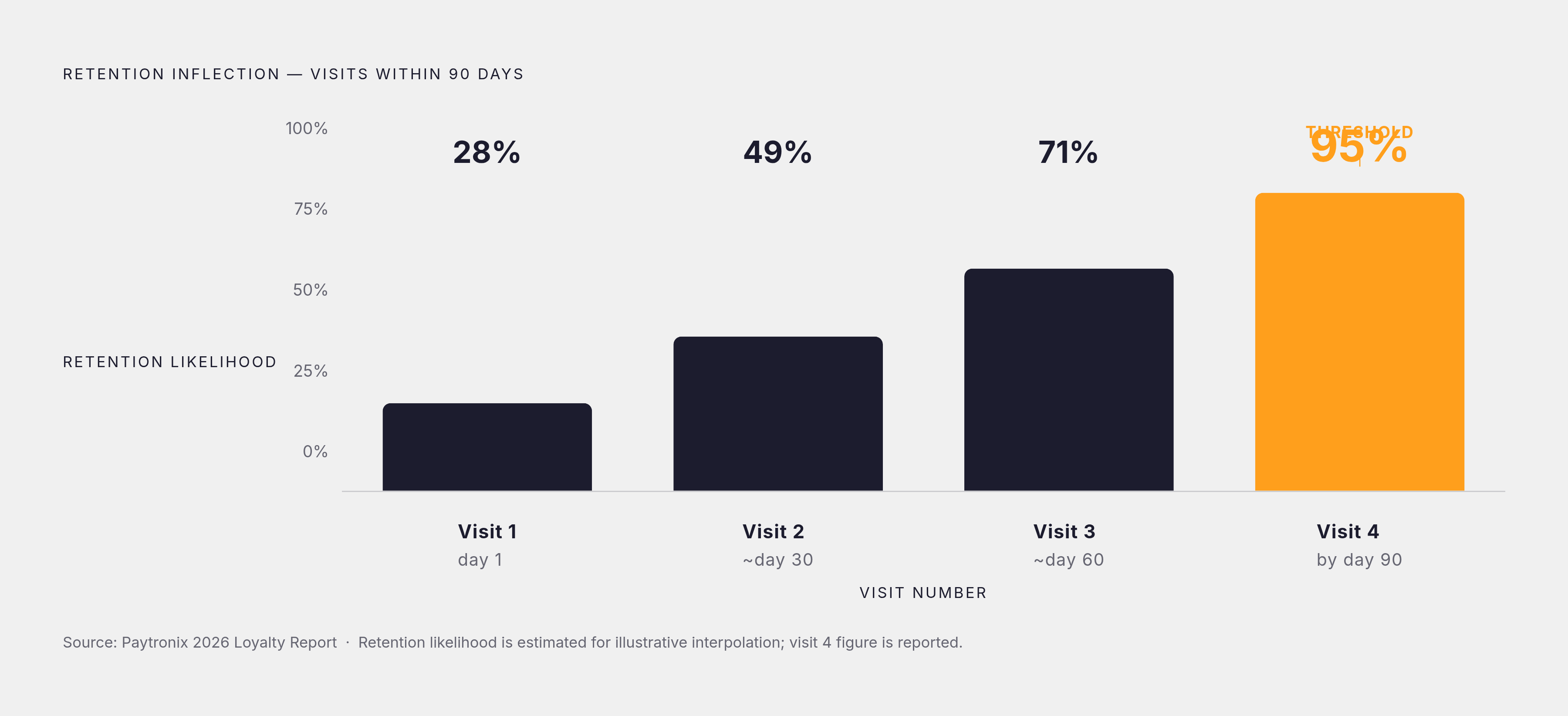
Paytronix's 2026 Loyalty Report found that brands who get a new member to a fourth visit within 90 days of signing up see a 95% likelihood of long-term retention. Call it the Fourth Visit Principle. A hybrid design that includes an early nudge, a double-points week right after enrollment, a visit challenge in the first month, isn't just adding a fun feature. It's directly engineering the exact outcome that data says matters most. Loyalty programs connected to online ordering platforms generate 12% to 18% more incremental profitability annually, because the data pipes connecting those channels produce the integration that makes a hybrid structure work. Every added layer should earn its place by solving a specific behavioral problem, driving that critical fourth visit, elevating the top 7%, winning back someone who's gone quiet. If the value proposition can't be explained to a first-time guest in one sentence at signup, there's one layer too many. As a hybrid layer, gamification through personalized, time-sensitive frequency challenges pushed 75% of participants to order above their average and generated 2.3x higher order frequency, per sourced loyalty data, and this mechanic can overlay any base structure.
Choosing the right structure based on your restaurant's customer mix, check size, and tracking capability
Three variables actually decide this, threaded through every section above: who your customers are, how much they typically spend, and what your systems can track. Put them together and the choice mostly makes itself. A QSR with high visit frequency tends to suit points or subscription formats; casual dining with occasion-driven visits leans toward tiered structures with strong birthday and anniversary mechanics; fine dining, with its naturally low visit frequency, is usually a poor fit for subscription math that depends on repeat monthly use. Check size shapes tier design specifically. Meaningful spend gaps between tiers are what make status motivating, so QSR tiers often need to track visit counts instead of dollars, while full-service restaurants can lean on spend-based tiers because the dollar gaps are naturally larger.
None of it matters, though, if the POS can't tie a transaction back to a specific member. Format is secondary to infrastructure here, full stop. Cost-wise, a digital platform still runs in the low hundreds of dollars monthly, and full profitability, meaning sustained gains that outweigh reward and platform costs combined, generally arrives somewhere in the 12-to-18-month window. Programs killed before that window rarely got a fair trial.
The segment-level evidence backs high-frequency formats specifically. Healthy programs should be growing both enrollment and engagement together.
Which brings the whole comparison back to a single filter. A structure that can't produce incremental revenue data, meaning member visits and spend measured against a comparable non-member baseline, can't be managed or improved; it can only be hoped about. That's the same blind spot that makes paid advertising so hard to evaluate: no clean link between the incentive and the table it actually filled. Solve attribution inside the loyalty program and an operator has effectively built the same muscle needed to judge every other marketing dollar spent. So before picking a structure at all, the sensible move is auditing what the POS and ordering system can actually track, because the most sophisticated program design is worthless without the data infrastructure to measure whether it is working. 76% of limited-service restaurants registered a traffic increase in 2024 driven by loyalty, according to Nation's Restaurant News, making the proof of concept strongest in high-frequency formats. 48% of diners enrolled in loyalty programs in 2025, with weekly engagement hitting 47%, and healthy programs should be growing both numbers.
Sources
- Restaurant Loyalty Program ROI: Data to Know as an Operator
- Loyalty Program Statistics 2026: 73+ Data Points
- Restaurant Loyalty Statistics 2026: Key Data
- Loyalty and Discount Program Trends and Statistics for 2026
- Restaurant Loyalty Program Statistics – Customer Engagement & App Usage Data
- Why points-based loyalty programs aren’t cutting it anymore | Restaurant Dive
- Best Restaurant Loyalty Program Structures for 2026