Online Ordering Platform Comparison for Restaurants
Commission structure and customer data ownership determine profitability far more than features.
Choosing an online ordering platform is a math problem dressed up as a technology decision. Commission rate, fee structure, and who ends up owning the diner's contact information will determine restaurant profitability far more than any app's font choice or checkout flow, and yet most comparison guides rank marketplaces, direct ordering platforms, and delivery logistics tools against each other as if they answer the same question. They don't. This piece walks through why the pricing model has to be the first filter, and why the "best platform" is really three separate decisions wearing a trench coat.
Start with the category problem, because it explains why so many restaurant owners end up comparing apples to delivery vans. Third-party marketplaces like DoorDash, Uber Eats, and Grubhub rent visibility. The marketplace owns the diner relationship, charges 15 to 30% commission per order, and in exchange puts the restaurant in front of people who weren't necessarily looking for it. Direct ordering platforms work differently: the restaurant owns the relationship, pricing runs flat-fee or low-commission, and orders come through the restaurant's own website or app. Then there's a third bucket entirely, operational tooling like Onfleet, which handles dispatching, routing, and kitchen display but doesn't touch demand generation at all. It's a fulfillment layer.
Picking the right bucket comes before picking the right product inside it. Otherwise a restaurant owner ends up comparing DoorDash's reach to ChowNow's flat fee as though they're interchangeable, when they're solving different problems for different line items on the P&L. 64% of guests say online ordering is the most important feature of a restaurant's website, and 58% of consumers say they'd rather order directly from the restaurant when given the option. Diners already want direct. The open question is whether the platform captures that preference or quietly routes it to a marketplace that takes a cut on the way through.
How commission structure determines per-order profitability before any other variable
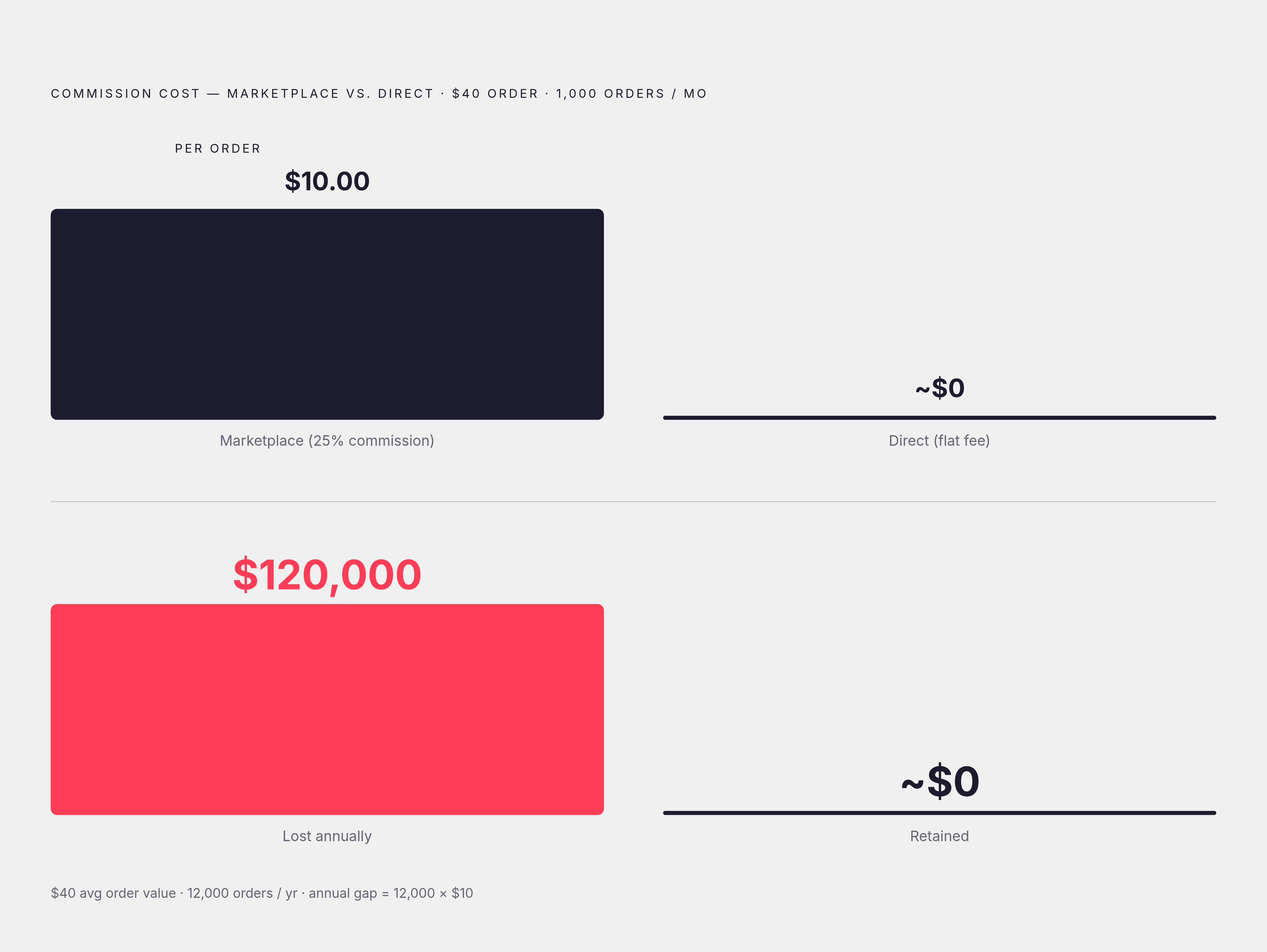
The average independent restaurant nets somewhere between 3 and 5% in profit margin, and third-party marketplace commissions run 15 to 30% per order. A 25% commission doesn't shrink that margin. It erases it, and then some.
Run the numbers on a single $40 order. At a 25% commission rate, the marketplace takes $10 off that order before the restaurant pays for food cost, labor, rent, or anything else. Route that same order through a flat-fee direct platform, and the transaction cost drops to cents on the dollar. Scale that gap across 1,000 monthly orders averaging $40 each, and the difference in retained margin is around $120,000 a year, according to ChowNow's 2026 guide. That's not a rounding error. That's the difference between a restaurant that survives its third year and one that doesn't.
It gets worse before it gets better, unfortunately. Effective commission costs on marketplace apps can climb past 30% once sponsored listings and promotional discounts enter the picture, because organic visibility inside these apps tends to be low enough that paid placement becomes close to mandatory just to show up in a search result. So the advertised commission rate on the marketplace's pricing page is often a floor, not a ceiling.
None of this means marketplaces are a bad deal in every circumstance, and it's worth resisting the urge to treat this section as an anti-marketplace argument. Marketplaces serve a real discovery function, which the final section of this piece covers directly. But commission math has to be the first filter applied to any platform decision, not an afterthought weighed against app design or button colors. A platform with a beautiful interface and a $0 monthly fee can still be the most expensive option in the entire stack if its commission structure quietly eats a quarter of every order.
Three pricing models appear across this market, and knowing which one a platform uses tells a restaurant owner more than any feature list. Marketplace commission takes a percentage of every order, which makes it a revenue-risk model: costs scale with sales, for better and for worse. Flat monthly fee charges a fixed cost no matter how many orders come through, which makes it a predictable-cost model, good for volume, less forgiving at low order counts. Per-order fee is variable, but usually capped, a hybrid that spreads risk without exposing the restaurant to a full percentage cut.
The second variable most platforms obscure: who owns the customer after the order
Commission rate gets all the attention because it's visible on a pricing page. Customer data ownership doesn't show up there at all, and losing it means the restaurant has no way to remarket to or retain those customers directly.
On a marketplace platform, the diner's name, phone number, and order history belong to the marketplace, not the restaurant. The restaurant cooks the food, packages it, and hands it off, but has no direct line to that guest afterward. No email address to send a reactivation offer to. No phone number for a loyalty program. The transaction happened, and then the relationship evaporated. On a direct ordering platform, the opposite is true: every order produces a diner record the restaurant actually owns, complete with contact information and order history, which becomes the raw material for loyalty programs, win-back campaigns, and repeat revenue.
Why does this matter beyond a single order? Loyalty program members visit roughly 20% more often, according to 2025 to 2026 industry data, which compounds into meaningfully more revenue over time. That compounding effect is only accessible if the restaurant has the data to build a loyalty program on. Without it, every customer is a one-time transaction, no matter how good the food was.
This turns the buying decision into a two-part question instead of a one-part question. A platform that charges zero commission but keeps the diner's contact information hasn't eliminated cost, it's just moved the cost somewhere less visible. So when evaluating any platform, the specific question to ask isn't whether it has a "loyalty feature" bolted on somewhere in the settings menu. The question is blunter: does the restaurant receive the guest's email address, phone number, and order history, in a format it can actually use? If the answer is no, the "free" platform has a price tag, it's just denominated in future customers instead of dollars.
Direct ordering platforms compared: pricing models, margin retention, and who each fits
The direct ordering category is crowded, and pricing models vary enough that a generic feature checklist won't tell an operator much. Commission structure, data ownership, marketing depth, POS integration, and best-fit operator profile are the variables that actually separate these platforms from each other.
Owner.com positions itself as a growth platform for independent restaurants, built for operators who want more direct traffic and repeat orders rather than just a place to take orders online. It includes a customized website, onsite ordering, a branded mobile app, automated marketing, loyalty, and customer data capture. It fits independent restaurants whose core problem is a weak web presence and a low repeat-order rate, including operators already doing solid delivery-app volume who want to shift more of it direct. Owner.com's own guide is written in the first person by the Owner.com team, so treat performance claims sourced from it as vendor-authored rather than independently verified.
ChowNow runs $229 to $449 a month billed annually (higher month-to-month), plus a $119 to $499 setup fee and 2.95% plus $0.29 in payment processing, per ChowNow's July 2026 pricing page. Direct orders carry no commission, and the restaurant keeps diner contact data on every single one. It integrates with more than 20 POS systems at a 99.9% success rate, and folds direct orders, third-party orders, and performance data into one dashboard. Restaurants using ChowNow's branded mobile app see roughly twice the direct orders of restaurants without one, and its automated email marketing tool drives an average of $34,000 in additional revenue and 60% more direct orders, according to ChowNow's own June 2026 review guide (figures worth attributing to the source, since they're self-reported). ChowNow claims switching to direct ordering saves the average restaurant $16,000 a year compared to relying on third-party platforms, and cites Emporium Thai in Los Angeles as a case study that saved $68,000 in commissions after the switch. On G2, ChowNow holds a 4.6 out of 5 across 73 verified reviews, with 91% ease-of-use and 90% ease-of-setup scores, and ranks first among food delivery providers for Best Relationship, Best Support, and Easiest to Do Business With. Its Discovery Network surfaces independent restaurants across Google, Apple Maps, and Yelp, while its Flex Delivery feature dispatches through Uber Direct and DoorDash Drive at a flat rate per order, no percentage commission attached. It fits operators who want commission-free direct ordering, owned customer data, and built-in discovery without stitching together three separate vendors.
Toast Online Ordering starts around $69 a month, or in the $75 to $100 range with a custom quote according to TheRestaurantHQ's 2026 rankings, where it scores 4.33 out of 5. It fits restaurants already running Toast POS, since menus sync automatically and orders fire straight to the kitchen without a separate integration project. The tradeoff sources flag consistently: it's an ordering function. Managed ad spend, deep loyalty tools, and marketplace pricing dynamics aren't part of the package. If a restaurant isn't already on Toast POS, the integration advantage that justifies the price disappears, and the case for choosing it weakens considerably.
Square Online offers a free plan at $0 a month with 3.3% plus 30 cents in processing, per Chowly's July 2026 figures. TheRestaurantHQ rates it 4.2 out of 5 and calls it the best free ordering website for small restaurants. It fits operators just starting out, especially those already on Square POS, or anyone who wants a low-friction entry point before committing to something with a monthly fee attached. Marketing depth and customer data tools are thin or exist only as paid add-ons, so it's not built for an operator trying to scale a loyalty program.
Menufy by HungerRush runs $149 a month billed annually with no percentage commission on direct orders, though a flat $1.75 per-order convenience fee applies, per Chowly's July 2026 data. TheRestaurantHQ scores it 4.45 out of 5 and calls it the best option for managed ordering and marketing. Its standout detail: Menufy restaurant partners reportedly pay just 12.5% commission on DoorDash and Uber Eats orders, roughly half the standard marketplace rate, alongside a custom ordering site built around the restaurant's own branding. It fits operators who want a flat-fee managed website paired with reduced marketplace commission exposure, rather than an all-direct setup.
Popmenu starts at $179 a month with ordering as an add-on, per Chowly, and pricing varies by configuration. It includes a restaurant website, mobile app, loyalty, and customer data tools, with some marketing features sold separately. It fits restaurants that want a menu-forward site with interactive ordering built in. Pricing on certain configurations is available only on request, so a direct quote is the move before assuming a number.
GloriaFood is free at its core, 0% commission, with a payments add-on running $29 a month. It's a starting point for very small operators taking their first online orders.
Outbites is built specifically for direct ordering, SMS, email, loyalty, and scan-based ordering, priced at $1 per fulfilled order. That per-order model fits operators who want cost tied directly to volume rather than paying a flat fee regardless of how many orders come through, which lowers risk for restaurants with lighter order counts.
UpMenu starts at $49 a month, scores 4.39 out of 5 on TheRestaurantHQ, and is positioned as best for branded mobile ordering and loyalty. It includes a website builder, branded app, and a built-in CRM, with fulfillment through pickup, in-house drivers, or delivery partners. It fits operators who want a branded app and loyalty program without a high entry price.
Restolabs starts at $55 a month billed annually, scores 4.28 out of 5, and is billed as best for payment and ordering flexibility. It offers a choice of payment gateway, order modifiers, and multilingual menu support, with 0% commission and fulfillment through pickup, curbside, in-house, or third-party delivery. It fits budget-conscious, do-it-yourself operators who specifically need payment flexibility or multilingual menus.
Flipdish starts at $119 a month billed annually and scores 4.19 out of 5, positioned as best for growing restaurant groups, particularly in the UK and Ireland. It includes a website, mobile app, and multilocation management tools. For high-volume operators, a flat €0.50 per-order fee stacks on top of a percentage commission, which can erode margin faster on smaller average tickets, so it's worth running the math against actual order size before committing.
Tock starts at a higher monthly price point, scores 3.88 out of 5, and is built for meal kits and scheduled preorders rather than everyday ordering. It handles timed orders, package sales, and inventory controls, with fulfillment through scheduled pickup and delivery. It fits specialized operators running meal kits, tasting menus, or reservation-style preorders, not general walk-in-and-order restaurants.
Where third-party marketplaces still earn their place in the stack
None of this makes marketplaces obsolete. DoorDash, Uber Eats, and Grubhub remain the single largest source of new-customer discovery for restaurants that need incremental order volume beyond their existing base, according to ChowNow's 2026 guide, and that discovery function is genuinely hard to replicate through a standalone website.
DoorDash's own direct product, Storefront, carries no monthly software fee and no commission on direct orders, sends orders straight to supported POS systems, and gives restaurants access to DoorDash's delivery network. It earned 4.53 out of 5 in TheRestaurantHQ's 2026 independent review. That combination, marketplace-level discovery with a direct-ordering cost structure, is exactly the kind of hybrid that makes sense once the commission math and the data-ownership question from earlier sections have already been settled.
Which is really the point of running all three categories through the same lens. A marketplace, a direct platform, and a fulfillment tool aren't competing products, they're different tools solving different problems, and the restaurant that treats them as substitutes is the one most likely to overpay for a solution to the wrong problem. Sort the bucket first, run the commission math second, confirm who owns the customer data third, and the "best platform" question mostly answers itself.
Sources
- Best Food Delivery Software for Restaurants (2026 Guide)
- 7 Best Online Ordering Systems for Restaurants in 2026
- The 7 Best Restaurant Online Ordering Softwares (2026)
- 9 Best Restaurant Online Ordering Systems for 2026
- 10 Best Restaurant Online Ordering Systems (2026) | Chowly
- Best Online Ordering Platforms for Independent Restaurants | Outbites