AI Tools for Restaurant Menu Pricing and Demand Forecasting
Data-driven pricing and forecasting turn gut-feel restaurant decisions into measurable profit.
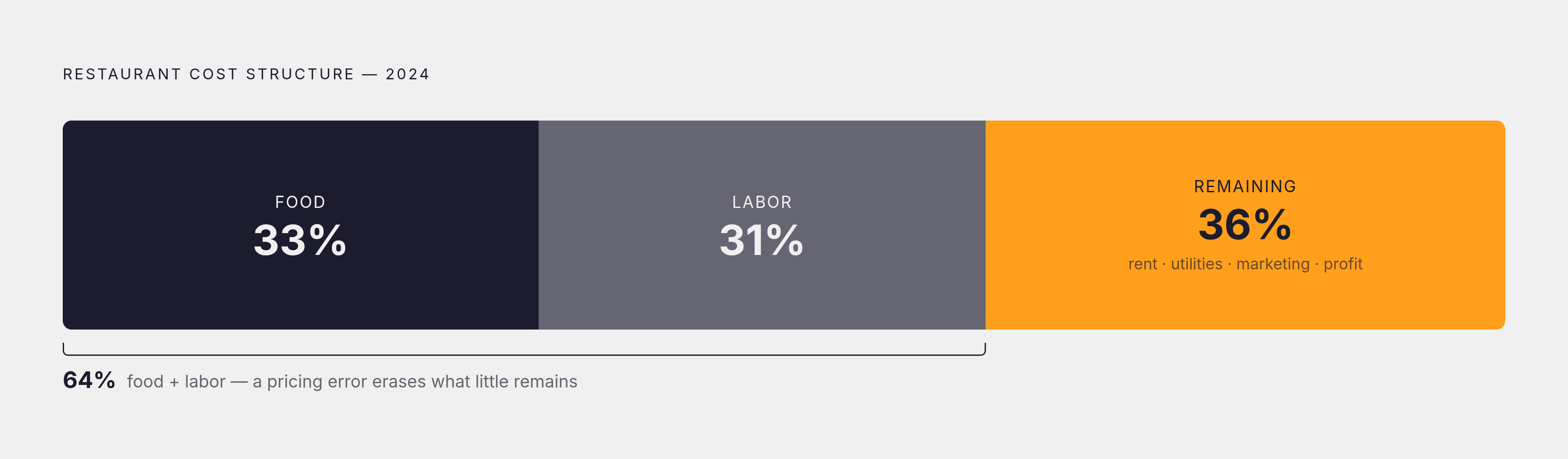
Menu pricing and demand forecasting used to run on gut feel: a manager's sense that Fridays get busy, that rain kills patio traffic, that the walk-in fridge needs restocking before a holiday weekend. AI tools now bring actual signals into that process, historical sales, weather data, local event calendars, food cost trends, so operators set prices and order inventory around what will actually sell. The stakes are not small. Food costs ate nearly 33% of total restaurant expenses in 2024, according to the National Restaurant Association, with labor close behind at 31%, leaving a thin margin where a pricing mistake or a bad inventory call turns a decent week into a break-even one.
US restaurant sales are on track to clear $1.5 trillion in 2025. That's a massive industry running on individual operators whose margins punish even small miscalculations, and the miscalculation shows up in a predictable place: forecasting, ordering, and pricing usually live as three separate jobs done by three different people looking at three different spreadsheets. A price held too low on a slammed Friday night just absorbs the extra demand without capturing any extra revenue from it. Inventory ordered on a hunch instead of a signal produces the waste that quietly eats margin all week long. Industry estimates put food waste from bad forecasting at 4% to 10% of what restaurants purchase, and on margins this thin, even small forecasting errors can move the needle on a restaurant's bottom line in a way that's hard to ignore. AI pricing and forecasting tools function as a structural patch on a genuinely leaky system.
What AI demand forecasting actually does, and why gut feel fails by comparison
Old-school forecasting runs on a manager's memory, a rough weekly average, and a hunch about the season. Those inputs miss the short-cycle stuff: a Tuesday that spikes because a concert let out three blocks away, a Wednesday that dies because it's suddenly 40 degrees and pouring.
AI forecasting models take in historical sales, weather patterns, local event schedules, delivery trends, and in some setups even social media chatter, and turn that into predictions broken down by the hour and by the specific menu item. A 2025 peer-reviewed study published in PMC modeled roughly 384 individual menu items using deep neural networks trained on historical sales and meteorological data, and hit a mean Pearson correlation coefficient of 0.7945, a solid predictive signal across a big, varied menu. The study used deep neural network architectures built to catch non-linear, time-dependent demand patterns, the kind of pattern-spotting no manager scribbling notes on a legal pad is going to replicate.
What does the model catch that the manager misses? Hot, humid days push demand toward lighter dishes; cold, rainy ones push it toward soup and anything served with gravy. Holidays and weekends nudge people toward the indulgent stuff, the stuff they order to celebrate rather than just to eat, and that shift shows up in the data predictably enough to plan around. Local events, ballgames, conventions, concerts, create demand spikes that are entirely foreseeable if the data feed includes an event calendar in the first place. The deeper value here goes beyond sharper predictions alone: all these inputs, weather, events, sales history, finally sit in one place instead of scattered across a manager's memory, a corkboard, and three different apps nobody checks.
What operators can actually do with a demand forecast — staffing, ordering, and prep
Deloitte's 2025 Foodservice Analytics Report found restaurants using predictive forecasting cut waste by up to 20% and improved cost predictability by 15% year over year. Those are not rounding-error numbers for a business running on the thin margins typical of restaurant operations.
Staffing is where the payoff shows up first. If a manager knows Thursday will run significantly heavier than Wednesday because of a stadium event two miles away, the schedule gets built around that instead of getting patched together in a panic at 4pm. Chili's rolled out Fourth IQ as its forecasting tool and reported a 20% jump in scheduling accuracy by combining sales history with outside factors like local events and weather. Bone Daddies, a restaurant group out of London, saw a 10% sales increase from AI-powered scheduling, a result that traces back to better demand forecasting rather than just smarter shift math.
Purchasing gets the same treatment. Order volume stops being a guess dressed up as a decision. Over-order and the walk-in fills with product that spoils before it sells; under-order and the kitchen is 86'ing entrees at 7pm on a Saturday, which is its own kind of revenue leak. The National Restaurant Association's Restaurant Technology Landscape Report 2024 found 76% of operators believe technology gives them a real competitive edge, and forecasting is the use case where that edge is easiest to actually measure in dollars.
Once a restaurant knows what it's going to sell, a second question shows up right behind it: what should it charge for it?
How AI-driven menu pricing works when it is done without triggering a customer backlash
AI pricing tools can shift menu prices in real time based on inventory, time of day, local demographics, and weather, surfaced through digital menu boards and apps. Done right, this is menu engineering with better data behind it: figuring out which items have room to move on price, which ones are loss leaders kept around to pull people in the door, and where a small bump goes unnoticed because the perceived value is already high.
That might mean nudging up a high-margin item a little during a period when demand is already confirmed, capturing margin on something that would have sold at the old price anyway. It might mean rotating a limited-time special priced to move inventory before it spoils. Charging more for a burger at noon on Saturday purely because the dining room happens to be packed is a different matter. That's surge pricing, and customers reject it on sight while reporters love to write about it.
The Wendy's episode is the textbook case for how framing decides the outcome, sometimes more than the mechanics do. In February 2024, Wendy's announced $20 million in digital menu board investment meant to enable real-time price updates. The announcement got labeled surge pricing within hours, and the company reversed course within days. The broader pattern is consistent: when dynamic pricing has stumbled publicly, it has tended to land at moments that compound customer frustration rather than offset it.
There's a mechanical flaw sitting underneath all of this. Raising the price right when demand peaks also means raising it right when wait times are longest and the whole experience feels worst, which reads to the customer like getting charged extra for a worse meal. Getting a surcharge for standing in a longer line pleases nobody.
What consumers will and will not accept, in their own words and numbers
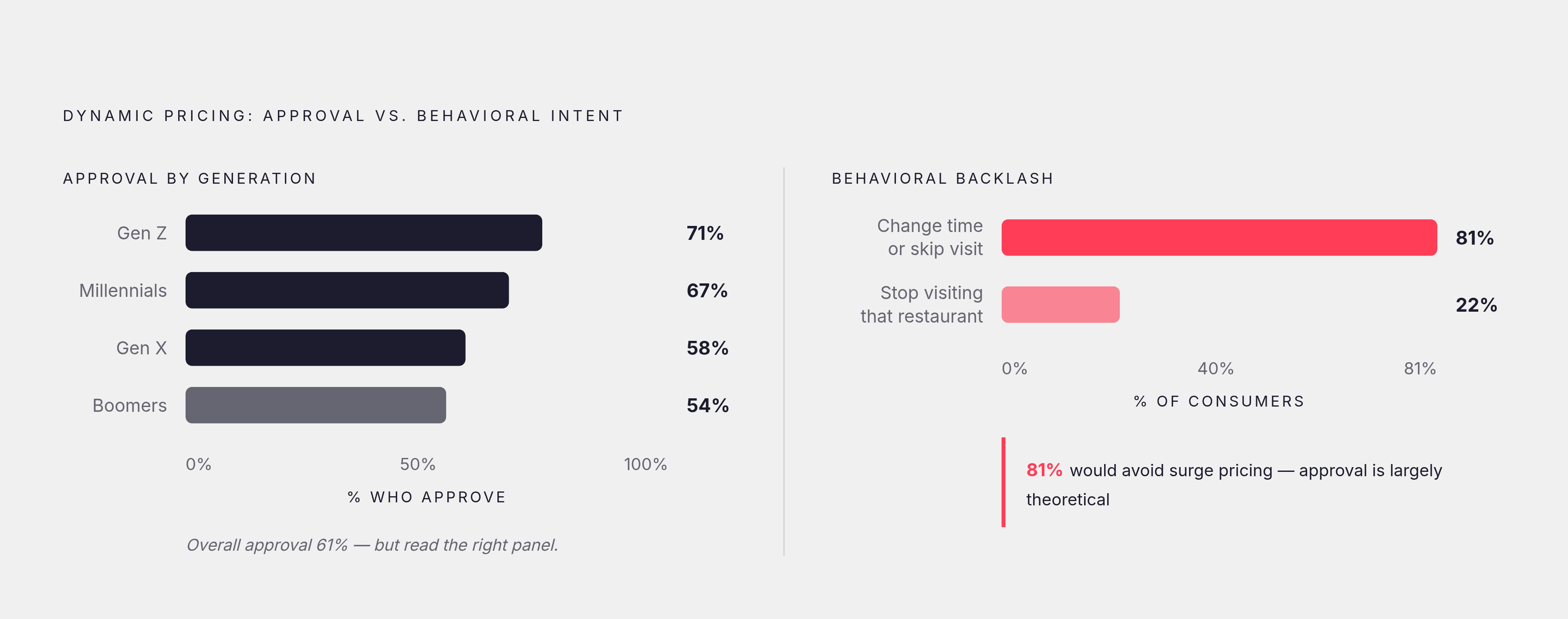
The topline number looks fine: the NRA's 2024 Restaurant Technology Landscape Report found 61% of respondents favor dynamic pricing overall. But that average papers over some real generational cracks. Gen Z came in at 71% in favor, millennials at 67%, Gen X at 58%, and baby boomers at 54%, a steady downward slope by age that says something about who grew up with surge-priced rideshares and who didn't.
HungerRush's March 2024 survey of about 1,000 US consumers tells a rougher story. Roughly 81% said they'd rather change their mealtime or just skip the restaurant entirely than pay a surge price. About 64% reacted negatively to the whole idea on its face. And separately, 22% of survey respondents said they'd stop going to a restaurant they already visit regularly if it added surge pricing, a churn number with real revenue attached for any operator whose business runs on regulars coming back week after week.
So which is it, 61% in favor or 81% ready to walk? Probably both, depending on what's being measured. The NRA number likely captures how people feel about the concept in the abstract; the HungerRush number captures what people actually do when a real price increase shows up in front of them mid-order. Younger, digitally native guests seem to have more patience for this than their parents do, but framing still matters as much as the mechanics. "Happy hour" and "early bird" pricing have been dynamic pricing for decades, and nobody's ever called them a scam, because they're framed as a reward for flexibility instead of a penalty for showing up at the busy hour.
The tools independent operators can realistically use and what they cost
For independent restaurants and small chains, the current lineup includes Lineup.ai, ClearCOGS, MarketMan, and 7shifts, all built to plug into common POS systems like Toast, Square, and Clover. Entry pricing runs $200 to $500 a month, positioned as a spend that pays for itself in weeks rather than fiscal quarters, at least according to the vendors selling it.
Several factors matter when picking one of these: how deep the POS integration goes, meaning whether it pulls real transaction history automatically or needs someone typing numbers in by hand every night. Whether it pulls in outside signals like weather and local event calendars, not just internal sales data. Whether the output is something a kitchen manager can act on directly, since a forecast trapped inside a dashboard built for data scientists isn't much use to someone trying to decide how much chicken to thaw. And scope matters too: MarketMan leans toward waste and ordering, 7shifts toward labor scheduling, Lineup.ai and ClearCOGS toward demand-to-menu forecasting. Matching the tool to the actual gap in a restaurant's operation counts for more than picking whatever has the flashiest dashboard.
Popmenu's 2026 Restaurant Trends survey found 44% of operators had already adopted some form of AI, with another 25% planning to by year's end, putting combined adoption or intent near 69%. Early adopters are quietly building something more valuable than this quarter's forecast: a data history that makes every future prediction sharper, because these models get better the longer they run on a restaurant's own numbers. The gap between early movers and everyone else is closing fast, and operators who wait aren't just missing this year's savings, they're falling behind on the training data that makes the whole system worth using.
Where pricing and forecasting data intersects with marketing — and why that connection closes the loop
Demand forecasting answers what will sell. Pricing tools answer what to charge for it. Neither one answers the question that actually matters to a marketing budget: which ad, which post, which promoted deal actually pulled a specific customer through the door on a specific night?
That's the missing link, tying a social ad, a local creator's post, or a promoted offer to an actual transaction on the POS system. Without that link, a restaurant running a promotion during a period the forecast already flagged as busy has no way to tell whether the forecast predicted those customers or the campaign created them. Multi-touch attribution is the framework built to close that gap, tracking a guest from seeing an ad through booking a table or walking in, all the way to the transaction itself. That only works if the marketing platforms and the POS system are actually talking to each other; last-click attribution alone tends to misassign credit and leads operators to cut the exact channels that were quietly filling tables.
Put it together and the payoff is straightforward: a restaurant that forecasts demand accurately, prices intelligently around it, and then traces in-store revenue back to specific ads can pour more budget into what's actually working and cut what isn't. That gap separates marketing that's profitable and repeatable from marketing that's just guesswork with a nicer dashboard. Local creator content paired with paid distribution and this kind of closed-loop tracking is turning into a strong complement to AI pricing and forecasting, mostly because it generates real demand, the same demand the forecasting model then learns to see coming next time.