Restaurant Tech Stack Essentials for Independent Operators
How to build a restaurant tech stack that actually works instead of just accumulating software.

The pattern is nearly universal, and almost no one is proud of it in retrospect. A POS gets selected under pressure, usually during the opening sprint when a vendor representative is the most persistent voice in the room. Months later, when food costs start drifting, an inventory app gets bolted on. Then a competitor down the street launches a loyalty program, so one gets purchased to match. Each decision is made in isolation, in response to a specific pain, with almost no consideration for how the new tool connects to what's already running.
I've watched this play out enough times that it stopped surprising me. The result is information silos, duplicate data entry, and staff toggling between disconnected screens during a dinner rush. A 2025 survey of more than 500 restaurant professionals by 7shifts found that roughly 3 in 10 restaurants are still juggling disconnected digital tools like spreadsheets and group texts. Only about 1 in 3 has reached the stage where POS integrations start generating real efficiency gains.
The problem in most independent operations isn't a shortage of tools. It's a surplus of disconnected ones.
That distinction matters because the fix isn't simply "buy better software." It's buy in the right order, starting from a foundation that everything else can plug into. Think of it like constructing a building: you pour the foundation first, then raise the walls that sit on it, then add the systems that run through those walls. Violate the sequence and you're not building a stack. You're accumulating subscriptions.
The POS as the Non-Negotiable Foundation Every Other Layer Connects to
Before evaluating any other system, ask one question: does this integrate with my POS? If the answer is no, the tool creates a silo by definition.
POS selection isn't really a software decision. It's infrastructure selection, the same way choosing a commercial kitchen layout is infrastructure selection. Every other tool in the stack will need to communicate with it, pull data from it, or push data into it. Get this wrong and you're not just dealing with a bad POS; you're dealing with a bad foundation for everything you'll build afterward.
More than 65% of small and mid-size restaurants now prefer cloud-based POS systems, a rate that outpaces enterprise adoption, and the independent landscape has effectively consolidated around a small number of dominant players. Square serves single-location and food-truck operators well. Toast has become the default for operators running two or three locations; the platform processed approximately 16% of all U.S. restaurant card volume in 2024, which means its integration ecosystem is broad and its third-party support is generally reliable. That's not a product endorsement. That's a network effect observation.
What operators actually prioritize when evaluating POS systems is instructive: reliability ranks first, ease of use second, price third. Feature lists rank lower. Reliability comes first. That's an operator telling you they've been burned before, probably mid-service, probably on a Saturday night.
Cost realities are straightforward: software runs between $50 and $250 per month depending on tier; hardware, including terminal, stand, card reader, receipt printer, and cash drawer, adds upward of $700 upfront. Mobile POS terminals are relevant for full-service operators where tableside ordering measurably reduces wait times and order-error rates.
One number worth sitting with: 53% of operators changed POS systems in 2025, down from 71% the year prior. That declining churn rate suggests the industry is converging toward dominant platforms and that once an operator lands on one, switching costs in staff retraining and operational disruption are punishing enough to keep them there. The practical evaluation checklist should include native integrations with inventory and scheduling tools, offline mode reliability, support response time during service hours, and contract terms. Read the contract. Especially the contract.
Adding a KDS: The First Integration That Pays Off Immediately in the Kitchen
A kitchen display system replaces paper tickets with screens that update the moment a server enters an order. Orders route to the correct station, color-code by elapsed time, and give the front of house real-time visibility into what's ready. No re-keying. No lost tickets. Kitchen order routing had reached 52% adoption by 2025, leaving nearly half the industry still running on paper.
The data dimension is underappreciated, and it compounds in ways that aren't obvious at first. A KDS accumulates prep-time records over weeks and surfaces which stations are bottlenecking service. That information exists before a busy Friday becomes a bad review. It's surfaced during the Thursday morning review of last week's numbers. For a lean team, the KDS also reduces the verbal confirmation loop between front and back of house, which is a real labor efficiency gain without adding headcount. It sounds minor until you've watched a small kitchen lose fifteen minutes of productive time per service to expediting miscommunication.
One practical consideration: KDS is most impactful when the POS integration is native or at minimum certified. A poor integration creates synchronization delays that defeat much of the purpose. Confirm the integration before purchasing the hardware.
Online Ordering and the Delivery Channel Decision That Shapes Margin for Years
By 2025, effectively all restaurants offer at least one digital ordering platform. The question is no longer whether to offer digital ordering. It's how to structure it without surrendering the economics of the business.
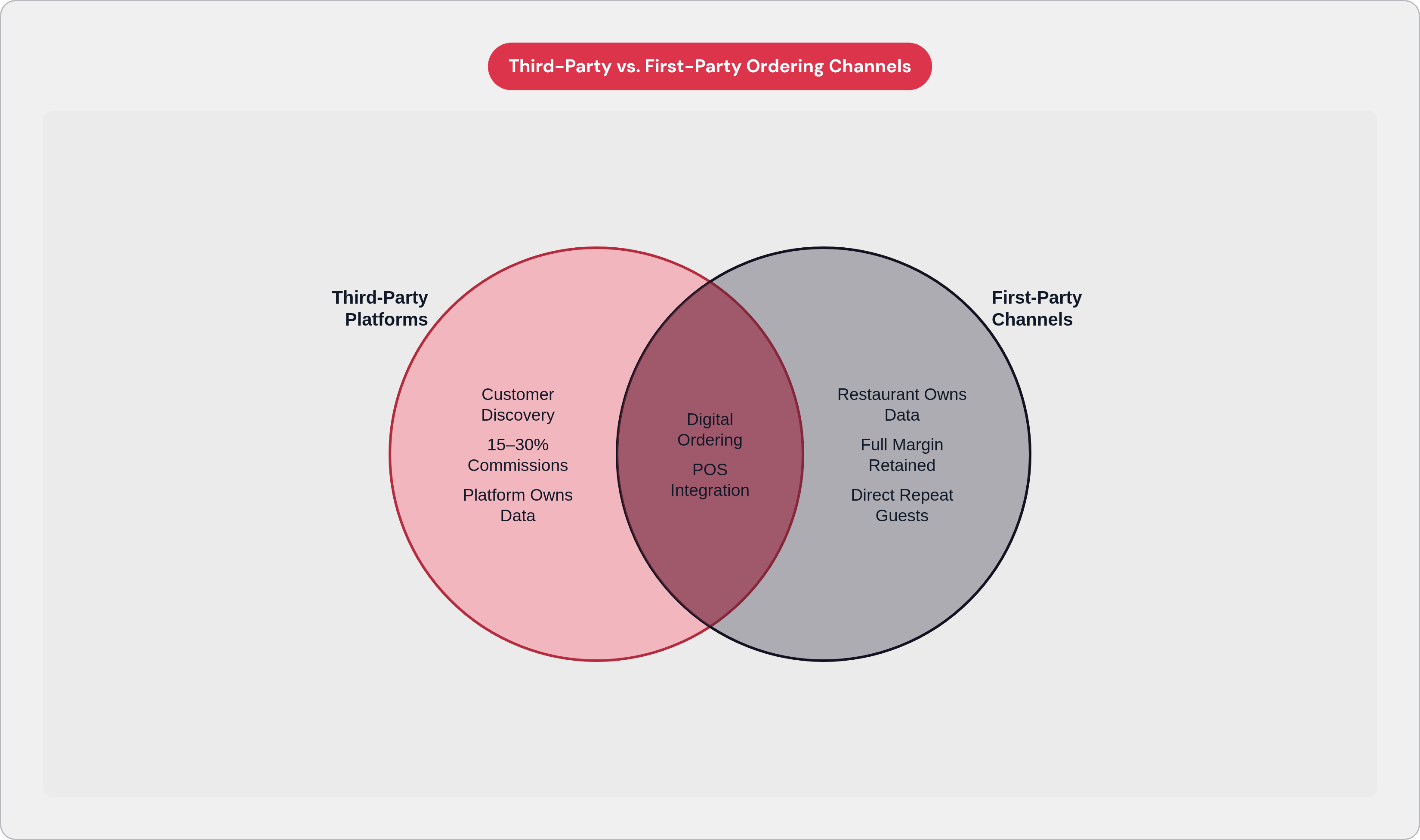
Commission rates from major delivery platforms typically run 15 to 30%, and when payment processing fees, marketing add-ons, and price adjustments are factored in, the real cost frequently climbs higher. Against a 3 to 5% net margin, giving a quarter to a third of an order's revenue to a platform doesn't merely compress the margin on that order. It eliminates it. The math here isn't subtle.
The less-discussed cost is the customer data problem. Every guest who orders through a third-party marketplace belongs to that platform. Their contact information, order history, and preferences sit in the platform's database, unavailable to the restaurant. The operator absorbs the operational cost of fulfilling the order and surrenders the relationship. That's a bad trade when taken over years.
The consensus strategy among operators who've worked through this: use third-party platforms for discovery and incremental demand among new customers, then redirect repeat customers to a first-party channel where the restaurant retains the relationship, the data, and the margin. First-party, in practice, means ordering through the restaurant's own website or branded ordering page, integrated with the POS so orders flow directly to the KDS without re-entry. That integration requirement is the sticking point. Roughly three-quarters of delivery customers report that tech-enabled ordering and payment are important when choosing a restaurant. A first-party channel that is clunky or slow relative to the marketplace experience will send customers back to the marketplace rather than migrate them.
The practical sequence: get third-party listings functioning first for reach, then invest in a first-party ordering channel integrated with the POS, then build a mechanism, whether a loyalty offer, email capture at checkout, or a receipt QR code, to migrate repeat customers off the marketplace. This is a multi-quarter project, not a single decision. Treat it accordingly.
Inventory Management: The Layer Where the Financial Return Is Most Precisely Measurable
Nearly half of operators planned to invest in inventory management software as of 2025, but fewer than a quarter currently use any form of automated inventory control. The cost of that gap is quantifiable, which is precisely what makes it so frustrating to observe.
Industry estimates suggest up to 10% of food purchased is discarded before it reaches a customer. Research published by the Champions 12.3 coalition found that for every dollar invested in systematic kitchen waste reduction, restaurants save approximately seven dollars in operating costs on average. Toast's 2025 Restaurant Trends Report found that integrated inventory management systems produce an average improvement of 4.2 percentage points in food cost. At $1.5 million in revenue, that translates to roughly $63,000 in additional annual profit. That is not a rounding error.
There is also a time argument that doesn't get enough attention. Daily inventory reviews that once required 30 to 60 minutes can run in under a minute with automated systems. For operators without a dedicated back-office manager, that's not a marginal improvement. It's operationally transformative.
Tools scaled to independent operators include MarginEdge and xtraCHEF (now part of the Toast ecosystem) for smaller and mid-size operations; Restaurant365 suits operators managing multiple locations. The integration requirement is non-negotiable: inventory software needs to pull sales data from the POS to auto-deplete stock and generate accurate reorder alerts. This is, again, a reason why POS selection upstream determines which downstream tools are even viable.
What to look for: invoice capture (preferably automated via photo or email forwarding), recipe costing tied to specific menu items, and variance reporting that flags discrepancies between theoretical and actual usage. That last feature is the one that catches theft, portioning drift, and spoilage simultaneously. It is doing three jobs at once, which is exactly what tools in a lean operation need to do.
Labor Scheduling Software and Why It Belongs in the Stack Before Operators Think They Need It
Labor represents 30 to 35% of total operating costs, and scheduling inefficiency alone accounts for a meaningful portion of that figure in restaurants operating without automated systems. The 7shifts 2025 Restaurant Workforce Trends Report places the inefficiency cost at 3 to 5 percentage points of labor spend for operators scheduling by intuition and spreadsheet. That number sounds abstract until you apply it to a real payroll.
The turnover problem compounds the scheduling problem in ways that are easy to underestimate. Restaurant annualized turnover runs close to 80%, according to Bureau of Labor Statistics data for the leisure and hospitality sector. The NRA estimates replacement cost at roughly $5,864 per hourly employee. A scheduling tool that improves schedule quality, reduces short-notice callouts, and creates more predictable week-to-week patterns functions as a partial retention mechanism. It's not glamorous, but neither is posting a job listing for the fourth time in six months.
What scheduling software actually does that a spreadsheet cannot: it pulls sales forecasts from the POS to right-size shifts before the week begins rather than after, tracks overtime thresholds automatically, and handles compliance requirements around minor labor laws and mandated break intervals that an overloaded shift manager will eventually miss. Toast data suggests that restaurants integrating POS forecasts into scheduling reduce idle-labor costs by 15 to 25% compared to intuition-based scheduling.
The tool landscape for independents is reasonably differentiated. Homebase offers a strong free tier for single-location operators and consolidates scheduling, time tracking, and hiring into one interface. 7shifts is built specifically for restaurants, with POS-integrated labor forecasting and separate department handling for kitchen and front-of-house scheduling. Sling carries a generous free plan for teams up to 30 users. HotSchedules and Fourth are better suited to larger independent groups than to single locations. The average monthly tech spend on scheduling tools in 2025 was roughly $196. That is a modest number against the labor cost it is managing.
Reservations and Table Management: When the Layer Is Worth Adding and When It Isn't
Not every independent needs this layer, and that is worth stating plainly before the vendor pitches start. Counter-service and fast-casual operators can skip it entirely. It becomes consequential for full-service operators managing covers and turn times, where the no-show problem creates recoverable revenue loss.
No-show rates at independent restaurants without automated confirmation and reminder sequences average somewhere between 15 and 20%, based on commonly cited industry estimates. A well-implemented reservation platform can cut that to the 5 to 8% range. At meaningful cover volume, that's directly recoverable revenue, not an abstraction.
But operators should evaluate these tools with clear eyes about what they've become. American Express acquired both Resy and Tock (the latter for $400 million in 2024); DoorDash acquired SevenRooms for $1.2 billion in 2025. These are no longer neutral booking utilities. They are distribution channels with their own economic interests in the guest relationship, and the guest data question deserves explicit scrutiny before signing anything. Does this platform share diner data with the restaurant, or does it retain that data for itself? The answer to that question changes the calculus considerably.
OpenTable's market share among top U.S. cities declined from 51% to 46% between 2022 and 2024 but remains the plurality leader in most markets. Resy has grown strongly in certain urban markets. Toast Tables captured 5% of market share by mid-2024, with a notable share of its users being first-time reservation platform users, suggesting it's pulling operators who were previously running without any system at all.
Table management features that generate returns at volume include waitlist automation, turn-time tracking, and server section assignments that connect to POS splits. Below a certain weekly cover threshold, these features are solving a problem the operation doesn't yet have.
Guest Marketing Tools: The Layer That Turns Transaction Data Into Repeat Revenue
More than three-quarters of restaurant operators believe technology gives them a competitive advantage, according to NRA survey data. Fewer than 15% are satisfied with their current tools. That gap is sharpest in marketing and loyalty, where tools are frequently bolted on without a clean data connection to the systems that actually know what guests ordered and how often they return.
That is the core failure mode. A loyalty program without a real data foundation is just a punch card with a monthly subscription fee.
The foundation of any guest marketing layer is a contact database the restaurant actually controls. First-party ordering channels, receipt QR codes, and checkout email capture are the mechanisms for building it. Without that database, no marketing tool in the stack has anything to work with.
What integrated loyalty actually looks like in operation: a purchase triggers a points update, which triggers a targeted offer when spend drops off, all without manual intervention from a manager. For most independents, the realistic starting point is a points economy requiring a dedicated app. It's email capture, a basic email platform (many POS providers include one at the base tier), and a simple frequency-based offer. Start there. Expand when the database is large enough to make the investment defensible.
Tools worth evaluating at independent scale: Toast Marketing for operators already on Toast, Mailchimp for basic email at any POS configuration, and Thanx or Paytronix for operators at higher volume who want more structured loyalty infrastructure. Feastalytics, a restaurant analytics platform that unifies POS, delivery, and marketing data to tie promotions and campaigns directly to in-store sales revenue, is another option for operators who want to know which specific offer drove which dollars. Keep the tool count low and the integration tight. Standalone apps that require guests to download a separate experience are designed for brands with the marketing pull to demand that behavior. Most independents lack that pull, and the ones that think they have it are usually wrong.
How to Sequence the Build and What to Skip Until the Operation Is Ready for It
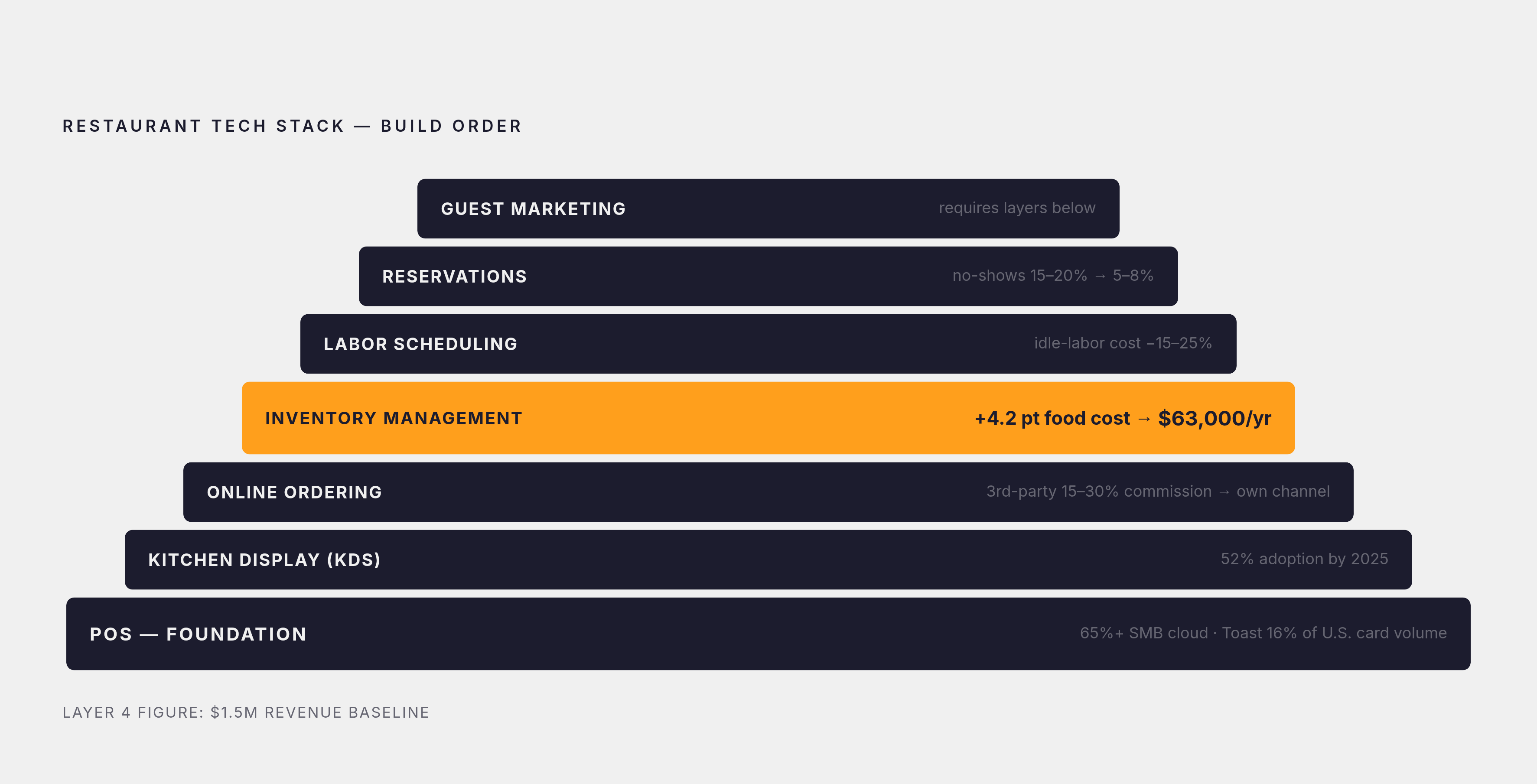
The 7shifts adoption maturity model maps reasonably well onto the independent experience: from paper and gut instinct, through disconnected digital tools, through integrated restaurant-specific software, toward a fully integrated, data-driven operation. Most independents should aim for the third stage before optimizing anything. The fourth stage is a goal, not a starting condition.
Here is the honest sequence, with the caveats that follow.
POS comes first, and no other decision is more consequential. Every subsequent layer integrates with it. Selecting incorrectly here means either tolerating poor integrations downstream or absorbing the disruption of a mid-operation platform switch. Neither is a good use of a Tuesday.
KDS comes second, for any full-service or higher-volume operation. The payback is immediate, the prep-time data it generates becomes useful input for later layers, and if you've bought within the same POS ecosystem, the integration is usually native.
Online ordering and delivery channel strategy comes third. Get third-party listings active first for reach, then build the first-party channel, then build the mechanism to migrate repeat customers off the marketplace. This layer shapes margin for years in either direction, which is why it belongs early even though most operators treat it as an afterthought.
Inventory management is fourth. The financial return here is the most precisely measurable of any layer. Operators who skip it are subsidizing inefficiency with cash they cannot afford to spare.
Labor scheduling belongs fifth, and earlier than most operators install it. The POS-integrated forecasting capability is what separates it from a digital spreadsheet.
Reservations and table management are sixth, for full-service operators past a meaningful cover threshold. Counter-service operations can generally skip this layer without consequence.
Guest marketing is last, and it only works if the previous layers have built a first-party database. Installed before that foundation exists, it has nothing to work with.
What to skip, full stop: any tool that fails to integrate with the POS, any loyalty platform requiring a standalone app download at the independent scale, and any enterprise-grade system whose implementation assumptions include an IT department or a six-month runway.
That said, consider the sequence a set of guiding principles rather than a rigid prescription. A specific operator's acute pain might demand installing inventory management before a KDS. A reservation problem might be severe enough to justify skipping ahead. The underlying logic is what matters: every tool in the stack should extend the data that the tools below it generate, and no tool should create a new silo. That principle doesn't change based on who the vendor is or how persuasive their sales cycle is. Violate it and you end up exactly where most independents started — with a stack nobody designed, subscriptions nobody remembers approving, and the clipboard still on the shelf.
It remains because it's the only system in the building that never lost its integration.