Structuring Creator Partnerships for Restaurants
Restaurants need formal agreements with creators, not just comped meals and hope.

There is something mildly absurd about the fact that a restaurant can spend years perfecting a ragu, sourcing heritage pork, training a front-of-house team to narrate the dish with genuine enthusiasm, and then hand a plate of it to someone with a ring light and 40,000 followers, shake hands, and call it a marketing strategy. No deliverables. No contract. No way of knowing whether anyone who watched the post ever made a reservation. Just vibes, and a comped osso buco.
That is not an influencer partnership. That is a dinner with optimism attached.
The distinction matters more now than it did even two years ago. According to Influencer Marketing Hub's 2025 report, 72% of influencers now use formal rate cards, which means the casual gifting arrangement that once passed for a campaign is increasingly misaligned with how working creators actually operate. And the scale of creator activity in food has made this a competitive landscape: per CreatorIQ, more than 437,000 creators posted about food and beverage brands more than 1.2 million times in the first half of 2023 alone, generating $4.8 billion in earned media value. Restaurants are not just reaching out to creators. They are competing for the credible ones.
What separates the restaurants winning that competition from those leaving money on the table is structural clarity, established before any outreach begins. Clear deliverables, compensation aligned to output, and content expectations both parties can hold each other to. The rest of this piece works through exactly what that structure looks like, from choosing the right creator to measuring whether any of it worked.
Stop Leading With Follower Count: Choosing the Right Creator Tier
Follower count is a seductive metric because it is easy to read. The problem is that it answers the wrong question. The right question is: will this creator's audience actually show up at my restaurant? Those are meaningfully different queries.
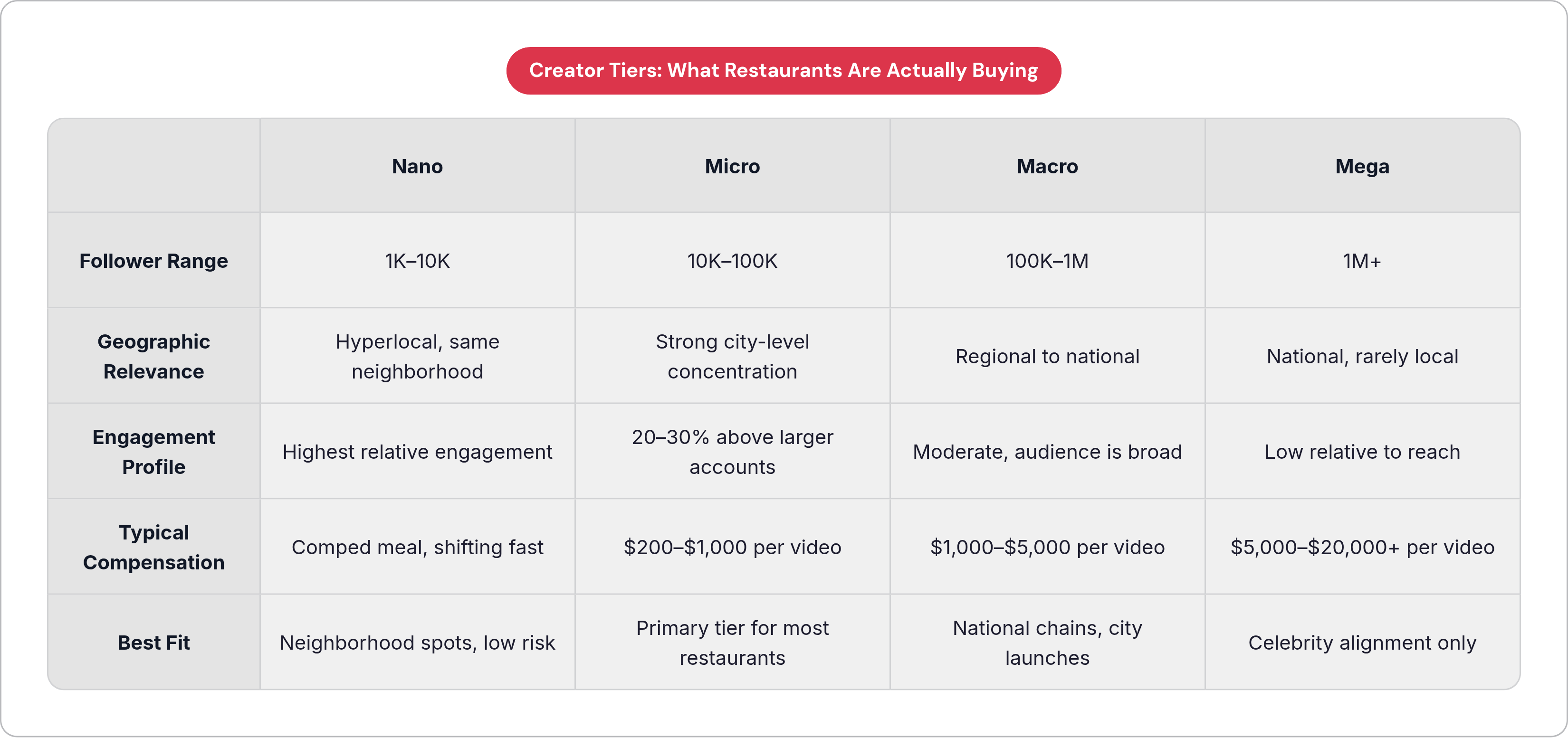
Practitioners commonly organize creators into five tiers. Mega creators, defined as those with more than one million followers, tend to be celebrities or near-celebrities. Their reach is enormous; their connection to any specific city or neighborhood is usually not. For a single-location or regional restaurant, the economics rarely resolve in your favor. Macro creators, between 100,000 and one million followers, present a similar geography problem at a lower price point. They can generate impressive national visibility; they cannot reliably drive a Tuesday dinner rush in Nashville.
Micro creators, generally 10,000 to 100,000 followers, represent the strongest starting point for most restaurants. The research here is reasonably consistent: micro-influencers tend to deliver 20 to 30 percent higher engagement per follower than larger accounts, because the relationship between creator and audience remains personal enough to carry weight. Nano creators, between 1,000 and 10,000 followers, go further still. Their audiences frequently live in the same neighborhood as your restaurant. Compensation at this tier can still be meal-based, though even that is shifting.
Food bloggers and YouTubers occupy a distinct category, not because of follower count, but because the format operates differently. Long-form content builds trust more slowly, but the content longevity changes the cost-per-impression calculation over time in a way short-form social does not.
That raises an important question: if geography often matters more than scale for local restaurants, why do so many still lead with reach as the primary filter? Partly because reach is measurable at a glance and geography requires actual research. But the industry's own behavior has already answered the question. National chains redistributed budget in 2024 and 2025 away from macro food creator campaigns toward city-specific micro creator activations. A brand that once spent its full creator budget on two macro accounts increasingly distributes that same budget across dozens of local micro creators in specific metro areas. The logic is not complicated. It is just slower to permeate downward to independent operators.
Two additional screening criteria deserve weight before a single outreach email goes out: niche alignment and content aesthetic. Creators in health, wellness, and plant-based spaces command rate premiums of 30 to 50 percent above general food benchmarks, which affects budget allocation before any conversation happens. And a creator whose feed is moody, high-contrast, and urban will produce content that looks foreign on a warmly lit family trattoria's Instagram page. Aesthetic misalignment is not a creative preference; it is a brand coherence problem.
Practical screening criteria, in descending order of importance for most restaurants: audience location concentration, engagement rate relative to follower count, content tone and aesthetic alignment, and whether the creator has covered comparable restaurants before.
What Creators Actually Cost in 2025–2026, and Why Format Changes Everything
The honest range, to anchor expectations: restaurant influencer content runs from a comped meal at the nano tier to more than $20,000 per video at the mid-tier. The question is not what that costs; it is what it buys, and whether the format you are purchasing matches the outcome you need.
On TikTok, the 2025 and 2026 benchmarks break down roughly as follows: nano and smaller micro creators in the 10,000 to 100,000 range typically charge $200 to $1,000 per video; mid-level micro creators between 100,000 and one million followers run $1,000 to $5,000 per video; and mid-tier accounts between one and ten million followers command $5,000 to $20,000 per video. Collabstr's marketplace data, drawn from more than 860,000 influencers, puts the average food and drink influencer rate at $170 for a sponsored post across social platforms in 2026. That figure is useful as a floor benchmark, not a target; it flattens meaningful differences across platform and format.
Format creates pricing differentials that restaurants consistently fail to factor in at the outset. Video, whether Reels, TikToks, or YouTube Shorts, typically commands two to three times the price of a static post, reflecting actual production complexity. Carousel posts often cost 20 to 30 percent more than single static posts. YouTube productions cost more upfront than any short-form format, but the content longevity changes the cost-per-view math over a longer horizon.
One line item most restaurants miss entirely: usage rights. They are priced separately from the post itself, and the difference is not trivial. Licensing a creator's content for paid advertising, running their footage as a Meta ad for three months, typically adds roughly 40 percent to the base rate. A full perpetual worldwide buyout can add approximately 150 percent. Why does this matter? Because a restaurant that negotiates usage rights upfront can take a creator's best-performing clip and run it as performance creative in paid social, turning a one-time partnership into an ongoing advertising asset. Restaurants that do not negotiate usage rights are leaving that option on the table, often permanently, since going back to renegotiate after the fact is awkward and frequently more expensive.
Nano creators may still accept a meal in exchange for a post, but this is increasingly the exception among creators with solid engagement or high-production-quality content. And there is a pricing dynamic worth noting before moving on: long-term partnerships typically justify a 15 to 30 percent discount on per-post rates, a dynamic that sets up a broader argument for how restaurants should be structuring these relationships in the first place.
The One-Off Model Is Structurally Underselling the Channel
Here is what a one-off campaign actually produces: a post, and then silence. The creator's audience hears about the restaurant once, engages with the content in whatever way their algorithm allows, and moves on. The restaurant gets a momentary impression in a feed that updates every hour. That is not nothing. It is also not a sales channel.
The data on this point is fairly clear. Long-term creator partnerships yield meaningfully higher engagement than one-off campaigns, and ambassador programs produce cost-per-acquisition figures that are substantially lower compared to equivalent one-off campaigns over comparable time periods. The market has moved accordingly: per Afluencer, 73% of brands were using ambassador programs in 2026, up from 51% in 2024. That is a 43% increase in two years. Brands are not adopting ambassador structures because they are trendier. They are adopting them because the economics are more defensible.
The mechanism is not mysterious. Creators accept reduced per-post rates in exchange for guaranteed multi-month income. The restaurant gets a lower effective cost per impression across a larger body of content. Both sides benefit from the predictability. More importantly, a creator who has visited the restaurant four times over six months is a credibly different spokesperson than one who visited once for a paid post. Audiences register this distinction intuitively, even when they cannot articulate it.
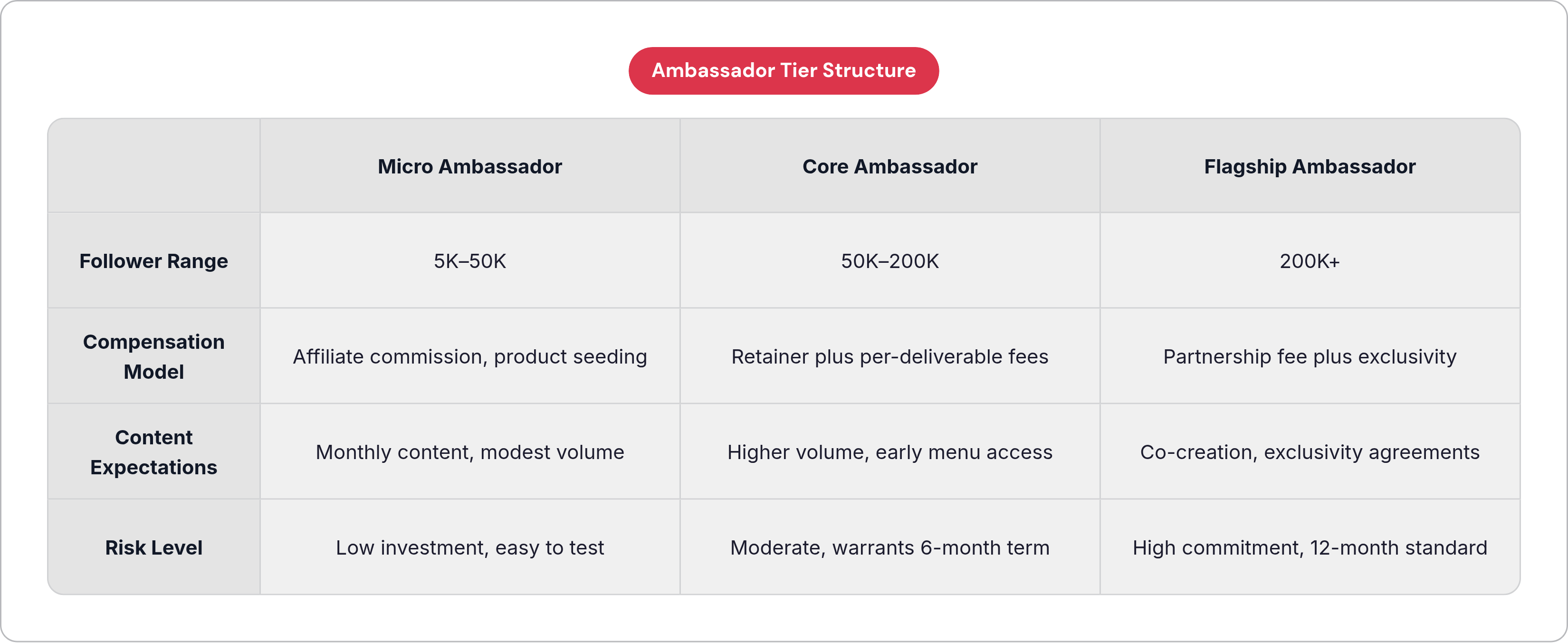
But what if a restaurant is not ready to commit to a six-month program with someone they have never worked with? That is a fair objection. Which is why a practical tiering model helps. Micro ambassadors, those in the 5,000 to 50,000 follower range, can be structured around monthly content commitments, affiliate commission, and product seeding; the investment is modest and the risk is low. Core ambassadors in the 50,000 to 200,000 range warrant higher content volume, early access to new menu items, co-creation opportunities, and performance bonuses. Flagship ambassadors, 200,000 followers and above or those with high strategic value in a specific market, justify partnership fees, exclusivity agreements, and meaningful creative collaboration.
The compensation structure that holds up best in practice combines a monthly retainer with per-deliverable fees. The retainer covers ongoing brand alignment, event attendance, exclusivity, and the general always-on commitment. The per-deliverable fees ensure that payment tracks actual content output rather than a flat amount regardless of what gets produced. On contract length: three months is the minimum for a relationship that can reasonably be called an ambassador program; anything shorter is a multi-post campaign with a better title. Six months is the most common term for core ambassadors. Twelve months is standard for flagship relationships with significant compensation packages. For any first-time relationship, three months is the right starting point; evaluate fit before extending.
The Contract Is Not Bureaucracy, It Is the Partnership
The most common failure modes in restaurant-creator partnerships share a structural cause: ambiguity established at the outset. Missed posts, last-minute cancellations, content that misrepresents the restaurant, disputes over who owns the footage. Every one of these is preventable with written terms that both parties confirmed before anyone picked up a camera.
Six components are consistently recommended by practitioners who have worked through enough of these breakdowns to know which clauses matter.
Deliverables and timeline. Specific post types, quantities, platforms, and due dates, confirmed in writing before the creator visits. Not a general understanding; specific commitments. Vague agreements do not just create disputes; they create disputes in which neither party is clearly wrong.
Content expectations. Type of posts, frequency, key messages, tone, and any mandatory elements such as dish names, location tags, and booking links. The purpose of specifying these early is not to control the creator's voice; it is to ensure they have the information they need to produce the right content rather than revising after the fact.
Compensation and payment timing. Define payment milestones explicitly. For ongoing partnerships, monthly invoicing or milestone payments tied to content delivery are appropriate. Include a non-delivery clause: if deliverables are not posted within a defined window, payment may be withheld or rescheduled. Include a kill fee of roughly 30 to 50 percent of the agreed amount if the brand cancels; this protects the creator's time and preserves the relationship, which is worth protecting.
Usage rights. Negotiate upfront. Define duration, platforms, and whether the creator retains the right to use the content in their own portfolio. Clarity here prevents the situation where a restaurant wants to run a creator's clip as a paid ad and discovers the rights were never discussed.
Exclusivity. For ambassador programs, the retainer covers a competitive exclusivity expectation. Define what "competitor" means specifically, not just "other restaurants," since that is unworkable. Other pizza concepts in the same metro is a defensible definition. Every food establishment within ten miles is not.
Confidentiality. Covers recipes, supplier relationships, pricing structures, and unreleased menu items. This is the clause that feels unnecessary right up until it is necessary.
Per Sprout Social's 2025 Influencer Marketing Report, 65% of influencers prefer being brought into strategy conversations early rather than receiving a rigid brief. A contract that includes a collaborative brief development step tends to produce better content and fewer revision cycles. That finding is worth building into the process, not just the contract.
One practical note: for nano and micro partnerships, a detailed email confirmation covers most of these points adequately. A formal contract is standard from the micro-tier upward and for any ambassador arrangement.
FTC Compliance Is Not Optional, and the Penalties Make That Clear
The FTC revised its Endorsement Guidelines in 2023 to clarify what counts as an endorsement and how material relationships must be disclosed. These rules apply to restaurants, creators, and any agencies involved. Liability is shared across all three parties. That is worth sitting with for a moment, especially for operators who assumed compliance was the creator's problem.
The current civil penalty sits at $53,088 per violation as of mid-2026. A separate August 2024 rule banning fake reviews carries fines of up to $51,744 per incident. These are not negligible numbers for most independent restaurants.
What the rules require in practice: any material connection triggers the disclosure requirement. Financial compensation, gifted meals, discounts, and personal or family relationships all qualify. A comped dinner is sufficient. Platform "Paid Partnership" labels alone are no longer sufficient; disclosure must also appear in the caption, in verbal delivery for video, and in visual elements as appropriate. "#ad" buried at the end of a caption does not meet the standard. Disclosure must appear early and be legible without any effort from the viewer. For video content, the disclosure should be spoken aloud and appear as on-screen text, not relegated to the description.
The practical implication for contracts: the disclosure requirement should be written explicitly into every creator agreement, specifying the required language, placement, and format. This documentation is the restaurant's evidence that it instructed the creator to comply.
The fake-review rule adds a related due-diligence obligation. Brands should not work with creators who have purchased followers or engagement, both because inflated metrics make the partnership economically unsound and because doing so exposes both parties to regulatory risk. Vetting for follower authenticity before signing is no longer optional diligence; it is a compliance step.
How to Brief Creators So the Content Actually Does Something
Platform choice should follow content type, not the reverse. TikTok is discovery-driven; the algorithm can surface a smaller creator's video to audiences far beyond their follower count. A single well-executed food review can generate same-week foot traffic in a way that few other formats can match. Instagram's Reels function similarly for reach; carousels work better for detail and longer consideration cycles; Stories are appropriate for time-sensitive offers. YouTube's higher production cost is justified when the restaurant wants content that continues generating views months after publication, better suited for awareness than immediate conversion.
A strong brief specifies which dishes to feature and why, the restaurant's current priority (new menu launch, weekend reservations, online ordering), the call to action (a reservation link, a promo code, a story swipe-up), and any brand constraints on tone or visual style. What a strong brief does not do is over-script. As noted above, 65% of influencers prefer early involvement in strategy over a rigid brief. Over-prescribing language and shot lists produces content that reads as an ad rather than a recommendation; audiences recognize that distinction, and the conversion rate reflects it.
It is also worth considering what actually converts. The most effective restaurant content tends to be unscripted reactions, genuine favorites from the menu rather than the most photogenic items, and honest framing rooted in the creator's real experience. More than 80% of diners research venues through social recommendations before deciding where to eat; the brief should be designed so that someone who finds the content while researching has enough information to act, including a clear visual of the food, the location, and a frictionless next step.
Build conversion mechanics into the brief from the start: unique promo codes, trackable reservation links, or "mention this post" offers at the point of sale. These are what turn impressions into outcomes that the restaurant can actually account for.
Measuring Whether It Worked, and What to Do Next
The metrics that matter depend on what the restaurant said it was trying to achieve at the outset. This is where the earlier structural work pays off. If the deliverables were specified and the brief included conversion mechanics, measurement is relatively straightforward. If neither of those things happened, measurement is an exercise in retrofitting meaning onto ambiguous data.
Distinguish between awareness metrics, things like impressions and reach, and conversion metrics: promo code redemptions, trackable reservation link clicks, walk-in customers who cite the content, and direct revenue tied to a specific campaign window. Awareness metrics tell you how many people saw the content. Conversion metrics tell you how many of them did anything about it.
For ongoing ambassador programs, engagement rate over time is a meaningful signal. A creator whose engagement on restaurant content is consistently strong and whose audience is asking follow-up questions in the comments is generating a qualitatively different outcome than one whose posts perform adequately but generate no downstream conversation. Both matter; they measure different things.
What to do with the data: feed it back into the next brief. Which dish generated the most engagement? Which call to action produced the most link clicks? Which creator tier delivered the lowest cost per trackable conversion? Feastalytics, a restaurant analytics platform that unifies POS, delivery, and marketing data to tie specific campaigns to in-store revenue, is one tool built to answer exactly that kind of question. The value of structured partnerships is not only that they produce better individual outcomes; it is that they generate data that compounds across relationships and over time. A restaurant running its fifth ambassador program has a meaningful informational advantage over one running its first.
One-off campaigns, by contrast, generate a data point. A data point is not an informational advantage. It is just a number with insufficient context to act on.
That, more than any single metric, is the argument for structure. The comped osso buco is a fine dinner. The ambassador program is a sales channel. Restaurants serious about the channel should build it like one.