Crafting High Converting SMS Copy for Restaurant Offers
Open rate won't tell you which SMS messages actually drive revenue for your restaurant.
Restaurants text customers because texts get read, full stop. What almost nobody measures is what happens after the read, and that's exactly where most SMS programs quietly rot even while the open-rate number looks fantastic on a slide.
Email gets skimmed and archived. A social post scrolls by in two seconds, and paid ads get the blind eye that decades of banner fatigue trained into every phone owner alive. SMS breaks that pattern structurally: open rates run 90 to 98%, and most consumers check a text within five minutes of it landing, because a text sits on the lock screen the way an email never gets the chance to. Nearly four in five consumers opted in to receive business texts before the first campaign ever went out, which means the yes came before the ask.
Every restaurant on the block has the same 160 characters and the same opt-in mechanics, so reach stopped being the differentiator a while back. What separates a text that sells out Friday night from one that gets swiped away is craft: the structure of the message, who it's sent to, when it lands, and whether anyone bothered to connect the send to what happened at the register. Most restaurants optimize the wrong number, at the wrong moment, for the wrong guest, and open rate is usually the culprit sitting at the top of that mistake.
The vanity metric that makes SMS look better than it is
Open rate measures visibility, and treating it as the headline metric is the fastest way to misread a campaign, along with the single worst habit an SMS program can pick up.
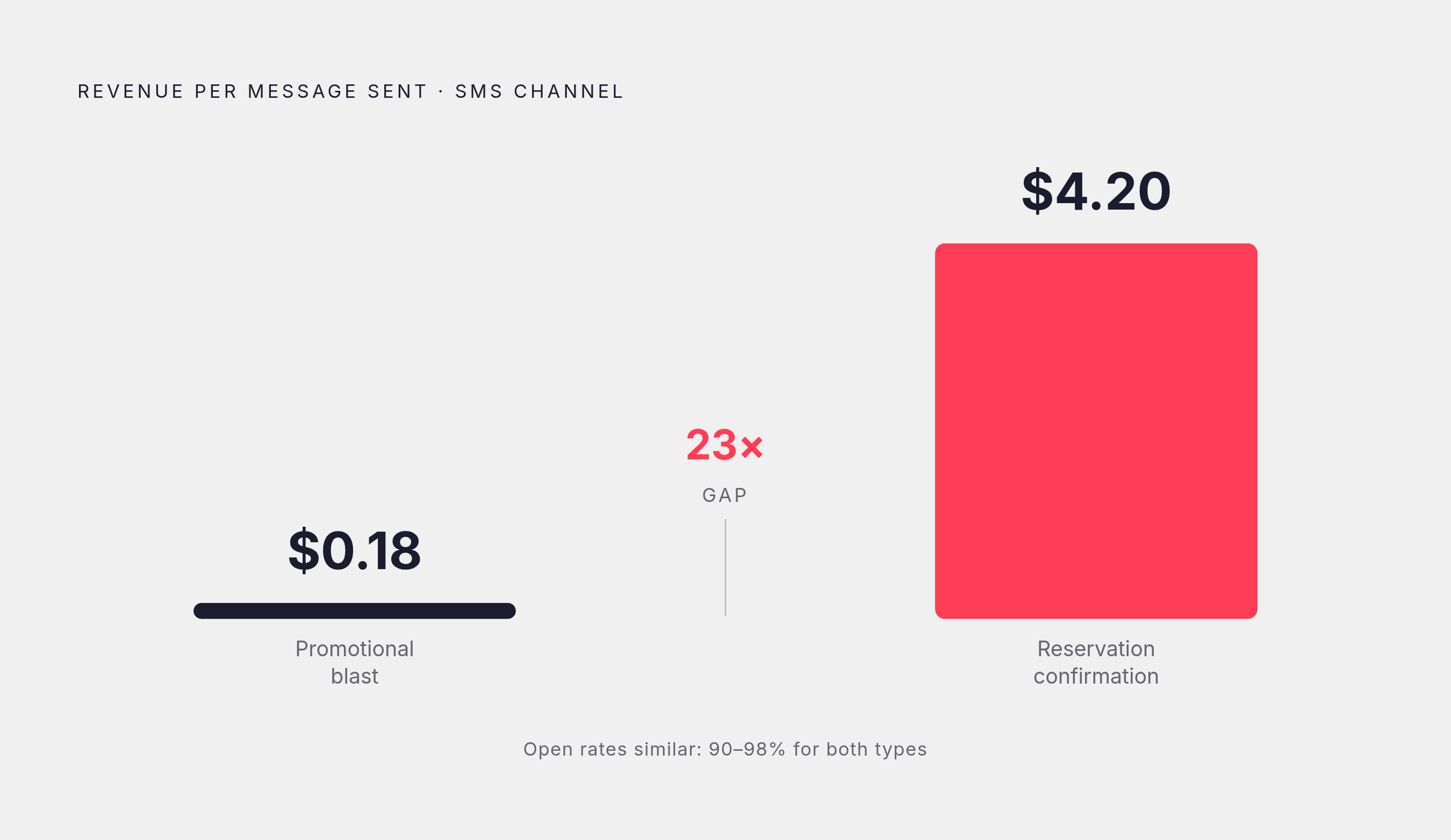
Here's the tell: a promotional blast can post a 93% open rate and still generate roughly $0.18 per message sent. A transactional confirmation text, the standard "your table is booked for 7pm" kind, generates around $4.20 per message. Same channel, same phone, similar open rate, and a 23x gap in value that open rate never once hints at. Report open rate alone to an owner and both campaigns look like wins. The number can't tell a hit from a miss, and it was never built to.
Conversion gets closer to the truth, though it still isn't the finish line. Transactional messages convert at 30 to 50% because the recipient already wants the information inside. Promotional campaigns land at 3 to 8%, cold prospecting drops below 2%, and hospitality promotions specifically sit around 9%, a touch better than general retail promo but nowhere near what a confirmation text does without trying.
Revenue per message should anchor the whole operation. Everything else, copy structure, segmentation, send time, offer type, only matters in service of it. Open rate answers "did the phone light up." Revenue per message answers the only question that pays rent, and any restaurant still leading its reporting with open rate is measuring the wrong end of the transaction.
The structural principles behind SMS copy that actually converts
Start with character count, since the medium enforces its own discipline whether the writer likes it or not. The functional window sits between 75 and 160 characters; past that, messages fragment across screens or read like an unsolicited legal notice.
One idea, one offer, one action. That's the entire architecture of a text that converts, and stacking two offers into a single message is the most common way restaurants sabotage their own send. A recipient asked to choose between two offers frequently chooses neither, which is worse than picking the weaker one outright.
Specificity does work that adjectives can't. "Braised short rib, half price tonight only" proves a human wrote it about an actual dish. "Check out our weekend specials" could have been copy-pasted off any restaurant's Instagram since 2019, and reads exactly that way. Vagueness reads as a blast; specificity reads as a message meant for the person holding the phone. Name the restaurant clearly, too, since most people don't remember saving the number.
The call to action needs exactly one verb: Reserve. Reply YES. Show this text. A fork in the road slows people down instead of moving them forward.
Urgency only works when the deadline is real. "8 seats left for Friday" is urgency. "Offer ends at 6pm" is urgency. "Limited time only!" with nothing behind it is noise, and recipients figure that out fast. Once they do, they stop trusting the real deadlines too, because the channel has now trained them not to believe any of it. Fake urgency doesn't fail once and disappear; it poisons every send that follows. Recipients tune out messages they find irrelevant, and a countdown with nothing behind it counts as irrelevant the moment someone notices the pattern.
Compliance belongs in this section, because a blocked message converts at exactly 0%. Opt-in has to be real, opt-out instructions need to stay visible, and carriers flag alcohol mentions aggressively enough that "discounted margaritas" can tank deliverability for an entire send. A brilliant offer that never lands is indistinguishable from no offer at all, and restaurants that treat compliance as an afterthought find that out the hard way, usually mid-campaign.
How personalization and segmentation change what a message is worth
Segmentation is the biggest lever after the copy itself, and skipping it is the second most common way restaurants leave money on the table. Segmented campaigns see an 83% increase in engagement over blasts sent to the whole list at once. That's the gap between a campaign that covers the cost of the platform underneath it and one that quietly doesn't.
First-name personalization alone lifts conversion by 19%. Layer in behavior-based personalization, meaning the offer matches what someone actually ordered or how long it's been since their last visit, and conversion climbs toward 16% overall. Birthday and occasion campaigns redeem at a rate 20% higher than generic offers, and guests celebrating something specific spend 23% more per check. A message matched to an actual moment in someone's life reads as the restaurant remembering them; a blast reads as the restaurant remembering it has a phone number. That difference lands very differently once it hits someone's pocket.
Four segments carry most of the useful work here, and treating them identically is where segmentation efforts usually fall apart. Lapsed guests, meaning anyone who hasn't visited in 60 days or more, need a win-back message built around absence rather than discount. Loyal regulars need exclusivity framing, closer to "for our best guests only" than a coupon code. Reservation holders need confirmation copy with a soft upsell attached. Birthday-month subscribers need occasion framing tied to the actual date, not a vague "this month" gesture.
Sequencing matters beyond SMS alone, too. An SMS sent as a follow-up to an email boosts conversion by 27%, which suggests the two channels work in relay, with SMS handling the leg that actually closes the loop.
When to send and how often before the unsubscribe rate climbs
Timing follows the decision, not the clock. A lunch offer sent mid-morning catches someone before their midday plans have hardened. A dinner offer sent mid-afternoon catches them before the evening's already spoken for. Early morning and late evening sends carry real cost, since they read as intrusion, and intrusion gets punished with an unsubscribe rather than a shrug.
Frequency is where restaurants quietly torch their own lists, and this is the part most operators get backwards: more sends doesn't correlate with more revenue, and often tracks with a faster path to the unsubscribe button. Opt-out rates sit between 0% and 1.5% per send when frequency and relevance both hold, with the overall average under 3.5%. That average hides the operators sending a weekly blast regardless of whether there's anything worth saying, and those lists bleed subscribers fast.
There's no universal ceiling on how often is too often. The real test is a question asked before every send, not after the unsubscribe count comes in: would this specific message feel like a value to the person receiving it, or a nuisance? Anyone who can't answer that in one sentence shouldn't be sending yet.
Special events earn a slot that routine promos don't. A wine dinner, a chef's tasting, a seasonal menu launch: these carry a natural ceiling on seats and a real date attached, so the urgency in the copy is honest instead of manufactured. Recipients can tell "8 seats left for the tasting menu Thursday" apart from "limited time only," even if they couldn't explain exactly why.
Copy patterns for the specific offers that drive the most revenue
Five message types carry most of the value in restaurant SMS, and they are not interchangeable, whatever a generic content calendar might suggest. Reservation confirmation paired with a small upsell sits at the top, generating the roughly $4.20-per-message figure from earlier, because it answers a question the guest already asked. Confirm the table, then add one specific line, "mention this text for a complimentary dessert," and stop there.
No-show reminders solve a real leak. Something like 20% of reservations go unused, and a well-timed SMS recaptures a meaningful share of that lost revenue, provided the tone stays warm instead of threatening. A guest doesn't respond well to a restaurant that sounds like it's issuing a citation.
Limited-seat events are where genuine scarcity earns its keep: name the event, name the date, name the seats remaining, name the action. Four specific facts in one text, every one of them true, which is exactly what separates this from the fake-urgency trap covered two sections back.
Win-back messages for lapsed guests should personalize to the actual last visit, something like "it's been a while since your last dinner with us," paired with a specific reason to return rather than a blanket discount. Birthday and occasion offers work best tied to the individual date, with a real perk and a real expiry window attached, since a birthday offer with no expiration reads as forgotten rather than special.
One thread runs under all five: shoppers redeem SMS-only deals at three times the rate of deals posted elsewhere. Exclusivity framing, something like "for subscribers only, not posted anywhere else," does measurable work here rather than serving as decoration. Every one of these five types should answer three questions before the recipient has to think about it: what is this, why now, what happens next. Skip the preamble, skip stacking offers, skip any call to action asking for more than one step.
Connecting a text to a table: attribution between the send and the POS
Here's the part almost nobody sets up before hitting send, and it decides whether anything in the previous five sections can even be evaluated. A guest gets a text Monday, thinks about it Tuesday, books Wednesday, shows up Thursday. Count "this week's covers" without tracing that chain back to the original message, and the campaign looks like it did nothing, when in fact it did everything, just on a delay nobody bothered to track.
Closing that loop takes discipline, not sophistication, and overcomplicating it is where most restaurants get stuck. A unique promo code per campaign, redeemed at the point of sale, ties the visit back to the specific text that prompted it. "Show this text" works too, low-tech as it sounds, provided staff are actually trained to log it instead of nodding and comping the dessert without a note in the system. Dedicated booking links per campaign, tagged with UTM parameters, show which send drove which reservation. Each of these needs to be set up before the campaign goes out; retrofitting attribution afterward leaves a restaurant guessing backward from a number that no longer means anything.
The value compounds with loyalty data. Per Circana's 2025 analysis, loyalty members make 22% more restaurant visits per year than nonmembers and account for 39% of total restaurant visits industry-wide. An SMS list built from loyalty enrollment is the highest-value audience a restaurant controls directly, and treating it like just another blast list is the last mistake worth naming here.
The closing math is simple, even if the setup takes discipline. Revenue per message is the number worth tracking, ahead of open rate and click rate both, and it only exists if the attribution work happens before the send, not bolted on after the tables have turned twice. Visibility without measurement leaves a restaurant guessing at what worked. Closing the loop between the text and the transaction turns that guess into a number the next campaign can actually be built on.