AI Tools for Restaurant Operations and Marketing
Most restaurants know AI could help, but few know which problems specific tools actually solve.

There is a version of this conversation happening in every restaurant group's back office right now, and it goes roughly like this: someone in a leadership role has just returned from a trade show, or read a press release, or had a vendor pitch that included the phrase "AI-powered," and now there is a meeting. The meeting is about AI. Nobody in the meeting is entirely sure what they are evaluating.
That is not an insult. It is an accurate description of where the industry sits. According to the National Restaurant Association's 2026 State of the Restaurant Industry report, only 26% of operators are actively using AI tools today. Yet 82% of operators across eleven countries plan to increase AI investment by at least 6% in the next fiscal year, per Deloitte's 2025 survey of 375 operators. The gap between those two numbers is where most restaurants actually live: somewhere between curiosity and commitment, running pilots, kicking tires, or simply waiting to see who figures it out first.
What makes that gap interesting is this: 86% of operators already report feeling comfortable with AI, per FSTEC 2025 data. Comfort is not the barrier. Knowing which problem a given tool is actually solving, that is the barrier.
Treating Operations AI and Marketing AI as Different Things
Before evaluating any specific product, it is worth establishing a distinction that most vendor pitches are structurally motivated to obscure: operations AI and marketing AI share the same underlying technology but are aimed at entirely different problems.
Operations AI works inside the four walls. It reduces labor waste, food waste, unanswered phone calls, and equipment downtime. Its outputs are measurable against costs that already exist in your P&L. Marketing AI works outside the four walls. It generates content, personalizes offers, automates loyalty touchpoints, and manages how discoverable you are to people who have never heard of you. Its outputs are measured against guest behavior and revenue that you are trying to grow.
Why does this distinction matter for purchasing? Because a tool that claims to do both rarely does either as well as a purpose-built one. Specificity of function produces specificity of outcome. That is not a revolutionary claim; it is the same logic that keeps a chef from using a paring knife to break down a whole animal — the right tool for the right cut, or you end up with a mess on both ends.
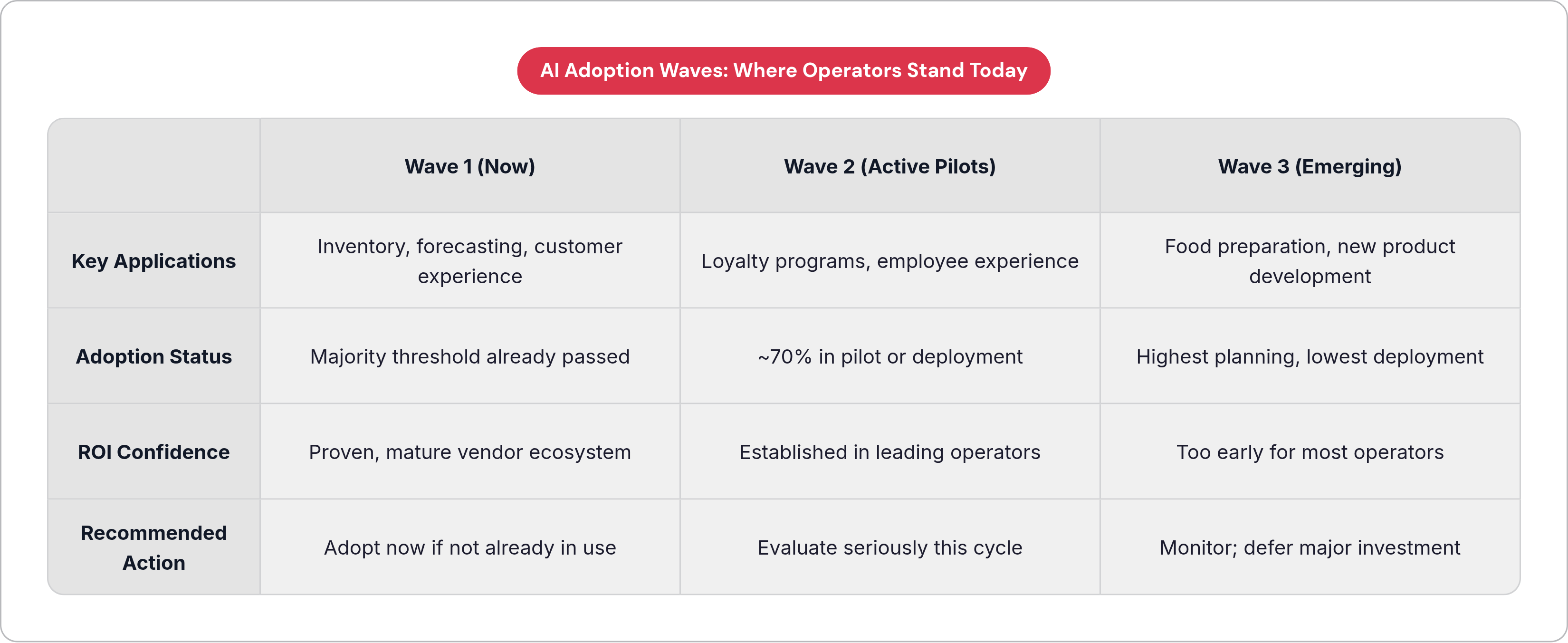
Deloitte's 2025 framework for understanding where AI applications sit in their maturity cycle offers a useful map here. Wave 1 tools, those currently in widespread use, center on customer experience enhancement and inventory and forecasting, with adoption already above the majority threshold in both categories. Wave 2, which includes customer loyalty and employee experience tools, is in active pilot or deployment across roughly 70% of operators surveyed. Wave 3, covering food preparation and new product development, is still emerging, with the highest planning activity but the lowest current adoption. The practical implication of this framework is that it helps operators self-locate. Are you behind on Wave 1 fundamentals? Or are you ready to pilot Wave 2 applications? Casual dining concepts, which have complex menus and larger teams, are leading adoption across most categories, because the pain points are simply more acute.
Start there. Not with what is newest. With where you actually are.
Labor Scheduling: The Most Direct Operational Lever in a 75% Turnover Industry
Restaurant industry turnover has reached 75%, and 77% of operators report they do not have sufficient staff to meet customer demand. Those two figures together describe a situation where raising hourly wages, the obvious lever, runs directly into the margins that make most restaurant economics viable. AI scheduling tools exist in that gap.
How they work is less mysterious than the marketing around them suggests. Platforms like 7shifts, Harri, and Restaurant365 ingest sales trends, weather data, local events, and employee availability, then use that information to predict staffing needs and generate schedules automatically. McDonald's "Virtual AI Manager," introduced in January 2025, takes this further: it uses large language models to synthesize labor laws, forecasted demand, and individual crew preferences, then produces fourteen-day rosters delivered directly to a mobile app, reportedly cutting manual planning time by 85%.
That 85% figure is striking, but it is the secondary benefit. The primary one is precision. Fewer overstaffed Tuesday afternoons. Fewer understaffed Friday nights that send guests elsewhere and demoralize the crew working them. And, counterintuitively, more predictable schedules for employees, which research on hourly workers consistently links to reduced turnover. You are not just saving a manager two hours a week. You are reducing the cost of replacing someone who quit because they could not plan their life around their shifts.
When evaluating these tools, the integration questions matter more than the feature list. Does it pull from your actual POS sales data, or does it rely on manual inputs? Does it incorporate local event feeds, not just historical patterns? Can staff access and swap shifts through a mobile interface? These are the details that separate tools that work in a real restaurant from tools that work in a demo.
Inventory Management: The Fastest Payback, and the Most Honest ROI Story
U.S. restaurants lose an estimated $162 billion annually to food waste. That number is large enough that even modest percentage improvements translate to meaningful dollars, which is partly why 55% of restaurant executives, per Deloitte's 2025 survey, are already using AI in inventory management daily. This is mature, Wave 1 technology. The adoption case is established.
Operators who actively refine their AI inventory models typically see waste reduction of 30 to 40% within the first year. High-waste areas like prep and overproduction can achieve reductions at the higher end of that range. Food cost savings of 2 to 8% of total food spend appear consistently in the literature, and on margins that often sit below 10%, that is the difference between a good year and a difficult one.
The platforms most frequently cited in peer-reviewed research include Leanpath, which uses cameras and scales to track waste in real time; Winnow, which identifies and logs discarded food automatically; and Kitro, which requires no manual input at all. Hilton Tokyo Bay's deployment of Winnow Vision is one of the cleaner public case studies: a 30% reduction in food waste within the first four weeks, translating to more than 17,000 meals saved and approximately $31,000 in annual savings. Starbucks's proprietary DeepBrew platform does something similar at scale, matching store-level inventory to local consumption patterns to reduce spoilage while maintaining product availability.
The honest caveat: these results compound over time. First-year numbers depend heavily on how consistently staff actually engage with the system. An AI inventory tool that gets ignored during a dinner rush is not doing anything. The technology is not the implementation.
ROI timelines for AI inventory systems, combining waste reduction, labor savings, and improved purchasing decisions, consistently sit in the six to twelve month range. For a category that involves real infrastructure cost, that is a credible payback window.
Reservations and Phone Answering: The Revenue Leak That Does Not Show Up on Any Report
Forty percent of restaurant calls go unanswered. That figure does not appear as a line item anywhere in your reporting. It is invisible loss, which is why operators underestimate it so consistently.
The consumer side of this is already settled: 79% of diners globally are comfortable with AI handling their reservations, per SevenRooms' 2025 data. The operator side has not caught up. Only 32% of operators use AI for call management, despite voice AI adoption reaching 34% across the industry in 2025, with booking accuracy in the mid-90s and booking lifts averaging 35% in Q3 2025 restaurant tech data.
One concrete example gives a sense of the scale. Casper Hospitality's deployment of SevenRooms Voice AI handled more than 3,800 calls in a single month, created more than 850 covers, and booked $28,000 in revenue at one location. That is not a projection. That is a month. Vendor data more broadly suggests AI voice systems are generating between $3,000 and $18,000 in additional monthly revenue per location, at costs that put the return ratio as high as 25 to 1.
The demand forecasting applications within reservation management deserve separate attention. One VP of Growth at a large U.S. casual dining group, speaking at FSTEC 2025, reported a 14% reduction in no-shows and a 28% increase in mid-week covers after implementing AI-powered demand forecasting in their reservation system. Mid-week covers, historically the hardest shift to fill, are a meaningful operational win.
The evaluation question to ask before signing anything: does the voice AI connect directly to your reservation system and POS, or does it create another data silo? Because a voice tool that captures reservations into a separate system that does not talk to your table management platform has solved one problem and created another.
Analytics: What Happens When You Try to Run a Business Across Five Systems That Do Not Talk to Each Other
The average restaurant operates across four or five separate systems: a POS, a scheduling platform, an inventory tool, one or more delivery platforms, and some form of invoice management. None of these were designed to communicate with each other. The result is that meaningful operational patterns, the ones that would actually inform decisions, are distributed across reports that no single person has time to reconcile manually.
AI analytics tools address this by aggregating across those systems and surfacing correlations that do not appear in any individual report. Per Toast's 2025 survey of 712 restaurant decision-makers, 42% of operators say they are extremely likely to adopt AI for competitive benchmarking, and 41% for forecasting and demand planning, a demand that platforms such as Feastalytics, a restaurant analytics tool that pulls together POS, delivery, and marketing data to show operators which campaigns are actually driving in-store revenue, are built to address alongside category leaders.
What Toast IQ's adoption trajectory in early 2026 reveals, specifically the nature of the prompts operators were actually using, is that the real demand is not for more reports. It is for distillation. Operators want something to look at the complexity and surface the two or three decisions that actually matter this week. That is a different product than a dashboard.
It is also worth considering a purchasing trap embedded in this category. Operators who adopt AI tools incrementally, one at a time, without a unifying integration strategy, often end up with a new layer of silos stacked on top of the old ones. The tool evaluation question becomes: does this connect to my existing systems, or does it require a parallel data entry workflow? If the answer is the latter, you are not solving the analytics problem. You are adding to it.
Predictive maintenance is an adjacent application worth watching. McDonald's is currently developing AI to anticipate equipment servicing needs before failures occur. It is early, and its relevance scales with volume, but for high-traffic operators the economic logic of preventing a fryer failure on a Saturday night is obvious.
Content Creation: The Easiest Entry Point, With a Ceiling Worth Knowing About
Marketing is currently the top category where AI tools are being used in restaurants. Among full-service operators, 19% report using AI to assist with marketing; 15% of limited-service operators do the same, per the NRA's 2026 report. Both figures exceed most operational AI categories. The reasons are not complicated: the tools are cheap, they require no integration, and the output is immediately visible.
Among operators using AI for marketing, 51% use it for video creation, 42% for images, and 36% for copywriting. The context that makes those numbers make sense: Instagram leads restaurant discovery at 22%, followed by Facebook at 19% and TikTok at 18%, per DoorDash's 2025 Delivery Trends Report. Two-thirds of restaurateurs have joined these platforms specifically to attract diners. That creates a sustained content demand that is difficult to meet with traditional production resources.
The current tool landscape is reasonably well-differentiated by use case. Canva's menu maker is accessible to operators with no design background. Adobe Firefly serves restaurants already inside the Adobe ecosystem, primarily for stylized visuals and print materials. FoodShot AI occupies a specific niche: it converts a smartphone photo of a dish into a studio-quality image in roughly 90 seconds, with style presets for delivery apps, fine dining, Instagram, and three dozen more. For operators who cannot afford a food photographer but need imagery that does not embarrass them on a delivery platform, that tool addresses a real problem.
Budget reality for single-location restaurants: marketing tools, not ad spend, typically run between $50 and $350 per month. Use that range to benchmark vendor pitches.
The honest limitation: AI content tools accelerate volume, and volume matters for social algorithms. But brand voice, and food photography that actually looks like your food rather than a stylized simulacrum of it, still require human judgment. The tools lower the floor of production quality. They do not automatically raise the ceiling.
Personalization and Loyalty: Moving From Sending Everyone the Same Email
One-third of consumers are using restaurant loyalty programs more frequently due to economic pressure, per PAR Technology's 2025 survey of 1,000 U.S. consumers. Another 36% report maintaining their usage at current levels. That is a significant portion of the dining population actively signaling that loyalty mechanics affect their behavior, and it represents a real opportunity for operators willing to move beyond batch-and-blast email campaigns.
AI-powered loyalty and marketing platforms have demonstrated up to a 30% increase in repeat visits and a 25% boost in average order value in their strongest implementations. Implementing AI for personalization more broadly can boost repeat customers by 15 to 25%, per Hospitality Insights, though that range reflects real variation in execution quality. The spread matters. A 15% lift and a 25% lift represent meaningfully different returns on the same technology investment, and the differentiator is almost always how well the operator uses the segmentation capabilities rather than the platform's raw capability.
Panera Bread's MyPanera program is one of the more transparent public examples of AI-driven personalization at work: the system recommends menu items based on individual purchase history, creating a feed that is at least partially personalized to each member. The concept is straightforward. The execution at scale is the hard part.
Platforms purpose-built for restaurants in this space include Popmenu, Incentivio, Thanx, and Owner, each integrating loyalty mechanics with online ordering and email and SMS campaigns.
That raises an important question about consumer receptivity. PAR Technology's September 2025 survey found that 24% of consumers are excited about AI-driven predictive features like "suggest my usual order," but 27% have concerns about accuracy and 27% are neutral. The distribution is not a mandate for enthusiasm. It suggests that operators should treat opt-in mechanics and accuracy thresholds as prerequisites before rolling out predictive features broadly. A loyalty program that guesses wrong about what someone wants, and does it repeatedly, is worse for the relationship than no personalization at all.
Deloitte's 2025 survey data shows that customer experience, at 60%, and loyalty programs, at 31%, are the top areas where restaurant executives expect AI to have the most near-term impact. Investment is already following that expectation.
Local Search and AI Discoverability: The Infrastructure Problem Nobody Wants to Think About
This is the section operators are most likely to skip, and it is the one with the most compounding consequence.
As AI assistants and AI-enhanced search become more common paths through which consumers find restaurants, the accuracy and completeness of your business data across platforms has become a prerequisite for being surfaced in recommendations at all. This is not speculative. Sixty-two percent of U.S. chains cite "data visibility across locations" as their top digital pain point, per FSTEC 2025. Inconsistent or incomplete data — hours, menu, location, reviews — is the mechanism by which a restaurant simply does not appear in an AI-generated local search result, regardless of what is being spent on content or advertising.
The practical implication is less about adopting a new tool and more about auditing what you already have. Is the information about your restaurant consistent across Google, Yelp, Apple Maps, and delivery platforms? Is your menu data accurate and current in the places AI search tools are likely to scrape? These are not glamorous questions. They are the foundation on which every other marketing investment either performs or underperforms.
For multi-location operators, this problem reappears with additional complexity. Inconsistent location data across a portfolio does not just affect individual units; it undermines discoverability at the brand level. AI tools applied to local SEO and reporting can recover meaningful time weekly by automating insights and scheduling across locations, per FSTEC 2025 data, but the time savings are secondary to getting the underlying data right in the first place.
Making Adoption Decisions Without Getting Embarrassed at the Next Operator Meeting
The NRA's guidance on tool selection starts with a deceptively simple instruction: identify the specific operational or marketing problem before evaluating any product. That is a check against a very common failure mode, which is buying a solution before you have confirmed the problem.
A useful sequencing principle follows from the Deloitte wave framework. Wave 1 tools, which include inventory management, basic analytics, and customer experience applications, have proven ROI timelines and a mature vendor ecosystem. If you are not using them, the case for adoption is already well-established; you are not an early adopter anymore. Wave 2 tools, centered on loyalty and employee experience, are in active deployment across much of the industry and warrant serious evaluation now. Wave 3 tools, in food preparation and product development, are worth monitoring but do not yet have the implementation track record to justify major investment for most operators.
But what if the framework is too tidy? Real adoption decisions do not always follow clean sequences. A restaurant with a genuine labor crisis might need scheduling AI before it is ready to address food waste. A single-location operator with a strong social following might generate more ROI from a $90/month content tool than from an inventory platform requiring six months of staff training. Context does not disappear because a framework is available.
The question is never whether to adopt AI. The question is which category of problem a specific tool is actually solving, and whether that problem is costing you enough, in dollars or in hours or in guests you are not seeing again, to justify the investment. Start there. Work backward to the product. The hype will still be there when you are done.