Restaurant Loyalty Program Design and Structure
Loyalty programs work only if they drive repeat visits and higher spending, not just sign-ups.

A restaurant loyalty program only earns its keep when it's built to produce trackable repeat visits, not just a growing list of sign-ups. Most programs never get there, because the people designing them are solving the wrong problem from the start. Restaurant margins are thin enough that any new cost needs to justify itself fast, and a loyalty program dressed up as a perk rarely does.
The uncomfortable part sits right there. Read that number straight and the implication is blunt: if the whole design revolves around handing out discounts, the operator has built a machine that costs money every time it fires, not one that recruits new spending. That's a cost center wearing a retention engine's name tag.
The measurement gap makes this worse. Restaurant marketing dashboards are stuffed with sign-up counts, app downloads, and engagement scores, none of which say anything about whether a guest actually came back and spent more. Restaurant marketing dashboards rarely put visit frequency, incremental ticket size, and revenue attributable directly to the program on the same dashboard, which means most operators are flying with an instrument panel that measures altitude but not fuel.
The distinction this piece keeps coming back to is between a program engineered around trackable repeat visits and one engineered around sign-up volume or redemption rate as ends in themselves. Operators who treat program design as a revenue system see returns in the 4 to 5x range. Operators who treat the same program as a marketing perk, a nice-to-have loyalty badge slapped on the app, watch it quietly drain margin, one free appetizer at a time. Everything that follows in this piece is an argument for which side of that line a given design choice lands on.
The size of the loyalty opportunity and the rising floor
Loyalty has stopped being a differentiator and turned into infrastructure. Do the arithmetic on those two figures and the takeaway is plain: a restaurant without a program isn't just missing an opportunity, it's competing against a rival's program every single time a guest decides where to eat.
The capital backing this shift tells its own story. The global loyalty management market sat at an estimated $12.9 billion in 2025 and is projected to hit $20.36 billion by 2030, a 9.6% compound annual growth rate. That's not a fad curve. That's an infrastructure buildout, the kind that shows up when an entire industry decides a category of technology has moved from optional to required.
Why does the timing matter so much right now? Because the industry it's landing in has almost no room for error. The National Restaurant Association projects total foodservice sales reaching $1.55 trillion in 2026, but real sales growth is forecast at just 1.3%. In an environment that tight, loyalty-driven retention isn't a growth lever so much as a defense against decline, and the data backs that framing up directly. Circana data shows loyalty-driven traffic grew 5% in 2024 while overall restaurant traffic fell 2%. One might argue that's just correlation dressed up as insight. 76% of limited-service restaurants registered a traffic increase in 2024 driven by their loyalty program (Nation's Restaurant News), not a correlation, a directional signal.
The market case, in other words, is close to settled. The real question operators face isn't whether to run a program. It's whether the one they're running is built to produce the returns the category is capable of. 39% of U.S. restaurant visits now come from loyalty program members (Circana and Nation's Restaurant News, 2025–2026), roughly double the share since 2019. 52% of QSR customers belong to at least one restaurant loyalty program (QSR Magazine, 2025–2026), while 61% of operators now offer a program (National Restaurant Association).
The financial return a well-structured program can realistically produce
Two independent datasets converge on roughly the same number, which is the kind of agreement that should make an operator sit up. Antavo's Global Customer Loyalty Report found 92.7% of loyalty program owners reporting positive ROI, averaging 5.3x. Restroworks, working from a separate dataset, found 90% reporting positive ROI at an average of 4.8x. That spread, 4.8x to 5.3x, isn't one vendor's marketing claim inflated for a press release. The 4.8x–5.3x range comes from two independent datasets, not one vendor's number.
What produces that return? Spend behavior changes measurably once a guest is enrolled. Circana and Paytronix data show loyalty members spend 38% more per visit and visit 22% more often, and that lift appears when the program is simple enough to use and gets promoted consistently at the point of sale. Run the math on an ordinary guest: someone spending $25 a visit, 1.5 times a month, is worth $450 a year at baseline.
Time matters here more than most operators expect. Operators who abandon programs before 18 months often leave the compounding returns on the table, since first-year programs boost average order values 8%–12% while programs running three or more years show 15%–25% increases.
The Paytronix 2026 Loyalty Report found that brands that get a new member to a fourth visit within 90 days of enrollment see a 95% likelihood of long-term retention.
Zoom out and the leverage becomes obvious. Repeat guests generate 60% of restaurant revenue while 77.4% of first-time guests never return, and that gap is where loyalty programs pay for themselves. Reaching that return, though, isn't automatic. It comes down to specific structural choices, starting with which type of program an operator picks in the first place. Bain and Company found that a 5% improvement in customer retention can lift profits 25%–95%, a leverage disproportionate to the effort.
The five main program structures and their matching concepts
The punch card or stamp system is the oldest and simplest: buy a certain number of items, get one free. It suits high-frequency, low-ticket, counter-service concepts where the entire goal is visit frequency. The tradeoff shows up in what the punch card can't do, though. A punch card captures zero data, offers no personalization, and is easy to fake, so the ceiling on what it can do stays low, because there's nothing to act on.
Points-based programs are the workhorse of the category, flexible enough to fit almost any restaurant concept, which is exactly why they're the most common format. Domino's and MyMcDonald's both run points systems. Capital One Shopping's research found loyalty members spending 12% to 18% more than non-members, and points programs earn that lift by rewarding every single transaction, however small. But the mechanics can quietly sabotage themselves. A system where $1 spent earns one point and a free entrée costs 500 points is technically running just fine and practically broken, because the reward sits hundreds of transactions away from any given guest, too distant to change what anyone actually does.
Tiered membership programs (commonly labeled Bronze, Silver, Gold, Platinum) let guests unlock better rewards as they climb, based on cumulative spend or visit count. They fit mid-range and upscale dining, and multi-location or brand-led restaurants chasing status-driven frequency and long-term lifetime value. There's something almost embarrassingly human about why tiered programs work: nobody wants to stay Silver once they can see what Gold gets.
Subscription or paid membership models flip the entire relationship. The guest pays first, recurring, and the restaurant owes them ongoing value in return. This fits routine-driven categories, coffee, weekday lunch, anywhere habit formation and predictable recurring revenue line up naturally. MyPanera+ Sip Club runs at $14.99 a month, while El Lopo's $10-a-month subscription delivers $100 in food-and-drink credits plus extra perks, a 10-to-1 value ratio built to make cancellation feel like leaving money on the table. Customers expect at least 150% return on any paid membership fee. Paytronix's trends research found quick-service subscription models generating notably higher customer lifetime value than traditional loyalty formats, which makes the subscription model worth a serious look for any habit-forming concept.
Cash-back or visit-based programs keep things simple: straightforward credit returned on spend, no tiers, no points math. They suit fast repeat occasions where the guest wants speed over aspiration, trading a lower engagement ceiling for the lowest possible friction to join and use.
Fine dining deserves its own note, because discounts and free appetizers feel out of place against white tablecloths. Rewards there should lean into exclusivity and experience instead: priority reservation access, private wine tastings, a chef's table seat, a personalized menu, a complimentary course. Structurally, it's still a tiered program. But the reward catalog is a different animal entirely, closer to concierge service than to a punch card, and treating it like a points system with nicer food misses the point of why the guest is there.
Choosing a structure is only step one. Getting the internal math right inside that structure is what decides whether the program changes behavior or just rewards spending that would have happened anyway.
Reward economics: setting earning rates, thresholds, and expiry that change behavior without destroying margin
Programs rarely fail because the operator picked the wrong structure. They fail because the numbers inside the structure don't add up to anything a guest notices. A points system where $1 spent equals one point, and a free entrée costs 500, leaves the average guest hundreds of transactions from a reward, which means no behavioral signal ever fires. The program looks alive on paper and is functionally dead in practice.
There's a useful benchmark for catching this before it becomes a problem: a healthy program keeps roughly a 1-to-3 ratio between customer acquisition cost and lifetime value. If the reward economics push that ratio out of range, either the rewards are too generous, too stingy, or too far away to matter, and the fix usually isn't complicated once it's diagnosed.
Generosity itself deserves scrutiny, because restaurants have set a strange precedent. Airline and retail loyalty programs typically return around 1% of spending back to the customer. Restaurant programs often return 10% or more. That gap made sense when margins were looser. Airline and retail rewards typically return roughly 1% of spending, while restaurant programs often return 10% or more, a level of generosity becoming harder to sustain as margins tighten industry-wide, forcing a rethink of reward ratios.
Expiry policy sits in a similar bind. Expiring points create urgency, sure, but they can also breed resentment in a guest who feels punished for not showing up often enough. The right call depends entirely on the concept's natural visit cadence, so a policy copied from a competitor's program without adjusting for that cadence risks alienating exactly the guests it was meant to motivate.
What actually works better than blunt generosity is segmentation. That's a sharper tool than a flat point rate, because it targets the specific guest's specific pattern instead of applying one rule to everyone.
Win-back messaging deserves a mention too, since it's often the highest-return message an operator can send. A guest who used to visit and then stopped is sitting on more latent value than a brand-new prospect, and an automated message offering bonus points or a special reward to bring them back tends to outperform almost every other campaign an operator runs. One guardrail governs all of this: the entire point is incremental revenue. A program shouldn't get credit for spend a guest would have made anyway. What matters is the lift above baseline, not the total revenue sitting under a member's name.
Even reward math built with real care falls apart if the program can't get guests enrolled and moving early. That's the next problem. Segmentation beats generosity: personalized, time-sensitive frequency challenges pushed 75% of participants to order above their average and generated 2.3x higher order frequency (per thehospitalityhangout.com analysis cited in sources), and behavior-based offers consistently outperform generic points.
The 90-day activation window: why enrollment rate is the wrong metric to watch
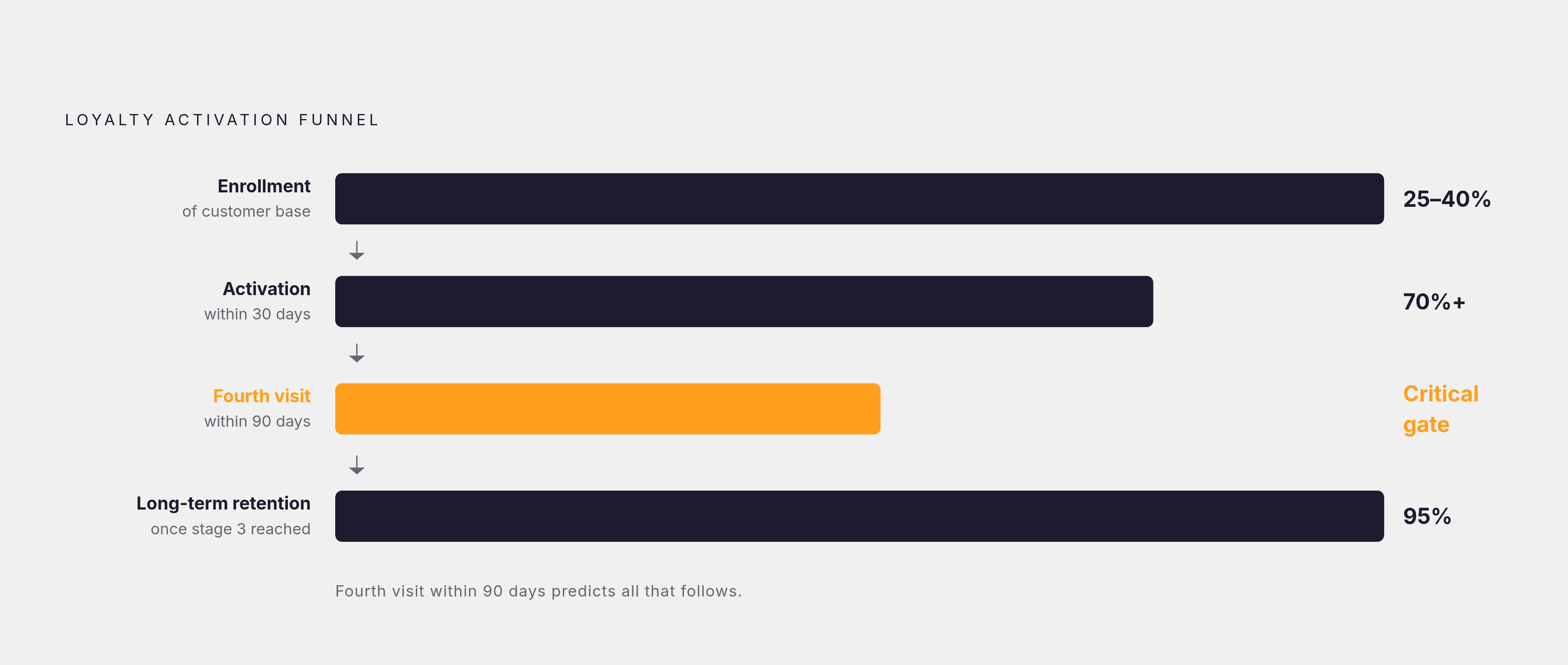
Enrollment volume is the number most operators watch, and it's the wrong one. The benchmark that actually predicts program health is activation within 30 days and a fourth visit within 90 days.
That fourth-visit figure comes from Paytronix's Loyalty Report, built from more than 800 client brands and 225 million guest profiles, and it stands as a clean design target for this category: hit that fourth visit inside 90 days and the odds of long-term retention jump to 95%. Everything a program does in its first three months should be pointed at that single milestone.
So what does a healthy version of this look like in practice? Roughly 25% to 40% of a restaurant's customer base enrolled, with 70% or more of new members activating within their first 30 days. Weekly engagement among enrolled members is around 47%. Enrollment industry-wide reached 48% of diners in 2025, which puts a rough floor under what "competitive" now means. A program stuck below that isn't just underperforming, it's losing ground relative to where the category has already moved.
Friction is the silent killer here. If signing up takes longer than about 30 seconds, most potential members simply drop off before finishing. Enrollment needs to live everywhere a guest already is: the POS screen, a QR code on the table, the receipt, the digital order confirmation. Every extra step is a guest who decided the free appetizer wasn't worth the hassle.
And here's a detail most operators overlook completely. The single most important conversion in the entire loyalty funnel isn't first enrollment, it's getting that guest to come back a second time. Yet most marketing budgets pour almost entirely into acquiring new sign-ups, leaving the second-visit conversion to fend for itself. Reallocating even part of that effort toward the second visit is arguably the single highest-leverage move available to an operator running a program that already exists.
None of this happens without the staff. A program simple enough for a server or cashier to explain in one sentence, and one that gets mentioned consistently at the point of sale, sees meaningfully higher activation than one that relies purely on an app icon nobody opens. The first channel any loyalty program has is the person handing over the check, which is a fact that's easy to forget once the technology conversation starts.
Technology and channel architecture: what connects the program to actual visit behavior
Which brings up whether the plumbing underneath the program can track those behavioral targets, because none of them matter if it can't.
The biggest structural trap is fragmentation: rewards split across separate balances or separate apps, so a guest earns points on the mobile app but can't redeem them through the same channel they used to order delivery. Single-profile loyalty experiences consistently outperform fragmented ones, mostly because the guest never has to stop and wonder where their points went or which app they're supposed to open this time.
The most effective programs running in 2026 share a pattern: automated, driven by actual purchase history, and connected to both email and SMS rather than locked inside a standalone app. Programs tied into email communication see meaningfully higher repeat visit rates than programs confined to an app or a social feed. That tracks with a broader pattern in how guests actually behave: multi-channel customers, the ones who move between ordering online and ordering in person, buy more often and spend more than guests locked into a single channel.
POS integration is what makes any of this measurable. Without a direct line into the point-of-sale system, there's no way to separate revenue the program actually caused from revenue that would have shown up regardless. Without a connection to the POS, an operator cannot distinguish program-driven revenue from revenue that would have occurred anyway, which makes ROI calculation impossible.
There's a data dividend buried in all this too. Digital wallet and app-based programs capture the richest layer of customer data available to a restaurant: order history, stated preferences, visit frequency, average spend per ticket. For a high-frequency concept, that data alone can justify the technology investment before a single reward gets redeemed.
A strong first-party loyalty program gives an operator a way to pull guests back onto owned channels instead of commission-heavy delivery aggregators, which is one of the most underrated returns loyalty investment produces for any brand doing heavy off-premise volume. That lines up with where marketing budgets are already headed. A 2026 marketing budget for an independent restaurant should put roughly 60% into owned channels, meaning Google Business Profile, SMS, email, loyalty, and first-party data capture. Loyalty infrastructure sits right at the center of that owned-channel category, not off to the side as an accessory.
Put the pieces next to each other and the shape of the whole argument comes into view. Market pressure has made a program close to mandatory. The return on a well-built one is real and repeatedly measured, somewhere between 4.8x and 5.3x. Getting there depends on choosing the right structure for the concept, pricing the rewards so they actually move behavior, engineering the first 90 days around one visible milestone, and building the technology so all of it can be measured rather than guessed at. Skip any one of those steps and the program doesn't collapse. It just quietly turns into what most of them already are: a slow, steady leak in the margin, dressed up as a rewards card.
Sources
- Restaurant Loyalty Program ROI: Data to Know as an Operator
- 14 Smart Restaurant Loyalty Programs That Boost Profit
- Loyalty Program ROI: Restaurant FAQ for 2026
- Value Incentives are Undermining Restaurant Loyalty Programs - QSR Magazine
- Restaurant Loyalty Program Statistics – Customer Engagement & App Usage Data
- Get with the program: Building loyalty grows business | National Restaurant Association