Marketing Automation Platforms for Restaurant Operators
Right platform connects how guests discover restaurants to revenue, not just message volume.
Choosing a marketing automation platform for a restaurant depends on measurement. The right platform connects how guests discover the restaurant, make a first visit, and return to revenue attributable to a campaign. That connection, rather than the volume of messages sent, is the standard by which operators should judge their tools.
Why most restaurant marketing platforms fail the only test that matters
The frustrating part of paying for a marketing platform is still not knowing what filled the tables. An email went out, an ad attracted clicks, and the weekend was busy. Did the campaigns bring guests through the door, or would those guests have arrived anyway? A dashboard full of activity can make uncertainty about what filled the tables look impressively organized.
The cause is a break between systems. Meta and TikTok report clicks and views, while the POS records what guests buy. Marketing platforms often sit between those records without connecting them, automating promotion delivery while leaving results unaccounted for. More sends do not repair the missing connection. Without it, operators cannot distinguish a campaign that produced revenue from one that merely preceded it.
Rather than asking whether a platform offers email, SMS, and promotions, an operator needs to ask whether it connects a first impression to a verified visit and an attributable return. Features remain useful, but only within that chain of evidence. Otherwise, the restaurant is buying a faster way to distribute messages.
The guest journey a platform must be able to follow
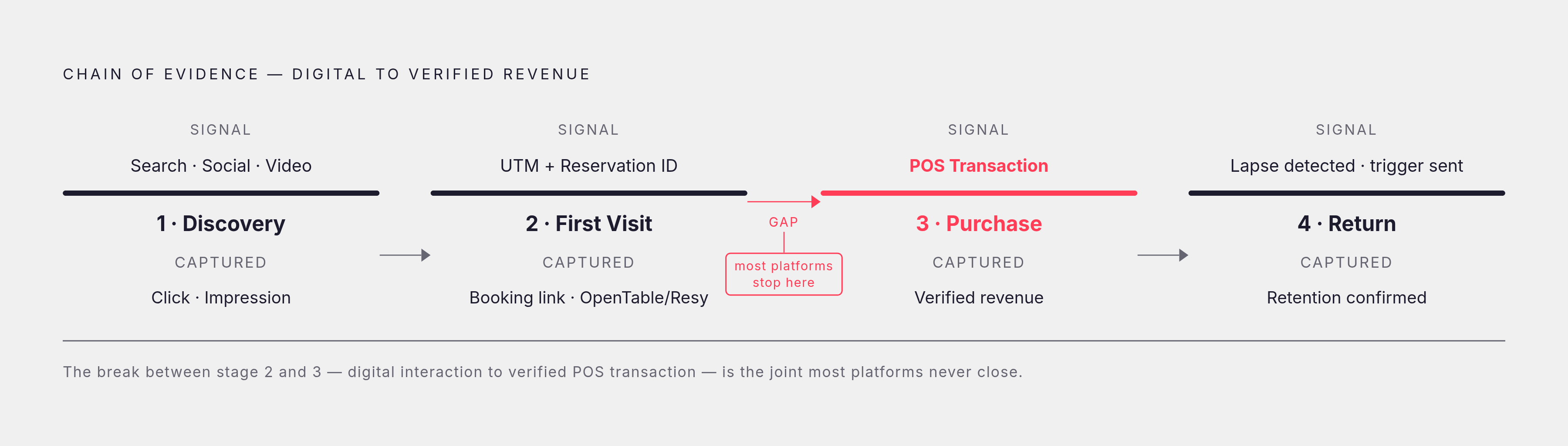
Discovery begins with a simple question about visibility. Can the platform identify whether a guest arrived through search, a social post, or a creator’s video? These are distinct acquisition sources. TouchBistro’s 2025 Diner Trends data shows that a large share of diners check a restaurant’s Facebook profile before visiting. A platform that observes only email subscribers begins watching after part of the decision has already happened.
The first visit presents the harder question. Can the tool connect a digital interaction to a physical arrival? Unique campaign booking links through OpenTable or Resy provide a direct path from an ad click to a completed reservation. UTM parameters identify the campaign in analytics, although a booking alone is not proof of a completed meal. The purchase record completes that connection to revenue.
Not every guest books a table online. Device-level foot traffic attribution offers another signal, but it cannot establish causality alone and becomes more useful when paired with incrementality testing. At the other end of the technical spectrum, asking “how did you hear about us?” at the host stand produces first-party source data. When connected to POS records, that answer can anchor lifetime value by acquisition source.
Can the first-visit record trigger a relevant follow-up, identify a lapse, and show whether the guest returned? Automated win-back campaigns are a useful place to start because they reach known guests who have stopped coming. The return then becomes evidence for both retention and acquisition decisions, rather than an isolated success inside an email report.
The five criteria that separate accountable platforms from activity generators
For operators evaluating a purchase, the first criterion is POS integration depth. Does the platform sync natively, in both directions and in real time, or does someone have to export CSV files? This is the most consequential joint. A CSV-only process interrupts the connection to the actual purchase and makes attribution depend on manual data stitching. Compatibility with the restaurant’s existing POS therefore comes before the appeal of any workflow demonstration.
The second criterion is automation trigger variety. Can campaigns respond to visit frequency, spend tier, lapse windows, and lifecycle events as well as birthdays and holidays? A guest who visited once but never returned needs different treatment from someone who crossed a spending threshold. High email or SMS open rates cannot compensate for triggers that know nothing about those differences.
The third criterion is attribution architecture. Does reporting connect a send or ad to in-store revenue, or end with opens and clicks? POS transactions tied to campaigns and reservation links give evidence that does not come from an advertising platform’s own report of how well it did. That independence deserves scrutiny because Meta and TikTok have an incentive to claim credit for visits that might have occurred anyway. Attribution shows a link, while incrementality testing helps show whether marketing brought in more visits.
The fourth criterion is multi-location support. A group needs brand-level reporting that still shows how each restaurant is doing. Separate location dashboards can leave performance trapped in silos, making it harder to move budget toward the campaigns and restaurants producing better results. A useful platform supports both views. A single-location operator, by contrast, should not confuse an elaborate group reporting structure with a solution to a more immediate tracking problem.
When costs are published and stay predictable, an operator can judge the results against the actual bill. Percentage-of-spend billing pays more when budgets grow, even when each dollar buys less, while flat monthly pricing based on locations or contacts avoids that incentive. Contract length also allocates risk. Short-term or month-to-month terms preserve the option to leave when the platform fails to justify its cost.
How the leading platforms perform against these criteria
POS integration makes Toast Marketing a natural starting point for existing Toast users. A guest’s visit history, what they spend, which items they prefer, and server notes feed straight into campaign triggers without a third-party integration. Its strongest advantage is also its boundary. Marketing history remains tied to the Toast ecosystem, workflow flexibility is narrower than in a standalone automation platform, and measurement stays within Toast’s reporting rather than providing an independent attribution layer.
Square Loyalty is a simpler way to get started for small restaurants already using Square POS. Native integration and pricing transparency support operators who have not yet built a guest data layer. Its scope is deliberately narrower. Automation trigger variety and multi-location support are weaker fits for more complex needs, and a loyalty program should not be mistaken for a full attribution platform.
For groups managing two or more locations, US Tech Automations addresses a different problem. It combines SMS, email, review management, and loyalty triggers in one workflow builder, with multi-location reporting and behavioral trigger depth as its main strengths. That makes it relevant when disconnected tools are fragmenting guest information. The purchase still depends on the restaurant’s specific POS compatibility and attribution requirements alongside the convenience of consolidation.
Popmenu suits single-location restaurants that rely heavily on promoting their menus and taking online orders. It stands out by linking how well menu items sell to marketing triggers, so a seasonal item that sells fast can trigger email and SMS promotion. That is a concrete use of operating data. Its broader automation depth is narrower, however, with restrictive SMS volumes at lower tiers and limited review management automation.
Mailchimp serves operators at the beginning of email capture and basic automation. Without a native POS integration, purchase data requires manual stitching, and attribution stops at email opens and clicks. Operators using it this way should keep that limit in mind even when a campaign report looks good.
Malou and ActiveCampaign address two further needs. Malou suits larger groups managing presence across Google, Facebook, Instagram, TripAdvisor, Uber Eats, DoorDash, and OpenTable, with strengths in multi-location support and local SEO visibility and limitations in social-to-store revenue attribution. ActiveCampaign offers advanced CRM and automation logic but requires custom POS integration because it is not restaurant-native. Technical resources become part of that decision. For operators not ready for a full suite, specialized tools for email, review management, and local SEO can be appropriate when selected against the same five criteria.
Where paid advertising fits in, and why the platform cannot be evaluated without it
A platform that manages only existing contacts handles retention. Paid advertising brings in new guests, and the platform must keep track of where they came from. Google captures immediate search intent from someone already considering where to eat, while Meta and TikTok can build desire before that decision forms. The channels play different roles. Comparing them only through clicks obscures whether each is bringing diners into the restaurant.
Socialinsider’s analysis finds that Instagram carousels get the most engagement of any format, with Reels close behind, which challenges the idea that every campaign should be video. Instagram’s 2025 search indexing change also allows public content from Business and Creator accounts to appear in Google search. Location-specific captions and tagging therefore connect social content with local discovery. Social marketing and local SEO no longer occupy entirely separate rooms.
Cheap clicks can hide poor results when they never lead to purchases, while showing an ad again and again can cost more without bringing more conversions. Promotions introduce another complication. A buy-one-get-one offer may fill tables while producing a negative operating margin, so attributable revenue is necessary but not sufficient to establish profitability.
The practical requirement is a traceable acquisition signal. The platform must know which ad and campaign introduced the guest and connect that information to the POS transaction. Operators can then spend more on channels with a lower cost per diner instead of those that charge the least for attention. Without that connection, the CRM receives a new contact but loses the evidence needed to explain what acquiring that contact achieved.
Why local creators are the paid channel most platforms are not built to track
Matter Communications’ consumer research ranks food and beverage first among categories consumers are most interested in seeing and most likely to act on in influencer content. For a restaurant, audience geography sharpens that advantage. A smaller creator with a concentrated local following can be more useful than a national account whose audience mostly lives elsewhere. Most of those followers live too far away to dine there tonight.
Operators can find those creators by looking at successful restaurants nearby that compete with theirs. Instagram’s “Tagged” tab reveals creators who have worked with a comparable local concept, while searching the restaurant’s name on TikTok can surface relevant food content. This produces candidates with demonstrated local relevance. It does not, however, establish what their work will return for another restaurant.
Consider a restaurant paying a creator $300 for a Reel and then seeing a busy weekend. Without a connection between the post and purchases, the restaurant cannot prove the relationship. Untracked Meta advertising leaves the restaurant with identical uncertainty. Views and revenue remain separate events, leaving creator-specific ROI unknown.
Unique booking links with UTM parameters can bridge that gap when guests click and reserve. Email capture or loyalty enrollment during the resulting visit can then support tracking of return frequency and lifetime value by source. The platform needs to ingest that reservation data and connect it to POS records. The accountability standard is revenue attributed to a specific creator within a campaign window, compared with the cost of the relationship.
What a complete, accountable restaurant marketing system actually looks like
A complete system links acquisition, first visit, retention, and reporting while keeping track of where the guest came from at every step. Tagged ads and creator content record how the guest was acquired. Reservation data, a POS transaction, or loyalty enrollment connects that signal to the visit, while purchase data supplies the basis for behavioral follow-up. Reporting then attributes revenue to the campaign, creator, or channel. Each connection has a distinct job.
For an operator deciding what to change, the first action is a stack audit against the five criteria. The task is to locate the broken joint. That may be untagged acquisition, reservation data that never reaches the POS, retention messages disconnected from visit history, or reports that stop at opens. Integration costs, API overages, manager maintenance time, and annual escalators also belong in the assessment because the subscription price does not describe the whole operating cost.
The next decision follows from that diagnosis. A group that needs to coordinate campaigns based on guest behavior needs a different tool from a single restaurant that relies most on how its menu sells, while an operator just starting email capture needs something else again. The platform should repair the identified break. Buying a broader bundle without identifying it risks adding another dashboard to the same unanswered question.
Finally, every acquisition campaign needs source tagging from day one. UTM-tagged booking links, landing pages unique to each creator, and source capture when guests join a loyalty program give the system records it can link. Sophisticated automation cannot reconstruct evidence that was never collected. The operator’s agency lies in making that evidence a condition of spending, so the next marketing decision rests on which campaigns filled tables.