Win-Back Campaigns for Lapsed Restaurant Customers
Treat lapsed customers as a timing problem, not a lost cause.
Restaurant win-back campaigns succeed when they treat a guest’s absence as a timing problem. The strongest approach detects a break in someone’s usual visit pattern, starts with a warm reminder, and reserves incentives for those who need them. Its test is equally practical. Did the guest come back through the door, and did that return become a renewed habit?
Why most restaurants lose their best customers without ever noticing
The Tuesday lunch regular paid their check in March, left as usual, and never received a message when they stopped coming. There was no complaint to answer or cancellation to investigate. An angry customer at least provides a signal. A drifting customer leaves an absence, which is much harder to spot during service.
That silence makes lapse a detection problem before it becomes an offer problem. A familiar face can stop coming even if the food was good. Without a loyalty program or POS-linked contact capture, the restaurant has no guest-level visit history through which to recognize the change. By the time someone notices, the seat may have been empty for months.
Even when that history exists, it can sit unused inside the POS. The records may show that a regular has stopped coming as often, yet never lead anyone to get in touch. This is what makes the loss so frustrating. The guests most worth recovering can remain invisible because what the restaurant knows never reaches the person who could act.
Why the recency window is the single most important variable in win-back success
A guest absent for 30–45 days is meaningfully more recoverable than one whose last visit was 60–90 days ago. Beyond 120 days, the probability of recovery falls very low. Delay changes the campaign before any copy is written. The restaurant is no longer interrupting a recent drift but trying to revive a much older relationship, with a much weaker prospect of success.
Yet elapsed days alone do not define lapse. A regular lunch guest and an occasional visitor have different rhythms, so the same calendar trigger can be late for one and premature for the other. Regulr’s win-back guide favors custom triggers based on each guest’s average visit interval over fixed-date triggers. The practical target is a guest whose absence has reached 1.5x that interval.
To act inside that window, operators need loyalty enrollment, POS-linked email capture, or WiFi-based visit logging so they can see who has stopped coming. “Eventually” is a poor scheduling rule when the prospect of recovery is steadily shrinking. Once the trigger fires, however, speed is only half the decision. What the restaurant says next can restore the relationship while protecting margin or lead it to pay unnecessarily for the return.
Why leading with a discount trains customers to wait for one
Leading with the strongest incentive rewards the very inactivity the campaign is meant to reverse. It also makes waiting look profitable. A guest who would have returned after a reminder receives a discount instead, while the restaurant establishes a cheaper reference point for future visits. Generosity is useful when it changes behavior, less so when it subsidizes what would have happened anyway.
Regulr’s win-back email examples therefore set a counterintuitive rule that the first touch should never include a discount. A soft opening separates guests who only needed a nudge from those who need a benefit. Welcome Back’s sequencing guidance favors loyalty-anchored incentives for the second group because an earned reward motivates without establishing a new menu price. Chowly’s win-back email guide favors a free item over a percentage discount at the final touch because food feels generous. The three-stage sequence puts those distinctions into a practical order, moving from recognition to reward to urgency.
The three-stage sequence: what to say at 30, 45–60, and 90 days
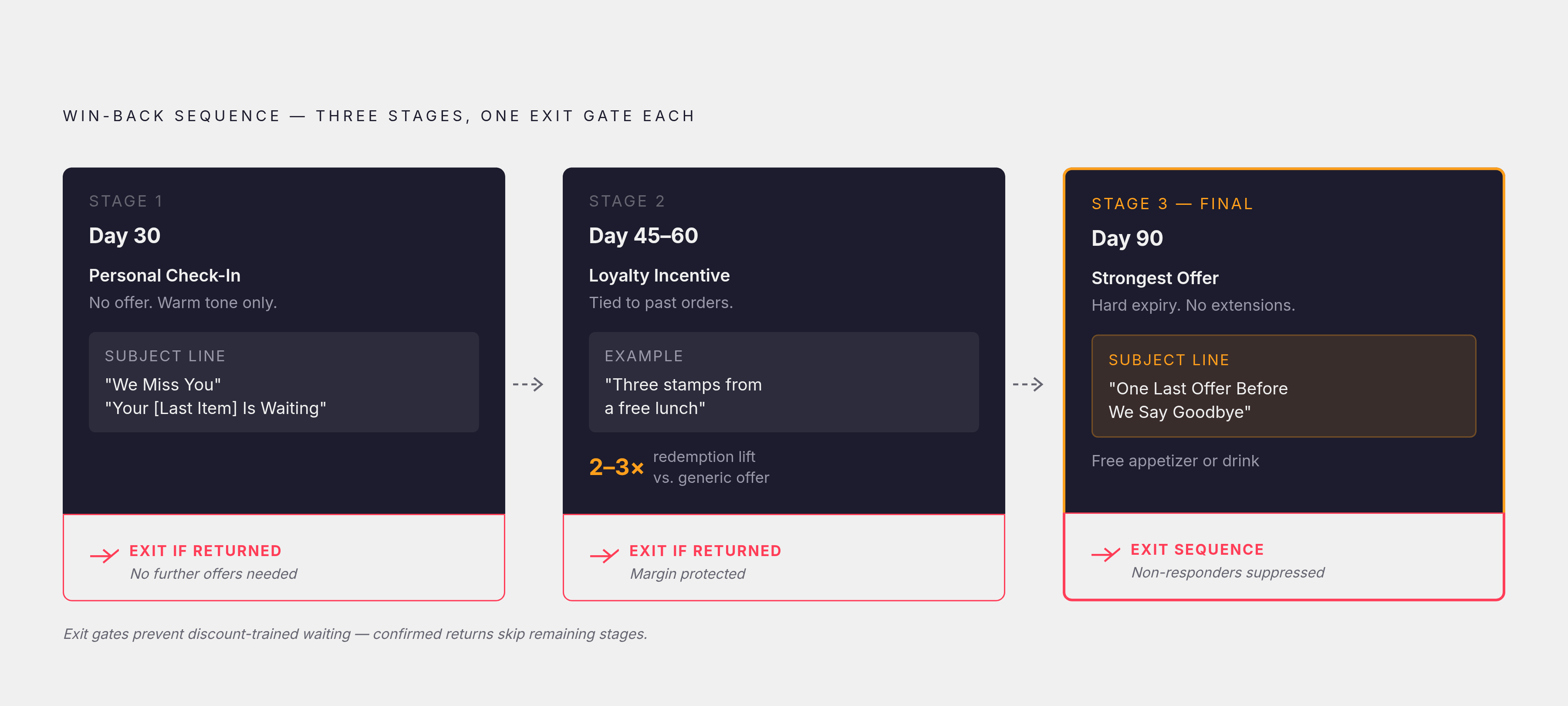
For operators putting this into practice, the sequence is a timed flow with an exit after every confirmed return. Day 30 begins with a personal check-in and no offer. Chowly’s template guide supplies “We Miss You” and “Your [Pad Thai] Is Waiting” as subject lines, with the latter naming the guest’s actual last-ordered item. The message acknowledges the absence and invites another visit. Welcome Back says this warm reminder can bring back guests who have been distracted without an incentive.
Regulr offers a “What’s New” alternative for this opening. New menu items or a seasonal change give the guest a curiosity-based reason to return without making price the attraction. Guests who visit after either version exit the sequence. They do not receive the incentive-bearing messages that follow. Non-responders move forward to the second stage.
At day 45–60, the message introduces a specific loyalty-connected benefit. Welcome Back’s example is “You are three stamps away from a free lunch — come in this week and we will get you there faster”. For formerly high-value guests, Regulr also suggests referencing loyalty status or accumulated rewards, drawing on the wish to avoid losing something already earned. Qubriux’s data-driven win-back analysis reports redemption rates two to three times higher for incentives naming things the guest bought before compared with incentives based on what they like in general. Guests who return leave the sequence, while those who are still absent move on.
At day 90, the remaining guests receive a short message with the strongest offer and a specific expiration date. Chowly supplies “One Last Offer Before We Say Goodbye” for this close, with a complimentary appetizer or drink providing the free-item incentive. Regulr’s “Everything okay?” offers an alternative check-in that can uncover an unreported bad experience. Welcome Back recommends ending the sequence after this touch for guests who still do not respond. Each branch depends on knowing who belongs in it, which makes segmentation the condition for the sequence to work.
Segmentation: why sending win-back messages to the wrong guests breaks the campaign
A “we miss you” message sent to someone who came in last Tuesday punctures the personal tone immediately. Welcome Back therefore excludes active customers from win-back outreach. The starting data are visit frequency, average spend, and last visit date, which already live in the POS. Operators usually need to extract and use those records.
Last order date also needs to be read with channel in view. Outbites’ win-back campaign guide targets guests absent 14–21 days from their last direct order for its first wave. That direct-order starting point belongs beside the guest’s normal rhythm and other visit information. Otherwise, a targeting rule can mistake silence in one channel for the disappearance of the customer.
Qubriux puts guests who came often, spent more than average, and have been absent 60–90 days first, and puts those who came once and never returned lower on the list. It recommends giving the best offers to the first group, while a general newsletter may work better for the second group than a deep discount. Regulr recommends that recovered guests enter a cooldown period before further outreach, preventing an immediate return to the same funnel. Once the restaurant knows whom to contact, it needs to choose how to reach them, because even a message sent to the right guest can fail if they never see it.
Channel choice: why push notifications and SMS outperform email for win-back specifically
Welcome Back says average open rates for restaurant marketing email are around 20%, so most messages go unseen. Push notifications, by contrast, appear on the lock screen when sent, in the same visual space as a personal text. Visibility changes the opportunity for a reminder to work. A win-back message needs to interrupt an absence, whereas a newsletter can afford to tell a longer story.
Welcome Back describes Apple Wallet or Google Pay loyalty cards as push delivery channels that require no separate app download. A contextual message such as “We miss you. Your loyalty card has a new reward waiting.” can meet the guest while they are walking past the neighborhood.
Email still has a useful role when the message needs room for menu news or a photo. Outbites recommends taking turns with email and SMS so both do not arrive in the same hour, and keeping SMS under two short sentences plus a link. It recommends sending the same words through both at once only when the news is truly urgent, such as a weather closure. The medium should suit the job. Matching that choice to each guest’s timing and history takes automation when there are many guests to reach.
Automating the sequence so high-value guests never slip through uncontacted
Qubriux identifies manual tracking as the reason valuable lapsed guests slip through unnoticed. Operators nevertheless begin with different foundations. Some have loyalty programs producing clean records, while others start with a CSV export. Those records need to support a dependable trigger and the recognition of a return.
Purple Engage’s win-back strategy guide describes a straightforward automated flow. A customer’s device remains absent from the network for a defined interval, the customer enters the appropriate segment, and the first message sends automatically. Its guide describes guest WiFi with captive-portal email capture as a way to log physical visits without POS integration or a loyalty app. Direct ordering systems that collect contact details at checkout also keep a history that lapse triggers can use. The source of data determines what kind of absence the system can actually detect.
Purple Engage notes that a generic email platform such as Mailchimp can send the campaign but cannot itself detect physical absence from the venue. Email activity is not attendance. A guest who visited and paid cash can still receive an inappropriate reminder if that return never reaches the campaign’s records. Automation makes the rule repeatable, but it does not make an incomplete rule accurate.
Regulr’s implementation guide recommends a monthly review of which stage recovers guests, which offers redeem, and whether trigger intervals still match actual visit patterns. The review also exposes the final requirement. To judge the automation, the operator needs evidence that outreach produced a visit.
Measuring whether the campaign actually filled tables, not just inboxes
A guest physically returning within a defined window after outreach is the primary recovery metric. Opens and clicks describe attention. Other measures to track are cost per recovery, subsequent visit rate, and revenue per recovered guest. Together, they distinguish a campaign that produces activity on a screen from one that brings commercially useful visits back to the restaurant.
Regulr recommends unique offer codes for each stage so that POS redemption connects the visit to the message. The cost per recovery is the total cost of the campaign divided by the number of guests who actually returned. Loyalty-program check-in data or a system tracking the social-to-store journey can also connect outreach with attendance. That connection is essential because Meta and email platforms report engagement without visibility into whether the guest walked through the door. An open receipt is not a restaurant receipt.
The measurement then needs to extend beyond the first return. Regulr recommends tracking what share of recovered guests visit again within 90 days, because that second return shows they are getting back into the habit after coming in to redeem an offer. Strong clicks with weak orders point toward the checkout path, while weak clicks call for improving the first line and incentive before buying more reach.
Regulr also notes that a strong recovery visit can prompt a review, extending its value beyond the transaction. That possibility depends on what happens after the message has done its job. The campaign may reopen the door, but the visit must give the guest a reason to use it again. The most useful evidence of success is therefore not simply that someone accepted an invitation, but that the restaurant became part of their routine once more.